Agent evaluation tools: MLflow vs DeepEval in 2026
30M+ monthly downloads puts MLflow ahead of the pack for AI agent engineering in 2026. Production-grade evaluation demands more than a pass/fail check on the final string; it requires thorough metrics spanning rule-based format validation and detailed LLM judges for safety. We need architectures that convert manual human labels into automated scoring mechanisms that improve without constant hand-holding. The goal is conversation-level evaluation capable of spotting failures across multi-turn interactions, not just isolated requests.
The split among MLflow, DeepEval, Ragas, Arize Phoenix, and LangSmith is architectural rather than cosmetic. MLflow ships tracing, dataset management, and visualization in one open-source package; DeepEval keeps visualization behind the Confident AI platform at $19.99 per user per month; Ragas stays a metric library with no UI and no tracing backend at all. That split decides how much evaluation infrastructure your own team ends up building.
The Critical Role of Trace-Aware Scoring in Modern Agent Evaluation
Trace-Aware Scoring Against Output-Only Checks
Binary pass/fail scores on final outputs are useless for modern agents. They hide the specific reasoning error or hallucinated tool call that caused the failure. Agent Evaluation must systematically score task performance by assessing intermediate steps like tool selection, not just the end result. Trace-aware scoring analyzes every step, including LLM invocations and planning decisions, to isolate exact failure points within complex chains. A correct final answer can still stem from a flawed logical path, and modern agents rely heavily on multi-step reasoning.
Market analysis in March 2026 indicates that leading platforms now distinguish themselves by offering granular step-level tracing rather than relying solely on domain-expert outcome scoring. Without this depth, operators cannot differentiate between a lucky guess and a strong process. Capturing these traces enables LLM judge alignment, where automated scorers learn from human labels on specific trajectory segments. Ignoring intermediate states leaves teams blind to drift in planning logic until catastrophic failures occur in production environments.
Multi-Turn Evaluation and Judge Calibration
Single-turn testing creates a blind spot for production agents because it fails to capture context carry-over or recovery from earlier mistakes. Multi-turn evaluation scores behavior across full conversations, requiring frameworks to assess quality units rather than isolated prompts. The technical shift involves treating the entire dialogue history as the input object for scoring functions. This approach is now a critical specification for 2026 tools, distinguishing mature platforms from basic single-prompt testers.
Calibrating automated judges requires LLM Judge Alignment, a process using human labels to optimize scoring prompts. Algorithms adjust judge parameters to match human preferences, reducing the gap between automated metrics and actual quality. This feedback loop prevents judges from assigning high scores to plausible but incorrect reasoning chains. A smooth path from manual feedback to automated evaluation allows teams to scale human review without sacrificing accuracy. Operationalizing this workflow demands converting production traces into evaluation datasets. Teams must enable subject matter experts to annotate specific turns, feeding these labels back into the judge optimization cycle. This continuous improvement loop ensures that as agent capabilities expand, the evaluation criteria remain rigorous. Builders must balance granular domain-expert outcome scoring against the need for rapid iteration cycles in development environments.
MLflow, DeepEval, and Ragas Framework Comparison
Selecting an agent evaluation framework requires validating specific support for multi-turn conversational scoring. Five distinct platforms dominate the 2026 environment, with MLflow, DeepEval, Ragas, Arize Phoenix, and LangSmith all offering varying degrees of multi-turn evaluation capabilities. This technical distinction separates tools that assess isolated prompts from those analyzing full dialogue history. Engineers often face fragmented workflows when stitching together metric libraries for reasoning chains and tool use. Managing multiple libraries can be messy; using a platform like MLflow that integrates multiple metric libraries through a single interface is recommended.
| Framework | Multi-Turn Support | CI/CD Integration | open-source |
| MLflow | Yes | Yes | Yes |
| DeepEval | Yes | Yes | Yes |
| Ragas | Yes | Yes | Yes |
| Arize Phoenix | Limited | Yes | Partial |
| LangSmith | Yes | Yes | No |
DeepEval and Ragas also confirm support for metrics, multi-turn evaluation, and CI/CD integration according to recent comparisons. However, Ragas lacks native conversation simulation features found in broader platforms.
Inside the Architecture of LLM Judge Alignment and Automated Issue Detection
How GEPA and MemAlign Calibrate LLM Judges
LLM Judge Alignment depends on algorithms like GEPA and MemAlign to tune automated scoring functions against human preference data. These mechanisms iteratively adjust the judge's internal logic, reducing the gap between algorithmic ratings and human reviewer labels. The process generates candidate judge prompts, evaluates their correlation with human scores on a validation set, and selects the configuration that maximizes agreement. Such rigor guarantees that automated scores mirror actual quality priorities instead of superficial token matching.
Frameworks supporting this capability let teams collect human labels on output samples and automatically refine judges to match those assessments. This shift enables a move from manual review to automated evaluation while preserving accuracy. Builders must select systems enabling a smooth path from manual feedback to automated evaluation to maintain valid metric coverage.
| Feature | Static Prompts | Aligned Judges (GEPA/MemAlign) |
|---|---|---|
| Adaptability | None | High (iterative) |
| Human Correlation | Low/Variable | Optimized |
| Compute Cost | Low | Moderate/High |
Integrating aligned judges into development workflows allows teams to gate deployments based on reliability metrics reflecting user experience. Without alignment, engineering teams risk optimizing for metrics failing to correlate with actual agent performance in production environments.
Scoring Full Execution Traces in MLflow
The mlflow.genai.evaluate API ingests complete execution traces to score intermediate tool calls and planning decisions rather than just final outputs. This trace-aware capability distinguishes production-grade evaluators from single-turn testers missing multi-step reasoning failures. Built-in Agent GPA scorers assess Goal-Plan-Action fidelity across the entire reasoning loop, while custom Python scorers handle domain-specific logic. Unlike static checkers, this system validates logical consistency between the agent's stated plan and its actual tool invocations.
Operators gain granular visibility into agent breakdowns by scoring each step of the execution flow. This granularity enables automated issue detection clustering failure modes, allowing teams to prioritize fixes for planning errors over minor formatting glitches. Integrating these scorers into CI/CD pipelines gates deployments on trace-level performance, preventing agents with broken reasoning chains from reaching production. The limitation is increased computational overhead during evaluation runs, as analyzing full traces requires more tokens than output-only scoring. Trace-aware architectures are recommended for any agent managing complex, multi-turn workflows where intermediate steps determine success.
Hidden Costs in DeepEval and Arize Phoenix Licensing
DeepEval restricts visualization, dataset management, and collaboration features to its paid Confident AI platform, which starts at $19.99 per user per month. This gating means teams running local pytest suites cannot inspect trace timelines or collaborate on failure modes without purchasing seats. The Confident AI dependency creates a hard ceiling for open-source-only deployments requiring visual debugging. Arize Phoenix presents a different constraint through its Elastic License 2.0 (ELv2), which explicitly prohibits offering the software as a managed service. While internal use remains unrestricted, this license prevents cloud providers from hosting Phoenix as a service and blocks enterprises from embedding it within their own commercial SaaS offerings.
| Framework | License Type | Visualization Access | Managed Service Restriction |
|---|---|---|---|
| DeepEval | Apache 2.0 (Core) | Paid Platform Only | No |
| Arize Phoenix | Elastic 2.0 | Included (Open Source) | Yes |
Teams aiming to fix evaluation score discrepancies often find their workflow interrupted by these access barriers. A common failure mode occurs when engineers attempt to calibrate LLM judges against human feedback but cannot view the underlying trace data required to understand scoring errors. The operational cost here is not monetary alone; it includes the friction of context-switching between local terminals and restricted web interfaces. It is advisable to verify license terms before integrating these tools into commercial pipelines, as the ELv2 clause specifically targets hosted deployments. Unlike fully open alternatives, these frameworks introduce architectural dependencies that may conflict with long-term infrastructure strategies.
Comparative Analysis of MLflow, DeepEval, Ragas, Arize Phoenix, and LangSmith
Open Source Scope: Full Platform, Library, and Paid UI
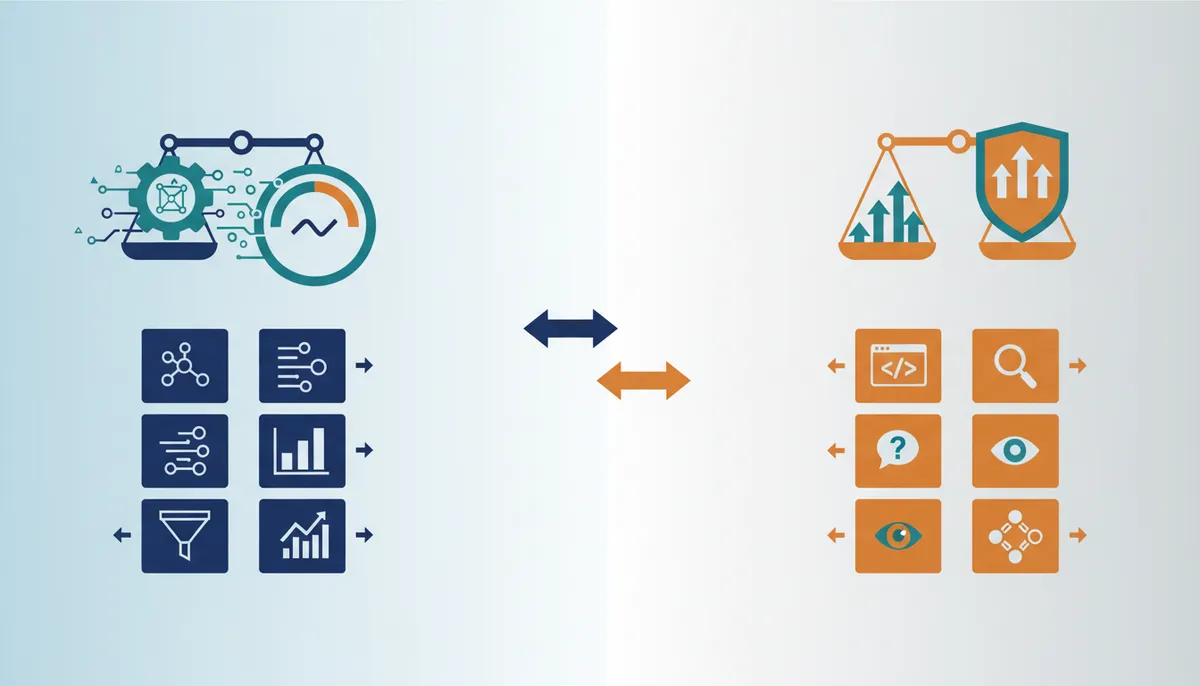
Architectural scope determines whether an evaluation framework functions as a standalone library or a complete platform. MLflow operates as a thorough open-source system with 30M+ monthly PyPI downloads, integrating dataset management and visualization directly into the core package. This all-in-one approach eliminates the need for external services when storing evaluation traces or rendering metric dashboards. DeepEval adopts a different strategy where dataset management remains SDK-only, requiring Confident AI for graphical analysis of results. Ragas defines openness as a lightweight Python library, excluding a UI, tracing backend, or platform layer entirely. Teams using Ragas must construct their own infrastructure to visualize scores or manage evaluation datasets over time.
| Feature | MLflow | DeepEval | Ragas |
|---|---|---|---|
| open-source Model | Full Platform | Library + Paid UI | Library Only |
| Dataset Management | Built-in | SDK-only | None |
| Visualization | Native UI | Requires Confident AI | None |
| PyPI Downloads | 30M+/mo | 1.9M+/mo | 1M+/mo |
The structural constraint for builders is that choosing a lightweight library like Ragas or DeepEval shifts the operational burden of building evaluation infrastructure onto the engineering team. Frameworks with native visualization allow teams to quickly understand why scores drop or edge cases surface without digging through JSON logs.
LangSmith Tracing Against Ragas Research Metrics
LangSmith captures full agent trajectories to expose reasoning chains that basic output scoring misses. This trace-aware architecture allows engineers to debug specific tool calls and planning failures within complex multi-turn conversations. While LangSmith provides the necessary infrastructure for visualization and dataset management, it lacks the academically validated metrics found in specialized libraries. Ragas fills this gap by offering research-backed scores like AgentGoalAccuracy and ToolCallAccuracy, which originated from an EACL 2024 paper establishing standards for RAG evaluation. However, Ragas operates as a lightweight Python library without a native UI or tracing backend, requiring teams to build custom infrastructure for result visualization.
| Feature | LangSmith | Ragas |
|---|---|---|
| Tracing Backend | Yes | No |
| Research Metrics | Custom/Manual | AgentGoalAccuracy |
| Visualization | Native UI | None (SDK only) |
| Multi-turn Support | Yes | Yes |
Operators choosing between MLflow, DeepEval, Ragas, Arize Phoenix, and LangSmith must weigh platform completeness against metric specificity. If a team requires immediate visual debugging of agent loops, LangSmith offers a complete solution. Conversely, teams prioritizing rigorous, paper-validated scoring for RAG pipelines often select Ragas despite its lack of interface. The critical distinction is that while LangSmith records full execution traces, Ragas functions as a metric library that requires teams to build or integrate their own infrastructure for trace ingestion and visualization. Engineers frequently bridge this by exporting traces to apply Ragas metrics externally, though this adds orchestration overhead. For production systems where human feedback must align with automated judges, relying solely on library-based metrics without a tracking server introduces significant operational debt. Integrating trace capture first provides the necessary foundation for layering specific metric libraries when standard scoring proves insufficient for a domain.
Operational Risks: LangSmith SaaS Lock-In and Ragas API Costs
Adopting LangSmith introduces architectural dependency because the platform operates as a proprietary SaaS. This centralization routes all trace data through vendor infrastructure, creating potential lock-in for organizations requiring strict data sovereignty. Ragas metrics rely on LLM calls for scoring, meaning every evaluation run incurs direct API costs from the underlying provider despite the package being open-source. Teams running high-frequency regression tests on large datasets face compounding expenses that do not exist with rule-based scorers. This subscription model contrasts with self-managed alternatives where storage costs scale linearly with volume rather than user count.
The hidden risk lies in the coupling of evaluation frequency to operational budgets. Unlike static code quality gates, agent evaluation scales with traffic volume and test depth. As evaluation becomes the foundation of responsible AI development, teams must ensure their testing pipelines are systematic rather than ad-hoc. Engineers must weigh the convenience of managed tracing against the long-term financial impact of per-call scoring models.
Building the Evaluation Loop: Trace Ingestion and Framework Selection
What a Production Evaluation Loop Consumes
Real production systems demand trace-aware analysis that consumes complete execution paths instead of isolated outputs. The mlflow.genai.evaluate API makes this practical by accepting the full execution trace, which allows scorers to grade tool calls and reasoning chains next to final responses. This architectural change handles the messiness of modern agentic systems where end-to-end simulation matters because single-turn QA misses multi-step planning failures entirely. Effective setups implement LLM judges tuned to match human feedback so automated quality gates mirror actual user priorities. Automated scores often fail to represent nuances of helpfulness and safety without this alignment. Balancing granular visibility with system performance means using frameworks that support both rule-based checks and detailed LLM scoring.
What to Verify Before Selecting a Framework
Select frameworks that natively ingest full execution traces to score intermediate reasoning steps effectively. Libraries like DeepEval and Ragas ship with broad pre-built metric sets, yet complex agent workflows often demand custom rule-based checks alongside LLM judges. Operators must verify that chosen tools support defining these custom criteria without extensive boilerplate code. Sustainable evaluation requires built-in human feedback collection mechanisms to gather ground truth labels from reviewers. The selected platform should automatically improve judge prompts using these labels, ensuring automated scores align with human priorities over time.
| Feature | Standalone Libraries | Unified Platforms |
|---|---|---|
| Metric Coverage | Pre-built sets | Native integrations |
| Custom Checks | Script-heavy | Unified interface |
| Human Feedback | SDK-only or Manual | Built-in collection |
| Judge Alignment | Manual tuning | Automated tuning |
Standalone libraries often suit script-based CI pipelines whereas platforms provide necessary capabilities for visualization, dataset management, and online monitoring. A tension exists between metric breadth and lifecycle integration; broad coverage means little if the tool cannot ingest production traces for continuous calibration. Prioritizing systems that unify tracing, custom metric definition, and feedback loops helps avoid disjointed evaluation silos and ensures production traces can be converted into evaluation datasets.
About
Marcus Chen is Lead Agent Engineer at AI Agents News, where he daily architects and stress-tests production multi-agent systems using frameworks like CrewAI, AutoGen, and LangGraph. His direct experience shipping autonomous agents that rely on complex tool use and orchestration makes him uniquely qualified to evaluate agent evaluation tools. Chen understands that deploying agents without rigorous testing harnesses is akin to shipping untested code, a reality he faces in every build cycle. At AI Agents News, an independent hub dedicated to covering the agentic environment for engineers, Chen leads technical deep dives that strip away vendor hype. He connects his hands-on work with evaluation harnesses and memory management to this guide, ensuring the comparison of frameworks like MLflow and DeepEval is grounded in actual engineering constraints rather than marketing claims. This article reflects the specific metrics and iterative labeling workflows his team relies on to validate agent reasoning steps before deployment.
Conclusion
Scaling AI agents exposes a critical fracture: evaluation tools that cannot ingest full execution traces create blind spots in reasoning quality. As agent complexity grows, the operational cost of maintaining disjointed scripts for custom metrics becomes unsustainable. Teams relying on standalone libraries face a compounding debt of manual boilerplate code just to define basic rule-based checks. This fragmentation prevents the continuous calibration necessary for production stability. You must prioritize unified platforms that natively support custom criteria and automated judge alignment over tools requiring extensive scripting. The shift from experimental prototypes to reliable infrastructure demands a system where human feedback directly improves automated scoring without manual intervention.
Adopt a unified evaluation platform only if it ingests production traces and supports custom rule definitions without excessive coding. Do not settle for pre-built metric sets if they cannot evolve with your specific workflow requirements. This transition should occur before your agent deployment frequency exceeds weekly cycles, as manual review bottlenecks will otherwise cripple iteration speed. Start this week by mapping your current custom evaluation logic against available platform capabilities to identify gaps in trace ingestion. Focus your immediate effort on integrating human feedback collection mechanisms that automatically refine your LLM judges. AI Agents News provides the strategic guidance needed to navigate these infrastructure decisions effectively.
Frequently Asked Questions
The Confident AI platform starts at $19.99 per user per month. This pricing gate means teams running tight budgets must carefully evaluate if the advanced trace-aware scoring features justify the specific recurring expense for every seat.
Five distinct frameworks currently define the agent evaluation market in 2026. Engineers selecting tools must choose between these five options to ensure they support critical multi-turn conversation analysis rather than relying on outdated single-prompt testing methods.
Trace-aware scoring analyzes every reasoning step instead of just the final result. This depth prevents teams from missing logical flaws that lead to correct answers by luck, surfacing safety issues along the decision path instead of at the final answer alone.
LLM judge alignment uses human labels to optimize automated scoring prompts. This process allows teams to scale human review efforts effectively, ensuring that automated metrics accurately reflect nuanced quality dimensions like safety without requiring constant manual intervention.
Production traffic behaves differently than static test sets due to model drift. Frameworks must convert live traces into evaluation datasets to catch these shifts, ensuring that quality regressions surface as actionable signals before they impact end users significantly.
References