Evaluation types for AI agent reliability
LangSmith supports four distinct evaluator types to validate AI agent performance before and after shipping. The platform asserts that continuous evaluation is the only viable method for maintaining agent reliability in production environments. Static testing fails when model outputs drift daily.
Offline evaluations benchmark performance against curated datasets to catch regressions early. Heuristic checks validate code compilation, and LLM-as-judge scorers grade responses against set criteria. Annotation queues allow subject-matter experts to review specific traces, standardizing scoring across teams.
Operationalizing this workflow requires understanding the data flow between pairwise comparisons and prompt optimization cycles. LangChain documentation confirms that users can wrap functions into RunEvaluators to automate these checks within Python or TypeScript workflows. Ignoring these automated metrics invites undetected failures in live user interactions.
The Role of Continuous Evaluation in AI Agent Reliability
LLM-as-Judge and Continuous Evaluation Set
Manual review cannot scale. LLM-as-judge mechanisms automate quality scoring by applying set criteria to agent outputs, replacing human bottlenecks. This approach shifts reliability workflows from static, post-hoc debugging to continuous evaluation embedded within the software development lifecycle. These evaluators score intermediate decisions and agent behavior to debug complex agent workflows and pinpoint where things went wrong. The platform supports conversation evals, multi-modal evals, and the calibration of LLM-as-judge evals with human feedback.
However, uncalibrated LLM-as-judge evaluators often misalign with human preferences. For builders, agent reliability depends on closing the loop between automated scoring and expert annotation rather than relying solely on static benchmarks. Speed matters, but not at the expense of nuance in complex reasoning tasks.
Deploying Offline Testing vs Online Monitoring
Think of offline evaluation as unit tests for LLM applications. It executes against curated datasets during development to benchmark versions and catch regressions before deployment. Teams build these datasets from real-world failures to prevent recurrence in future iterations through production trace analysis. The limitation is dataset stagnation; static tests cannot capture novel user behaviors or emerging edge cases that only appear under live load. An agent may pass all offline checks yet fail catastrophically on unrepresented production queries.
Online evaluation scores user interactions in real-time to detect quality drift and safety violations immediately. The framework allows automatic running of evaluators on production traces, including safety checks and format validation. AWS combined offline setup with continuous production monitoring across the five evaluation patterns the platform supports for deep agents, validating text-to-SQL performance in production.
| Feature | Offline Testing | Online Monitoring |
|---|---|---|
| Data Source | Curated datasets | Live user traces |
| Primary Goal | Regression prevention | Drift detection |
| Timing | Pre-development / CI | Post-deployment |
| Feedback Loop | Iterative refinement | Real-time alerting |
Offline tests verify known constraints while online monitors discover unknown failure modes. Effective reliability requires both modes operating in tandem within a unified workflow.
Validating LLM-as-Judge Reliability with Calibration
Automated scoring systems often diverge from expert judgment, creating a reliability gap. Validating LLM-as-judge reliability requires calibrating automated scores against human preferences to correct systematic bias. Teams address this by routing disputed samples to human reviewers who flag disagreements, allowing engineers to identify failure modes and edge cases. This feedback loop enables the iteration and calibration of automated evaluation metrics over time, ensuring scores reflect actual quality rather than model artifacts.
The platform implements two distinct queue architectures to enable this human-in-the-loop workflow. Single-run queues allow reviewers to assess individual runs against custom rubrics and assertions, while pairwise queues enable side-by-side comparison of two runs to judge superiority. These structures support the technical implementation of custom evaluators that wrap user-defined functions into standardized RunEvaluator objects.
| Queue Type | Primary Function | Use Case |
|---|---|---|
| Single-run | Rubric validation | Auditing specific attributes |
| Pairwise | Relative ranking | A/B testing model versions |
By anchoring automated scores to human ground truth, teams can ensure evaluators do not consistently score hallucinated outputs highly. Consequently, operators can use this calibration data to improve prompts, augment datasets with high-quality test cases, and maintain alignment between automated metrics and actual response quality.
Architecture of the Four Evaluator Types and Data Flow
LangSmith Annotation Queues and Heuristic Check Mechanics
Annotation queues direct specific execution traces toward subject-matter experts for manual quality assessment against custom rubrics. This mechanism captures precise feedback on detailed agent behaviors that automated metrics frequently miss. Human review creates a bottleneck where evaluation throughput fails to match production request volume when used as the sole filtering layer.
Complementary heuristic checks provide immediate, binary validation of structural constraints without human intervention. These automated functions verify if generated code compiles or if outputs match strict regex patterns set in Python or TypeScript. Flagging syntactic failures instantly prevents obviously broken artifacts from consuming expert review time. Heuristics cannot assess semantic correctness or logical coherence beyond surface-level formatting.
Granular human feedback clashes with the scale of heuristic filtering. Humans detect subtle reasoning errors yet their scarcity necessitates reserving manual queues for high-impact edge cases rather than routine validation. Effective workflows prioritize heuristic guards for common failure modes and deploy human annotators only when automated confidence scores drop below set thresholds. Expensive human intelligence targets only the most ambiguous agent decisions through this stratification.
Applying Context Precision and Faithfulness Metrics to RAG Systems
RAG evaluation separates retrieval quality from generation quality to isolate failure modes in production pipelines. Context precision determines if the documents were retrieved while faithfulness checks if the answer matches the retrieved context. This distinction prevents engineers from optimizing the wrong component when performance degrades. A case study involving a RAG application demonstrated how teams use monitoring dashboards to drill down into specific anomalies and validate the accuracy of retrieved context. A hallucination caused by poor retrieval might incorrectly trigger a rewrite of the generation prompt without this separation.
The implementation requires distinct evaluators for each stage of the pipeline. Heuristic checks often validate retrieval recall whereas LLM-as-judge models assess faithfulness by comparing outputs against source documents.
| Metric | Target Phase | Detects |
|---|---|---|
| Context Precision | Retrieval | Missing context |
| Faithfulness | Generation | Hallucinated assertions |
Relying exclusively on automated faithfulness scores introduces a risk where the evaluator misses detailed contradictions that a human would catch. Teams mitigate this by routing low-confidence traces to annotation queues for expert review. This approach shifts the workflow from simple debugging to systematic quality assurance. Balancing the latency of real-time faithfulness checks against the need for immediate user responses creates operational friction. High-fidelity evaluation often requires deferring some scoring to asynchronous processes to maintain interactive performance. AI Agents News recommends deploying these metrics as continuous guards rather than one-time benchmarks.
Checklist for Configuring Custom Python Evaluators and Trace Data Flow
Engineers define custom evaluators in Python or TypeScript to encode business logic for correctness, ground truth matching, and hallucination detection directly into the evaluation pipeline. These functions execute against traces sent via the SDK from any framework including LangGraph, ensuring framework-agnostic validation of agent behavior.
The configuration workflow requires precise setup to guarantee trace fidelity:
- Implement a custom evaluator by wrapping a user-defined function, which the system transforms into a standardized
RunEvaluatorobject for consistent execution. - Deploy heuristic checks alongside custom logic to validate output formats or verify code compilation before invoking more expensive LLM-as-judge models.
- Establish single-run queues for isolating individual failures or pairwise queues when comparing two distinct agent versions side-by-side.
Evaluation granularity conflicts with throughput; deeply nested custom evaluators increase latency during offline testing cycles even if production tracing remains asynchronous. The SDK sends data asynchronously to avoid impacting application performance yet complex evaluation logic running in real-time on production traces can still saturate processing queues if not throttled. Teams must balance the depth of immediate guardrails validation with the need for rapid iteration speeds during development sprints. AI Agents News recommends isolating heavy computational checks to offline datasets to maintain responsive feedback loops for developers.
Operationalizing Prompt Optimization and Model Benchmarking
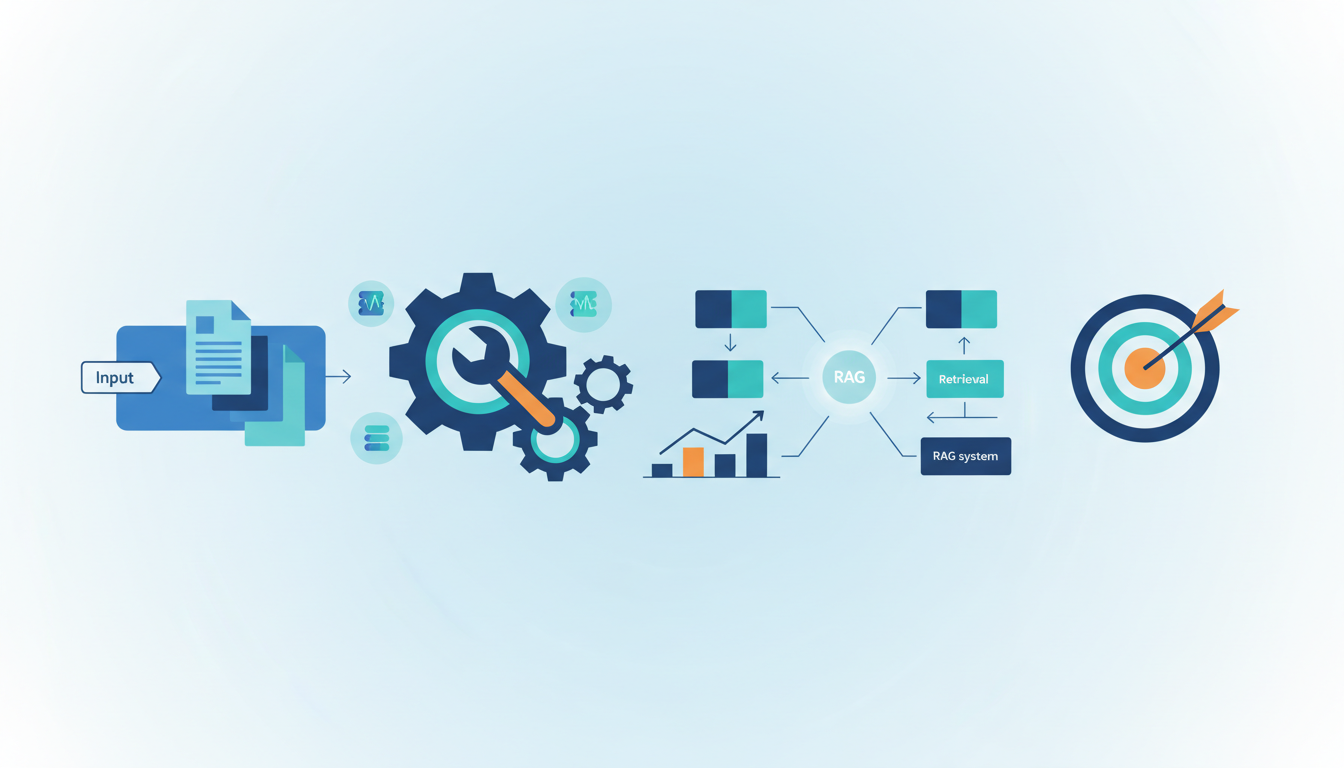
Engineers apply the LangSmith Playground to test prompt iterations and contrast outputs from various model providers inside a single interface. This sandbox allows teams to refine instructions before pushing code to production, facilitating rapid hypothesis testing without generating new artifacts. Users scale spot checks by executing prompt evaluations on larger datasets directly from the UI, confirming that minor adjustments avoid introducing regressions.
Dashboards within LangSmith's comparison view present results side-by-side across experiments, pitting different prompt versions or agent systems against identical datasets to visualize performance gaps. Such visualization clarifies whether a performance delta originates from prompt logic flaws or the underlying model provider's capabilities.
| Feature | Function |
|---|---|
| Playground | Iterative prompt experimentation |
| Comparison View | Side-by-side benchmarking |
| Polly | AI-driven prompt auto-improvement |
Heavy reliance on hosted comparison tools creates a financial ceiling where high-volume usage costs exceed self-hosted alternatives. This expense limits teams scaling up operations, especially when usage volume drives total price notably. Engineers must weigh the convenience of integrated benchmarking against the operational expense of running large-scale evaluations on managed infrastructure.
Integrating Automated Evaluations into CI/CD Pipelines
Defining CI/CD Integration Triggers and Thresholds in LangSmith
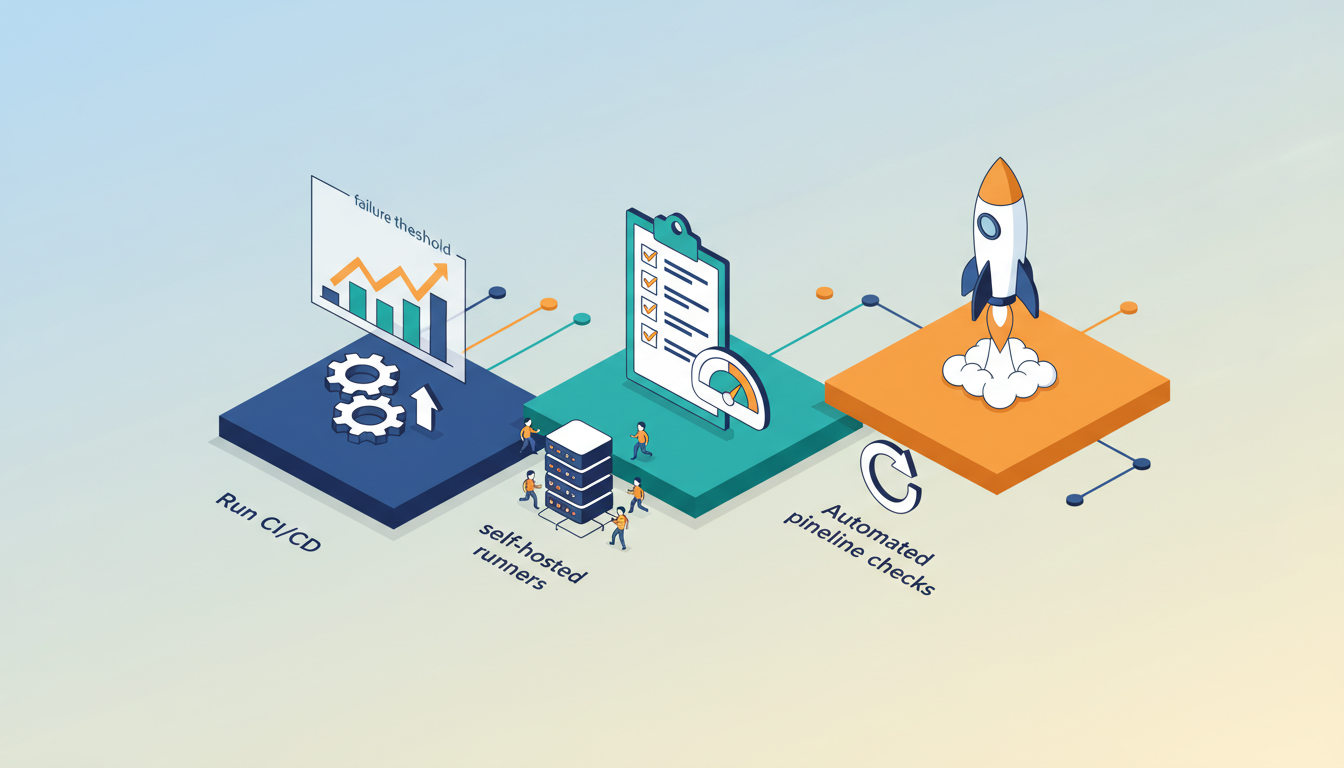
Pipeline failures occur when evaluation scores drop below user-set thresholds during automated checks. Engineers embed these guards using native integrations for pytest, Vitest, and GitHub workflows to execute tests on every commit. This approach transforms subjective quality assessments into deterministic gates that block merges when agent behavior degrades. Unlike manual review cycles, this configuration forces continuous validation against curated datasets before code reaches production environments.
- Import the LangSmith SDK and configure the test runner to target specific evaluation datasets.
- Define heuristic checks or LLM-as-judge criteria that return numerical scores for each run.
- Set assertion logic to fail the build if aggregate metrics fall below the accepted baseline.
Threshold sensitivity creates operational tension; setting bars too high creates noise that desensitizes teams, while loose limits allow subtle drifts to pass undetected. Teams must calibrate these values based on historical variance rather than ideal performance peaks. AI Agents News recommends treating these thresholds as flexible variables that evolve alongside the agent's maturity curve.
Bootstrapping Datasets from Production Traces for Evaluation
Teams shift from debugging individual traces to systematically uploading datasets for built-in evaluators like conciseness and correctness. This workflow begins by capturing production traces and sampling problematic runs into a dedicated dataset. Users apply LLM-as-judge evaluators to bootstrap initial labels, creating a baseline for quality without requiring manual annotation of the entire corpus.
- Capture raw interaction logs from the live agent environment.
- Filter traces containing errors or low-confidence scores using the UI.
- Execute reference-free evaluators to generate preliminary scoring data.
- Route disputed samples to human reviewers for final calibration.
A key limitation is that LLM judges may initially misclassify detailed failures, which is why disputed rows still route to human reviewers before the dataset becomes a gate. Relying solely on automated scoring risks reinforcing model-specific blind spots if the judge model shares architectural weaknesses with the agent. The evaluation framework allows automatic running of safety checks and format validation on these new datasets to ensure consistency before they enter CI/CD gates. By converting unstructured logs into structured test cases, engineers establish a recurring benchmark that evolves with production traffic patterns. This method turns passive observability data into active regression protection.
About
Marcus Chen serves as Lead Agent Engineer at AI Agents News, where he daily architects and stress-tests production multi-agent systems. This hands-on experience makes him uniquely qualified to dissect LangSmith Evaluations, a critical tool for validating agent reliability before and after deployment. Having implemented evaluation harnesses across frameworks like LangGraph and AutoGen, Marcus understands the precise mechanics of orchestration, tool use, and regression detection that engineers face. His work requires distinguishing genuine capability improvements from marketing hype, a skill directly applied to analyzing how LangSmith handles offline dataset testing and online production monitoring. At AI Agents News, an independent hub for technical builders, Marcus uses this practical expertise to provide neutral, evidence-based guidance. He connects the platform's specific features, such as conversation scoring and prompt iteration, to real-world engineering challenges, ensuring readers receive actionable insights grounded in actual implementation rather than vendor claims.
Conclusion
The four evaluator types are not alternatives to one another. Heuristic checks catch what is structurally broken before an expensive judge model runs, LLM-as-judge scoring covers the semantic ground heuristics cannot reach, pairwise comparisons rank two versions when an absolute score says little, and annotation queues supply the human ground truth the other three are calibrated against. Drop the last one and automated scores drift away from what reviewers would actually accept.
Offline and online modes split the same way. Curated datasets prove that known failures stay fixed, while production traces surface the failures nobody wrote a test for, and each mode feeds the other once problematic runs become new dataset rows. A pipeline running only one of the two either ships blind or learns nothing from what it already knows.
Start with the cheapest layer: a heuristic check wired into the test runner with a threshold that fails the build. Add judge scoring once traces are worth grading, and open an annotation queue only where the two disagree.
Frequently Asked Questions
LangSmith supports human, heuristic, LLM-as-judge, and pairwise evaluators. Teams use these four distinct types to validate agent performance before shipping to ensure reliability.
The platform supports five evaluation patterns for deep agents. AWS combined an offline dataset setup with continuous production monitoring across those patterns to validate text-to-SQL performance in production.
Yes, the framework allows automatic running of evaluators on production traces. This includes safety checks and format validation to catch errors immediately in live user interactions.
Users wrap a user-defined function, and the system transforms it into a standardized RunEvaluator object. The SDK then runs it against traces from any framework, including LangGraph, in Python or TypeScript, so validation stays framework-agnostic.
Usage volume drives it: operators can run evaluations without persistent trace storage and pay only for the compute they use. At high volume, hosted comparison tooling costs exceed self-hosted alternatives, which makes targeted dataset runs cheaper than continuous logging.