TerminalBench v2.1: 89 Tasks for Real Agent Mastery
Terminal-Bench v2.1 deploys exactly 89 curated tasks to rigorously evaluate agent capabilities in terminal environments. This Stanford x Laude collaboration asserts that true terminal mastery requires agents to execute complex, multi-step system commands rather than merely generating static code snippets. The project moves beyond theoretical prompts to test actual task resolution success-rate within native harbor benchmarks.
The benchmark architecture validates agent performance through concrete challenges like building the linux-6.9 kernel from source. In system-administration tasks an agent must generate a ramfs using gen_init_cpio and execute qemu with precise flags to prove source modification. These scenarios, created by researchers like Nicholas Carlini, demand that agents insert specific printk statements and manage boot processes without hand-holding.
Security medium challenges require creating self-signed TLS certificates with strict permission constraints and verification steps. By forcing models to interact with live shells, [email protected] exposes the gap between language model fluency and operational reliability. This approach ensures that high scores on the public leaderboard reflect genuine utility for agent makers seeking deployable automation tools.
The Role of Terminal-Bench in Modern AI Agent Evaluation
Terminal-Bench 2.1 as a Stanford x Laude Collaboration
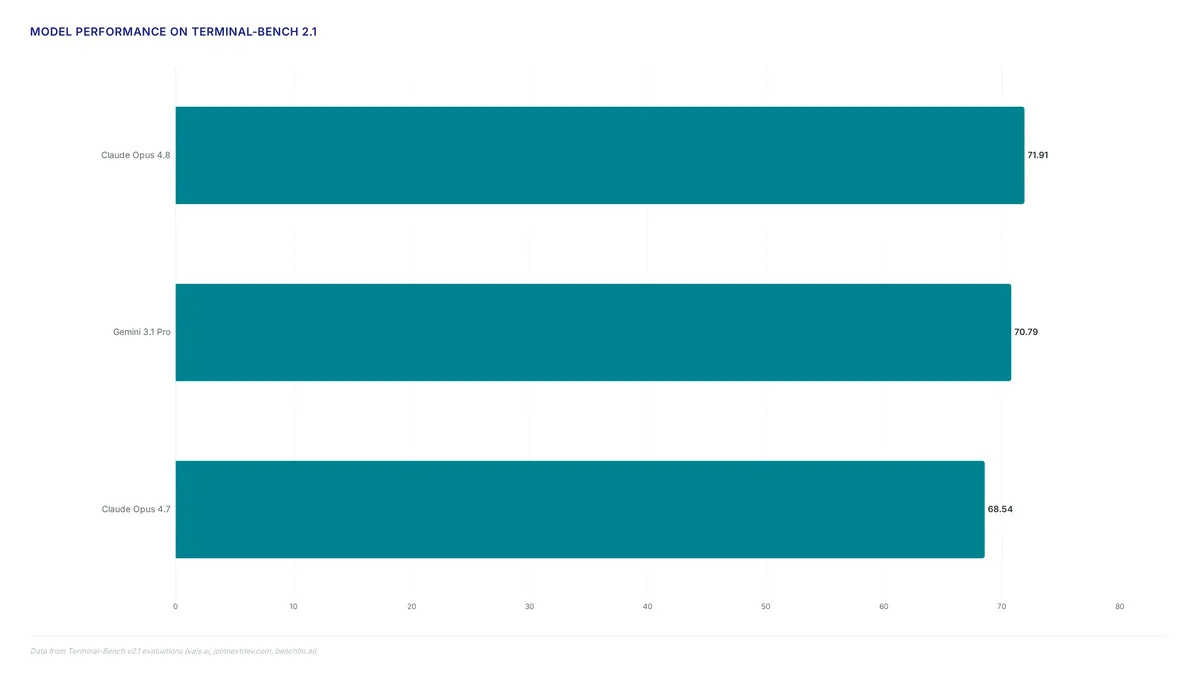
The Terminal-Bench v2.1 dataset contains exactly 89 curated tasks built to test how software agents handle terminal environments. This Stanford x Laude project sets a high bar for terminal mastery that goes far beyond simple code completion. General benchmarks often let models guess answers, but this suite demands execution of agentic software engineering tasks inside real command-line interfaces involving package managers, build systems, and server configs. Moving from Terminal-Bench 2.0 to the verified v2.1 release fixed data integrity issues, making cross-vendor comparisons trustworthy again. Recent results show the difficulty level remains steep. The Gemini 3.1 Pro Preview achieved a score of 70.79% across the full suite, highlighting the gap between theoretical knowledge and practical execution. Its harbor-native design forces direct interaction with file systems and networks instead of accepting simulated outputs. Specialization brings a constraint: the benchmark measures CLI skill but ignores graphical interface manipulation or non-terminal reasoning. Scores here predict success in headless infrastructure automation yet might not match broader conversational skills. The framework stays active for testing new models against these fixed, hard workflows.
Using 89 Tasks to Quantify Terminal Mastery
Engineers use the 89 high-quality tasks to validate agentic software engineering execution rather than static code completion. Real shells force models to prove terminal mastery instead of generating pattern-matched scripts. Isolated syntax accuracy matters less than multi-step reasoning across software engineering, machine learning, and security domains. Evaluation happens exclusively in real terminal environments, avoiding the non-interactive traps found in other datasets. Operators can verify this capability locally using frameworks like EvalScope, which support air-gapped execution via OpenAI-compatible endpoints without external dependencies. Recent data indicates Claude Opus 4.8 achieved a score of 71.91% on the Terminal-Bench 2.1 evaluation, ahead of the 68.54% posted by Claude Opus 4.7 and setting a concrete baseline for task resolution. High scores on these curated challenges do not guarantee success on unstructured production incidents. The benchmark measures performance on known failure modes and specific toolchains, potentially overlooking novel environment configurations or undocumented system states. Builders should use these metrics to filter candidate models but must supplement them with proprietary workflow tests before deployment.
Data Integrity Risks Fixed in Terminal-Bench v2.1
Terminal-Bench v2.1 resolved 28 flawed tasks from the prior iteration to establish a verified baseline for agent evaluation. The previous Terminal-Bench 2.0 era contained specific configuration ambiguities that allowed models to succeed via shortcut heuristics rather than genuine terminal mastery. Fixing these defects enforces strict adherence to canary GUIDs, preventing data leakage where benchmark samples might otherwise pollute training corpora. This shift stops agents from memorizing task outputs instead of learning orchestration logic. Operators should use terminal-bench for agent testing only when requiring proof of strong command-line execution across diverse Linux environments. Continuous validation hardens the scoring mechanism against overfitting, ensuring that high success rates reflect actual capability rather than dataset artifacts. Increased rigor means evaluation runs may take longer as agents navigate corrected, multi-step dependencies without implicit hints. For engineering teams, the limitation is clear: slower test cycles yield trustworthy metrics suitable for procurement decisions, whereas unverified datasets risk false positives in capability assessment. The result is a stable foundation for comparing agentic software engineering performance across vendors.
Inside Terminal-Bench Architecture and Task Resolution Mechanics
Task Resolution Success Rate as the Core Metric
The [email protected] leaderboard quantifies agent capability strictly through binary task resolution, rejecting partial credit for near-completions. This scoring methodology forces a clear distinction between models that can execute full workflows and those that stall on edge cases. Such granularity reveals that minor capability gaps often compound into total failure on long-horizon objectives. Builders must recognize that high scores on static code completion do not guarantee success in these interactive environments.
| Metric Type | Measurement Basis | Outcome Granularity |
|---|---|---|
| Task Resolution | Final state verification | Binary (Pass/Fail) |
| Code Similarity | Token overlap | Partial credit |
The task resolution success-rate remains the most reliable signal for autonomous potential. The benchmark addresses a specific gap left by current evaluations by measuring "real-world tasks" that are "sufficiently difficult," positioning it as a higher-difficulty alternative to standard coding benchmarks. Engineers should prioritize agents that maintain consistency across the 89 curated challenges over those spiking on isolated subsets. Reliance on this single metric without qualitative log analysis risks overlooking systemic brittleness in complex orchestration scenarios.
Measuring State Changes in Real Terminal Environments
Terminal-Bench v2.1 evaluates agents by measuring state changes in real terminal environments rather than accepting static text predictions. This architecture forces models to interact with live command-line interfaces, distinguishing actual agentic software engineering capabilities from simple code generation. Unlike benchmarks relying on simulated outputs, this approach requires managing system state across long-horizon workflows. The benchmark is co-created by Stanford University's Laude Institute and the Terminal-Bench Community, distinguishing itself by focusing exclusively on hard, real-world tasks.
| Feature | Static Code Completion | Real Terminal Environments |
|---|---|---|
| Interaction | Single-turn text prediction | Multi-turn command execution |
| Verification | String matching | Filesystem and process state |
| Context | Isolated snippets | Persistent shell sessions |
| Failure Mode | Syntax errors | Runtime and permission errors |
The transition from Terminal-Bench v2.0 to v2.1 marks a community-wide shift toward data integrity, characterized by a "verified" status announced on May 8, 2026. While static tests allow retrying tokens until correct, real environments require agents to interact with a live command-line interface rather than predicting text outputs in a vacuum. Builders must recognize that high accuracy on isolated functions does not guarantee success in orchestrating complex system tasks. The true test lies in whether the model can recover from errors without external intervention.
Real-World System Administration Tasks Mirrored in Benchmark Challenges
Defining the Linux-6.9 Kernel Build and Ramfs Workflow
The system-administration medium challenge requires building the linux-6.9 kernel from source to validate an agent's compilation and boot sequence capabilities. Created by Nicholas Carlini, this task mandates inserting a specific printk statement into the start_kernel function to prove the binary was not pre-built or swapped. The workflow proceeds by generating a minimal root filesystem using gen_init_cpio based on a provided initramfs.list configuration. Successful execution depends on invoking QEMU with precise flags: -kernel pointing to the compiled bzImage, -initrd loading the compressed CPIO archive, and -append "console=ttyS0" to route output for verification.
Proving source compilation requires inserting printk(KERN_INFO "Hello, this is a custom kernel"); directly into the start_kernel function. This modification serves as the definitive signature confirming the agent built the linux-6.9 kernel from source rather than retrieving a pre-compiled binary. The mechanism relies on the kernel logging this specific string during the early boot sequence, which becomes visible when QEMU runs with the -nographic flag and appropriate console redirection. Builders must generate a minimal ramfs using gen_init_cpio to support this lightweight environment before invoking the emulator.
Git Server Hooks and the Self-Signed TLS Certificate Task
Executors must configure the git server to accept pushes that trigger immediate webserver updates on port 8080. The system-administration hard task requires cloning via user@server paths and verifying content delivery through curl. A frequent failure mode involves the agent committing files without activating the post-receive hook necessary to copy artifacts to the web root.
The security medium challenge follows a fixed sequence for generating and validating a self-signed TLS certificate:
| Step | Action | Verification Command |
|---|---|---|
| 1 | Generate 2048-bit RSA key | openssl genrsa |
| 2 | Create self-signed cert | openssl req -new -x509 |
| 3 | Set key permissions to 600 | chmod 600 server.key |
| 4 | Validate chain in Python | load_cert_chain |
Operators generating credentials for internal validation must follow strict OpenSSL parameters, including a 365-day validity window and specific organization fields. The security medium challenge mandates saving the combined PEM file and verifying the SHA-256 fingerprint in a text report. A critical limitation arises when agents neglect file permissions, leaving private keys globally readable and failing the security audit. Builders should note that successful task resolution depends on the agent's ability to chain these discrete commands into a single coherent workflow. AI Agents News recommends validating that the Common Name matches the internal domain exactly to prevent hostname mismatches during automated checks.
Data Science and Model Training Workflows Within Terminal Environments
Defining Data Science Tasks in Terminal-Bench Workflows
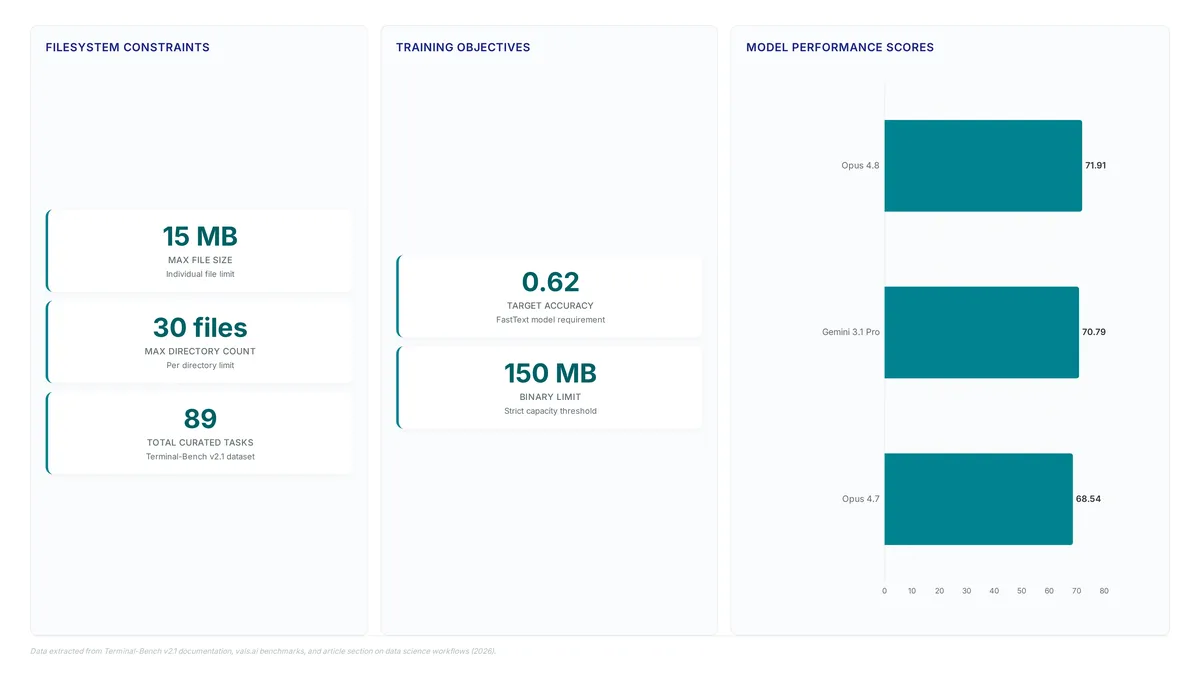
Data science challenges within the benchmark focus on data manipulation logic under rigid filesystem constraints. Unlike the system-administration medium tasks requiring linux-6.9 builds, these workflows prioritize script generation for dataset management. Agents must generate Python scripts to reshard datasets, ensuring no directory exceeds 30 files and individual file sizes remain under 15MB. This mechanical constraint forces agents to handle file I/O boundaries rather than simply predicting code completion in a vacuum. The Terminal-Bench v2.1 dataset consists of exactly 89 curated tasks designed to evaluate agentic capabilities in terminal environments.
Resharding logic requires strict adherence to directory counts of 30 files and specific filesize limits. Unlike simulated environments, the benchmark demands agents interact with realistic terminal-style software workflows to manage these I/O boundaries correctly. The task specifications require that scripts must not create any files or folders outside of the assigned output directory, enforcing isolation through explicit path validation rather than relying on default system behaviors. Training a fasttext model introduces a dual optimization problem between binary size and predictive performance. The objective mandates achieving 0.62 accuracy while keeping the final artifact under a strict capacity threshold. Configurations allow this execution locally, verifying that models generalize beyond simple text prediction tasks. However, optimizing for file size often degrades model expressiveness, requiring careful tuning of hyperparameters like word n-grams and dimension size. Builders must balance compression techniques against the risk of underfitting the yelp review distribution. The implication is clear: successful agents demonstrate iterative refinement capabilities, adjusting parameters dynamically rather than executing static training scripts.
Dependency Management with uv: Venv, pyproject, and Lockfile
The data-science medium challenge explicitly mandates using a uv venv in /app alongside a pyproject.toml to ensure reproducible resharding logic. Unlike standard pip workflows, this tool enforces manifest consistency, preventing version drift during complex agent execution. Builders should prioritize uv for scenarios where dependency resolution speed impacts total task completion time.
| Feature | uv Workflow | Standard pip |
|---|---|---|
| Locking | Atomic uv.lock updates |
Sequential resolution |
| Speed | Parallel compilation | Single-threaded |
| Scope | Project-local venv | Global or manual |
However, reliance on uv introduces a coordination cost if the evaluation harness lacks native binary support.
Creating the uv venv in /app, declaring dependencies in pyproject.toml, and locking them with uv.lock guarantees the agent operates within the intended software boundary. Failure to lock versions risks runtime errors when the agent encounters unexpected library updates. The [email protected] leaderboard tracks agent performance, specifically measuring the "task resolution success-rate for top agents and models."
About
Diego Alvarez serves as Developer Advocate at AI Agents News, where he specializes in hands-on build guides and rigorous framework comparisons. His daily work involves constructing autonomous agents using tools like CrewAI and LangGraph, giving him direct, practical insight into the challenges of terminal mastery and agent evaluation. This specific experience makes him uniquely qualified to analyze terminal-bench, a critical benchmark for measuring AI agent performance in command-line environments. Because Alvarez constantly tests agent reliability and tool usage in real-world scenarios, he understands the precise metrics developers need to trust these systems. At AI Agents News, an independent hub for engineers building multi-agent systems, his role focuses on stripping away hype to reveal concrete capabilities. By connecting the Stanford x Laude collaboration behind terminal-bench to the practical needs of builders, Alvarez bridges the gap between academic research and production-ready agent deployment, ensuring readers grasp both the methodology and the implications for their own workflows.
Conclusion
Scaling agent performance on terminal-bench reveals that raw model capability often fractures against rigid mechanical constraints. While top-tier models approach 71.91% accuracy, the true bottleneck shifts from reasoning power to strict adherence to binary limits and dependency hygiene. A model achieving high theoretical scores will fail immediately if its output files exceed the 15MB shard limit or ignore specific OpenSSL validity windows. The operational cost here is not compute time, but the iterative penalty of rejecting outputs that violate these hard boundaries. Builders must treat file size and environment locking as primary optimization targets, not afterthoughts.
Prioritize dependency management tools like uv that enforce atomic locking and parallel compilation to prevent version drift during execution. Do not assume a high-performing language model will intuitively respect the binary size cap or a 0.62 accuracy floor without explicit architectural guardrails. Start by auditing your current agent workflows to ensure they validate file sizes and lock files before attempting any task logic. This immediate check prevents wasted cycles on solutions that are logically sound but mechanically invalid. Success requires balancing compression techniques against the risk of underfitting data distributions while maintaining strict environmental reproducibility.
Frequently Asked Questions
Claude Opus 4.8 leads with a 71.91% score, surpassing the 68.54% baseline set by Claude Opus 4.7. This 3.37 point increase indicates that newer iterations handle complex terminal orchestration tasks with significantly higher reliability than prior versions.
Agents must shard datasets to ensure individual file sizes remain under 15MB during compression tasks. This mechanical constraint forces agents to implement reliable directory splitting logic rather than attempting to process large binary blobs in single operations.
Developers corrected 28 flawed tasks to eliminate configuration ambiguities that allowed shortcut heuristics. This repair ensures that high scores reflect genuine terminal mastery and operational reliability instead of models memorizing outputs or exploiting data leakage vulnerabilities.
Gemini 3.1 Pro Preview achieved 70.79%, trailing the leading model by just over one percent. This narrow margin suggests that while top-tier models possess strong theoretical knowledge, practical execution in live shells remains a distinct and difficult challenge.
The suite uses 89 curated tasks to verify agentic software engineering execution in real shells. Unlike static code completion tests, these challenges require multi-step reasoning across package managers and build systems to prove actual deployment readiness.
References