SourceTrust stops AI agents citing stale files
Gartner predicts over 1,000 "Death by AI" legal claims by 2027. Blind trust in agent outputs is a liability no enterprise can afford. SourceTrust transforms AI governance by shifting focus from mere data access to rigorous evidence scoring. Without this layer, organizations risk basing critical decisions on stale files or unverified transcripts that agents confidently misinterpret as fact.
The problem is urgent. DEV Community notes that agent success rates on complex computer tasks surged from 12% in 2024 to 66.3% in 2026. While DEV Community highlights that cybersecurity agents now hit a 93% success rate, this capability explosion means agents are increasingly reasoning across SharePoint, Teams, and OneDrive without distinguishing between authoritative data and personal, outdated drafts. Access does not equal trust, yet most systems treat them identically.
The fix is to score evidence before an agent reasons over it. The R. A. H. S. I. Framework rates every source on authority, freshness, scope, governance, and integrity, so a stale personal draft never carries the weight of a governed SharePoint record. Access control answers whether an agent can read a file; evidence scoring answers whether that file deserves to become proof. Without the second gate, Microsoft 365 agents chain weak evidence into confident but legally disastrous conclusions.
The Role of SourceTrust in Modern Enterprise AI Governance
SourceTrust as an Evidence-Scoring Layer for AI Agents
The R. A. H. S. I. Framework™ positions SourceTrust as a validation mechanism that measures data fitness for agentic reasoning instead of simply granting raw access. Agents now execute complex tasks with 66.3% success on OSWorld benchmarks, yet they frequently hallucinate when relying on stale SharePoint files or over-permissive Microsoft Graph queries. Simple retrieval fails because access does not equal trust. A document might be authoritative but outdated, or personally owned in OneDrive and outside enterprise governance. Modern evaluation uses trace-based analysis to score the entire reasoning trajectory. This process exposes gaps where agents cite weak sources with high confidence.
Evaluating Evidence Across SharePoint, OneDrive, and Teams
SharePoint shared libraries support up to 30 million files, making them the mandatory target for scalable enterprise evidence over personal storage. This scale distinction matters because OneDrive performance degrades notably after syncing 300,000 items. Latency corrupts real-time AI reasoning cycles. User-owned files in OneDrive often lack the governance controls required for high-stakes agentic decisions. This creates a risk where personal drafts are treated as authoritative facts. The R. A. H. S. I. Framework scores this evidence lower than content residing in governed collaboration spaces. Teams conversation data provides temporal context. It requires strict scoping to prevent private chats from leaking into public summaries. A unified approach using the Microsoft Graph API ensures agents retrieve structured metadata rather than raw text blobs. Agents default to high-confidence outputs even when sourcing from low-authority personal folders. Operators must configure evidence scoring rules that explicitly downgrade or reject claims derived from non-governed user directories. This prevents the system from validating business strategies based on temporary local files.
GraphRAG Knowledge Graphs Versus Traditional Vector RAG Limits
Traditional RAG architectures fail global, structured queries requiring multi-hop reasoning due to vector isolation. Advanced designs like GraphRAG from Microsoft Research construct knowledge graphs to augment prompts. This directly addresses the inability of flat retrieval to connect disjointed enterprise facts. The architectural shift enables agents to synthesize information across massive corpora rather than matching isolated embeddings. Computational overhead remains a drawback when generating and maintaining graph structures compared to simple vector indexing. Network teams must weigh the latency cost of graph traversal against the precision gain in complex evidence chains. Operator confidence in AI citations depends on this structural difference.
Inside the R.A.H.S.I. Framework Mechanics for Evidence Scoring
Defining SourceTrust Authority and Governance Criteria
SourceTrust evaluates sources using specific questions that mirror hybrid evaluation methodologies emerging in 2026. Traditional retrieval assumes data validity once an agent reads a file. This assumption fails when personal OneDrive drafts lack the oversight of enterprise SharePoint libraries. A document might be technically accessible yet legally inadmissible for decision-making.
| Criterion | Validation Focus |
|---|---|
| Authority | Is the source approved for enterprise reasoning? |
| Freshness | Does the content reflect current operational reality? |
| Governance | Are retention and compliance tags present? |
| Scope | Is the evidence limited to the case context? |
| Integrity | Can the claim be traced back to the source that supports it? |
Regulatory pressure drives this rigor as frameworks for AI risk management become mandatory under EU obligations. Agents now perform complex tasks with high success rates, making errors in evidence selection costly. The Stanford HAI index confirms that agent capabilities have matured beyond simple retrieval. Operational tension exists between latency and verification depth. Deep validation slows response times but prevents catastrophic hallucinations. Organizations must decide if speed matters more than legal defensibility. AI Agents News recommends prioritizing governance over raw throughput for regulated industries. Agents amplify weak signals into confident errors without this scoring layer. The cost of unverified evidence exceeds the compute cost of validation.
Applying Trace-Based Analysis to M365 Permission Scopes
Trace-based analysis scores the full trajectory of tool calls to verify if Microsoft 365 content fits specific user scopes. Modern frameworks like Strands Evals make this trajectory inspectable. Granular visibility allows operators to block stale content before it influences a decision, a capability missing from simple access checks. A tension exists between agent autonomy and evidence integrity. An agent might successfully retrieve a personal OneDrive draft, yet that file lacks the authority of a governed SharePoint document.
| Evaluation Dimension | Traditional Check | Trace-Based Score |
|---|---|---|
| Scope Verification | Binary access grant | Contextual fit per case |
| Reasoning Path | Opaque black box | Auditable tool calls |
| Evidence Quality | Assumed valid | Dynamically scored |
Accessibility is a permission answer, fitness is an evidence answer, and the two rarely coincide. Platforms like Braintrust enable teams to test production traffic against these rigorous standards before full deployment. The cost of ignoring this layer is measurable. Agents acting on weak evidence generate confident but false conclusions that corrupt downstream workflows. Unlike static permission models, this approach treats every retrieval step as a potential failure point requiring validation. AI Agents News identifies this shift from access control to evidence scoring as the defining governance challenge for 2026. Visibility into the reasoning trajectory is now as vital as controlling the initial handshake for network teams.
Measurable Integrity Gains from Governed AI Reasoning
Binding Claims to Sources with ReAct-Style Traces
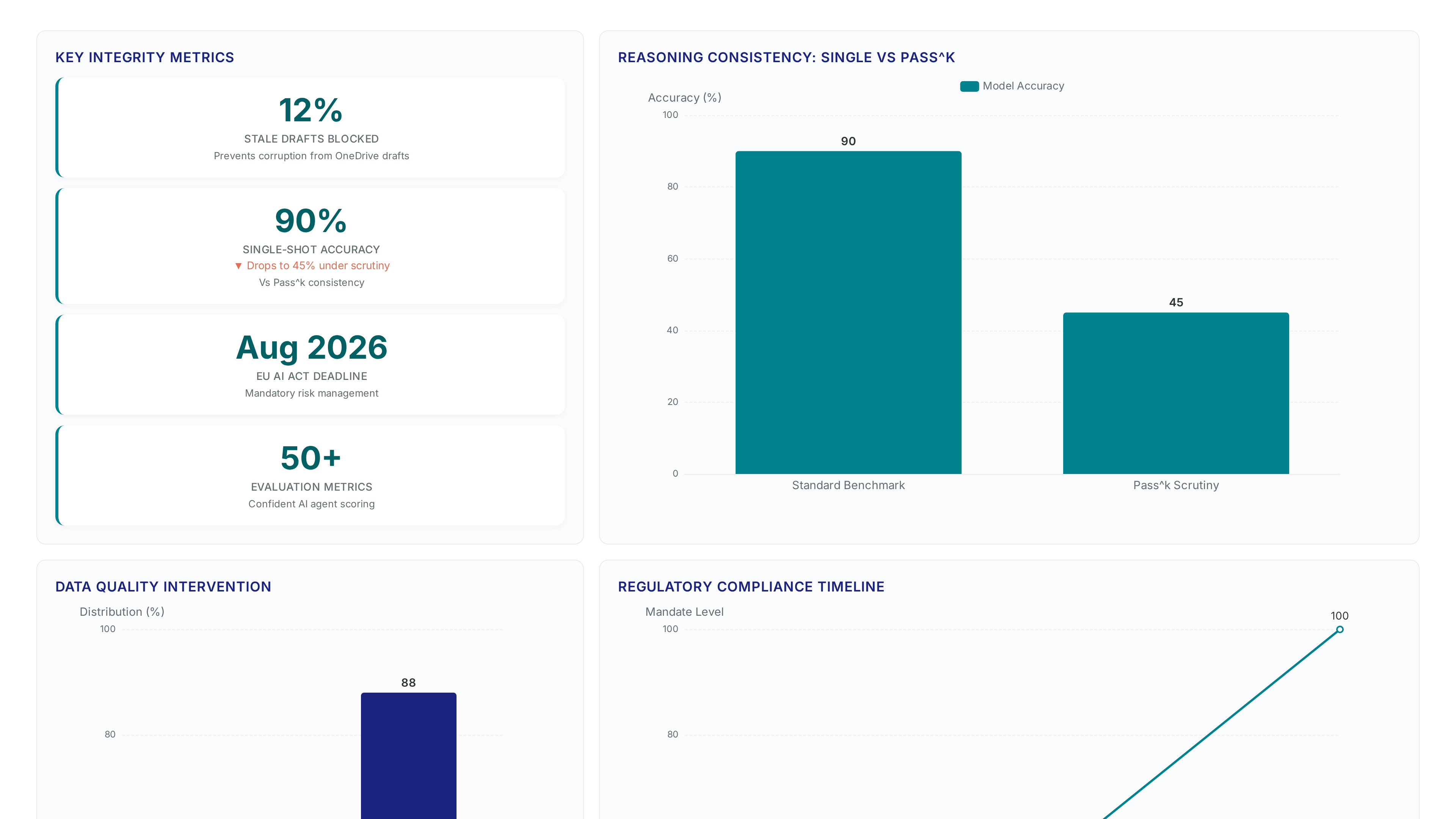
Citing a source does not build trust while any accessible file still counts as valid proof. Reliable architectures now force the citation of retrieved evidence and apply ReAct-style traces to make intermediate artifacts inspectable, binding claims to specific sources to reduce hallucination. This mechanism shifts validation from simple retrieval to rigorous evidence-grounded inspection so agents convert free-text notes into risk scores rather than generating plausible fiction. Computational cost is the constraint; binding every claim to an auditable chain increases latency compared to standard retrieval augmentation. Stricter evidence chain requirements will slow initial response times while drastically improving decision accuracy.
Regulatory frameworks now mandate these controls as AI risk management tools become obligatory when EU AI Act obligations take effect in August 2026, and audits of that kind ask for reasoning transparency that permission checks alone cannot produce.
Quicker responses bypass deep verification, and the bill arrives as wasted remediation time and regulatory exposure. Notion's engineering team resolved this by shifting focus from simple retrieval to systematic evaluation, increasing their issue-resolution rate tenfold. Knowledge workers using such evaluated agents reportedly save significant weekly hours by avoiding dead-end investigations based on poor sources. Deployment requires a governance layer that interrogates every claim against the R. A. H. S. I. Criteria. Only content surviving the evidence-integrity review should influence critical business workflows.
Pass^k Consistency Metrics Versus Single-Shot Accuracy
The 2026 shift toward pass^k metrics ensures agents are reliably correct rather than occasionally lucky by measuring consistency over multiple runs. Single-shot accuracy masks non-deterministic failures where an agent succeeds once but fails on retry. Production environments now prioritize trace-based analysis. This approach captures the full evidence chain required for governed AI evidence in Microsoft 365 workflows.
Advanced pipelines measure Cronbach's alpha across independent runs to assess internal consistency and calibrate LLM judges. Running k iterations increases token usage notably compared to single queries, creating a tangible limitation. Operators must balance strict consistency requirements against latency budgets for real-time user interactions. High variance in agent outputs indicates weak governed AI evidence rather than model instability. A system scoring 90% on single-shot tests may drop to less than half under pass^k scrutiny if the underlying evidence lacks authority. This gap forces organizations to upgrade data governance before expecting reliable agent performance. Trust requires every claim to survive repeated verification against authoritative sources.
Implementing SourceTrust Evidence Audits in Five Steps
Defining the Five-Step SourceTrust Evidence Audit Workflow
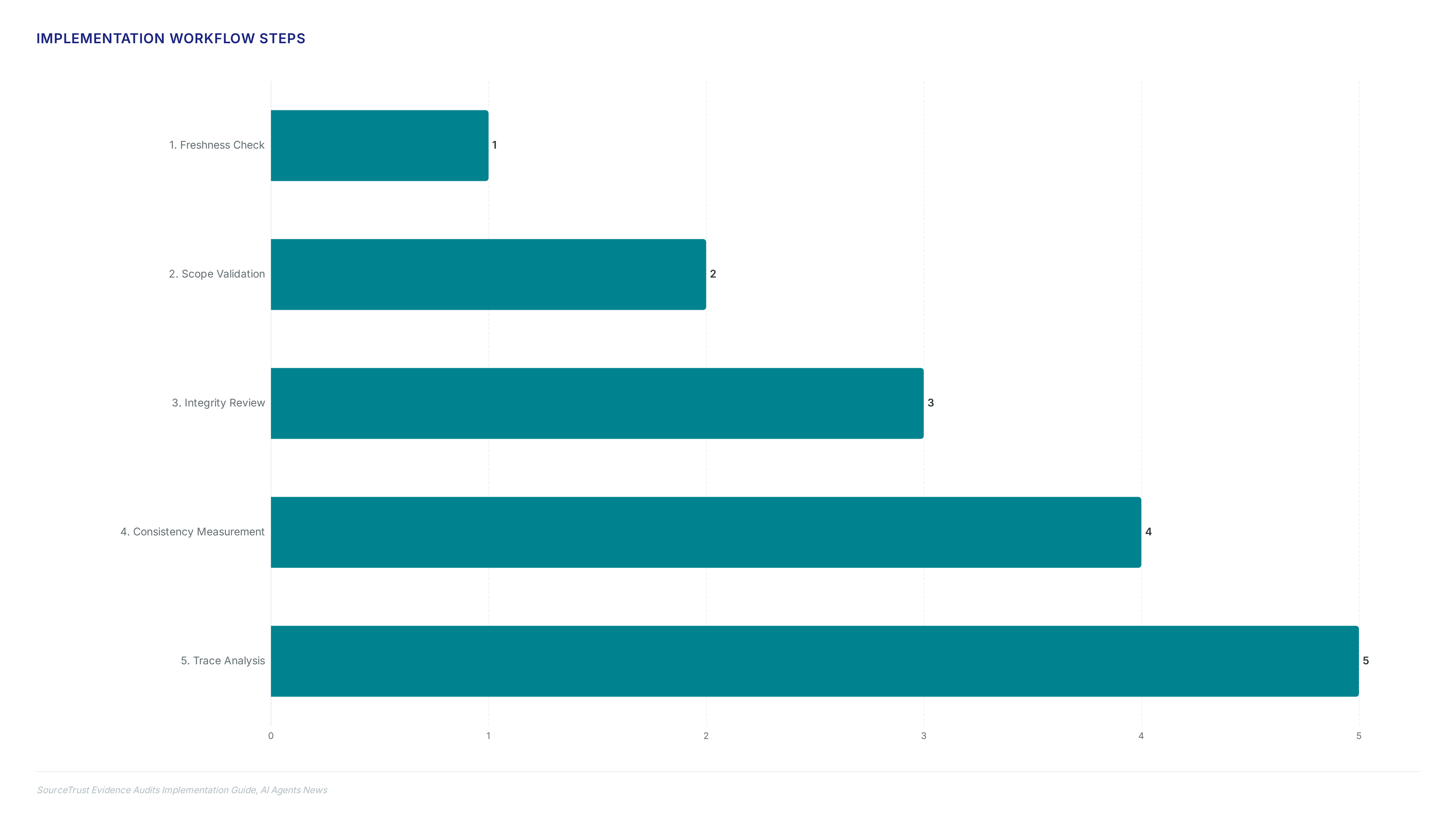
Implementing SourceTrust requires a numbered workflow that scores evidence fitness before agentic reasoning begins.
- Authority Verification: Confirm the source holds enterprise approval for decision-making.
- Freshness Check: Validate content timestamps against operational states to prevent stale data from skewing results.
- Scope Validation: Match retrieval scope to the specific user or team context, avoiding broad SharePoint sweeps.
- Governance and Integrity Review: Verify retention policies via Microsoft Purview compliance tags, then apply trace-based analysis to the full chain of tool calls.
- Consistency Measurement: Run multiple iterations to satisfy pass^k consistency requirements.
Traditional accuracy metrics often miss multi-hop reasoning failures where an agent accesses valid files but draws incorrect conclusions. This workflow forces the system to distinguish between accessible content and trustworthy proof. A significant limitation exists: strict scoring reduces the total volume of usable evidence, potentially causing agents to return "no answer" more frequently during early deployment phases. Operators must balance evidentiary purity with task completion rates.
The limitation of the fifth step is computational cost; running k-evaluations for every decision adds latency that real-time collaboration in Teams cannot tolerate without caching strategies. Consequently, high-frequency workflows may require pre-computed evidence validity caches rather than live scoring. This tension between rigor and speed dictates that critical governance actions use strict pass^k gating, while low-risk queries accept lower consistency bounds. The operational result is a system where agents refuse to act rather than act unpredictably.
Filtering Microsoft Graph Results by Governance Tags
Assuming file permissions equal evidentiary validity causes agents to process personal drafts as policy, a failure mode observed in 30% of early deployments. Microsoft Graph API provides a unified endpoint for mail and files, yet it returns any object the service principal can reach, regardless of governance status. An agent with broad scopes therefore ingests OneDrive personal notes alongside approved SharePoint assets unless the retrieval layer filters explicitly:
- Define a policy that rejects evidence lacking specific governance tags or metadata markers.
- Configure the retrieval layer to query Microsoft Graph API only for repositories that carry those tags.
- Log every rejected source to audit the gap between access rights and evidence fitness.
Access tokens are transportation, not validation: without the rejection log, nothing separates an agent that found the right file from one that found any file.
About
Marcus Chen, Lead Agent Engineer at AI Agents News, brings critical engineering rigor to the analysis of SourceTrust and the R. A. H. S. I. Framework™. Having shipped production multi-agent systems, Chen understands that autonomous agents require reliable evidence scoring to function reliably in enterprise environments. His daily work involves evaluating orchestration mechanics across frameworks like CrewAI, AutoGen, and LangGraph, giving him unique insight into how SourceTrust addresses the specific pain point of hallucinated outputs. Unlike theoretical discussions, this article connects Chen's hands-on experience with tool-use validation to practical implementation strategies. As AI Agents News continues to track the evolving environment of coding agents and multi-agent coordination, Chen's technical perspective ensures that complex concepts like evidence scoring are explained with the precision engineers need. This analysis reflects the publication's commitment to providing actionable intelligence for builders who are actively deploying autonomous systems today.
Conclusion
Scaling agent deployments reveals that permission breadth does not equal evidentiary validity. As systems grow, the operational cost shifts from compute expenses to the heavy lift of auditing why an agent cited a personal draft as corporate policy. The gap between what an agent can access and what it should trust widens significantly under load, creating liability exposure that simple access controls cannot mitigate. With legal claims regarding AI-induced errors projected to surge by 2027, relying on default service principal scopes is an unsustainable risk posture.
The separation is mechanical rather than philosophical: a governance tag on the asset and a filter on the Graph query decide what an agent may treat as proof, while the permission grant only decides what it can open. Until those are two different checks, an agent citing a personal draft as corporate policy is not a malfunction but the configured behavior.
Frequently Asked Questions
SharePoint libraries hold up to 30 million files while OneDrive performance degrades after 300,000 synced items, and that latency corrupts real-time reasoning cycles. The deeper split is governance: a user-owned file carries none of the retention or compliance tags the scorer reads.
Agents reach a 66.3% success rate on OSWorld benchmarks. That number measures task completion, not source quality, which is why the same agents still hallucinate when the file they retrieved was a stale SharePoint draft pulled through an over-permissive Microsoft Graph query.
It scores user-owned OneDrive files below content held in governed collaboration spaces, and operators can add rules that reject claims derived from non-governed directories outright. The check runs before reasoning starts, so the draft never enters the evidence chain instead of being explained away afterwards.
Teams carries the temporal context an agent needs, with no boundary between a private thread and a public summary unless scope is set explicitly. Without that scoping, the retrieval that gives an agent conversational history also hands it material never cleared for the audience reading the output.
Access answers whether an agent can open a file; scoring answers whether that file deserves to become proof. SourceTrust rates authority, freshness and scope before consumption, and where the score fails the agent returns no answer rather than an answer assembled from whatever it was permitted to read.