Skillspector Review: Stop Blind AI Skill Installs
Executable scripts in AI skills are 2.12 times more likely to harbor vulnerabilities than non-executable components. Blind installation is a security failure. NVIDIA SkillSpector enforces a mandatory pre-installation review, replacing dangerous trust assumptions with a rigorous, dual-stage verification pipeline for AI agent skills.
Standard linters miss context-specific threats. This tool fills that gap. It uses a static analysis phase to detect dangerous patterns like eval usage and taint flows, followed by an LLM review that contextualizes intent while resisting jailbreak attempts. Unlike generic scanners, this approach targets the unique attack vectors of agent frameworks, filtering false positives to deliver a clear risk score rather than noise.
Pre-installation scanning is non-negotiable. Snyk found 1,467 malicious payloads in a small ClawHub sample. The dual-stage pipeline balances speed with semantic understanding. Deploy SkillSpector via Docker or CI/CD to secure automation workflows before execution.
The Critical Role of Pre-Installation Scanning for AI Agent Skills
Defining SkillSpector: NVIDIA's Open-Source Scanner for AI Agent Skills
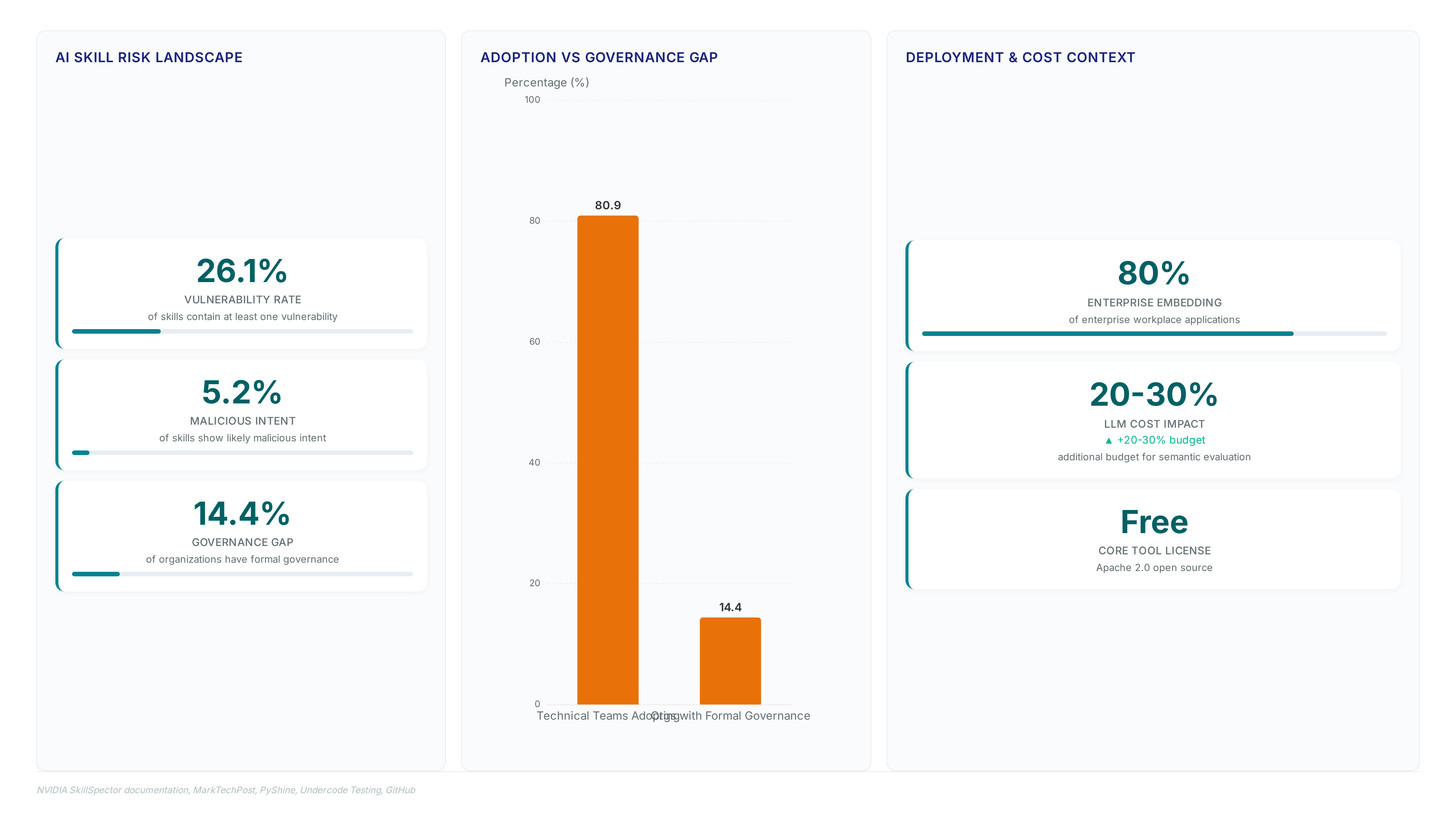
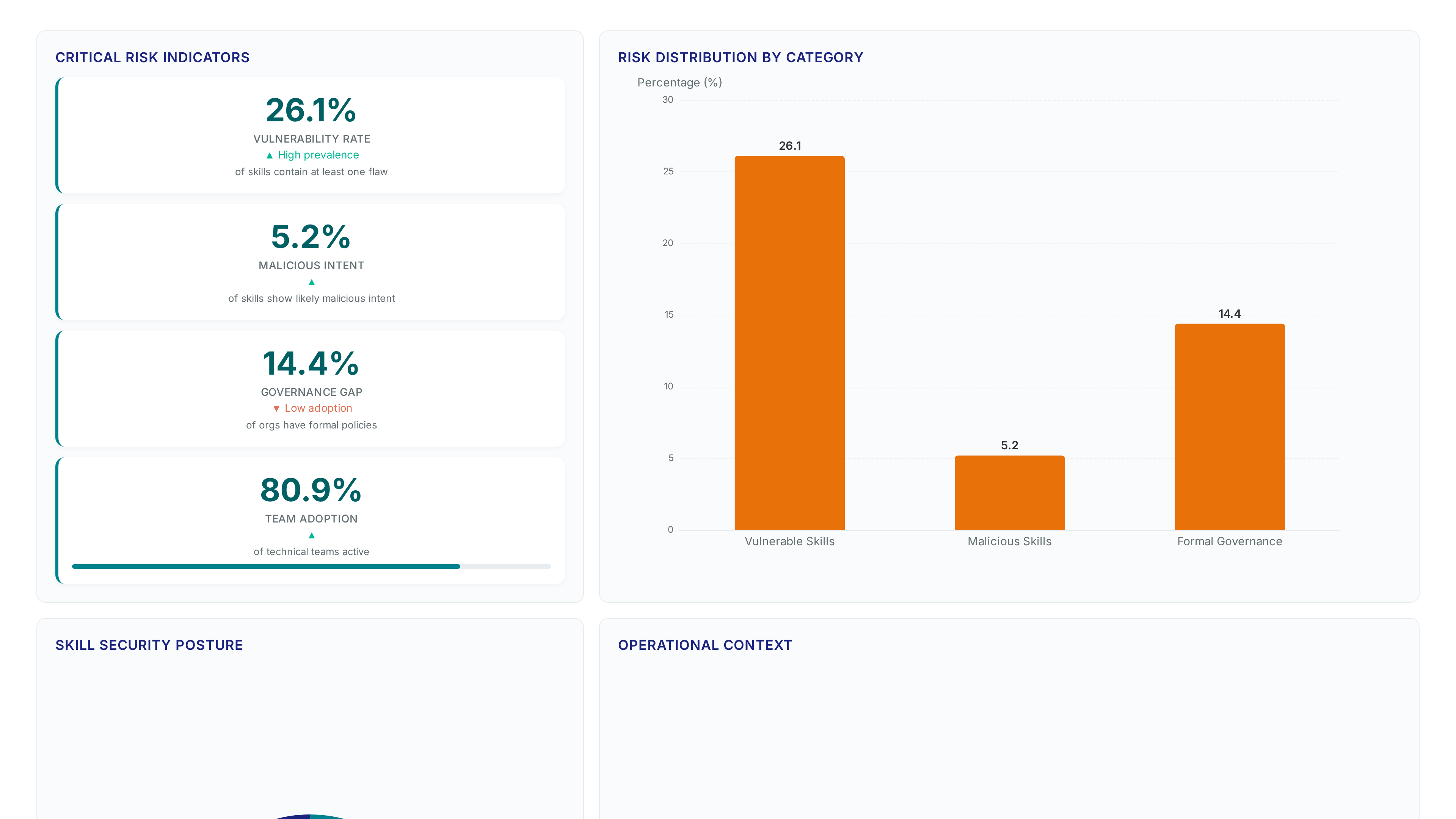
SkillSpector is an open-source static analyzer released by NVIDIA to detect malicious payloads in AI agent skills before installation. Conventional security utilities often overlook context-specific threats targeting frameworks like Claude Code and Codex CLI. Research analyzing 42,447 skills found that 26.1% contain at least one security vulnerability, while 5.2% show patterns of likely malicious intent. General scanners fail here because they lack semantic understanding of agentic behavior. Unlike Semgrep, which focuses on general SAST, this tool covers 64 vulnerability patterns across 16 categories including prompt injection and tool poisoning. The mechanism combines regex-based pattern matching with optional LLM semantic review to filter false positives.
Manual configuration for LLM providers becomes necessary to enable deep analysis, adding operational overhead compared to simple signature checks. This constraint yields higher precision in distinguishing benign automation from data exfiltration attempts. Operators gain a specialized gate that general antivirus solutions cannot provide. Deploying generic code scanners leaves a critical blind spot for AI-specific attack vectors. Organizations must integrate purpose-built analysis to secure the software supply chain for autonomous agents effectively.
Real-World Deployment: Integrating SkillSpector into CI and ClawHub Pipelines
Jacob Bennett identifies the unverified skill installation process as a significant security blind spot suitable for CI gating. Operators deploy SkillSpector within pull request checks to enforce policy before code merges. The tool outputs SARIF reports that integrate natively with GitHub Code Scanning and IDEs. Automation prevents vulnerable patterns from entering the production environment without manual review. Static analysis alone generates noise that requires semantic filtering to remain actionable. Computational overhead presents a drawback; running LLM passes on every commit slows pipeline throughput during high-velocity development cycles.
Registry-level enforcement addresses scale where individual CI checks fragment. OpenClaw collaborated with NVIDIA to embed scanning directly into the ClawHub publishing workflow. Every published artifact now ships with a verified Skill Card documenting its origin and capabilities. Centralization ensures consistent security posture across the system rather than relying on downstream consumers to validate inputs. Dependency on registry cooperation remains a limitation; private repositories or alternative markets lack this enforced gate. Developers building custom extensions must replicate the validation logic locally to achieve similar assurance. Real-world scans of personal MCP tool directories confirm the utility of flagging network-accessible skills that save API keys.
The Hidden Danger of Unaudited AI Skills: Malicious Payloads and Credential Theft
Skipping pre-installation scans exposes agents to credential theft because eight malicious skills remained public on ClawHub after audit findings. A Snyk audit identified 1,467 malicious payloads in a sample of 3,984 skills, confirming that executable scripts pose disproportionate risks. These payloads often function as trojans or cryptominers that steal environment variables during execution. The threat environment expands rapidly as volume surges, yet only 14.4% of organizations have established formal AI supervision protocols. This governance gap leaves most deployments vulnerable to agentic risks where an agent executes hidden instructions without oversight. Executable components are notably more likely to contain vulnerabilities than static configurations, making manual review insufficient for high-velocity environments.
| Risk Factor | Consequence |
|---|---|
| Unaudited Code | Immediate credential exfiltration |
| No Supervision Plan | Undetected lateral movement |
| High Volume | Manual review becomes impossible |
Automated scanning cannot fully replace human judgment regarding business-logic abuse. Operators must balance speed of deployment against the certainty of static analysis results. Relying on unverified skills invites supply chain compromise that traditional perimeter defenses cannot stop. AI Agents News recommends integrating automated gates before any skill receives network access. Ignoring these signals risks total environment compromise rather than simple data loss.
Inside the Dual-Stage Analysis Pipeline of Static and LLM Review
Regex and AST Pattern Matching in Static Analysis
Dangerous calls like exec, eval, and subprocess surface immediately through regex and AST pattern matching before any LLM review begins. The scanner parses source code into an Abstract Syntax Tree to detect structural anomalies that simple string matching misses. This method catches obfuscated payloads hiding within complex function calls. Unlike general tools like Bandit which rely solely on static AST analysis, SkillSpector combines this with regex signatures for known malware patterns. The static stage cross-references dependencies against the OSV.dev database. SkillSpector detects 64 distinct vulnerability patterns across 16 security categories tailored for agentic workflows. The system assigns a risk score from 0 to 100 based on the severity and count of triggered patterns. A score above 50 indicates high risk, suggesting the operator should not install the skill. Static analysis alone cannot distinguish between malicious intent and benign utility in ambiguous code blocks. The drawback is a higher false-positive rate compared to the dual-stage approach, forcing operators to manually triage safe but flagged patterns.
| Feature | Static Only | Static + LLM |
|---|---|---|
| Speed | Milliseconds | Seconds |
| Context | None | Semantic |
| False Positives | High | Low |
Scan latency competes with precision when configuring CI gates. Relying exclusively on regex and AST parsing leaves semantic vulnerabilities undetected until runtime execution occurs.
Configuring Local LLMs via Ollama and vLLM
Local models like llama3.1:8b connect via Ollama at localhost:11434/v1 to bypass API dependencies. This configuration requires setting OPENAI_BASE_URL to the local endpoint while leaving the API key empty. The static pass runs instantly, but enabling the semantic layer introduces latency proportional to model size. Local deployment eliminates external data exposure, yet it demands significant GPU memory resources that vary by model architecture. The optional LLM-based semantic evaluation layer incurs variable token-based costs when using cloud providers, whereas local inference shifts expense to hardware capital.
| Provider Type | Configuration Target | Cost Model |
|---|---|---|
| Local | localhost:11434 |
Hardware overhead |
| Cloud | api.anthropic.com |
Token usage |
| Enterprise | build.nvidia.com |
API subscription |
Adding the flag --no-llm executes only the fast static pass for rapid iteration cycles. This approach suits high-velocity development where immediate feedback outweighs deep semantic validation. Skipping the second stage leaves false positives from regex matching unfiltered, requiring manual triage. Privacy competes with explanation quality. Local models provide context-aware reasoning without transmitting code snippets to third parties, a strict requirement for proprietary skill development. Cloud providers often deliver higher accuracy on novel attack patterns due to broader training corpora. Production environments handling sensitive data should prioritize local vLLM instances to maintain sovereignty over the analysis pipeline. AI Agents News recommends validating the local endpoint connectivity before scaling scans across the CI matrix.
Interpreting Risk Score Bands from 0 to 100
Four explicit bands map scores where 51 to 80 triggers a HIGH severity "do not install" verdict based on detected threat density.
| Score Range | Severity | Action |
|---|---|---|
| 0 to 20 | LOW | Safe |
| 21 to 50 | MEDIUM | Caution |
| 51 to 80 | HIGH | Do Not Install |
| 81 to 100 | CRITICAL | Do Not Install |
Every finding must include the exact file line and a plain-language explanation generated by the LLM layer. This semantic context distinguishes the tool from standard static analyzers like Bandit. High scores often result from taint flows where data moves from sensitive sources to network sinks without sanitization. The prompt includes anti-jailbreak protections preventing malicious skills from manipulating the review process. Reports output in SARIF format enable direct integration with CI pipelines for automated gating. False positives in the static stage require the optional LLM pass to resolve, adding latency to the scan. Teams face noise that obscures genuine credential theft attempts without this second pass. The quantitative score provides immediate triage, but the underlying pattern name determines the specific remediation path.
Deploying SkillSpector via Docker and CI/CD Integration
Installing SkillSpector via Docker and Python Virtual Environments
Cloning the repository starts the process for a Python 3.12+ environment or pulls the official python:3.12-slim-bookworm container image. Developers select local virtual environments using uv or standard venv modules to manage dependencies directly on the host machine. Isolated execution paths bypass host configuration entirely by encapsulating the Apache 2.0 licensed scanner within a reproducible boundary. This isolation prevents host contamination when scanning untrusted code from diverse sources like Git repositories or zip archives.
- Initialize the environment with
git clonefollowed bymake install. - Execute scans against local directories or remote URLs using the CLI.
- Export results as SARIF files for immediate CI/CD pipeline integration.
Containerized methods reduce flexibility for custom LLM provider configuration compared to local installs. Network policies often restrict Docker containers from reaching internal model endpoints like Ollama without complex bridge networking. Local installations offer full network access but require careful management of package versions to prevent breakage. Operational safety conflicts with configuration ease in this scenario. Teams prioritizing strict isolation should adopt the Docker path. Those needing deep integration with internal tooling might prefer the virtual environment route. AI Agents News recommends validating the specific ingress rules for any chosen deployment model.
Executing Scans on GitHub Skills and Local Folders
Static scans run against local directories, single SKILL.md files, or remote Git repositories without requiring a configuration file. The CLI accepts these diverse targets natively and resolves the input type automatically before parsing the abstract syntax tree. This flexibility eliminates manual preprocessing steps often needed when auditing third-party agent capabilities.
- Run
skillspector scanon the localmy-skill/folder for analysis. - Target a specific GitHub skill by passing the repository URL directly to the scanner.
- Generate SARIF output to integrate findings into VS Code or GitHub code scanning dashboards.
JSON formatting supports automation scripts while SARIF enables visual review within integrated development environments. The absence of mandatory config files accelerates deployment but removes granular policy enforcement for team-specific thresholds. External orchestration customizes risk tolerance levels beyond the default bands. AI Agents News highlights that skipping the optional LLM layer via the --no-llm flag reduces accuracy but guarantees zero token costs. This constraint suits high-volume CI pipelines where speed outweighs semantic nuance. Direct mapping of findings to line numbers allows rapid triage. The tool cannot block installation without external policy engines consuming the output.
Embedding the LangGraph Workflow Instead of Shelling Out
Embedding the LangGraph workflow directly returns a risk_score and risk_severity without shell invocation. This approach bypasses CLI latency for high-volume pull request checks where 80.9% of technical teams have moved past the planning phase of AI agent deployment. Unlike Bandit, which cannot perform cross-file taint analysis, SkillSpector traces data flow between components to detect complex credential exfiltration.
- Generate SARIF reports using
--format sariffor native GitHub Code Scanning integration. - Invoke the Python graph object to embed logic within existing orchestration tooling.
- Map output severity bands to CI/CD failure thresholds automatically.
| Feature | SARIF Output | LangGraph Embed |
|---|---|---|
| Latency | File I/O bound | In-memory execution |
| Context | Static snapshot | Flexible state |
| Integration | PR Comments | Runtime gating |
File-based SARIF introduces disk I/O bottlenecks during peak build windows. Direct embedding reduces overhead but requires strict version pinning to prevent schema drift in the evaluation graph.
Operational Risks and Troubleshooting Common Scan Failures
Static Analysis Blind Spots: Encrypted Code and Non-English Content
Static analysis engines fail to inspect encrypted payloads or compiled binaries, leaving opaque code blocks unexamined within agent skills. The scanner cannot execute skills to observe runtime behavior, meaning flexible decryption routines bypass detection entirely. Content embedded inside images remains invisible to text-based pattern matching, creating a vector for hiding malicious instructions in plain sight. Non-English content frequently evades regex-based filters designed for English syntax patterns.
Unlike VirusTotal which relies on known malware signatures, static tools struggle with novel obfuscation techniques that hide intent until execution. The harder gap is intent itself: a pattern matcher flags exec but cannot see an agent tricked into misusing a legitimate tool, so excessive agency, memory poisoning, and tool poisoning slip through code whose syntax is sound. Semgrep focuses on general source code vulnerabilities rather than agent-specific behavior.
Hidden costs of these blind spots include:
- False confidence in scanned skills containing encrypted loaders.
- Undetected prompt injections hidden in non-ASCII characters.
- Missed credential exfiltration logic triggered only by specific runtime states.
- Rogue agent behavior hidden behind valid API calls, including cross-file taint flows where sanitization is bypassed semantically.
Operators must treat a "LOW" risk score as a baseline rather than a guarantee of safety. The tool fills a niche for agentic risk but requires supplemental runtime monitoring for high-value deployments. Relying solely on static analysis leaves networks exposed to sophisticated threats that activate only after installation.
Resolving Missing API Key Errors and Offline OSV.dev Lookup Failures
Missing API keys block semantic analysis, yet local models like llama3.1:8b run via Ollama without external credentials.
Operators configure OPENAI_API_KEY=ollama to bypass paid providers entirely. This setup eliminates token costs while retaining the LLM semantic review layer for context-aware filtering. Relying on remote endpoints introduces latency and potential data exposure risks that local execution avoids. The trade-off is increased local resource consumption for model inference.
Live CVE lookup via OSV.dev demands outbound network access that air-gapped systems cannot support. Offline environments fallback to a smaller built-in list, potentially missing recent vulnerability disclosures. A developer scanning an MCP tool directory confirmed the scanner flags real-world risks like saved API keys even in limited modes. Network isolation forces a choice between immediate scan speed and thorough dependency validation.
Common operational failures include:
- Attempting remote LLM calls without setting provider environment variables.
- Assuming static analysis covers all agentic risks without semantic context.
- Neglecting to update the local OSV database cache regularly.
AI Agents News recommends validating scanner behavior against known malicious samples before production deployment. Static patterns miss fewer vulnerabilities when combined with semantic checks, but only if the model receives clear input. Blindly trusting offline results leaves gaps in supply chain security posture.
About
Marcus Chen serves as Lead Agent Engineer at AI Agents News, where he architects and evaluates production multi-agent systems daily. His direct experience shipping complex workflows using frameworks like CrewAI and LangGraph positions him uniquely to analyze the security implications of AI agent skills. Because Chen routinely integrates third-party capabilities into autonomous agents, he understands the critical risks of installing unverified code from marketplaces without scrutiny. This practical background allows him to assess tools like NVIDIA's SkillSpector not just theoretically, but through the lens of a builder who manages real-world orchestration and tool-use mechanics. At AI Agents News, an independent hub for engineers building with agents, Chen focuses on the technical realities of autonomous systems. His analysis connects the explosive growth of skill repositories to immediate security needs, offering a factual perspective on why scanning specific agent extensions is now necessary for maintaining safe, reliable deployments in rapidly evolving environments.
Conclusion
The useful question is not whether the scanner is perfect but whether anything at all stands between a marketplace and your environment. For most teams today nothing does: skills arrive as executable code and receive the trust normally reserved for a signed release, and the scan that would have caught a cryptominer or a saved API key is simply never run. SkillSpector changes that default from trust to verification, and that is the whole of its value.
Treat its verdict as a floor rather than a certificate. A LOW score means the patterns it knows did not fire, not that an encrypted loader or an instruction hidden inside an image is absent, so pair the gate with runtime monitoring wherever a skill touches credentials or the network. Start this week by putting a scan in front of every install path you own, then decide per pipeline whether the semantic pass earns its latency. The failure worth avoiding is not a noisy report; it is installing a skill nobody read.
Frequently Asked Questions
Research indicates that 26.1% of analyzed AI agent skills contain at least one security vulnerability. This high prevalence makes blind installation dangerous, necessitating tools like SkillSpector to scan for malicious payloads before execution occurs.
Approximately 5.2% of scanned skills demonstrate patterns suggesting likely malicious intent rather than simple errors. These specific threats often involve credential theft or data exfiltration attempts that generic scanners frequently miss entirely.
Only 14.4% of organizations have established formal AI supervision protocols despite rapidly growing volumes. This lack of oversight leaves most enterprises exposed to significant operational risks from unaudited and potentially hostile skill installations.
No, the core scanning tool is free under the Apache 2.0 license without paid requirements. Optional LLM semantic evaluation incurs variable token costs, but basic static analysis functions fully without any API keys or subscriptions.
It targets unique agent threats like prompt injection and tool poisoning across sixteen categories. Generic scanners lack the semantic understanding required to distinguish between benign automation scripts and actual data exfiltration attempts effectively.