Skill standard fixes agent crosstool portability
The Agent Skills standard solves cross-tool portability by defining skills as directories with a mandatory SKILL.md entrypoint. This architecture allows teams to package task-specific knowledge once and deploy it across Claude Code, GitHub Copilot, Cursor, and Gemini CLI without manual adaptation. Without this format, checklists written for one agent remain trapped in tool-specific silos, forcing developers to rewrite logic for every new platform.
You will learn how the SKILL.md file acts as the single source of truth, combining YAML frontmatter with markdown instructions to encapsulate code templates, resources, and verification logic. Finally, the guide details implementing a versioned skill directory to distribute reusable knowledge layers across your entire engineering team.
This approach separates domain knowledge from orchestration logic, ensuring that a writing-rules skill functions identically whether invoked by a local CLI or a cloud agent. By adhering to the structure set at agentskills.io, organizations can build a shared library of capabilities that survives tool migration. The result is a composable system where agents access verified instructions instantly, eliminating the friction of non-Portable configurations.
The Role of the Agent Skills Standard in Cross-Tool Portability
The SKILL.md Entrypoint and YAML Frontmatter Structure
Stop treating prompts as ephemeral chat history. The Agent Skills standard mandates a SKILL.md file as the single entrypoint for any reusable capability package, replacing unstructured engineering with a rigid directory structure. This folder encapsulates four distinct components: instructions, code templates, resources, and verification logic. It creates a portable unit of procedural knowledge that survives platform shifts.
YAML frontmatter within the SKILL.md file provides machine-readable metadata, enabling progressive disclosure in agent workflows. Tools scan the description field to match skills to tasks dynamically instead of loading full instruction bodies into the context window immediately. This approach shifts the industry toward modular frameworks where metadata pays the context cost only until activation occurs.
| Component | Function |
|---|---|
SKILL.md |
Entrypoint containing metadata and instructions |
templates/ |
Static assets and code scaffolding |
examples/ |
Few-shot demonstrations for the model |
Beware the temptation to extend the standard with non-portable frontmatter fields. Specific behaviors vanish when moving between Claude Code and GitHub Copilot. While the open standard enables sharing via repositories like github/awesome-copilot, builders must audit YAML keys to ensure cross-tool compatibility. Performance gains from tool-specific extensions directly conflict with the goal of maintaining strict portability across the system.
Achieving Cross-Tool Portability with Standardized Skill Paths
Skill knowledge embedded in proprietary formats prevents Claude Code checklists from running on GitHub Copilot without manual rewrite. Enforcing fixed discovery paths like .claude/skills/ and .github/skills/ resolves this failure mode. Tools scan these locations for the mandatory SKILL.md entrypoint. This architecture enables a "store once" model where utilities like one-skills-manager symlink a single definition to serve four distinct agent environments simultaneously. Teams avoid maintaining duplicate procedural logic across Claude Code, Cursor, Windsurf, and Codex.
| Configuration | Portability Status | Maintenance Overhead |
|---|---|---|
| Standardized Paths | High | Low |
| Tool-Specific Formats | None | High |
Adopting this directory structure incurs unnecessary overhead for single-tool projects where a simple markdown file suffices for local execution. Tool vendors extend the standard with non-portable frontmatter fields that silently degrade functionality when moved between ecosystems. A skill relying on vendor-specific flags loses those behaviors when loaded by a different agent. Builders face a hidden compatibility layer they must audit.
Ad-Hoc Prompting Versus the Progressive Disclosure of Agent Skills
Ad-hoc prompting traps procedural knowledge in ephemeral chat history. The Agent Skills standard enforces progressive disclosure to optimize context usage.
| Feature | Ad-Hoc Prompting | Agent Skills Standard |
|---|---|---|
| Knowledge Location | Ephemeral chat history | Portable SKILL.md files |
| Context Loading | Full repetition required | Metadata-first matching |
| Portability | Tool-specific rewrites | Cross-platform compatible |
| Maintenance | Manual repetition | Centralized updates |
Memory and scattered notes fail when scaling across teams. The standard enables packaging procedural knowledge that previously resided exclusively in a senior engineer's head into portable files. A tool matches a skill to a task by comparing the description field against current context without loading the full instruction body. This metadata-first approach reduces token waste notably compared to repetitive prompting. Organizations using tools like one-skills-manager adopt patterns where a single definition serves multiple environments, eliminating redundant writing. Rapidly changing instructions suffer under the versioning overhead required for SKILL.md assets. Teams must weigh the benefit of portability against the friction of formalizing fluid workflows.
Inside the SKILL.md Architecture and Discovery Mechanics
Mechanics: SKILL.md Folder Structure and Mandatory Frontmatter Fields
A valid skill exists only as a directory containing a mandatory SKILL.md entrypoint file. This folder-based structure serves as the primary interface for model execution, separating domain knowledge from tool logic. A typical deployment places this package within a skills/ root, organizing specific capabilities like writing-rules/ alongside templates/ and examples/ subdirectories. The SKILL.md frontmatter defines metadata, name, description, and version, that agents parse to match skills to tasks. An example of this frontmatter includes:
name: writing-rulesdescription: "Style, tone, and structure standards for content pages"version: 1.0.0
Unlike unstructured prompt engineering, this format standardization enables machines to discover capabilities without loading full instruction bodies. Tools scan fixed paths such as .github/skills/ or ~/.claude/skills/ to locate these assets.
Agent definitions reference these skills by name, while the skills themselves remain agnostic to the executing engine. When a contributor runs /draft-content, the agent definition for content-writer references writing-rules and the tool discovers .github/skills/writing-rules/SKILL.md. Maintaining this separation allows organizations to version control knowledge independently of their orchestration layer.
Precedence Rules for Project, User, and Plugin Skill Discovery
Skill resolution follows a rigid hierarchy where project-local definitions in .claude/skills/ or .github/skills/ strictly override user-level configurations found in ~/.claude/skills/, which in turn supersede bundled plugin skills. This cascade ensures team-mandated constraints cannot be bypassed by individual developer preferences stored locally. Agents execute a flexible discovery protocol at runtime, scanning these specific paths sequentially to build a merged registry before loading any SKILL.md entrypoint.
| Scope | Path Location | Persistence | Priority |
|---|---|---|---|
| Project | .github/skills/ |
Git Commit | Highest |
| User | ~/.claude/skills/ |
Local Filesystem | Medium |
| Plugin | Bundle Internal | Installation | Lowest |
When a task context matches a skill's metadata, the agent retrieves the file from the highest-precedence source and ignores lower-priority duplicates with the same name. This mechanism allows engineers to fork a default plugin behavior simply by recreating the directory structure in the project root. Teams sharing skills across diverse environments often apply symlink architecture to maintain a single source of truth while satisfying different path requirements for tools like Claude Code or Cursor.
Validating YAML Metadata and Agent Scope Matching
Correct YAML frontmatter prevents loading failures when agents match tasks to skill definitions. Tools parse the name, description, and version fields to determine if a specific capability applies to the current context.
| Field | Type | Function |
|---|---|---|
| name | String | Unique identifier for scope matching |
| description | String | Semantic target for task alignment |
| version | String | Tracks iteration and compatibility |
Unlike tool-specific frontmatter extensions that embed execution logic, this standard isolates procedural knowledge for portability across environments. Organizations using symlink architecture can store a single definition and serve it to multiple distinct agent environments simultaneously. Relying on tool-specific frontmatter extensions creates a risk where the skill loads but loses critical behavior when moved to a different host. The standard relies on plain Markdown files and folder structures, eliminating the need for specialized binary compilers.
Implementing a Versioned Skill Directory for Team Distribution
Defining the Four-Component Skill Package Architecture
Four distinct technical elements form a valid skill package: instructions, code templates, resources, and verification logic. Simple prompt templates lack this depth. The instructions component delivers core logic, whereas code templates supply reusable snippets for consistent output generation. Resources bundle necessary contextual data so the agent respects domain constraints. Verification logic allows the system to self-audit outputs, a capability missing from basic few-shot examples.
This architecture turns ephemeral prompts into versioned assets. A single skill package encapsulates these components within a folder structure requiring a mandatory file named SKILL.md to function as a reusable package.
- Create a
SKILL.mdfile containing YAML frontmatter and logic. - Populate
templates/with standard code blocks. - Add static
resources/for reference data. - Define checks in the verification module.
Non-portable frontmatter extensions break cross-tool compatibility because the standard remains tool-agnostic and confirmed only for tools publishing implementation documentation. This structure guarantees verification logic travels with the skill, preventing agents from executing unverified procedures. Strict adherence to these four components maintains interoperability across the system. Organizations maintain "skill registries" instead of rewriting instructions for every new project.
Implementing the writing-rules Skill for Content Teams
Create the .github/skills/writing-rules/ directory to establish a version-controlled location for team style guidelines. Tools discover skills from project locations like .github/skills/ or .claude/skills/, which are committed to the repo and shared with all contributors.
- Generate a
SKILL.mdfile containing YAML frontmatter withname,description, andversion. - Define audience constraints explicitly, instructing the model to skip introductory definitions and assume working knowledge.
- Encode structural mandates, such as requiring every page to open with a
>blockquote that defines the concept. - Enforce tone rules by listing "Active voice" and "No hedging" as non-negotiable execution parameters.
When a contributor executes /draft-content, the agent resolves the dependency and applies these constraints dynamically. Style compliance shifts from human reviewers to the generation layer. Redundant instruction writing drops to near-zero for repeated workflows. Portability introduces friction: teams must maintain strict schema adherence since tool-specific frontmatter extensions break cross-platform compatibility. Builders treat these files as interface contracts rather than loose suggestions to maintain consistency across the development environment.
Checklist for Validating SKILL.md Metadata and Discovery Paths
Validate the mandatory SKILL.md entrypoint to confirm the directory functions as a reusable package for agent discovery. This file acts as the primary interface between human intent and model execution, requiring strict adherence to the standard folder structure.
- Verify the presence of
SKILL.mdat the root of the skill folder, as tools cannot load incomplete definitions without this specific filename. - Inspect YAML frontmatter for
name,description, andversionfields to ensure metadata matches team distribution requirements. - Confirm the tool scans correct precedence paths like
.claude/skills/or.github/skills/before falling back to user-level configurations.
| Validation Target | Required Format | Failure Consequence |
|---|---|---|
| Entrypoint File | SKILL.md |
Agent ignores directory |
| Metadata Version | Semantic (e.g. 1.0.0) | Inconsistent version tracking |
| Discovery Path | .github/skills/ |
Skill not discovered in project |
Version control integration allows organizations to use existing Git infrastructure rather than purchasing dedicated skill-management software. Packaging specialized knowledge into portable folders reduces the recurring cost of re-explaining workflows for every new project or agent instance.
Strategic Trade-offs in Standardizing Agent Knowledge
Distinguishing Skills from Agent Definitions and Commands
Strict separation defines the architecture. Skills carry domain knowledge, Agent definitions hold identity, and Commands manage orchestration. This division stops conceptual confusion when teams scale across multiple AI coding tools. Skills function as the only reusable knowledge layer. Agents and commands remain specific to execution contexts.
Teams should standardize skills only when knowledge must cross tool boundaries or team silos. Plain markdown files introduce less overhead in single-tool environments. A tension exists between portability and tool-specific extensions. Relying on non-portable frontmatter fields causes skills to lose functionality when moved between implementations like Claude Code and VS Code. Automated creation of skill files via features like the /learn command accelerates adoption. This process risks propagating unverified workflows if audits are skipped. Operators must treat shared skills as third-party dependencies. Verification ensures the SKILL.md entry point contains only safe, portable instructions. Updates to domain knowledge proceed without rewriting orchestration logic or redefining agent identities.
Applying the Standard to Multi-Tool Team Workflows
Procedural knowledge drives the decision to standardize SKILL.md assets across distinct execution environments like Claude Code and Cursor. Centralizing definitions allows organizations to symlink a single source directory to multiple agent runtimes. This approach eliminates the labor of maintaining divergent copies for each tool. Local prompts change into shareable community resources. The github/awesome-copilot repository hosts cross-platform skill sets as proof of this pattern.
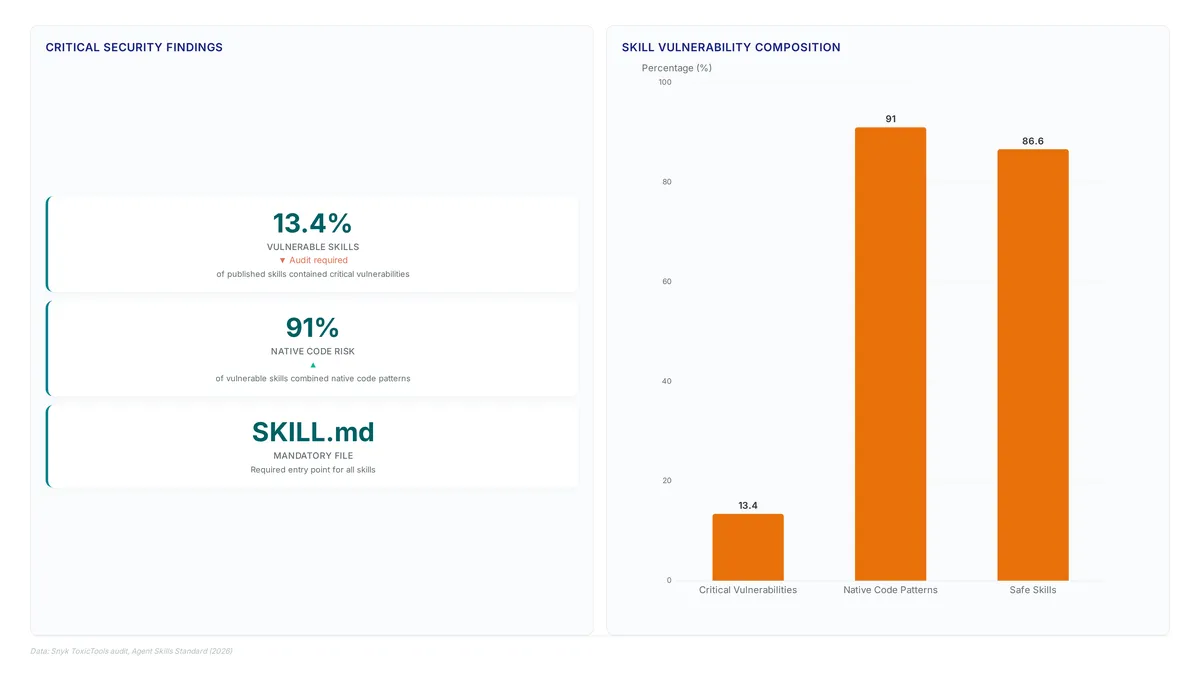
Portability introduces a severe supply-chain risk where malicious payloads execute wherever the standard is implemented. Snyk's ToxicTools audit revealed that 13.4% of published skills contained critical vulnerabilities, with 91% of those combining native code patterns and prompt injection. Community skills require treatment as untrusted third-party dependencies. Strict pinning and review become mandatory before adoption. Operational tension lies between rapid iteration and security governance. Automated capture tools like the Hermes Agent /learn command accelerate creation. These same tools widen the attack surface if ingestion sources are not sanitized. AI Agents News recommends isolating skill execution contexts to prevent credential theft during cross-tool orchestration. Standardization yields value only when the cost of duplication exceeds the overhead of securing shared assets.
Risks of Standardizing Single-Tool and Rapidly Changing Projects
Unused overhead appears when adopting the Agent Skills standard for single-tool projects. The portability guarantee provides no utility in these cases. A solitary developer operating within one environment faces unnecessary friction from the rigid SKILL.md directory structure. A flat CLAUDE.md file offers quicker iteration. The architectural requirement to maintain specific folders and YAML frontmatter slows progress notably when guidance evolves daily.
Tools like one-skills-manager enable symlinking skills across Claude Code, Cursor, Windsurf, and Codex. This cross-agent flexibility remains irrelevant for isolated workflows. The core architecture mandates a folder-based structure with a required SKILL.md entrypoint. This treats the skill as a portable unit rather than a transient note. Teams facing rapid conceptual shifts find that versioning these assets as directories impedes the speed of ad-hoc prompting. Structural consistency benefits multi-tool teams but penalizes solo practitioners needing immediate flexibility. Builders should reserve the standard for scenarios where knowledge must cross tool boundaries or team members. The formalism of the open standard acts as a drag on velocity for fast-moving, single-context tasks. AI Agents News recommends evaluating the frequency of tool switching before committing to the directory-based workflow.
About
Marcus Chen, Lead Agent Engineer at AI Agents News, brings direct engineering rigor to the analysis of the SKILL.md open standard. Having shipped production multi-agent systems and evaluated orchestration frameworks like CrewAI and LangGraph release-by-release, Chen understands the critical friction of siloed task knowledge. His daily work involves dissecting how tools handle function calling and context, making him uniquely qualified to assess why a portable, tool-agnostic format matters for builders. At AI Agents News, an independent hub for technical leaders, Chen focuses on concrete capabilities over marketing hype. He connects the SKILL.md specification, currently implemented by Claude Code and GitHub Copilot, to real-world engineering needs, explaining how standardized SKILL.md folders enable smooth knowledge sharing across diverse AI coding environments. This perspective ensures the analysis remains grounded in practical utility for engineers evaluating agent interoperability.
Conclusion
Operational risk escalates when teams treat the SKILL.md format as a universal default rather than a specialized boundary for cross-tool orchestration. While modular frameworks promise standardized interfaces, applying this rigid directory structure to single-tool projects introduces unnecessary friction that slows iteration. The real cost emerges when developers maintain complex folder hierarchies and YAML frontmatter for workflows that never leave their local environment. This structural overhead actively penalizes velocity in rapidly changing contexts where a flat configuration file suffices. Teams must recognize that portability offers zero value if the asset never crosses agent boundaries.
Adopt the standard strictly when skills require execution across multiple agents or team members, but reject it for isolated, fast-moving prototypes. You should enforce this distinction before your repository accumulates unused structural debt. Start by auditing your current project folders this week to identify any solitary skills wrapped in full SKILL.md scaffolding and flatten them to simple text files if they lack cross-agent requirements. This immediate reduction in complexity restores focus to actual workflow logic rather than directory compliance. Balancing the structure against practical speed ensures your agent architecture scales without collapsing under its own weight.
Frequently Asked Questions
Critical vulnerabilities appear in 13.4% of published skills according to audits. Teams must verify code patterns because 91% of these flaws combine native code execution with unsafe practices.
It eliminates manual rewrites by using a single SKILL.md file for multiple platforms. This approach stops the cross-tool breakage seen when native code patterns conflict across different agent environments.
Non-portable fields cause features to vanish when moving between tools like Claude Code. This creates hidden compatibility layers that require auditing to prevent the 13.4% critical vulnerability risk in shared packages.
Store skills in .github/skills/ or .claude/skills/ directories for automatic discovery.
No, skills provide domain knowledge while agent definitions handle identity and orchestration logic.