Agent skills catalog: 18k tools from 307 repos
Aggregating 18,142 skills from 307 repositories solves the immediate crisis of AI agent fragmentation.
The proliferation of disjointed frameworks forces developers to constantly rebuild identical tools, creating a chaotic Wild West environment that stifles innovation. Kingdom-based workflows organize these capabilities into functional domains: Gondor for web tasks, Moria for infrastructure.
Without a unified standard, organizations face compounding technical debt as they attempt to integrate disparate systems. The Lord of the Skills project shows how a centralized catalog enables cross-framework discovery, mapping 1,630 orchestration skills and 10,141 UI interactions into one coherent system. This approach moves the industry beyond reinventing the wheel for every new tool like Cursor or Cline. Adopting these shared resources allows teams to focus on complex AI agent skill integration rather than basic utility creation.
The Role of Canonical Skills in Solving Agent Fragmentation
Defining Canonical Skills Against Wild West Fragmentation
Frameworks like Claude Code and AutoGen spawn incompatible tool definitions daily, turning the current AI agent system into a "Wild West." Developers constantly reinvent identical functions because existing implementations remain siloed within specific repository formats. The Lord of the Skills resolves this fragmentation by aggregating 18,142 skills from 307 repositories into one searchable directory. This consolidation enables cross-framework discovery previously impossible when capabilities were buried in obscure Gists or massive monorepos.
Within this aggregated volume, the project identifies 357 Canonical Skills representing gold-standard versions of common tools. Engineers no longer need to evaluate fifty variations of a single search function; they select the deduplicated canonical entry to ensure consistency. This curation transforms raw code snippets into reliable agent capabilities that function across different orchestration layers.
| Metric | Count |
|---|---|
| Total Aggregated Skills | 18,142 |
| Source Repositories | 307 |
| Canonical Standards | 357 |
Noise plagues the 18,000+ items, but the project performs the hard work of deduplication and curation to address it. For production teams, adopting these standardized skills eliminates redundant development time compared to writing wrappers from scratch.
Navigating LOTR Kingdoms Like Gondor and Moria for Skill Discovery
The LOTR-themed kingdoms structure the 18,142 aggregated skills into 10 functional domains, replacing inefficient keyword guessing with a logical mental model for capability discovery.
Engineers locate precise browser automation tools within Gondor, which houses 10,141 skills dedicated to Web & UI tasks including React and Vue frameworks. Infrastructure requirements route directly to Moria, containing 914 specialized capabilities for DevOps operations like terminal management and Terraform orchestration. This separation mirrors the architectural distinction between stateful application logic and underlying cloud infrastructure found in frameworks like LangGraph.
| Kingdom | Domain Focus | Skill Count | Primary Use Cases |
|---|---|---|---|
| Gondor | Web & UI | 10,141 | Browser automation, frontend frameworks |
| Moria | DevOps | 914 | Terraform, AWS, kernel debugging |
| Isengard | Orchestration | 1,630 | Multi-agent design, state machines |
Adopt canonical skills to bypass the noise of reinvented wheel-spinning common in the current agent environment. Operational teams gain rapid deployment velocity by browsing specific kingdoms like Moria for cloud tools and Mordor for security scripts, then dropping the Canonical versions into their framework of choice.
Raw Implementations Versus 357 Gold Standard Canonical Versions
Raw tool implementations reside in obscure Gists, whereas the project curates exactly 357 Canonical Skills as gold standards. Developers previously wasted cycles reinventing wheels for specific frameworks while functional code hid in monorepo subdirectories. The Lord of the Skills initiative resolves this noise by distinguishing between thousands of raw variants and a single, verified gold standard.
| Feature | Raw Implementations | Canonical Skills |
|---|---|---|
| Source Location | Obscure Gists, deep subdirectories | Curated central directory |
| Verification | Unverified, framework-specific | Audited gold standard |
| Selection Logic | Review 50+ variations | Select single version |
| Deployment Risk | High (formatting errors) | Low (deduplicated) |
Instead of reviewing 50 different Google Search variations across repos, engineers should select the one Canonical Skill. The result is a simplified workflow where users avoid spending excessive time writing AWS and security tool wrappers from scratch, using the curated catalog to equip agents with specialized skills quickly.
Inside the Deduplication Engine and Framework Integration Mechanics
Deduplication Logic Mapping 307 Repos to Canonical Skills
Gathering skills at this scale generates immediate redundancy unless strict filtering logic intervenes. Claude Code contributes 8,104 entries while Cline / Roo adds 2,200+, often defining identical capabilities with divergent syntax. This fragmentation forces developers to rewrite wrappers for the same underlying API across different agent frameworks.
| Input State | Deduplication Action | Output State |
|---|---|---|
| 50+ "Google Search" variants | Select gold-standard implementation | 1 Canonical Skill |
| 18,142 raw entries | Filter by functional equivalence | 357 curated tools |
| Framework-specific configs | Normalize to SKILL.md spec | Interoperable Markdown |
The mechanism identifies functional duplicates rather than simple string matches, prioritizing the strongest implementation as the Canonical Skill. A single "gold standard" version exists for every capability, yet this assumption falters for niche or rapidly evolving APIs where multiple experimental approaches hold validity. Teams relying solely on the curated set might miss novel integration patterns found in the broader dataset. Organizations must balance the speed of deploying verified tools against the need to experiment with emerging framework-specific features found in the uncurated Long Tail. Reduction to one canonical item per capability notably lowers cognitive load but centralizes dependency risk on the maintainers' selection criteria. Developers gain immediate interoperability but lose the granularity of framework-optimized code paths.
Searching 18k Skills Across 14 Frameworks Including Claude Code
Engineers locate specific tool implementations by filtering the directory's 14 supported environments rather than parsing raw repository trees. The collection indexes 8,104 skills for Claude Code, alongside 2,200+ entries for Cline / Roo and 1,400+ for Cursor. Newer additions include 820 skills for Google Antigravity, 600+ for Aider, and 400+ for OpenHands. This structure allows operators to bypass framework fragmentation when equipping agents with verified capabilities.
| Framework | Skill Count | Primary Use Case |
|---|---|---|
| Claude Code | 8,104 | Anthropic-native production agents |
| Cline / Roo | 2,200+ | VS Code integrated workflows |
| Cursor | 1,400+ | Editor-centric code generation |
| Google Antigravity | 820 | Experimental Google system tools |
| Aider | 600+ | CLI-based code editing |
Users navigate via LOTR-themed kingdoms to find functional equivalents across these distinct syntaxes without manual deduplication. Relying on the full 18,000-item index introduces noise that slows production deployment cycles. The directory mitigates this by surfacing 357 Canonical Skills as the default view for common operations like search or database access. Curation prevents teams from integrating divergent wrappers for identical APIs, a frequent failure mode in multi-agent orchestration. Operators should prioritize these gold-standard versions to maintain consistency across heterogeneous agent fleets.
Local-First Agents Versus Massive Cloud-Based Swarm Architectures
Local-first agents require tight filesystem integration, whereas massive cloud-based swarms demand stateless orchestration logic. The directory supports both models by normalizing these skills into a unified registry, preventing developers from rewriting wrappers for identical capabilities. Fragmentation currently forces engineers to maintain divergent syntax for the same API across different agent frameworks.
| Deployment Model | Primary Constraint | Directory Solution |
|---|---|---|
| Local-First | Filesystem access latency | Direct tool binding |
| Cloud Swarm | Network coordination overhead | Standardized interfaces |
This architectural split means a single tool definition cannot serve all environments without abstraction layers. The repository addresses this by categorizing skills into functional kingdoms, allowing builders to filter by deployment constraint rather than framework brand. A security auditor running locally needs direct terminal access, while a cloud swarm requires HTTP-compatible endpoints. Ignoring this distinction leads to runtime failures where local tools attempt unauthorized network calls or cloud agents lack persistent memory. Selection depends entirely on whether the workload prioritizes low-latency resource access or distributed coordination. Builders must match the skill interface to the execution environment to avoid costly refactoring later.
Operationalizing Agent Skills Through Kingdom-Based Workflows
Defining the Canonical Skill Integration Workflow
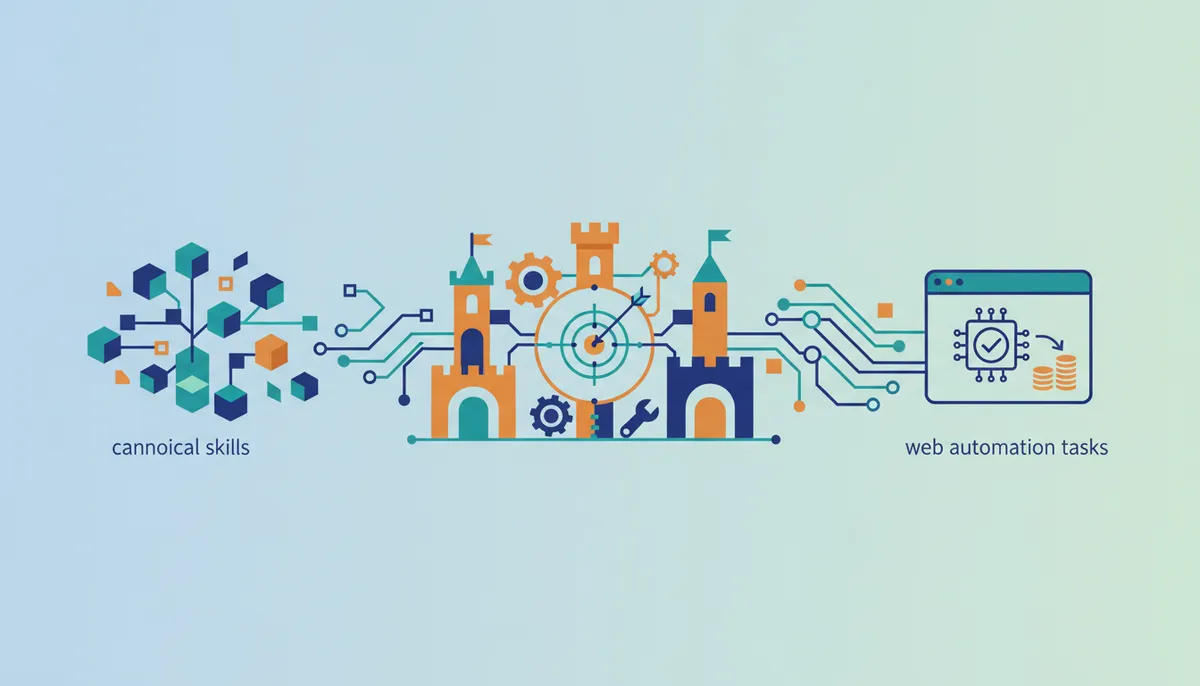
Spotting a production bottleneck starts by browsing the Moria kingdom for infrastructure tools or Gondor for web interfaces. Developers often waste two weeks writing custom AWS wrappers when pre-integrated versions exist within the aggregated 18,000+ tool repository. The workflow requires locating one of the 357 Canonical versions assigned as gold standard implementations to bypass redundant coding efforts. Teams select their target environment from 14 supported frameworks, noting that LangChain offers flexibility while CrewAI specializes in team-based orchestration. Dropping these deduplicated skills directly into the chosen framework eliminates the fragmentation plaguing the current agent environment.
Deploying Gondor Web Automation and Moria Infrastructure Agents
Developers bypass writing custom wrappers by selecting pre-integrated tools from the Gondor kingdom for React tasks or Moria for AWS infrastructure.
The Gondor catalog contains 10,141 skills covering browser automation and UI interaction, allowing immediate deployment of frontend agents without defining low-level selectors. Teams building dashboard monitors use these existing modules to parse DOM elements rather than engineering fresh extraction logic. Relying on shared community scripts introduces version drift risks if the underlying website structure changes unexpectedly. Operators must pin specific skill versions to maintain stability across production environments.
For infrastructure, the Moria kingdom offers 914 skills for Terraform management and cloud orchestration. A developer constructing a security auditor avoids spending two weeks coding AWS wrappers from scratch by dropping canonical cloud tools directly into their chosen framework. This approach accelerates time-to-value notably, potentially saving 10 days of development time on specialized agents. The limitation remains the necessity of validating that imported scripts adhere to internal compliance policies before execution.
Selecting the correct framework integration remains a key architectural decision. The directory supports 14 environments, yet developers often find that educational frameworks prioritize transparency over the raw throughput required for heavy batch processing.
Centralizing these assets eliminates redundant engineering effort but shifts the operational burden toward rigorous skill verification. AI Agents News recommends treating the Canonical designation as a starting point for auditing rather than a guarantee of safety.
Validating Framework Compatibility Across 14 Agent Ecosystems
Select a target runtime before importing canonical skills to avoid syntax errors during execution. The directory indexes 8,104 skills for Claude Code, 1,400+ for Cursor, and 2,200+ for Cline, requiring distinct validation paths for each. Operators must verify that selected tools match the specific function-calling signature of their chosen orchestration layer.
| Framework | Skill Count | Validation Focus |
|---|---|---|
| Claude Code | 8,104 | Tool definition schema |
| Cursor | 1,400+ | Context window limits |
| Cline / Roo | 2,200+ | File system permissions |
Deployments targeting local-first agents face different constraint profiles than massive cloud-based swarms, particularly regarding latency and token budgets. Framework mismatches frequently cause silent failures in multi-step workflows. Relying on a single framework limits access to the full 18,000+ skill repository, forcing a trade-off between system lock-in and tool diversity. Builders must explicitly map LOTR-themed Kingdoms like Moria or Gondor to their agent's native tool format rather than assuming universal compatibility. This manual mapping step ensures that function calling parameters align with the host environment's expectations. AI Agents News recommends testing skill execution in a sandbox before integrating into production pipelines.
Contributing to the Community-Driven Skill System
Defining the Community-Driven Contribution Model
This initiative resolves duplication across a fragmented agent system by relying on a fellowship of developers rather than functioning as a static library. Major AI labs now ship distinct agent SDKs, creating significant interoperability challenges that a decentralized approach addresses directly. New participants enter the workflow through good first issues, which lower the barrier for validating skill metadata or testing framework wrappers. These tasks allow Python experts and prompt engineers to engage with the Canonical Skills identified as the gold standard versions of common tools.
Every submission passes through the same deduplication and curation the catalog was built on. This constraint prevents the re-emergence of the very silos the project aims to eliminate. Prioritizing these validated contributions ensures long-term directory stability.
Submitting Canonical Skills via GitHub Issues
Engineers initiate skill ingestion by filing a structured GitHub Issue to report missing capabilities or flag duplicates within the entry directory. This workflow prevents the fragmented market from expanding further through uncoordinated tool definitions.
- Navigate to the repository and locate an open good first issues ticket or create a new proposal using the canonical template.
- Provide the source URL, target framework, and a justification for why this skill lacks representation in the current canonical set.
Maintaining a single source of truth across divergent framework syntaxes requires careful coordination. While speed of submission is tempting, rigorous validation ensures the Lord of the Rings themed kingdoms remain navigable rather than becoming noisy archives. The repository currently highlights specific entry points for Python experts and prompt engineers to join the fellowship without overwhelming the review queue.
| Step | Action | Verification Goal |
|---|---|---|
| 1 | File Issue | Confirm absence of existing skill |
| 2 | Submit Draft | Validate syntax against framework spec |
| 3 | Review | Check for functional redundancy |
This process enforces a gatekeeping mechanism where the Canonical Skills serve as the definitive reference for common tools. Without this friction, the catalog would degrade into the same disorganized state as the individual repositories it aggregates.
Validating New Entries Against the Curated Catalog
This collection serves as the central library for the agentic era, preventing the resource from regressing into a disorganized link dump. Contributors should execute the following validation sequence:
- Search the repository to confirm the skill does not already exist under a different name.
- Map the tool to one of the ten LOTR-themed kingdoms based on functional utility.
- Use the directory's structure to enable cross-framework discovery.
Adding links without checking the canonical set creates maintenance debt for the fellowship of maintainers. Rapid system growth conflicts with the strict curation required for production reliability. Operators who skip this verification cause the directory to lose its value as a trusted reference. Treating the catalog as a codebase instead of a bulletin board maintains its continued utility.
About
Priya Nair serves as AI Industry Editor at AI Agents News, where she tracks the rapidly evolving environment of autonomous coding platforms and framework ecosystems. Her daily work involves verifying product launches and analyzing market fragmentation across tools like Claude Code, AutoGen, and OpenHands. This specific article addressing the "Wild West" of disjointed AI agent skills directly stems from her continuous monitoring of how developers unnecessarily silo resources across competing repositories. By documenting 18,000 skills across 14 frameworks, Nair uses her deep familiarity with vendor-specific tooling definitions to highlight critical interoperability gaps. Her role requires distinguishing genuine technical progress from marketing hype, ensuring that the analysis of these fragmented skill sets remains grounded in factual utility for engineers. Through AI Agents News, she provides the technical community with the neutral, verified insights needed to navigate this complex environment without reinventing the wheel.
Conclusion
Scaling this catalog reveals that manual curation cannot sustain quality as the system fractures beyond the current "big three" frameworks. The operational cost of validating submissions will skyrocket if the community treats the repository as a simple bulletin board rather than a strict codebase. As every major lab ships proprietary SDKs by 2027, the friction of verification becomes the only barrier preventing total informational decay. You must prioritize strict adherence to the three-step validation sequence over the speed of new entries. Treat the absence of a skill in the canonical set as a hypothesis to test, not an invitation to dump unverified code. This discipline preserves the potential to save ten days of development time for downstream users who rely on these vetted integrations.
Start by auditing your intended contribution against the existing canonical entries before drafting any new syntax or documentation. Map your tool to one of the ten functional kingdoms only after confirming no functional redundancy exists within the current fellowship of maintainers. This immediate check prevents the accumulation of maintenance debt that plagues rapidly expanding open-source projects.
Frequently Asked Questions
Teams can save approximately 10 days of development time on specialized agents. This efficiency comes from avoiding the need to rewrite wrappers for over 18,142 existing ai agent skills.
Fragmentation forces developers to constantly rebuild identical tools, creating significant technical debt. With over 307 repositories currently siloed, organizations waste resources reinventing wheels instead of integrating verified AI agent skill sets.
Kingdoms organize 18,142 skills into 10 functional domains, replacing inefficient keyword guessing. Gondor holds the 10,141 Web and UI skills while Moria holds 914 DevOps entries, so engineers browse one domain instead of the whole index.
Canonical Skills represent gold-standard versions that eliminate the noise of fifty variations for one function. Raw variants sit in obscure Gists and deep subdirectories, while the canonical entry is deduplicated and audited before it enters the catalog.
Yes, the project aggregates skills from 14 frameworks including AutoGen and Claude Code. This cross-framework discovery allows users to apply 18,142 consolidated tools regardless of their specific orchestration layer.
References