Research agent data beats manual sales digging
Outreach reports its predictive AI achieves 81 percent accuracy in deal predictions and revenue forecasting. That number sets the bar for automated sales research. Manual data gathering is dead. The modern research agent does more than collect links; it synthesizes internal engagements and public sources into immediate strategic advantages.
Sales teams now deploy custom signals to detect specific triggers like funding rounds or executive moves without human intervention. Instead of wasting hours on preliminary digging, representatives access actionable insights saved directly to account fields for instant use in AI-personalized messaging. This shift allows organizations to focus entirely on engagement quality rather than data volume.
The gain is concrete: transparent, sourced intelligence on demand instead of guessing which accounts are ready to buy. The cost sits in the same place. Signal volume overwhelms rep attention unless triggers stay scoped to the ideal customer profile, external triggers still need internal validation, and research integrity has to survive evolving web structures and internal schema changes. That calibration is the work automated research moves a team toward, not away from.
The Role of AI Research Agents in Modern Sales Infrastructure
Outreach AI Research Agent Definition and Targeting Signals
Manual prospect preparation burns selling time you never get back. The Outreach AI Research Agent removes this friction by synthesizing internal transcripts and external web data into actionable account intelligence. It extracts targeting signals from Kaia call summaries, emails, and public news to drive precise account strategy without human aggregation. By consolidating these disparate inputs, the system eliminates the latency typical of manual research.
Standalone research tools force representatives to manually transfer findings between platforms. This agent skips that step, populating account fields for immediate use in filters and workflows. Personalization evolves here from simple variable insertion to deep, research-grounded context referencing specific financial priorities and tech stacks. Sellers re-engage stalled opportunities by automatically surfacing updated intelligence on funding rounds or executive moves.
| Feature | Manual Research | AI Research Agent |
|---|---|---|
| Data Synthesis | Siloed tabs | Unified internal/external view |
| Workflow Integration | Copy-paste required | Native field population |
| Signal Detection | Reactive | Automated trigger |
Users configure prompts to surface exact insights needed or apply pre-built templates, enabling customization by use case, persona, or Go-To-Market (GTM) motion. Building custom signals indicates when an account is ready to engage, allowing representatives to skip unnecessary details and focus on priority matters. This configuration ensures the Research Agent prioritizes signals aligned with their ideal customer profile and sales motion.
Scaling Sales Personalization with Real-Time Account Intel
Generating executive summaries and meeting briefs instantly enables true personalization at scale. Outreach's predictive AI delivers 81 percent accuracy in deal predictions and revenue forecasting.
Surfacing timely, relevant insights tailored to each persona helps representatives craft messages that connect without manual data aggregation. This approach shifts personalization from simple variable insertion to deep, research-grounded context referencing specific account signals. The agent constructs this intelligence by synthesizing internal engagement data with external web sources, ensuring every touchpoint reflects current buyer conditions.
Basic monitoring differs notably from this architecture. Signal agents identify the "why now," while the Research Agent builds the "what matters" through deep account intelligence. This layered methodology allows sellers to re-engage previously lost accounts with updated context rather than stale templates. The agent pulls from external sources like company websites and news, or internal engagement data from emails, calls, and meetings, combining 1st and 3rd party insights to help teams better understand buyer context.
Automating sales research tasks and skipping manual prep returns preparation time to representatives. Improved data enables them to send more relevant messages, accelerate planning, and increase engagement rates. For leaders, the agent drives consistent account planning, scales best practices, and improves visibility into pipeline health and strategy.
Inside the Architecture of Automated Sales Research
Dual-Source Data Aggregation in Research Agent
Account intelligence emerges when the system queries internal engagement logs alongside external web indices simultaneously. This dual-source aggregation mechanism ingests call transcripts, meeting summaries, and emails as primary internal inputs. Concurrently, it executes searches against web content to capture real-time external signals like funding rounds or executive moves. The agent correlates these disparate data streams to surface targeting signals without manual synthesis.
| Input Category | Specific Sources | Function |
|---|---|---|
| Internal | Transcripts, emails | Contextual history |
| External | Web search, news | Real-time triggers |
Findings save directly to account fields, a design choice that mitigates data volatility by preserving the state of intelligence at the exact moment of extraction. Teams customize prompts for specific industries while maintaining a unified data schema under this approach. Internal data offers high-trust derived from recorded conversations, whereas external data provides the novelty required for new outreach angles. Freshness of web data balances with the stability of internal records to generate rich, real-time account intel. Understanding this hybrid ingestion model is necessary before attempting to replicate it with custom orchestration tools.
Automating Executive Summaries and Meeting Briefs
Executive summaries generate automatically by ingesting transcripts and external news to populate account fields instantly. This automation workflow allows representatives to act on funding rounds or exec moves immediately upon detection.
| Data Input | Output Action | Operational Value |
|---|---|---|
| Internal Emails | Risk Identification | Contextual Awareness |
| External News | Expansion Signals | Timing Precision |
| Call Transcripts | Meeting Briefs | Strategy Alignment |
Signal volume often overwhelms rep attention, so the system allows teams to build custom signals specific to their Ideal Customer Profile. Only account signals matching that profile trigger alerts under this configuration. Deal predictions and revenue forecasting help teams prioritize accounts effectively.
The Research Agent functions as part of a coordinated multi-agent system, working alongside other agents to automate workflows across the revenue cycle. Pre-built templates configured with best practices accelerate deployment, and meeting briefs reflect real-time buyer conditions without a separately maintained external data pipeline.
Validating Signal Transparency and Source Attribution
Operators verify data trust by hovering over findings to reveal exact source URLs for every signal. This source attribution mechanism anchors insights to specific internal transcripts or external news articles, providing full transparency. Teams configure the agent to surface research aligned with their Ideal Customer Profile and specific sales motion requirements. The system functions within a coordinated multi-agent system, where the Research Agent builds the intelligence profile that complements signal detection and message drafting.
| Validation Step | Action | Outcome |
|---|---|---|
| 1. Hover | Reveal source URL | Confirms data origin |
| 2. Filter | Apply ICP constraints | Removes noise |
| 3. Deploy | Save to account fields | Enables workflow triggers |
Access simplifies while high-velocity signals remain grounded in verified data. Provenance of every funding round or executive move becomes immediately visible, allowing teams to trust the insights used to target accounts via the Research Agent. Automated actions base themselves on specific, traceable information rather than unverified heuristics because of this transparency. Users refine this trust further by configuring prompts to surface the exact insights needed for their specific use cases.
Operationalizing AI Insights for Account Engagement
Defining Custom Signals for ICP-Specific Engagement
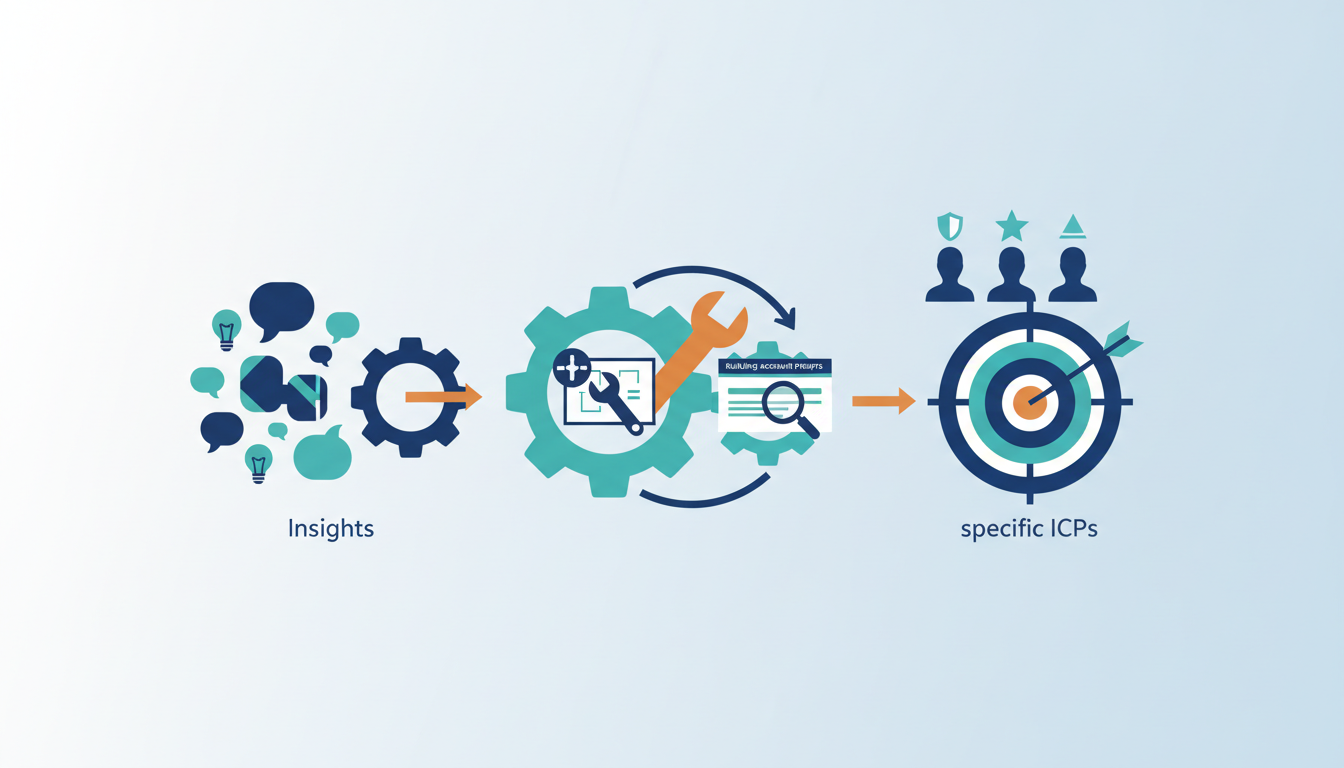
Operators configure the agent to surface research specific to their industry by building custom signals that indicate when an account is ready to engage. Sales leaders define these triggers through configurable prompts, tailoring detection logic to unique sales motions rather than relying on generic templates. The system supports this customization by allowing users to modify prompts for specific personas, industries, or GTM motions, or to apply pre-built templates provided by the platform.
| Signal Type | Configuration Target | Operational Outcome |
|---|---|---|
| Funding Events | External News Feeds | Capital Allocation Timing |
| Executive Moves | Leadership Changes | Stakeholder Mapping |
| Expansion Plans | Strategic Announcements | Upsell Identification |
Generic parameters flood representatives with irrelevant alerts while hyper-specific constraints miss emerging opportunities. Where that line falls decides whether targeting signals drive actual engagement or accumulate as static intelligence, and it stays a judgement for the operator rather than the platform. By surfacing research specific to a team's Ideal Customer Profile (ICP) and sales motion, the agent enables representatives to skip unnecessary details and focus on high-value matters.
- Action: Deploy custom signals to filter noise from genuine intent.
- Result: Accelerated planning cycles with verified data points.
- Risk: Over-reliance on external triggers without internal validation.
- Benefit: Reduced manual prep time for sales teams.
Integrating Real-Time Insights into Account Plans
Saving expansion plans, funding rounds, and executive moves directly into account fields allows teams to prioritize accounts and move quicker on inbound leads. The system ingests external triggers and internal engagement data, persisting them as structured data within Outreach rather than leaving them as unstructured text. This architecture allows operators to build flexible account plans where filters surface accounts exhibiting specific readiness signals. Unlike standalone research tools requiring manual copy-paste operations, this integration ensures timely insights are ready to act on across filters, account plans, AI-personalized messaging, and automated workflows.
| Data Trigger | Automated Action | Strategic Value |
|---|---|---|
| Funding Round | Prioritize Inbound Queue | Capital Availability |
| Exec Move | Update Stakeholder Map | Relationship Reset |
| Expansion Plan | Initiate Outreach Sequence | Growth Alignment |
Automation speed sometimes conflicts with contextual nuance. The platform provides full transparency by allowing users to hover over each finding to see its source. Teams use this visibility to verify every insight and signal used to target accounts. The operational consequence is a shift from reactive research to proactive engagement, supported by rich, real-time account intel that helps reps personalize outreach with greater speed and precision. By automating manual research tasks, the system allows representatives to send more relevant messages and accelerate planning.
Strategic Advantages of Native AI Agents Over Custom Builds
Native Agent Accuracy Versus Custom Build Timelines
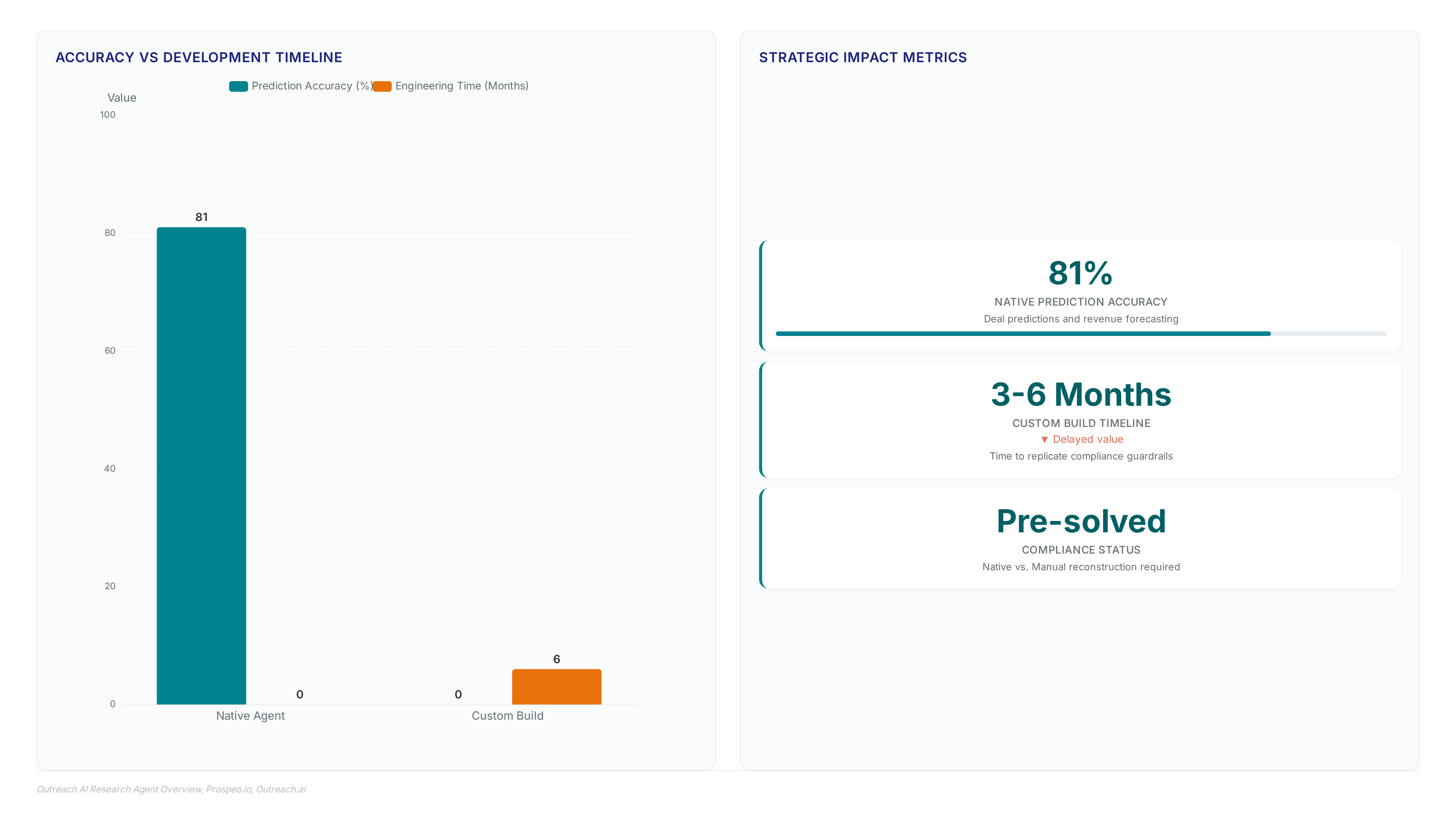
Immediate deployment of the native solution bypasses the 3-6 month engineering timeline required to replicate compliance guardrails in custom builds.
| Feature | Native Outreach Agent | Custom LangChain Build |
|---|---|---|
| Deployment Time | Immediate | Extended Timeline |
| Compliance | Pre-solved Guardrails | Manual Reconstruction Required |
| Data Integration | Native Field Sync | Custom Engineering Needed |
| Maintenance | Vendor Managed | Internal Engineering Burden |
Technical teams attempting to construct similar research agents using LangChain or Make.com face a distinct deficit in prediction reliability during early iterations. The native platform uses pre-trained models for instant signal detection. This gap forces engineering squads to choose between delaying launch for model tuning or managing risk in infrastructure and compliance. Teams also underestimate the complexity of maintaining research integrity across evolving web structures and internal schema changes.
The hidden cost of the custom approach extends beyond initial coding hours into ongoing maintenance of deliverability systems. A builder might successfully extract funding news but must manually reconstruct the logic to weight that signal correctly against recent exec moves without the benefit of pre-configured best practices derived from Outreach's expertise in revenue workflows.
In practice, the cost of building a custom solution includes not only engineering time but also the reconstruction of compliance features critical for avoiding reputation erosion. Teams must weigh the allure of full control against the reality of maintaining complex orchestration logic alone. Whether that opportunity cost outweighs a subscription depends on how much of the compliance and deliverability stack a team already owns.
About
Priya Nair serves as AI Industry Editor at AI Agents News, where she tracks product launches and platform shifts across the autonomous agent environment. Her daily work involves rigorously verifying claims from vendors like Devin and Cursor, making her uniquely qualified to analyze the Outreach AI Research Agent. Unlike superficial overviews, Nair's reporting dissects how this tool actually functions: automating the extraction of targeting signals from conversations and public data to populate Outreach fields. Her expertise in multi-agent systems allows her to evaluate whether the agent's ability to drive account strategy represents a genuine leap in orchestration or merely incremental automation. By connecting Outreach's specific capability to eliminate manual research with broader industry trends in agentic workflows, Nair provides engineers and technical leaders with a neutral, fact-based assessment. This ensures readers understand exactly what shipped, how it compares to existing frameworks, and its practical value for building scalable sales infrastructure without the usual marketing hype.
Conclusion
Scaling custom AI architectures reveals a critical fracture in long-term operational sustainability, not just initial deployment. While engineering teams may successfully code basic extraction logic, the ongoing burden of maintaining deliverability systems and compliance guardrails creates a hidden tax on technical resources that grows heavier with every regulatory update. The decision to build rather than buy often ignores the compounding cost of delayed revenue personalization while squads struggle to replicate pre-solved workflows. Organizations should commit to native solutions when their priority is immediate market engagement rather than proprietary control over standard sales signals. If your team lacks dedicated bandwidth for continuous model tuning and legal risk assessment, the custom path introduces unnecessary fragility to your revenue engine.
The headline claim holds only as far as the sourcing does. Automated research returns the preparation time and anchors every funding round or executive move to a source URL a rep can hover over, which manual digging never delivered at that speed. It does not decide which of those signals matters: generic triggers flood the queue, narrow ones miss the opening, and external news still needs the internal transcript to confirm it. The work moves from gathering data to calibrating what counts as a signal, and that calibration stays with the team.
Frequently Asked Questions
Custom builds require three to six months of engineering to match basic deliverability. Native solutions offer immediate availability, bypassing the lengthy development timeline needed to replicate compliance and functionality internally.
The predictive AI delivers 81 percent accuracy in deal predictions and revenue forecasting. This high precision allows sales teams to trust automated insights for critical pipeline decisions rather than relying on manual estimates.
The agent extracts insights from internal transcripts and external web content simultaneously. Combining these two primary source categories ensures every touchpoint reflects current buyer conditions without requiring manual data aggregation by representatives.
Representatives stop losing hours to preliminary digging because the agent automates the research tasks. The recovered preparation time goes into engagement quality and more relevant messages instead of data gathering.
Users can configure prompts to surface exact insights needed for their specific persona. This customization ensures the agent prioritizes signals aligned with their ideal customer profile and unique go-to-market motion requirements.
References