OpenHands cloud-1.33.0: Why MiniMax-M2.7 Is Default
With 78.1k stars, OpenHands now defaults to MiniMax-M2.7 to optimize agent autonomy.
Default model configuration has graduated from a preference setting to a strategic lever for enterprise reliability. Gartner forecasts that 15% of day-to-day business decisions will soon be autonomous. The mechanics behind agents like those in OpenHands now demand rigorous optimization. The platform, evolving from its 2024 "OpenDevin" roots to over 186 contributors, uses this update to balance performance with the gritty reality of agentic workflows.
We are moving past simple API swaps. The strategic role of these configurations represents an architectural necessity. This guide dissects the cloud-1.33.0 release, analyzing how specific token handling and context window management outperform previous iterations within the LiteLLM provider layer. We will detail executing the change in production, ensuring the transition from legacy defaults neither alters existing deployment pipelines nor breaks complex multi-step reasoning loops.
This shift is structural. The choice of a default model dictates the ceiling for agent capability. By anchoring the cloud-1.33.0 release to MiniMax-M2.7, the OpenHands team signals that raw benchmark scores are secondary to consistent, cost-effective execution in real-world coding scenarios.
What the cloud-1.33.0 Default Actually Changes
Defining the MiniMax-M2.7 Default in OpenHands cloud-1.33.0
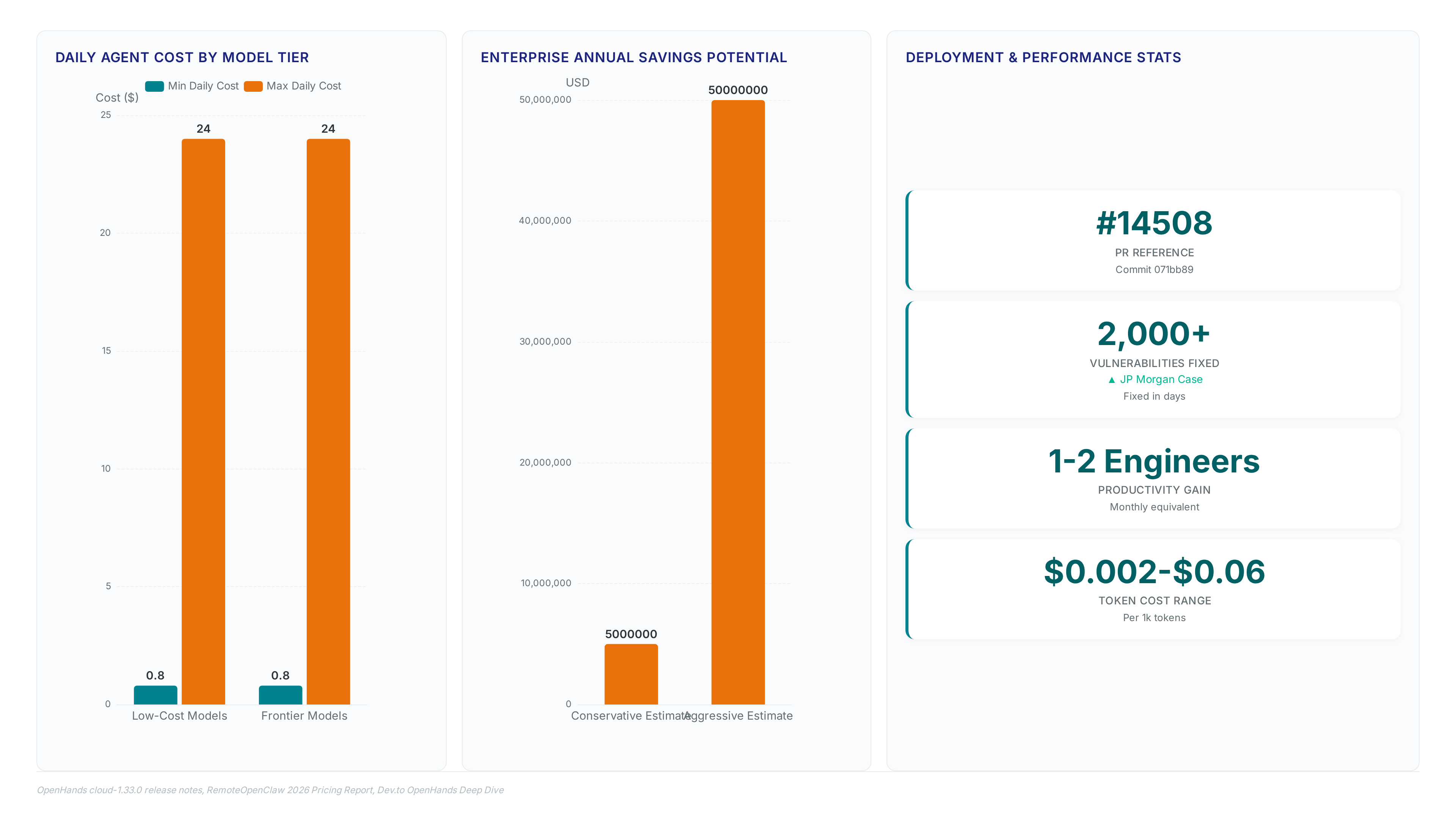
Commit 071bb89 hardcodes MiniMax-M2.7 as the default inference engine for the cloud-1.33.0 release. This move prioritizes cost-effective token generation for high-volume enterprise workloads over raw benchmark performance. Because the platform operates on a LiteLLM-based provider layer, it remains strictly model-agnostic despite the new default. Operators do not need to rewrite code to swap models; the system allows immediate changes via configuration files. Unlike proprietary ecosystems that lock users to specific vendors, this architecture supports diverse model options through standardized hooks.
Safety is enforced by default. The setup includes MAX_ITERATIONS limits and hard cost cutoffs to prevent budget overruns during autonomous loops. MiniMax-M2.7 offers competitive pricing near the $0.002 per 1,000 tokens floor for fast models. Latency variance does occur compared to frontier-tier alternatives. Teams requiring maximum reasoning capability for complex GitHub issue resolution might prefer manually configuring Claude Opus 4.7. This model leads current benchmarks at 66.7%. The strategic value here is clear: provide a safe, economical baseline that prevents accidental spend while retaining full flexibility for specialized tasks.
Applying Model-Agnostic Swapping Beyond the MiniMax-M2.7 Baseline
Operators can bypass the cost-optimized baseline by editing the config.toml file to swap MiniMax-M2.7 for higher-performing models like Claude Opus 4.7. This manual override is essential for complex engineering tasks requiring superior reasoning capabilities. When paired with such strong models, the platform resolves over 53% of SWE-bench Verified tasks. Clear gains appear for critical issue resolution.
However, frontier model usage incurs higher API costs. Expenses reach approximately $0.06 per 1,000 tokens compared to cheaper alternatives. Teams must balance this performance uplift against budget constraints when selecting their inference engine for production workloads. The architecture supports diverse model options through its provider layer. Vendor lock-in common in other coding agents does not exist here.
Internal Mechanics of the MiniMax-M2.7 Integration in OpenHands
LiteLLM Provider Layer Mechanics in cloud-1.33.0
Commit #14508 executes the MiniMax-M2.7 default switch by modifying the LiteLLM routing logic within the cloud-1.33.0 build. The provider layer intercepts inference requests and maps them to specific API endpoints based on configuration parameters rather than hardcoded paths. This architecture enables operators to fix model configuration errors instantly by updating environment variables, avoiding the need for code redeployment to change providers. Users can select from multiple model options without altering the underlying application logic, preserving compatibility while shifting cost structures.
Default settings include LLM_NUM_RETRIES set to 8 and a hard accumulated-cost cutoff to prevent budget overruns during automated loops. Relying on default retry logic introduces latency spikes if the upstream provider enforces strict rate limits without custom backoff tuning. Teams using the Individual Tier benefit from pay-as-you-go pricing that aligns with variable workload demands instead of fixed seat licensing. Default cost controls may prematurely abort long-running agent tasks if the cost cutoff threshold is set too aggressively for complex reasoning chains. Operators must balance the hard accumulated-cost cutoff against task complexity to prevent false positives in task termination.
The cloud-1.33.0 release page displays exactly 2 assets, yet interface errors block download access and obscure file integrity checks. This loading failure prevents operators from verifying the MiniMax-M2.7 binary against the commit hash 071bb89 before deployment. Such opacity introduces risk because the release notes contain a "Co-authored-by" attribution to openhands, suggesting automated generation that could mask packaging anomalies. Teams observing similar "unexpected error" patterns during Lightstreamer client library construction found that manual file validation was required to confirm artifact completeness.
Executing the Default Model Change in Production Environments
Switching the Default Model in a Live Deployment
The same default reaches production deployments through the standard manifest. It prioritizes cost-efficiency for the Individual cloud plan, which supports bring-your-own-key models without mandatory subscription fees. Operators retain full control because the underlying LiteLLM-oriented provider layer allows immediate model swapping through environment variable overrides rather than code changes.
To reconfigure the default agent, modify the deployment manifest using these steps:
- Define the
LLM_MODELenvironment variable to specify an alternative endpoint. - Adjust
MAX_ITERATIONSto approximately 100 to balance task completion against token spend. - Set
LLM_NUM_RETRIESto 8 to handle transient API failures without aborting workflows. - Apply a hard accumulated-cost cutoff to prevent budget overruns during long-running sessions.
The architectural separation of the SDK from tool execution ensures that changing the default model does not alter isolated sandbox environments required for security. However, relying solely on the new default may reduce complex task resolution rates compared to higher-scoring alternatives noted on the OpenHands Index. Teams requiring maximum efficacy for critical infrastructure repairs should consult AI Agents News for updated benchmarking data before locking in production defaults.
Deploying OpenHands Cloud with Isolated Sandbox Environments
Production deployments of cloud-1.33.0 require isolated execution contexts to secure the new MiniMax-M2.7 default against prompt injection attacks.
- Provision the runtime environment using Docker containers for local development or Kubernetes clusters for enterprise-scale isolation.
- Override the hardcoded MiniMax-M2.7 string by setting the
LLM_MODELenvironment variable to your preferred inference target. - Apply resource limits to the workspace pod to prevent runaway agents from consuming excessive cluster capacity.
The architecture separates the SDK from the workspace to address production concerns, ensuring tools isolate slow-running tests effectively. JP Morgan Chase utilized this isolated platform to fix over 2,000 vulnerabilities in days, gaining productivity equivalent to 1-2 engineers monthly. Running agents in strict sandboxes introduces latency overhead that can degrade performance for latency-sensitive tasks. Operators must balance security isolation against these variable costs when scaling to millions of tokens. AI Agents News recommends validating the commit hash 071bb89 integrity before applying the update to production clusters.
What the Default Costs and Saves at Volume
Defining ROI Through Token Volume and Condenser Efficiency
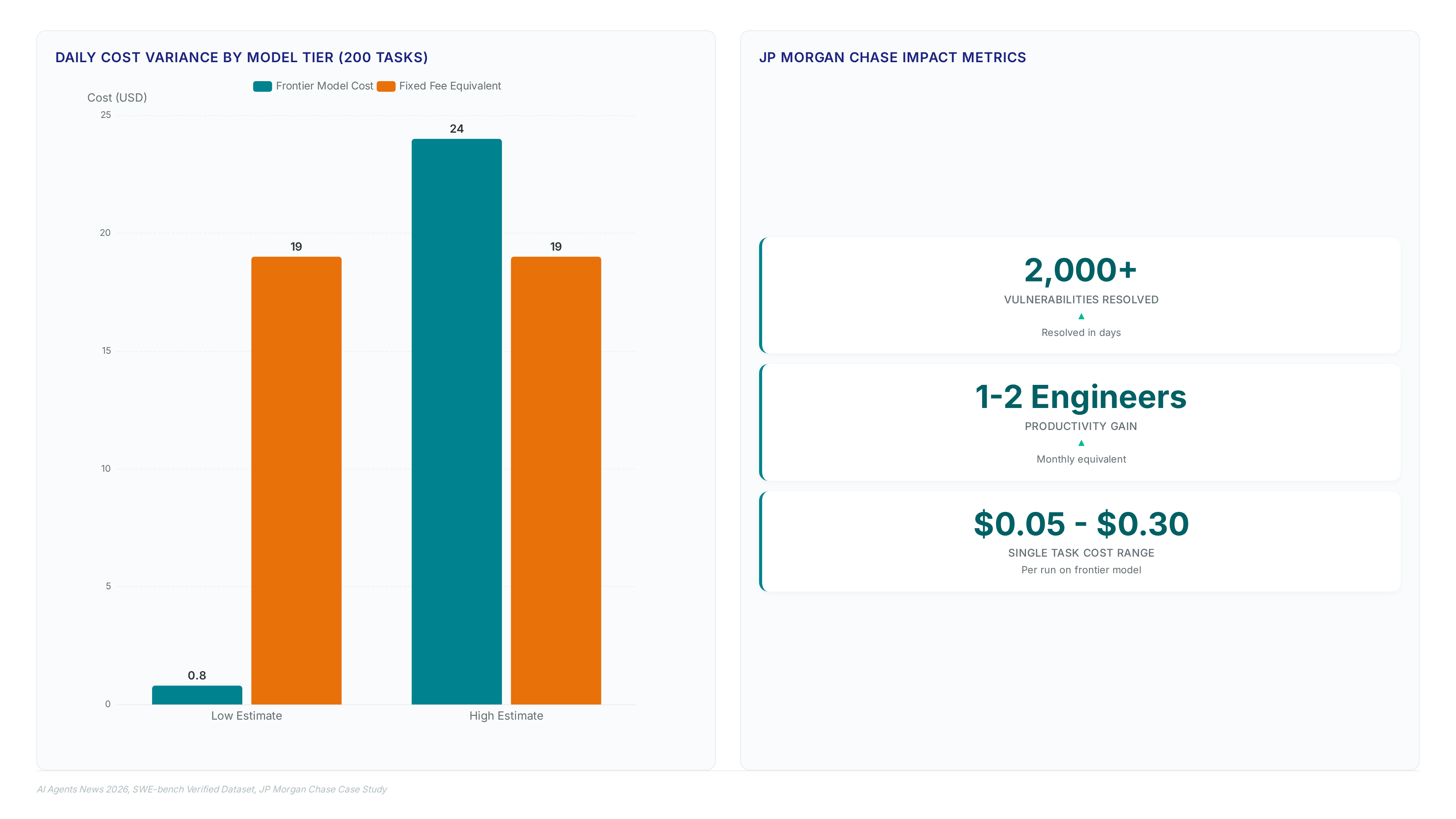
Questions regarding the switch to the MiniMax model in cloud-1.33.0 often center on token volume justification. A single trivial task using OpenHands on a frontier model costs between $0.05 and $0.30 per run, creating measurable budget variance at scale. Complex fixes drive higher spend. The default condenser trims redundant context from long sessions. This efficiency gain transforms marginal ROI calculations for high-frequency deployments. Raw token counts mislead without accounting for session duration. A business agent handling 200 tasks daily spends between $0.80 and $24 per day depending on the model chosen. Multi-hour autonomous runs accumulate costs that exceed fixed-fee competitor plans like GitHub Copilot Business without the condenser mechanism. Strict budget governance becomes necessary for network engineers managing AI infrastructure. Ignoring condenser efficiency leaves significant capital exposed to waste. AI Agents News identifies this optimization as the primary driver for enterprise adoption rates in 2026.
JP Morgan Chase Case Study: Fixing 2,000 Vulnerabilities
JP Morgan Chase resolved over 2,000 security vulnerabilities in days using the platform. This feat yielded productivity gains equal to 1-2 engineers monthly. Switching to MiniMax-M2.7 delivers immediate operational scale without proportional headcount increases. The architecture executes these fixes within isolated Kubernetes clusters to maintain strict security boundaries distinct from standard developer environments. Throughput must be weighed against specific workload types. The productivity gain observed here stems from high-volume, repetitive remediation tasks where speed outweighs complex reasoning. Cost structures vary. Trivial tasks on frontier models still incur per-run charges that accumulate rapidly across massive fleets. This case demonstrates value through hard engineering equivalents rather than vague percentage improvements. Such velocity requires pre-set remediation playbooks to prevent agent drift during autonomous execution. Network teams should adopt this configuration only when standardized fix patterns exist for the target vulnerability class. The strategic shift prioritizes volume processing over bespoke problem solving for known error signatures.
Financial delta emerges because GitHub Copilot Business charges a fixed $19 per user per month, a model that scales linearly with headcount rather than utility. In contrast, self-hosted OpenHands scales differently. Token volume drives expenditure instead of static subscriptions. Operational overhead remains a constraint. Teams must manage the underlying infrastructure that SaaS vendors abstract away. Shifting capital expenditure from operational budgets to engineering time required for maintenance defines this trade-off. High-volume users find that API spend becomes predictable only after establishing strict rate limits and context condensers. Enterprises ignoring this architectural shift face compounding costs as developer counts rise. Self-hosted deployments benefit from economies of scale in token pricing. The decision rests on whether an organization values immediate convenience or long-term marginal cost reduction. AI Agents News identifies this inflection point as critical for large-scale adoption strategies.
About
Diego Alvarez, Developer Advocate at AI Agents News, brings hands-on expertise in evaluating and building with autonomous coding agents. His daily work involves rigorous testing of frameworks like OpenHands, making him uniquely qualified to analyze the strategic shift to MiniMax-M2.7 as the new default model. As someone who constantly benchmarks agent performance, cost, and reliability, Diego understands how a default configuration change impacts developer workflows and system efficiency. This update in OpenHands, the leading open-source coding agent platform, reflects broader industry trends in optimizing LLM selection for agentic tasks. By connecting his practical experience in multi-agent orchestration with the technical nuances of this release, Diego provides engineers with a clear, factual assessment of why this specific model upgrade matters for real-world deployment. His analysis bridges the gap between raw release notes and actionable engineering decisions.
Conclusion
The default is an economic decision, not a quality verdict. MiniMax-M2.7 near the $0.002 per 1,000 tokens floor keeps a high-volume agent fleet affordable, while the same fleet on a frontier model at roughly $0.06 per 1,000 tokens turns a business agent handling 200 tasks daily into a very different line item. The provider layer means neither choice is permanent: one environment variable moves a deployment either way.
So the work is routing, not picking a winner. Send standardized, repetitive remediation to the cheap default, reserve the higher-scoring models for the issues that actually need deep reasoning, and keep the iteration limit, retry count and hard cost cutoff in place so an autonomous loop cannot quietly spend the difference.
Frequently Asked Questions
It prioritizes cost-effective token generation for high-volume enterprise workloads over raw benchmark scores. MiniMax-M2.7 offers competitive pricing near the $0.002 per 1,000 tokens floor for fast models, ensuring economical baselines.
When paired with strong models, the platform resolves over 53% of SWE-bench Verified tasks, demonstrating clear gains for critical issue resolution. This exceeds the capabilities of the standard cost-optimized baseline configuration.
Frontier model usage incurs higher API costs, reaching approximately $0.06 per 1,000 tokens compared to cheaper alternatives. Teams must balance this significant performance uplift against strict budget constraints for production.
Token throughput takes priority in MiniMax-M2.7 defaults, whereas the 66.7% benchmark score achieved by Claude Opus remains secondary. This configuration favors operational expenditure over maximum reasoning power for agents.
Defaults ship with MAX_ITERATIONS limits, LLM_NUM_RETRIES set to 8 and a hard accumulated-cost cutoff. Set that cutoff too aggressively and long reasoning chains abort before they finish.