Multiagent research loops handle complex tasks
Multi-agent systems with Claude Opus 4 outperform single-agent approaches by 90.2% on internal research evaluations. This isn't a marginal gain; it's a structural necessity for scaling AI in complex, open-ended tasks. We are moving past linear pipelines into autonomous collaboration, the only viable path for production-grade artificial intelligence.
The advantage lies in parallel execution flow. Subagents compress vast information corpora while maintaining distinct exploration trajectories, something a single context window cannot do. We see this in the orchestrator-worker pattern, where a lead agent plans flexible research processes rather than following hardcoded paths. This architecture exists to handle the unpredictability inherent in tasks requiring continuous adaptation based on emerging data.
Agent coordination is the primary bottleneck as organizations deploy these systems at scale. Unlike static models, these networks mimic human researchers by pivoting strategies when initial leads prove unfruitful. The massive adoption of agentic products like Claude Code validates this approach for handling breadth-first queries that stump solitary models.
The Role of Multi-Agent Architectures in Modern AI Research
Defining Multi-Agent Systems as Autonomous LLM Tool Loops
A multi-agent system consists of multiple large language models operating autonomously within tool loops. Instead of processing queries in a single linear line, a lead agent plans the overall process and spawns parallel subagents to gather information simultaneously. This coordination enables flexible adaptation of search strategies based on intermediate findings, ditching the static retrieval patterns typical of traditional Retrieval Augmented Generation (RAG).
Parallel execution provides the primary operational advantage. Single agents often fail to decompose complex queries requiring breadth-first exploration, whereas coordinated subagents distribute token usage across independent context windows. Internal evaluations indicate such systems outperform single-agent counterparts by 90.2% on specific research benchmarks. This performance gain stems from the ability to explore divergent investigative paths concurrently, effectively compressing vast information corpora into synthesized reports.
However, substantial token costs accompany this architectural depth. Multi-agent configurations consume approximately 15× more tokens than standard chat interactions, creating an economic constraint where task value must justify the compute expense. Domains requiring tight state synchronization across all agents remain poorly suited for this parallel approach. Builders must weigh the necessity of deep, adaptive search against the linear scalability costs inherent in orchestrating multiple autonomous loops. Claude's Research capability exemplifies this shift, moving from simple prompt-response cycles to complex, self-correcting investigation loops that prioritize thorough coverage over speed alone.
Flexible Multi-Step Search Versus Static RAG Retrieval
Iterative, adaptive queries define flexible multi-step search, standing in contrast to static Retrieval Augmented Generation (RAG) chunk fetching. Traditional RAG retrieves fixed document segments based solely on initial query similarity, limiting depth when context evolves. Agentic systems determine the next investigative step automatically based on prior results, enabling complex reasoning chains that single prompts cannot achieve. This adaptability allows the system to pursue tangential leads or pivot strategies entirely when intermediate data suggests a new direction.
| Feature | Static RAG | Flexible Multi-Step Search |
|---|---|---|
| Retrieval Mode | One-shot similarity match | Iterative, adaptive planning |
| Context Handling | Fixed input chunks | Builds on intermediate findings |
| Execution | Linear pipeline | Parallel subagent coordination |
| Best Use Case | Fact lookup | Open-ended investigation |
Market adoption signals strong preference for this autonomy, with related agentic products reaching an estimated annualized revenue run rate of approximately $2.5 billion as of February 2026. Builders should deploy multi-agent architectures when queries involve unpredictable paths requiring real-time strategy adjustment.
Inside the Orchestrator-Worker Pattern and Parallel Execution Flow
Parallel Subagent Context Window Compression Mechanics
Subagents compress insights from vast corpora by operating in parallel with independent context windows. This technical separation allows each worker node to ingest distinct document segments without contaminating the global state with irrelevant tokens. By isolating exploration trajectories, the system reduces path dependency and prevents early search biases from skewing the final synthesis. The lead agent receives only condensed, high-salience tokens rather than raw retrieval noise, effectively acting as a bandwidth throttle for reasoning.
Monolithic context loading forces premature truncation when token limits hit. Distributed context windows enable the system to process information volume that exceeds single-agent capacity constraints. Depth improves, yet coordinating multiple agents introduces variability in output consistency compared to simpler models.
Token efficiency shifts from minimizing usage to optimizing distribution across agents.
Autonomous Decision Loops in Unpredictable Research Paths
Unpredictable research paths demand autonomous loops where models pivot strategies based on intermediate findings rather than following linear scripts. Research problems often lack predefined steps, requiring systems to operate dynamically and adjust trajectories as new data emerges. Unlike rigid pipelines, these agents mimic human investigators who continuously update hypotheses, a necessity when required actions cannot be hardcoded in advance. The lead agent evaluates partial results to spawn specialized subagents, creating a feedback loop that refines the overall inquiry strategy in real-time.
Coordination challenges dissolve when cognitive load distributes across parallel workers, each managing distinct context windows to explore independent leads. Research involves open-ended problems where required steps are difficult to predict in advance, making the process flexible and path-dependent.
Google's Gemini Deep Research Agent offers similar autonomous planning capabilities, highlighting a broader industry shift toward non-linear exploration. The open-source GPT Researcher project further demonstrates this pattern by separating planning and execution roles to stabilize output. Not all domains benefit from such heavy parallelization; tasks with high inter-dependency between steps may suffer from coordination overhead rather than gaining speed.
Validating Orchestrator Strategy and Subagent Delegation Flow
The lead agent must analyze the prompt to create a strategy, ensuring delegated agents explore independent aspects simultaneously rather than duplicating queries. This separation reduces path dependency, a common error in subagent task delegation where workers converge on identical search terms.
Agent coordination fails when the orchestrator neglects strict context isolation between workers. Without isolated context windows, Subagents may inherit early search biases, effectively serializing a parallel operation. Distinct tools, prompts, and exploration trajectories maintain true concurrency and reduce path dependency.
| Failure Mode | Symptom | Mitigation |
|---|---|---|
| Task Overlap | Duplicate tool calls | Enforce unique query prefixes |
| Context Leak | Shared search history | Isolate worker memory scopes |
| Strategy Drift | Redundant synthesis | Validate plan before spawn |
This workflow transforms simple chat into agentic operations where the AI determines investigation paths dynamically. Multi-agent systems excel at valuable tasks involving heavy parallelization and information exceeding single context windows, but they require tasks where the value is high enough to justify the increased token usage. Domains requiring shared context or involving many dependencies, such as most coding tasks, are not currently a good fit for this architecture.
Where Multi-Agent Systems Outperform Single-Agent Approaches
Which Problems Justify the Parallel Cost
The advantage shows up on one class of problem: the one whose next step cannot be written down in advance. A static pipeline waits for the user to supply every action, while a lead agent reads intermediate findings and picks the next move itself, pivoting when a lead proves unfruitful.
Tasks with rigid dependencies or low information density often fail to justify the resource expenditure of parallel coordination. Builders should deploy these systems only when the problem space exceeds the reasoning capacity of a single context window or requires heavy tool interfacing.
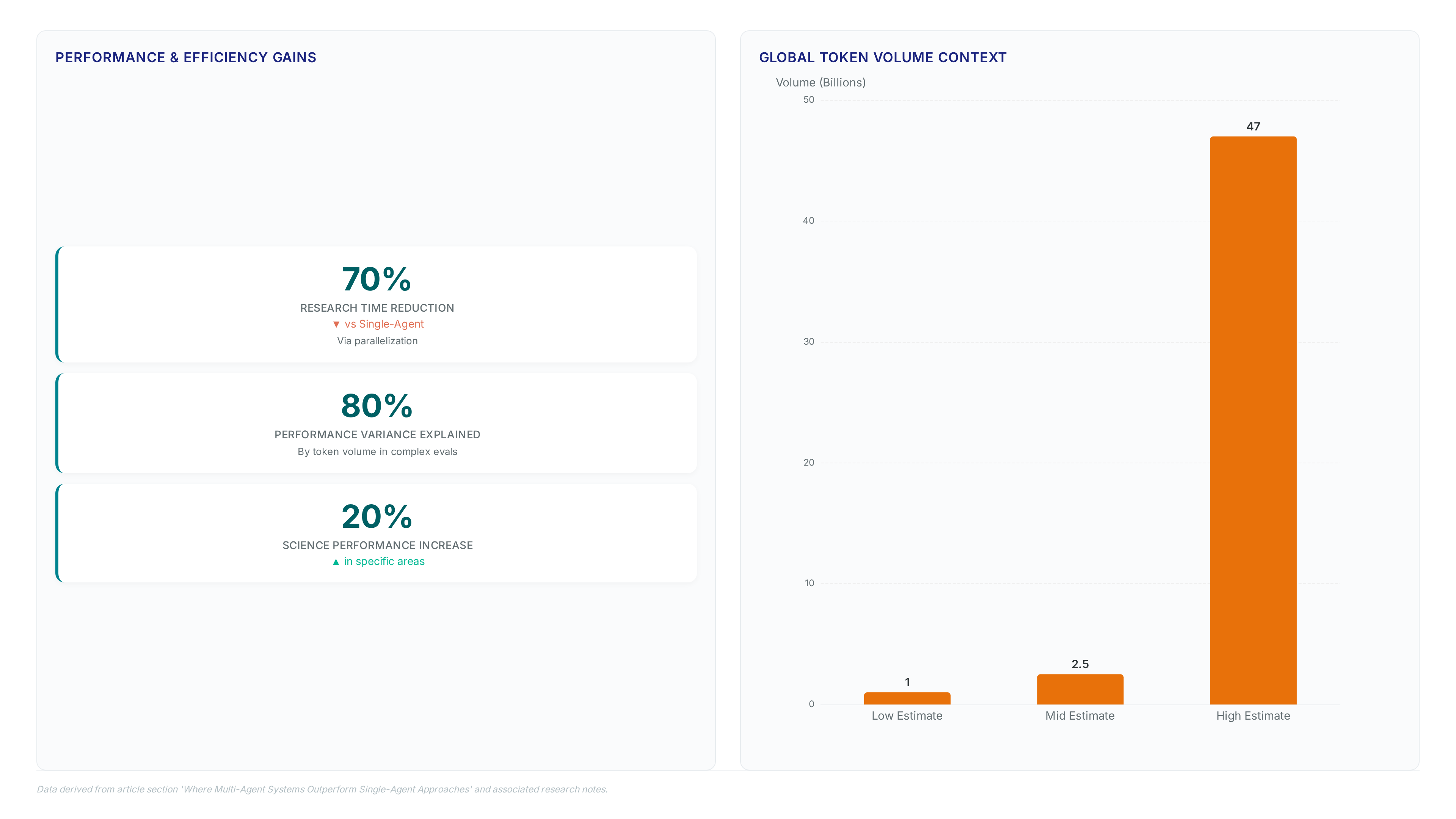
Economic constraints define the primary drawback: the roughly 15× token multiplier demands high-value use cases for viability. While token volume explains 80% of performance variance in complex evaluations like BrowseComp, the architectural choice to parallelize introduces coordination complexity that simple queries cannot absorb. Autonomous planning mechanisms confirm that competitors also prioritize breadth-first decomposition over linear retrieval.
LLM-as-Judge Versus Manual Testing for Agent Evaluation
Complex agent coordination and flexible outputs create unique challenges when evaluating multi-agent systems. Automated metrics provide scale yet often lack the nuance required to assess the quality of synthesized research or the validity of complex reasoning paths. Human insight fills the gap where algorithms stumble.
| Evaluation Method | Consistency | Edge Case Detection | Scale |
|---|---|---|---|
| LLM-as-Judge | High | Moderate | High |
| Manual Testing | Low | High | Low |
Manual inspection remains necessary for catching subtle logical failures that automated scorers might miss during agent performance audits. Internal evaluations often rely on specific, complex benchmarks, such as identifying all board members of S&P 500 companies, to clearly distinguish between the capabilities of single-agent and multi-agent architectures. A single LLM call outputting scores from 0.0-1.0 and a pass-fail grade was most consistent with human judgments. Testing a set of about 20 queries representing real usage patterns allowed the team to spot impacts clearly. This hybrid approach balances the need for high-volume validation with the precision required for complex reasoning tasks.
Optimizing for specific metric distributions rather than factual accuracy introduces risk when relying on automated scoring. Engineers must ensure their evaluation methodologies account for the specific failure modes of browsing agents, such as the inability to locate hard-to-find information. Systems may appear improved while degrading on unmeasured dimensions of research quality without rigorous testing against these known challenges. Combining automated scoring with detailed analysis of performance variance factors helps maintain system reliability: token usage, tool call counts, and model choice together explain 95% of performance variance in browsing evaluations.
Implementing Token-Efficient Agent Coordination and Parallel Design
Delegating Clear Objectives to Prevent Agent Duplication
Redundant investigation wastes compute cycles when subagents target identical data without explicit boundaries. Lead agents must decompose queries into subtasks with strict output formats and tool guidance to prevent this overlap. Developers should simulate agent behavior to observe how vague prompts trigger endless searches for nonexistent sources or excessive status updates. Unclear instructions once caused one subagent to explore the 2021 automotive market while another simultaneously investigated the same period.
Coordination complexity grows rapidly without these constraints, creating scenarios where early agents spawn excessive workers for simple queries. Increasing agent autonomy improves adaptability but raises the risk of redundant exploration if initial instructions lack precision. Operators balance flexibility with structural guardrails to maintain token efficiency. Effective delegation transforms a chaotic swarm into a coordinated research team. Every parallel thread explores unique data space rather than re-verifying established facts. Builders prioritize prompt clarity when debugging duplication errors in production systems.
Bypassing Coordinators with Filesystem Output References
Directing subagent outputs to external systems reduces token overhead by passing lightweight references back to the coordinator. This architecture shifts the burden of data storage from the context window to persistent storage. The lead agent processes only file paths rather than raw content. Specialized agents maintain independent execution states without exhausting the central coordinator's token budget by isolating large data payloads in external systems.
Parallel execution improves breadth, yet unmanaged context accumulation leads to exponential cost growth. The limitation is increased I/O latency; the system must wait for disk write completion before the coordinator can proceed. This delay is often negligible compared to the time saved by avoiding massive context window re-processing. Filesystem references enable stateful recovery after interruptions unlike operations that rely solely on memory. If a subagent fails, the lead agent re-reads the last saved checkpoint without re-executing the entire search trajectory. This durability makes the system more resilient to network partitions or transient tool failures.
Cascading Errors from Minor Changes in Stateful Agents
Prompt modifications in stateful agents trigger disproportionate behavioral shifts because errors compound over long execution windows. These systems maintain contextual memory across hundreds of turns unlike stateless APIs. A small deviation in early logic propagates through subsequent tool calls. Minor changes cascade into large behavioral shifts in agentic systems because agents are stateful and run for long periods. A single ambiguous instruction causes a subagent to enter infinite retry loops or hallucinate sources. The entire token budget allocated for a query disappears in such events.
Operators implement logic to handle anomalies without restarting full workflows to mitigate this risk. Systems resume from the point of failure rather than restarting. This approach preserves the investigative thread while correcting the immediate error. Expensive intermediate reasoning remains intact when a minor configuration update introduces instability. An update intended to fix a niche edge case might degrade performance across all complex queries by altering the orchestrator's delegation strategy without such mechanisms. Rigorous simulation of failure modes is recommended before deploying prompt changes to production multi-agent clusters.
About
Priya Nair serves as the AI Industry Editor at AI Agents News, where she tracks the business dynamics of autonomous systems. Her daily work analyzing product launches and platform strategies for tools like Devin and Claude Code uniquely qualifies her to dissect the complexities of multi-agent research systems. Unlike theoretical researchers, Nair evaluates how these architectures perform in real-world deployments, focusing on critical engineering challenges such as agent coordination, tool reliability, and evaluation metrics. At AI Agents News, a hub dedicated to technical founders and engineers, she translates market moves into actionable insights for builders. This article connects her rigorous market analysis with the technical realities of orchestrating parallel agents for complex tasks. By grounding the discussion in verified product capabilities rather than hype, Nair provides the neutral, fact-based perspective necessary for teams deciding whether to integrate multi-agent loops into their own infrastructure.
Conclusion
Multi-agent loops pay off only on open-ended problems whose next step cannot be scripted, and once such a loop runs for hours, durability outweighs raw speed: token volume drives 80% of performance variance. The critical breaking point is not compute capacity but the compounding impact of minor prompt deviations across hundreds of turns, where a single ambiguity can consume an entire query budget. Organizations must treat stateful agents as long-running processes requiring checkpointed recovery rather than transient API calls.
The decision therefore lands before the architecture. If the next step of a task can be written down in advance, a linear pipeline answers it and the parallel token multiplier buys nothing; if it cannot, that same multiplier buys the only approach that covers the ground, and the engineering problem shifts from making the loop faster to keeping it recoverable.
Frequently Asked Questions
Multi-agent systems outperform single agents by 90.2% on internal research benchmarks. The gap opens on breadth-first queries: several subagents hold separate context windows at once, while a single window has to walk the same ground in sequence and truncates when the corpus outgrows it.
Token volume alone explains 80% of performance variance in complex evaluations such as BrowseComp. The practical reading is about distribution rather than economy: parallel subagents spend far more tokens in total, but they spend them in independent context windows instead of one.
Work whose steps depend tightly on each other, most coding among it, because those tasks need the shared state that independent context windows deliberately withhold. Coordination overhead then costs more than parallel exploration returns.
A single agent cannot explore divergent paths at the same time, so an unfruitful early lead still sets the direction for everything that follows. Parallel workers keep separate trajectories, which is what stops an early search bias from shaping the final synthesis.
Agent coordination. The failures are concrete: two subagents investigating the same period, workers inheriting a shared search history, or one ambiguous instruction sending a subagent into retry loops that drain the query budget.
References