Coding agents shift to production with 1M context
June 26, 2026 marked the shift from AI coding agent demos to production infrastructure with 1M+ token context windows. Autonomous coding agents now execute scoped refactor jobs and manage pull request automation without hand-holding. This transition defines an environment where architecture discipline matters more than raw model capability. Teams deploying these systems rely on planner-retriever-executor pipelines to handle complex workflows that previously required days of manual orchestration. Tool-use has become a first-class capability, enabling agents to ingest entire repositories and reason through big dependency graphs without constant human intervention.
The planner-retriever-executor architecture is the new standard for reliable deployment, replacing ad-hoc scripting with structured JSON outputs and explicit guardrails. The June 26 production tiers, gpt-5.5, claude-opus-4.7 and gemini-3.1-pro-preview, differ mainly in context limits and pricing rather than in whether they can drive an agent loop. The bottleneck for engineering teams is no longer model capability; it is the implementation of proper architectural patterns.
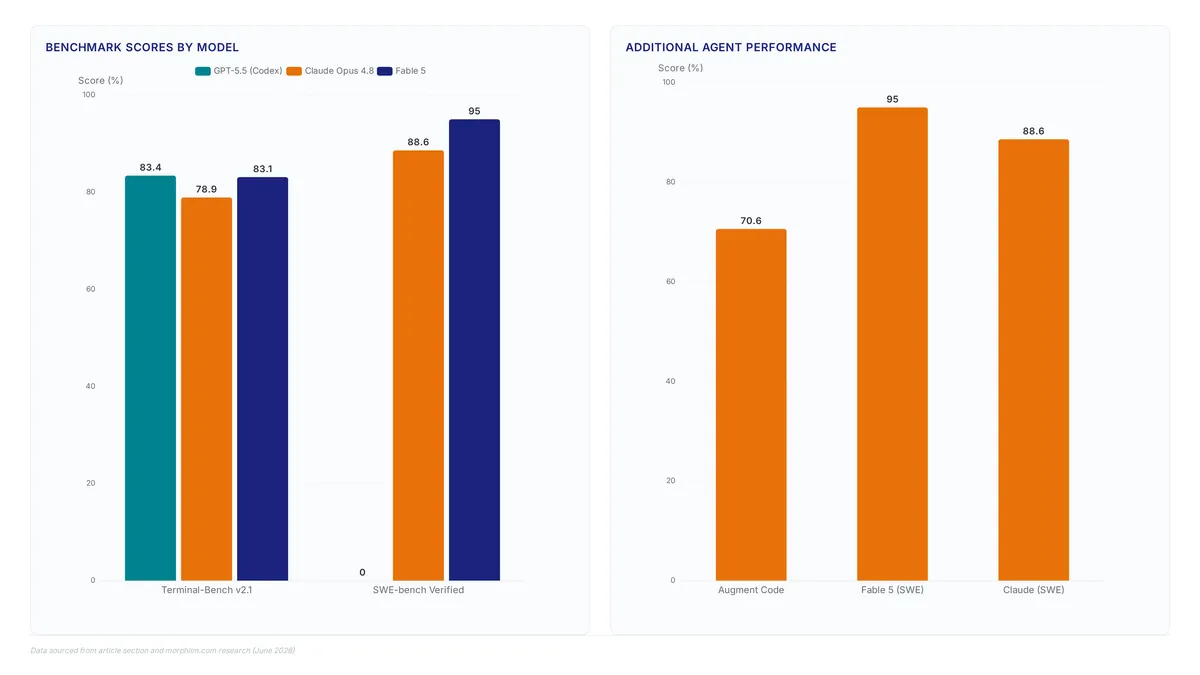
Benchmark data confirms this maturity. Codex powered by GPT-5.5 achieves a score of 83.4% on the Terminal-Bench v2.1 benchmark. Outside this trio, the Fable 5 model leads the SWE-bench Verified benchmark at 95.0%, a different test from the terminal tasks compared here. Modern agents are ready for the demands of modern software infrastructure.
The Role of AI Coding Agents in Modern Software Infrastructure
Defining Coding Agents via Planner-Retriever-Executor Pipelines
Modern coding agents are autonomous systems executing multi-step workflows through planner-retriever-executor loops, moving far beyond single-turn chat responses. These systems maintain state across minutes or hours to finish scoped refactor jobs without constant human intervention. Such an architectural shift transforms the model from a passive suggestion engine into an active participant capable of ingesting entire repositories and reasoning across dependency graphs. Tool-use has evolved into a first-class capability where models explicitly invoke external functions for file editing, testing, and version control operations. Convergence on structured JSON outputs serves as the critical guardrail preventing unbounded execution loops and hallucinated commands.
Autonomous Refactors Using gpt-5.5 1.05M Token Context
Entire repositories now fit within a single gpt-5.5 context window for autonomous refactoring. At roughly 1.05M tokens, the model processes full dependency graphs, test suites, and documentation simultaneously without external retrieval augmentation. This capacity enables scoped refactor jobs where the agent understands cross-file impacts before generating code. Multi-step coding flows that required a weekend of prompt engineering in early 2025 can now be assembled in a few hours using planner-retriever-executor patterns. Teams should adopt these agents now for legacy modernization tasks where global context prevents regression errors.
gpt-5.5 vs claude-opus-4.7 Pricing and Terminal-Bench Scores
Codex CLI running on gpt-5.5 achieves an 83.4% score on Terminal-Bench v2.1, edging out Claude Code on Opus 4.8 at 78.9%. This performance gap matters when selecting a primary model for complex, multi-step terminal interactions where precision is non-negotiable. Raw benchmark leadership does not dictate total cost of ownership for high-volume workflows. Pricing structures reveal a different optimization target: gpt-5.5 operates at roughly $5 input and $30 output per million tokens, while claude-opus-4.7, the tier Anthropic stabilized for production, sits near $5 and $25 respectively. The benchmark score and the price describe two different Claude releases, so weigh them as separate inputs. Market data tracks these efficiency metrics across coding agents to help builders balance performance against burn rates. AI Agents News recommends adopting gpt-5.5 for critical path debugging while reserving cheaper models for broad context scanning.
Inside the Planner-Retriever-Executor Pipeline Architecture
Planner-Retriever-Executor Pipeline Components
Most production-grade coding agents share these core components: Planner, Retriever, Coding executor, Verifier, and Supervisor. The Planner decomposes high-level objectives into sequential steps, while the Retriever injects the source files and documentation into the model's context window. A Coding executor applies edits using diff-based tools, whereas a Verifier runs linters and unit tests to validate correctness. Finally, a Supervisor enforces hard constraints on directory access and execution time to prevent unbounded loops.
This orchestration pattern addresses the reality that complex problem-solving consumes significant tokens per issue, requiring strict token efficiency strategies. Teams often isolate the Supervisor logic outside the model loop to guarantee safety regardless of model output. Builders must balance the need for rigid guardrails against the throughput gains of tighter model integration.
| Component | Primary Function | Critical Risk |
|---|---|---|
| Planner | Step sequencing | Infinite loops |
| Retriever | Context injection | Stale code retrieval |
| Executor | Code modification | Destructive edits |
| Verifier | Quality assurance | False positive passes |
| Supervisor | Constraint enforcement | Over-constraining valid paths |
Advanced models demonstrate this architecture's potential by achieving high scores on terminal benchmarks through optimized tool use. Production systems often maintain the Supervisor as an external enforcement layer to ensure constraints remain absolute regardless of model behavior.
Applying RAG and JSON Tool Calls for Code Retrieval
The Retriever module injects specific file paths and documentation snippets into the context window to ground the model's logic. By prioritizing RAG patterns, the system avoids hallucinating non-existent functions while navigating massive codebases.
Structured output formats ensure that tool interactions remain machine-parsable rather than free-form text. Modern APIs from vendors like OpenAI and Anthropic enforce strict JSON schemas, significantly reducing invalid payload errors during nested argument generation. This reliability allows the Coding executor to apply diffs with high confidence. Teams often mitigate parsing risks by wrapping tool calls in a verification layer that validates JSON syntax before execution.
| Feature | Unstructured Output | Structured JSON Tool Calls |
|---|---|---|
| Parsing Reliability | Low; requires regex heuristics | High; enforced by schema |
| Nested Arguments | Prone to syntax errors | Strong across deep hierarchies |
| Token Efficiency | Verbose explanations required | Minimal overhead |
In complex project development scenarios, agents average many turns per problem, making efficient retrieval critical for cost control. Without precise code retrieval, the token count expands rapidly, inflating expenses on long-context models. The architectural constraint is clear: broad context windows do not replace the need for targeted data injection. Builders must configure the Retriever to fetch only the relevant modules, as feeding an entire repository remains economically unviable even with reduced token pricing. Isolating retrieval logic helps maintain predictable token consumption profiles.
Preventing Unbounded Loops and Invalid Tool Payloads
Unbounded tool loops can rapidly deplete token budgets before reaching a valid solution. Technical anti-patterns like monolithic prompts and raw file writes frequently trigger these infinite execution cycles without intervention. A Supervisor module enforces hard constraints such as directory limits and strict timeouts to halt runaway processes. Various platforms operate as connectors to numerous LLM providers, yet any agent requires these external guardrails to prevent resource exhaustion.
Invalid tool-call payloads often occur when models generate nested JSON arguments that violate schema definitions. Modern APIs from OpenAI and Anthropic enforce structured outputs, reducing but not eliminating parameter errors. The Coding executor must validate these payloads against strict schemas before attempting file system changes.
| Failure Mode | Consequence | Mitigation Strategy |
|---|---|---|
| Unbounded Loop | Context window exhaustion | Hard timeout limits |
| Invalid Payload | Execution crash | Schema validation layer |
| Raw File Write | Data corruption | Directory allow-lists |
Operators must balance autonomy with safety by configuring the Verifier to reject edits outside approved paths. While cloud-hosted deployment modes offer isolated sandboxes for security, local execution demands rigorous policy enforcement. The cost of a single unguarded loop can exceed the budget for thousands of successful runs. Treating the Supervisor as a strict boundary is necessary for production workloads.
Context Windows and Cost Structures After the June 26 Releases
June 26 Model Lineup: gpt-5.5, claude-opus-4.7, and gemini-3.1-pro-preview
OpenAI, Anthropic, and Google formalized their production tiers on June 26 with distinct context and pricing profiles. OpenAI released gpt-5.5 and gpt-5.5-pro supporting up to 1.05M tokens, while Google made gemini-3.1-pro-preview available with a 1M token window. Anthropic stabilized claude-opus-4.7 to handle complex orchestration tasks without the instability observed in earlier iterations. These releases establish a new baseline where massive context windows are standard, yet cost structures diverge notably for high-volume agent loops. The constraint for production adoption is no longer context size but the economic viability of unbounded retry loops. Teams now face a hard ceiling on how many iterations an agent can attempt before the bill overshadows the value of the fix.
Selecting gpt-5.5 for Complex TypeScript and Python Refactors
Huge context windows change the math for refactoring projects. The model's 1.05M token context enables ingesting entire repositories in a single pass, eliminating the fragmentation errors common in smaller windows. This capacity allows the planner-retriever-executor loop to maintain global state without losing track of cross-file interfaces. Given that AI agents average 138 turns per problem to reach a solution in end-to-end scenarios, the ability to maintain long-context coherence is vital for reducing failure rates in multi-step workflows. For routine tasks, routing to cheaper alternatives preserves budget while maintaining velocity.
Cost structures diverge across the three vendors, which is why the $/task metric now matters more than raw token rates: agent loops vary in length. Evaluation of agents now strictly includes these outcome-based metrics rather than pure input/output token counting. Teams must weigh the benchmark gap against the potential 60% cost savings from using Google's tier over OpenAI's. This constraint defines the economic viability of deploying autonomous agents at scale, especially as the market shifts toward pricing models based on task completion efficiency.
Deploying a Production-Ready Pull Request Agent in Five Steps
The Five-Step Pull Request Agent Workflow Architecture
Operational sequences start by ingesting a GitHub issue to establish initial context and scope. A production agent executes a set loop: reading the issue, planning required changes, locating the code via search_codebase, proposing edits as unified diffs, running tests, and iterating fixes before opening a pull request with a summary. Teams often pair a Codex-family reasoning model such as gpt-5.2-codex with a cheaper executor to manage costs while maintaining accuracy across large repositories.
Community tools like OpenCode reached 6.5 million monthly developers by April 2026, signaling a shift toward autonomous engineering patterns. Relying on open loops without strict iteration limits risks exhausting token budgets on flaky test cycles. Operators must enforce hard stops on retry counts to prevent resource exhaustion during verification phases.
| Step | Action | Tool Example |
|---|---|---|
| 1 | Read Issue | get_issue_context |
| 2 | Plan Work | Internal Reasoning |
| 3 | Locate Code | search_codebase |
| 4 | Propose Diffs | write_diff |
| 5 | Verify | run_tests |
Success depends less on model intelligence than on the rigidity of the orchestration layer. Without explicit constraints on file paths and modification scopes, agents frequently drift into unrelated codebases, causing merge conflicts that human reviewers must resolve manually.
Executing Mechanical Changes and Glue Work with gpt-5.2-codex
Mechanical refactors achieve scale by constraining gpt-5.2-codex to structured JSON tool calls within CI pipelines. Teams deploying agents for log normalization or feature flag rollouts report 2 to 5× throughput gains compared to manual editing patterns. The mechanism relies on the model's ability to synthesize code across hundreds of thousands of tokens while adhering to strict output schemas that prevent unbounded loops.
Integrating these agents requires defining explicit tool specifications for read_file and write_diff operations rather than relying on chat completion. Developers prioritize local code control by running CLI-native agents that execute within secure sandboxes before committing changes. This architecture separates the planning phase from execution, ensuring that glue work like API client updates proceeds only after validation steps pass.
Unrestricted token consumption remains a risk if orchestration logic lacks global budget limits. gpt-5.2-codex excels at synthesis, yet unchecked recursion can exhaust quotas during complex dependency resolution tasks. The constraint is not model capability but the absence of hard stops in the supervisor layer managing the agent loop.
Operators must implement per-tool timeouts and require human approval for any modification outside the src/ directory. This discipline transforms the agent from a novelty into reliable infrastructure capable of handling routine maintenance without constant supervision. AI Agents News recommends starting with non-critical paths to calibrate guardrails before expanding scope. Value comes from architectural constraints, not raw model intelligence.
Guardrails for Security-Sensitive Code and Unbounded Loops
Autonomous agents must exclude schema migrations and cryptography from their allowed toolset to prevent irreversible data loss. Teams restrict agent workflows from modifying authentication flows or deep performance-critical code written in Rust or C++. These domains remain too risky for current autonomy levels because a single hallucinated migration script can corrupt production state. Human-in-the-loop defaults become mandatory when an agent proposes changes to database schemas or security primitives.
| Risk Category | Agent Capability | Required Guardrail |
|---|---|---|
| Schema Migrations | Read-only access | Manual DBA approval |
| Auth Flows | Forbidden | Static analysis block |
| Unbounded Loops | Token budget cut-off | Hard iteration limit |
Organizations mitigate runaway execution by enforcing explicit ownership of the agent's prompts and tools. This pattern ensures that guardrails are not suggestions but enforced constraints within the orchestration layer. Developers prioritize local code control by running CLI-native agents that terminate after hitting strict token budgets. The cost of such failures includes both financial waste and delayed incident response. Successful deployments pair gradual rollouts starting with non-production work with thorough observability via logs and traces. AI Agents News recommends tagging every PR generated by an agent to track acceptance rates and incident correlation. Full autonomy requires sacrificing speed for safety in high-risk code paths.
About
Priya Nair serves as AI Industry Editor at AI Agents News, where she tracks product launches and platform shifts across the autonomous agent environment. Her daily work involves rigorously verifying claims from substantial vendors like OpenAI, Anthropic, and Google, making her uniquely qualified to dissect the significance of the June 26 coding agent updates. Unlike generalist reporters, Nair focuses specifically on the transition from autocomplete tools to autonomous planner-retriever-executor pipelines, a core theme of this analysis. Her role requires constant evaluation of new capabilities such as 1M+ token context windows and structured tool use, ensuring her reporting distinguishes between marketing hype and actual engineering utility. At AI Agents News, an independent hub for technical founders and engineers, Nair applies strict editorial standards to provide a neutral, fact-based assessment of how models like gpt-5.5-pro and claude-opus-4.7 impact real-world development workflows. This article reflects her commitment to giving builders a clear, trustworthy read on the evolving agent market.
Conclusion
Scaling AI coding agents reveals that operational fragility often outweighs raw benchmark performance. While models like GPT-5.5 edge out competitors on Terminal-Bench, the real cost emerges in managing unbounded loops and preventing schema corruption. Teams cannot rely on model intelligence alone; they must engineer enforced constraints directly into the orchestration layer. The industry shift toward complex agent workflows demands that organizations treat autonomy as a risk management problem rather than a pure efficiency gain. Without strict token budgets and manual approval gates for database changes, financial waste from runaway execution will erode any savings from cheaper inference tiers.
Adopt a tiered autonomy strategy immediately where agents handle only non-critical path refactoring until your observability stack proves reliable. Do not grant write access to authentication flows or performance-critical Rust modules regardless of the model's stated confidence. This approach balances inference-cost savings against the catastrophic risk of production state corruption. Safety mechanisms must be architectural defaults, not optional plugins added after an incident.
Start this week by configuring your CLI-native agent to terminate automatically after a fixed number of iterations and require human review for any proposed SQL migration. This single guardrail prevents the most destructive class of autonomous errors while you calibrate trust levels for broader deployment.
Frequently Asked Questions
GPT-5.5 costs roughly $5 input and $30 output per million tokens. Teams can achieve significant budget efficiency by selecting Google's tier, which offers potential 60% cost savings compared to competitors.
Codex CLI running on GPT-5.5 achieves an 83.4% score on Terminal-Bench v2.1. This outperforms Claude Code on Opus 4.8, which scored 78.9%, making the former superior for complex terminal tasks.
The Fable 5 model reaches a performance score of 95.0% on the SWE-bench Verified benchmark. This high accuracy makes it the leading choice for teams prioritizing verified engineering outcomes over raw speed.
Complex problem-solving consumes significant tokens per issue, and without precise code retrieval the token count expands rapidly on long-context models. Engineers must budget carefully because feeding an entire repository stays economically unviable even with reduced token pricing.
In end-to-end project development scenarios, AI agents average 138 turns per problem to reach a solution. This high turn count necessitates reliable architectural guardrails to prevent infinite retry cycles.
References