Model failover drills: stop brittle AI agents now
95% of Generative AI pilots fail to show profit because outages expose brittle architectures. Your current fallback strategy is likely a liability. The industry is shifting from simple uptime monitoring to agentic durability, where autonomous systems must self-heal without human intervention. You need failover drills that intentionally degrade model paths to verify workflow safety rather than just connectivity. Unlike standard APIs, AI systems often return valid but incorrect outputs when stressed, demanding rigorous testing.
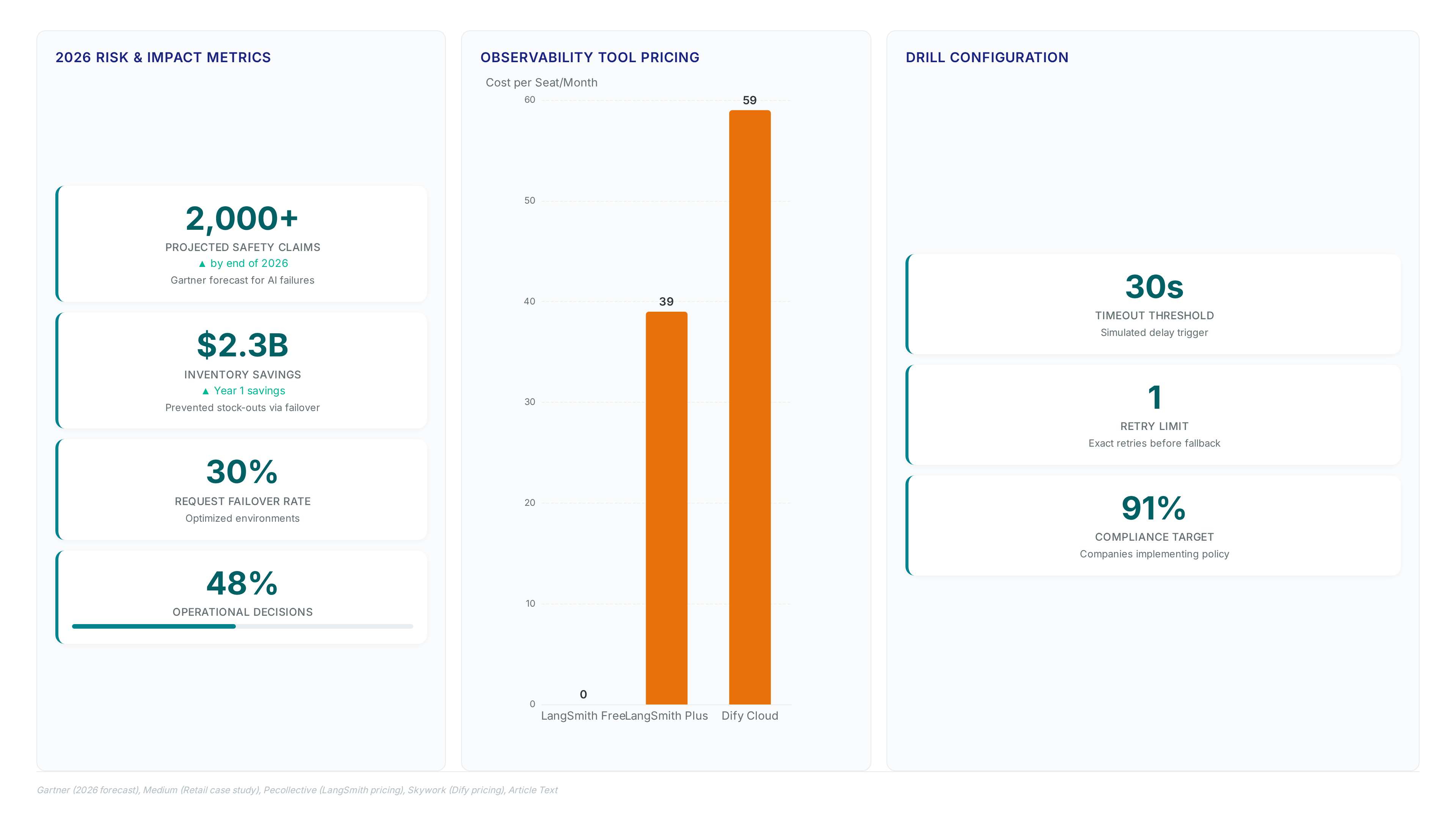
We detail the execution of drills for timeout scenarios and rate-limit spikes to ensure your agents remain honest and recoverable. With IBM predicting agents will handle 48% of operational decisions by 2030, the cost of a half-working fallback that drops tool state or alters output confidence is too high to ignore. This guide provides the concrete steps to make your primary model interchangeable enough to survive provider collapse while keeping the user experience intact.
Defining AI Model Failover Drills and Fallback Contracts
AI Model Failover Drills as Planned Degradation Tests
An AI model failover drill is an intentional breakage of one part of the model path to verify safe product behavior. This definition shifts focus from simple HTTP error handling to validating that fallback contracts hold under stress. A model fallback that only works in a diagram is not durability; it is a documented risk waiting to trigger. Proven drills measure time to first healthy prediction rather than just command issuance. Kubernetes exposes rollout history and status checks to enforce realistic latency budgets during failover. Basic implementations in open-source frameworks often react only to HTTP error codes. Degradation-aware routing considers model quality and latency before failing over. Session-scoped skip markers are required to avoid retrying known-bad paths after auth-class failures. This requirement adds complexity to the adapter layer.
Operators must recognize that 57% of executives believe swapping a core AI model would require a complete system rebuild. These drills represent the only safe way to validate migration paths. Network architects face a clear implication: without explicit payload adapters and verified contracts, failover mechanisms may silently drop tool state or alter schema meanings. Durability requires proving that the system degrades honestly rather than producing polished but incorrect outputs.
Degradation-aware routing enforces fallback contracts by filtering candidates on quality metrics before considering availability. Unlike basic retry logic that reacts solely to HTTP error codes, this approach evaluates model latency and schema fidelity to prevent silent failures. Platforms like TrueFoundry implement policy layers that verify data residency and contractual terms prior to applying cost logic.
A fallback contract defines invariant fields such as citation presence and confidence scores. This matters more than the specific model list. Without these guards, a cheaper model might ignore tool policies while returning valid JSON. Downstream systems receive misleading data in such scenarios. The Model Context Protocol standardizes these connections. Context passes intact during provider switches because of this standardization. Enforcing strict quality gates increases latency. Operators must balance safety against the user experience of waiting for validation.
| Failure Mode | Basic Retry Response | Degradation-Aware Response |
|---|---|---|
| Slow Token Stream | Timeout after fixed duration | Route to lower-latency model |
| Schema Drift | Pass invalid JSON downstream | Repair or switch schema-compatible model |
| Policy Violation | Attempt same prompt elsewhere | Route to policy-compliant flow |
Blind failover burns budgets and corrupts data. Teams must classify failure modes explicitly rather than treating all errors as signal to retry. If a wrong answer is worse than no answer, the system requires quality gates that validate output structure before releasing it to the user. This discipline transforms fragile diagrams into resilient workflows capable of surviving provider instability without compromising data integrity.
The Danger of Half-Working Fallbacks Changing Schemas Silently
Silent schema drift during failover corrupts agent state by dropping tool calls or skipping citations without raising alerts. This degradation mode occurs when a backup model accepts the request but returns valid JSON with altered field semantics, swapping confidence scores for probability metrics, or with citation data missing entirely. Unlike simple HTTP timeouts, these half-working responses trick the orchestrator into believing the workflow succeeded. The system silently violates the fallback contract while appearing functional.
Context engineering has become the top technical priority for maintaining session continuity across provider switches. If a fallback adapter fails to map tool schemas correctly, the agent loses its ability to execute subsequent actions. The user session becomes effectively bricked. Specific implementations now record session-scoped skip markers for non-primary candidates after authentication failures. This approach prevents retrying known-bad paths. Budget waste on providers that previously failed due to auth-class issues rather than transient load stops immediately.
| Failure Mode | Visible Signal | Actual Damage |
|---|---|---|
| Schema Drift | HTTP 200 OK | Missing tool arguments |
| Citation Drop | Valid JSON | Unverifiable claims |
| State Loss | Stream Complete | Broken conversation history |
Relying on basic retries instead of structured drills leaves systems vulnerable to these subtle corruptions. Executives often underestimate this risk. Many believe swapping a core AI model requires a complete system rebuild. The operational reality demands explicit payload adapters that validate output shapes before releasing responses to users. The agent then hallucinates capabilities it does not possess. True durability requires verifying that degradation-aware routing preserves data integrity. Connection uptime alone is insufficient.
Classifying Failure Modes and Adapting Payloads for LLMs
Defining the Six Core LLM Failure Modes for Taxonomy
Operational durability requires classifying exactly six failure modes: Timeout, Rate limit, Schema error, Safety block, Tool mismatch, and Quality regression.
A Timeout occurs when the provider is too slow, demanding an immediate switch to preserve user experience. Schema error involves Invalid JSON or missing fields, necessitating a repair attempt before engaging a schema-compatible fallback. Safety block happens when a Provider refuses a sensitive task; the system must route to a policy flow without blind bypass to avoid compliance violations. Ignoring these distinctions invites legal exposure, as Gartner forecasts more than 2,000 "death by AI" claims by 2027 tied to safety failures, pushing failover drills from a technical nice-to-have to a legal and insurance imperative.
Basic implementations in open-source frameworks may only react to HTTP error codes, missing subtle degradations like quality regression or tool mismatch. Advanced systems employ degradation-aware routing that considers model quality and latency before failing over. The constraint is operational complexity: maintaining distinct handlers for six failure types increases code surface area. For network operators, this taxonomy transforms vague "AI errors" into actionable routing decisions, ensuring that a safety block never triggers a costly retry loop.
Implementing Explicit ModelAdapter Interfaces for Schema Drift
Hardening the ModelAdapter interface prevents schema drift by enforcing strict ModelRequest types before provider transmission. This mechanism maps internal taskId and responseSchema fields to external provider formats, ensuring tool mismatch errors trigger immediate conversion rather than silent data loss. LangChain excels in agent orchestration yet often demands custom logic for strong failover compared to gateways like Bifrost that natively balance loads. The drawback is added complexity in maintaining parity across varying JSON modes and context windows. Operators must validate that fallback paths preserve citation fidelity, not HTTP success codes.
When a Rate limit blocks the primary path, the adapter switches providers while protecting the tenant budget. This approach avoids the half-working state where a backup model returns valid JSON with altered field meanings. Unlike simple retries, explicit interfaces force developers to declare supported capabilities like supportsJsonSchema upfront. AI Agents News recommends testing these adapters against real provider disruptions rather than relying on diagrammed flows. Without explicit payload contracts, failover chains introduce subtle corruption that degrades user trust quicker than total outages.
Validation Checklist for Schema Drift During Fallback Events
Validate ModelResult status codes immediately to halt writes on any invalid_schema signal before data corruption spreads.
- Intercept the raw provider response and verify JSON structure against the declared responseSchema using a strict parser.
- If fields mismatch, trigger exactly one automated repair attempt using the original evidence context.
- Should repair fail, stop the workflow or route to human review rather than forcing a write action.
- Record an in-memory, session-scoped skip marker for the failing model to prevent immediate retry loops within the same user session.
| Failure Signal | Adapter Action | Write Permission |
|---|---|---|
| Schema error | Repair once, then fallback | Denied until valid |
| Tool mismatch | Convert to plan-only mode | Read-only allowed |
| Safety block | Route to policy flow | Denied |
Operators must accept that model churn makes portable evaluations necessary, as noted in industry analysis of Meta's delayed AI model. No write action runs from ambiguous output, preserving the fallback contract even when latency increases.
Executing Failover Drills for Timeout and Rate Limit Scenarios
Defining AI-Specific Failure Modes Beyond Standard Timeouts
Standard API monitoring misses AI-specific failures like schema drift where backup models return valid JSON with altered field meanings. Unlike HTTP 500 errors, these subtle defects trick orchestrators into accepting citation loss or policy violations as successful completions. The same Gartner forecast pushes operators to classify failure modes beyond simple latency spikes. The limitation is that traditional health checks pass while the agent silently burns tenant budgets through excessive retries or ignored tool policies.
- Inject payload adapters that intentionally corrupt citation fields to verify detection logic.
- Simulate tool mismatch scenarios where the fallback model lacks specific function-calling capabilities.
- Measure time to first healthy prediction rather than just command issuance to enforce realistic latency budgets during rollout history
The delay of Meta's recent model rollout highlights how performance concerns can alter supply chains, validating the need for explicit fallback contracts. This reality demands drills that validate payload integrity against real-world provider disruptions rather than assuming interchangeability.
Executing Primary Provider Timeout and Rate-Limit Spike Drills
Injecting a sleep flag to force primary adapter delays beyond the timeout threshold while executing 10 golden tasks validates circuit breaker activation under stress. This drill confirms the system retries exactly once before routing to lower-latency capacity, preventing indefinite user waits during Meta-style performance degradations. Operators must verify that circuit breakers engage to stop traffic oscillation, as flip-flopping during partial recovery burns tenant budgets without restoring service.
Force the primary adapter to return a normalized rate_limited result while injecting concurrent requests from multiple tenants to test admission control logic. High-priority workflows should fail over immediately to reserved capacity, whereas low-priority tasks queue or degrade based on policy. In optimized environments, up to 30% of requests can successfully failover to shared capacity without triggering cascading collapses across the cluster. This approach mirrors AIMD congestion controls found in TCP stacks to dynamically adjust token budgets.
- Configure the test harness to inject specific latency spikes or quota exhaustion errors into the primary path.
- Run concurrent workloads to ensure per-tenant budgets remain enforced during the spike.
- Verify that payload adapters strip incompatible fields before passing data to the backup model.
The hidden tension lies between strict schema validation and latency budgets; rejecting malformed fallback outputs protects data integrity but increases tail latency. Gartner predicts that by 2029, most enterprises will standardize these drills as agentic agents manage critical infrastructure. Without explicit contracts defining acceptable degradation, agents may silently drop citations or alter tool behaviors while appearing successful.
Validation Checklist for Failover Behaviors and Latency Budgets
Verify the retry count stays at one to prevent budget exhaustion during provider outages.
- Measure time to first healthy prediction rather than raw command issuance to enforce realistic latency budgets
- Confirm per-tenant budgets remain intact even when fallback capacity absorbs sudden traffic spikes.
- Validate output schema consistency to ensure no silent field drops occur during model switching.
| Check Target | Success Metric | Failure Consequence |
|---|---|---|
| Retry Logic | Exactly one attempt | Budget burn |
| Latency | Sub-second switch | User timeout |
| Schema | Complete field match | Data corruption |
This drill exposes a hidden tension: aggressive failover improves availability but risks serving degraded quality if the backup model lacks specific tool capabilities. While OpenAI dominates the market, relying solely on their system without verified adapters invites schema drift. Savings from automated inventory workflows vanish entirely if fallback agents hallucinate stock levels. Operators must prioritize strict payload validation over raw speed. AI Agents News recommends treating every fallback path as a distinct product requiring its own quality gates.
Strategic Multi-Model Fallback Decisions for Workflow Safety
Defining High-Trust Workflows Requiring Multi-Model Fallback
Customer-facing chat answers demand multi-model fallback strategies because a single provider outage directly erodes user trust. Internal drafts tolerate delays, yet billing tasks and report generation require continuous access that backup connectivity solutions now provide as core infrastructure. Quality gates belong in the failover path when an incorrect answer causes more harm than no answer at all. 91% of companies plan to implement continuous compliance, making automated audit trails mandatory for governance. Agent workflows calling tools, RAG answers with citations, and data extraction into structured fields represent high-priority candidates for this protection. Non-blocking suggestions and nice-to-have summaries where a clear retry message suffices fall into the low-priority category. A half-working fallback that silently changes schemas or drops tool state without alerting the operator poses significant risk. Such subtle failures can trigger cascading issues that admission controllers using additive increase/multiplicative decrease logic aim to prevent.
| Workflow Type | Trust Impact | Fallback Requirement |
|---|---|---|
| Customer Chat | High | Quality Gates |
| Billing Tasks | Critical | Policy Flow |
| Internal Drafts | Low | Simple Retry |
Organizations waste resources on low-value redundancy when they treat all prompts equally. Degradation-aware routing considers model quality before failing over, rather than just reacting to HTTP error codes. Operators must classify failure modes explicitly to avoid blind bypasses of safety blocks. Lost tenant budgets and corrupted data states measure the cost of ignoring this classification.
Applying Fallback Logic to Tenant Budget and Citation Tasks
RAG workflows with citations require strict fallback contracts because 68% of healthcare AI agents now drive critical decisions where lost references compromise patient safety. Operators must implement degradation-aware routing that filters fallback sets by policy constraints before applying cost logic, preventing unauthorized data residency breaches during outages Degradation-Aware Routing. Blindly retrying failed requests burns tenant budgets rapidly, especially when admission controllers do not limit traffic to constrained providers using algorithms like AIMD. The mechanism enforces a hard stop after one repair attempt for invalid JSON, forcing a switch to a schema-compatible model rather than looping on broken payloads. Agents silently drop citation fields while maintaining valid output structures without these gates, creating high-risk hallucinations. Strict quality gates increase latency, potentially exceeding user tolerance thresholds during mass provider incidents.
Network architects should prioritize citation discipline over raw availability for compliance-heavy tasks. The system must return a partial result or queue for review instead of serving unverified claims if the primary model loses source tracking. This approach prevents budget exhaustion from excessive retries while maintaining audit trails required for governance.
- Enforce payload adapters to validate citation presence before releasing responses.
- Route safety-blocked tasks to policy flows without blind bypass attempts.
- Apply per-tenant budgets to stop runaway costs during cascading failures.
- Disable write actions if output confidence falls below set thresholds.
- Monitor fallback triggers to identify recurring provider instability patterns.
Consult AI Agents News for updated drill templates regarding implementation guidance on these patterns. Reduced throughput during incidents preserves trust better than fast, incorrect answers.
About
Diego Alvarez serves as a Developer Advocate at AI Agents News, where his daily work involves building and stress-testing autonomous systems with frameworks like CrewAI and LangGraph. This hands-on experience makes him uniquely qualified to discuss AI agent failover drills, as he constantly encounters the very provider outages and schema mismatches that threaten production stability. Unlike theoretical discussions, Diego's role requires him to engineer resilient workflows that survive real-world chaos, from rate-limit spikes to silent model degradation. At AI Agents News, a hub dedicated to technical founders and engineers, the focus remains on practical reliability over hype. By translating his routine debugging and benchmarking sessions into actionable guidance, Diego ensures that developers understand how to keep user interactions honest and recoverable. His insights bridge the gap between abstract architecture diagrams and the messy reality of maintaining functional agents when primary providers break.
Conclusion
Scaling AI agents reveals that semantic corruption during failover costs far more than simple downtime. When a backup model returns structurally valid but logically inverted data, it poisons downstream tool state and erodes user trust quicker than an explicit timeout ever could. The operational reality is that maintaining uptime without enforcing payload semantics creates a fragile illusion of reliability. Companies must shift focus from mere connectivity to rigorous content validation layers that inspect meaning, not just JSON syntax.
Organizations deploying agents for critical workflows must mandate semantic quality gates by Q3 2026. Do not allow fallback mechanisms to trigger write actions unless the system verifies field meanings match the original intent with absolute precision. If a backup cannot guarantee semantic fidelity, the architecture must default to a hard stop rather than risk propagating silently corrupted data. This approach prioritizes long-term data integrity over short-term availability metrics.
Start this week by auditing your current failover logs specifically for schema drift where field values remain valid but lose their original context. Identify any instance where a secondary model satisfied the structural contract while altering the semantic output, then immediately patch those adapters to enforce stricter contextual matching before the next deployment cycle.
Frequently Asked Questions
Simple retries miss subtle failures like schema drift or lost citations. Relying on them leaves 95% of Generative AI pilots failing to show profit due to outages and silent data corruption risks.
Many leaders incorrectly assume swapping a core AI model requires a complete system rebuild. In reality, 57% of executives believe this, though proper failover drills prove migration paths can be safe.
Drills intentionally degrade model paths to verify workflow safety rather than just checking connectivity. This approach ensures agents self-heal without human intervention, preventing polished but incorrect outputs during stress.
Traditional logic misses issues like schema drift, lost citations, and ignored tool policies. These subtle errors cause valid but incorrect outputs, requiring rigorous testing beyond simple HTTP error code checks.
IBM predicts agents will handle 48% of operational decisions by 2030. This high volume makes the cost of half-working fallbacks that drop tool state or alter output confidence too high to ignore.