MAI models: Microsoft's 35B reasoning engine explained
Microsoft AI announced seven new MAI models at Build 2026, led by a reasoning engine with 35 billion active parameters.
The release of the MAI model family marks a strategic pivot where Microsoft operates as both a platform provider and a frontier-model lab, prioritizing unusual technical disclosure over marketing vagary. Unlike previous launches obscured by hype, this rollout includes a 109-page technical report for the flagship MAI-Thinking-1, offering a level of transparency that has already drawn positive reactions from the technical community. This shift toward open specification sets a new baseline for enterprise trust in generative AI.
The 35B active parameter architecture drives performance within a sparse Mixture-of-Experts framework, using a massive 256K context window to handle complex reasoning tasks. Deployment now hinges on agent-native Windows environments and new secure execution layers designed to scale these models safely across corporate infrastructure. The broader system impact includes the integration of Web IQ for agent grounding and the positioning of GitHub Copilot as the central hub for this new development workflow.
The MAI Model Family Changes Technical Transparency in Frontier AI
MAI-Thinking-1 35B Active Parameter MoE Architecture
MAI-Thinking-1 operates as a sparse Mixture-of-Experts model using 35 billion active parameters for inference while maintaining a total parameter count of roughly 1 trillion. This architecture selectively activates specific expert sub-networks per token rather than engaging the full model width, enabling high-capacity reasoning within a constrained compute budget. The design supports a 256K context window, allowing the system to process extensive codebases or technical documentation in a single pass without truncation.
Microsoft emphasizes that this active-parameter count drives significant cost savings over larger competitor models, but this efficiency relies entirely on the sparsity mechanism functioning correctly under load. Operators deploying this model should anticipate variable latency profiles compared to dense models of similar active size, as routing overhead fluctuates with input complexity. This trade-off favors workloads requiring deep contextual understanding over raw throughput consistency. The distinction between active and total parameters fundamentally alters capacity planning for enterprise deployments.
Deploying MAI-Code-1-Flash in VS Code and GitHub Copilot CLI
Integrating MAI-Code-1-Flash into VS Code enables rapid agent-native Windows development with just 5B parameters. This configuration delivers 51% on SWE-Bench Pro, providing high-velocity feedback for local iteration loops. Developers using the GitHub Copilot CLI gain immediate access to this efficiency without managing remote inference queues. The model's small active footprint reduces latency during automated code review tasks within CI/CD pipelines.
Unlike larger reasoning models, Flash prioritizes token throughput over complex multi-step deduction. A critical limitation emerges when tasks require broad context retention; the smaller parameter count restricts long-range dependency tracking compared to the 35B active variant. Teams must route simple refactoring to Flash while reserving complex architectural changes for larger models. This bifurcation optimizes cost but demands precise prompt engineering to avoid hallucination. Configure fallback policies for tasks exceeding specific complexity thresholds.
MAI-Thinking-1 Versus Sonnet 4.6 on AIME 2025 and SWE-Bench Pro
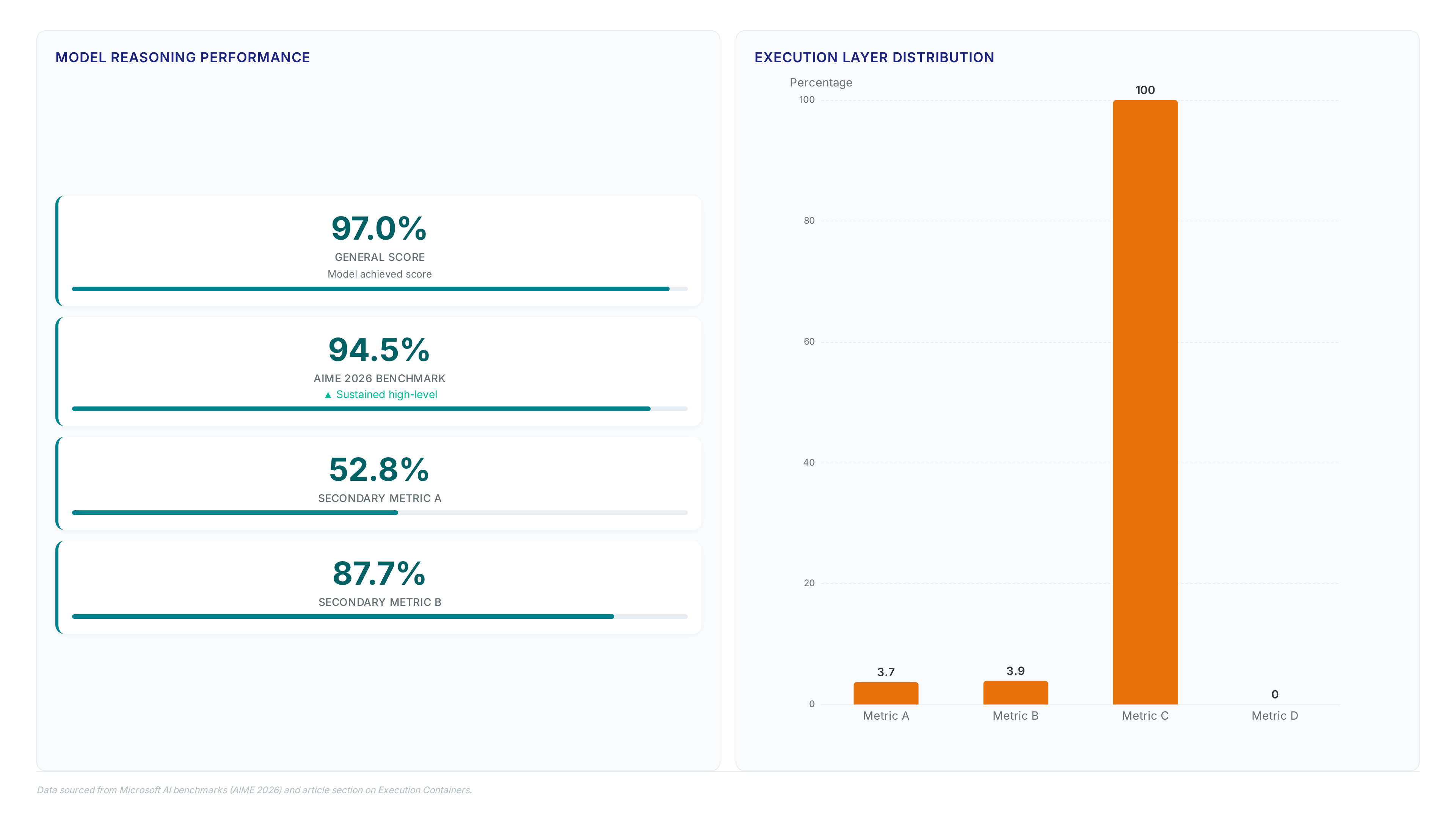
MAI-Thinking-1 is a reasoning model achieving 97.0% on the AIME 2025 mathematics benchmark. This score places it ahead of many contemporaries in the logic tasks. Microsoft reports the system matches Claude Opus 4.6 on the SWE-Bench Pro coding benchmark while using a sparse Mixture-of-Experts architecture. Independent evaluators reportedly preferred MAI-Thinking-1 over Anthropic's Claude Sonnet 4.6 during blind human assessments on the Surge platform. These results suggest the model's chain-of-thought processes align well with human judgment in complex problem-solving scenarios.
| Result | MAI-Thinking-1 |
| AIME 2025 | 97.0% |
| SWE-Bench Pro | Matches Claude Opus 4.6 |
| Blind human preference vs Claude Sonnet 4.6 | Preferred |
The data indicates a divergence between raw benchmark performance and perceived utility in side-by-side comparisons. High scores on static benchmarks do not guarantee superior user experience in flexible agent workflows. The cost of deploying a 35B active parameter model for every query may outweigh the marginal gains in specific reasoning tasks compared to smaller, quicker alternatives. Builders should validate claims against their own workloads rather than relying solely on leaderboard positions. The distinction between matching a competitor on coding tasks and exceeding them in human preference tests highlights the complexity of evaluating agent-native capabilities.
Inside the 35B Active Parameter MoE Architecture Driving MAI Performance
Efficiency Gain Metric and Internal NLL Data Composition
Architecture promotion relied on an Efficiency Gain (EG) metric rather than raw parameter scaling. This quantitative measure evaluated the cost versus reasoning capability, ensuring that increases in model size translated directly to verifiable performance improvements per token. The decision to advance specific architectural configurations depended on this ratio, prioritizing sparse activation patterns that minimized inference latency while maintaining high accuracy on complex benchmarks. Data curation for the internal private NLL set followed a strict distribution to optimize the scaling ladder. The composition included:
- 50% code
- 17.5% STEM
- 17.5% math
- 10% general knowledge
- 5% multilingual
This heavy weighting toward code and technical domains aligns with the model's demonstrated proficiency in logical reasoning tasks. The EG metric reportedly showed ablation improvements at roughly 100 to 200 tokens per parameter during training phases. The model's design emphasizes a specialized profile optimized for structured problem-solving environments. Reliance on a private dataset means external validation of data quality remains indirect, inferred only through final benchmark scores. This approach contrasts with open-weight models where training corpora are publicly auditable, introducing a variable for enterprise risk assessment regarding potential bias or gaps in the private NLL set.
MAIA 200 Optimization for Performance-Per-Watt Gains
Running MAI-Thinking-1 on MAIA 200 hardware delivers a 1.4x performance-per-watt gain compared to GB200 clusters, alongside a claimed 30% improvement in performance per dollar. Microsoft engineered this efficiency by aligning the model's sparse activation patterns with the silicon's memory bandwidth, avoiding the bottlenecks common in dense GPU configurations. The resulting architecture derives these metrics from end-to-end inference costs rather than raw FLOPS. Unlike standard scaling laws where performance grows linearly with power, this configuration uses specific hardware-software co-design to decouple throughput from energy consumption. These metrics apply specifically when running MAI models end-to-end on the corresponding infrastructure. The 1.4x gain is substantial yet remains tied to the corresponding infrastructure investment. Builders must weigh the capital expenditure of new hardware against the long-term operational savings in power and cooling.
Reasoning Capability Without Synthetic Data Distillation
Microsoft started reinforcement learning from a checkpoint with no prior reasoning exposure, verifying that high test scores do not require synthetic data distillation. This approach isolates the model's native logical capacity, proving that clean data lineage yields competitive results on mathematics benchmarks without inheriting biases from third-party systems. A substantial claim repeated across technical commentary confirms the training pipeline excluded all distilled datasets, relying instead on commercially licensed sources to maintain verifiable AI infrastructure.
| Feature | Value | Notes |
|---|---|---|
| Distillation | None | Prevents error propagation from teacher |
| Data Source | Licensed | Commercial sources only |
| Verification | Direct | Clean lineage confirmed |
The resulting model offers a distinct advantage for regulated industries where the origin of every token matters more than marginal speed gains.
Deploying Agent-Native Windows and Secure Execution Layers for Enterprise Scale
Windows Secure Execution Layers and Web IQ Grounding API
Microsoft Execution Containers (MXC) isolate agent processes to prevent unauthorized system access during automated workflows. This secure boundary enables deep integration with Windows Subsystem for Linux (WSL), allowing developers to run complex reasoning agents within a controlled secure environment. The architecture ensures that even if an agent attempts to execute malicious code, the containment layer restricts impact to the specific container instance. However, maintaining this isolation requires explicit configuration of network policies, as default settings may permit broader connectivity than intended for sensitive data tasks.
For response accuracy, the stack relies on the Web IQ API to ground outputs in verified search results rather than parametric memory alone. These APIs reportedly power nearly all substantial industry chatbots, providing a consistent mechanism for retrieval grounding. Engineers can invoke this stack to validate agent claims against current web data before presenting answers to users. The trade-off is increased latency; every grounding call adds round-trip time that real-time voice applications might not tolerate without optimization.
| Component | Function | Deployment Constraint |
|---|---|---|
| MXC | Process Isolation | Requires WSL integration |
| Web IQ | Data Grounding | Adds network latency |
Organizations adopting this stack gain verifiable execution paths but must architect for the added delay of external validation steps. Successful deployments treat grounding as an optional toggle for latency-sensitive modes.
Deploying Surface RTX Spark Dev Box for Local GPU Agent Workloads
The Surface RTX Spark Dev Box provides localized compute for running agent workloads without cloud dependency. This hardware supports the execution of large models directly on developer machines, using NVIDIA acceleration to maintain low latency during bidirectional tasks. GitHub Copilot functions as a primary desktop surface here, using canvases to bridge CLI operations with cloud-based continuity. Developers can schedule prompts and manage terminal UIs within this environment, ensuring that sensitive code remains within the local security boundary.
Implementing secure agent execution in Windows requires isolating processes within Microsoft Execution Containers. Local execution shifts the burden of resource management from the cloud to the endpoint. Validate memory headroom before deploying multi-agent swarms on this hardware.
Checklist for Integrating Copilot CLI Experimental Terminal UI Features
Validate that the experimental terminal UI displays tabs for distinct agent sessions before enabling prompt scheduling or voice input features. Engineers must confirm continuity across CLI, mobile, web, local, and cloud environments to prevent context loss during handoffs.
- Verify prompt scheduling queues tasks without executing them until explicit approval.
- Test voice input accuracy against noise floors typical of open office environments.
- Ensure built-in feedback loops capture evaluation metrics for every agent action.
| Feature | Configuration Goal | Risk if Skipped |
|---|---|---|
| Tabs | Isolate session state | Cross-contamination of variables |
| Voice Input | Enable hands-free control | Misinterpreted commands in noisy rooms |
| Scheduling | Defer execution windows | Uncoordinated resource spikes |
A critical tension exists between secure execution and developer velocity; strict Microsoft Execution Containers (MXC) prevent unauthorized access but may block legitimate package installations if policies are too narrow. Audit container logs weekly to balance these constraints. Overly permissive defaults expose the host to agent drift, while excessive locking stifles the bidirectional workflows the GitHub Copilot app promotes.
Integrating MAI Models via Microsoft Foundry for Custom Fine-Tuning
Defining the MAI Model Family and Enterprise Availability
Microsoft AI rolled out seven new models covering reasoning, code, image, speech transcription, and voice. The lineup includes MAI-Thinking-1, MAI-Code-1-Flash, MAI-Image-2.5, MAI-Transcribe-1.5, and MAI-Voice-2. These additions push the family past its initial reasoning focus into diverse enterprise modalities like audio processing. Market dynamics show open-weight models currently handle 69.1% of token volume while closed models take 30.9%, according to OpenRouter data. MAI-Thinking-1 targets a competitive spot in this split by offering commercial-grade lineage.
- Identify the specific modality required, such as speech-to-text or voice synthesis, within the MAI lineup.
- Access the models through Microsoft Foundry, where MAI-Thinking-1 is currently available in private preview.
- Use the model's architecture to optimize inference costs for enterprise deployments.
Engineers must balance the value of verified data sources against the current limitation to private preview access governed by enterprise agreements.
Implementing Enterprise Fine-Tuning Workflows with MAI-Transcribe-1.5
Access to MAI-Transcribe-1.5 starts inside the Microsoft Foundry private preview environment instead of public endpoints. This gating mechanism keeps downstream fine-tuning workflows aligned with strict data lineage requirements mandated by corporate governance policies. Private preview status means availability stays restricted to validated enterprise users with specific contractual access.
- Export labeled audio datasets matching the model's supported language configuration.
- Use the Microsoft Foundry interface to manage fine-tuning jobs within the secure enterprise environment.
- Apply keyword biasing for domain-specific terminology like medical or legal nomenclature.
A 109-page technical report details the reasoning capabilities and structural design backing MAI-Thinking-1. Documentation like this gives engineers the specifications needed to evaluate the model against competitors for complex task resolution. Operators face a cost when weighing reported accuracy metrics against the computational load of adapting a system with a large total parameter count. Customizing the base model for niche acoustic environments demands infrastructure capable of handling the scale. High-volume transcription tasks justify the infrastructure expense through marginal accuracy gains. Specialization is becoming the primary differentiator for enterprise adoption over raw benchmark scores.
Checklist for Validating MAI Model Integration via Microsoft Foundry
Check model access status in Microsoft Foundry before configuring downstream orchestration layers for production traffic. Developers need confirmation that their enterprise agreements support the private preview requirements necessary for initial connectivity.
- Verify Chat Completions API compatibility to ensure standard interfaces function without custom wrappers.
- Confirm Linux integration depth within Windows Subsystem for Linux supports required agent dependencies.
- Validate fine-tuning job parameters against the data lineage constraints enforced by the platform.
| Checkpoint | Validation Target | Failure Mode |
|---|---|---|
| Access Layer | Private Preview Gate | Connection Refused |
| Interface | Chat Completions API | Schema Mismatch |
| Data Policy | Eyes-off Compliance | Job Rejection |
Mustafa Suleyman described the training approach as the output of Microsoft's internal "hill-climbing machine," implying distinct weight structures that demand rigorous parameter verification during startup. Proper validation allows agents to reach the secure execution layers highlighted during Build. These announcements came from official Microsoft AI communications and leadership commentary on the company's strategic direction. Skipping this step causes silent failures where agents initialize but lack permissions for secure execution. Industry analysis suggests treating the private preview gate as a hard dependency for all enterprise fine-tuning workflows.
About
Priya Nair serves as the AI Industry Editor at AI Agents News, where she tracks critical product launches and platform shifts affecting autonomous systems. Her daily work involves verifying technical claims and analyzing market moves from substantial players like Microsoft, making her uniquely qualified to dissect the new MAI model family. As Microsoft positions itself as both a platform provider and frontier lab, Nair's expertise in agent-platform vendors allows her to evaluate how these seven new models, spanning reasoning, code, and voice, impact the broader system. Her reporting connects Microsoft's Build conference announcements directly to the practical needs of engineers building with tools like CrewAI and AutoGen. By focusing on concrete capabilities rather than marketing hype, she provides the technical clarity necessary for developers to understand how MAI-Thinking-1 or MAI-Code-1-Flash might integrate into existing multi-agent workflows. This grounded analysis ensures readers receive accurate, actionable intelligence on how these releases shift the environment for coding agents and orchestration frameworks.
Conclusion
The MAI family is best judged on the two things Microsoft actually documented: a sparse Mixture-of-Experts design where only a fraction of the total parameters activate per token, and a training pipeline built on commercially licensed data with no distillation from other systems. The first decides what the model costs to run at scale. The second decides whether a regulated buyer can defend using it at all.
Both claims come from the vendor. The published scores back the reasoning claim and the blind human comparison backs the output-quality claim, but the private evaluation set stays private, so external validation remains indirect. Treat the 109-page report as the starting point of your own evaluation rather than the end of it, and test the models on your own workload before the deployment details of Windows containers and Foundry access start to matter.
Frequently Asked Questions
The model uses 35 billion active parameters for efficient reasoning tasks. This specific count enables significant cost savings compared to larger dense models while maintaining high capacity through its sparse architecture design.
The system maintains a total parameter count of 1 trillion across its experts. This massive scale allows selective activation of sub-networks, enabling high-capacity reasoning within a strictly constrained compute budget for users.
MAI-Code-1-Flash delivers a 51% score on the SWE-Bench Pro benchmark. This configuration provides high-velocity feedback for local iteration loops, though it lacks the long-range context retention of larger variants.
The reasoning model achieved a 97.0% score on the AIME 2025 benchmark. This result indicates strong alignment with human judgment in complex problem-solving scenarios compared to other contemporary frontier models available today.
Optimization on MAIA 200 claims a 30% improvement in performance per dollar. This efficiency gain is critical for enterprises scaling agent-native workflows while managing overall infrastructure costs effectively.
References