LangGraph vs CrewAI: Picking Your Agent Framework
No single framework dominates the 2026 environment, but LangGraph and CrewAI have emerged as the top choices for agent orchestration. The industry has moved past simple chatbots to complex systems where AI agent frameworks must balance autonomy with structural reliability. Your architecture now dictates whether your agents fail silently or execute multi-step plans with precision.
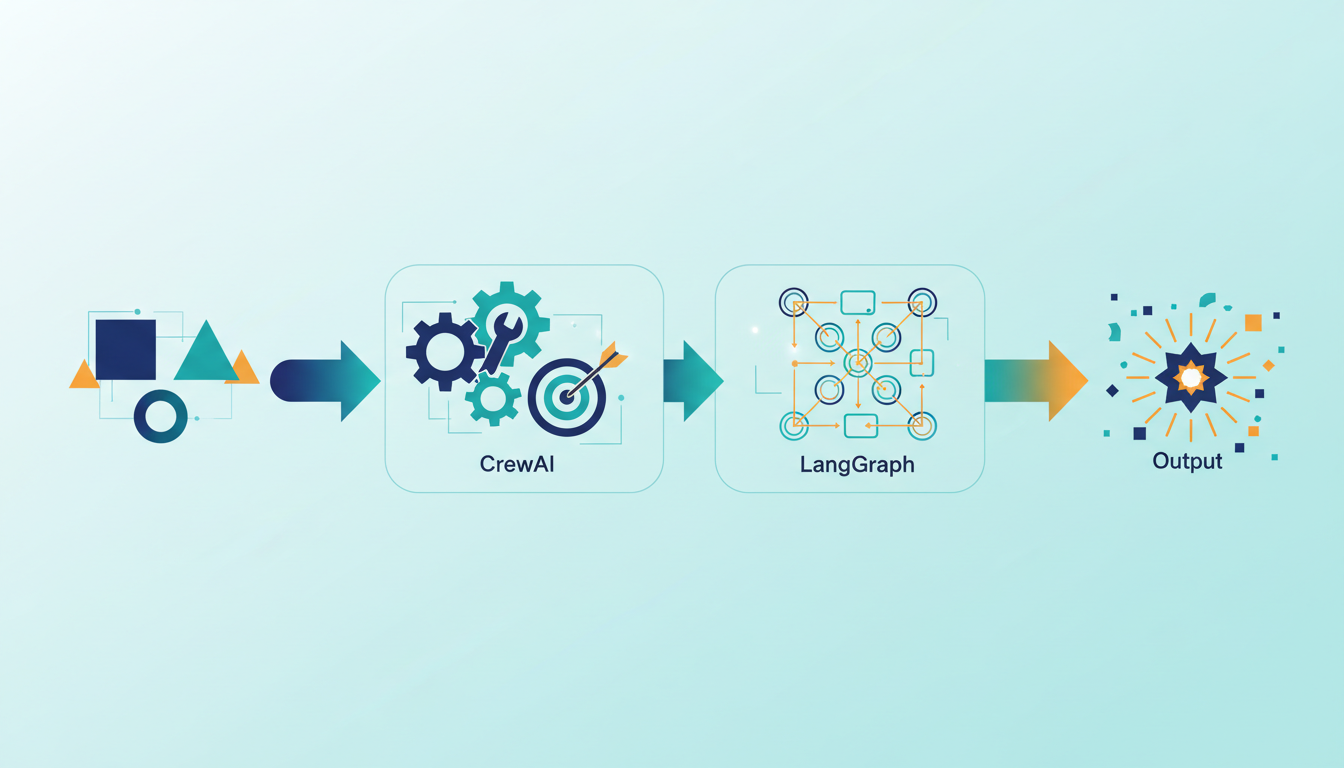
The split is topological. LangGraph draws the workflow as a graph and charges for that control in upfront edge definitions, while CrewAI hands the same workflow to a container of roles and charges for the speed in reduced visibility. The rest of the shortlist sits between those two positions: the OpenAI Agents SDK trades portability for native model access, AutoGen trades topology for asynchronous chat, Smolagents trades structure for generated code, and Semantic Kernel and the Strands Agents SDK trade setup time for enterprise controls.
Whichever way that choice goes, it stops being defensible the moment nobody can see what the agents did, which is why Langfuse shows up in the deployment criteria below rather than as an afterthought.
The Role of Agent Orchestration in Modern AI Architecture
LangGraph DAGs and CrewAI Role Abstractions
Mapping autonomous reasoning requires imposing specific topological constraints on how tasks flow. LangGraph executes this vision through a directed acyclic graph (DAG) where nodes stand for discrete prompts and edges strictly govern data transitions. Such an architecture fits complex workflows needing precise branching control alongside stateful error handling mechanisms. Developers model logic as explicit paths, enabling granular debugging of decision flows within the LangChain system. The graph structure supports complicated, multi-step tasks where precise control over branching is necessary, though it demands upfront definition of potential state transitions.
CrewAI takes a different path by using a higher-level abstraction known as a Crew. This container holds multiple agents with distinct functional roles. The role-based approach coordinates workflows by allowing agents to share context and build upon sequential contributions without manual pathing. While LangGraph requires mapping every edge, CrewAI agents dynamically delegate tasks, such as a Planner assigning research duties to a Writer. This flexibility accelerates setup for collaborative scenarios, using a cognitive memory layer that intentionally forgets and resolves contradictions.
| Feature | LangGraph | CrewAI |
|---|---|---|
| Topology | Directed Acyclic Graph | Role-Based Container |
| Control Flow | Explicit Edge Definitions | Flexible Delegation |
| Primary Use | Stateful Workflows | Collaborative Tasks |
Structural rigor clashes with operational fluidity here. LangGraph guarantees predictable execution paths at the cost of verbosity, and it demands that every potential state path be defined upfront. CrewAI prioritizes adaptive collaboration over strict path validation, which leaves hard constraints on inter-agent message passing to process types rather than explicit edges. Recent analysis identifies both as primary choices for complex multi-agent orchestration in 2026, so selection turns on whether the application demands deterministic state management or flexible agent interaction patterns. Evaluating the necessity of custom edge conditions is worth doing before committing to the graph-heavy framework.
Applying AutoGen Asynchronous Chats for Real-Time Tool Invocation
AutoGen frames operations as an asynchronous conversation among specialized agents to reduce blocking during execution. This conversational GroupChat dynamic enables non-blocking operations necessary for multi-turn dialogues requiring flexible tool execution. Unlike the rigid graph structures found in LangGraph, AutoGen allows agents to function as ChatGPT-style assistants that orchestrate message passing fluidly between tool executors. This approach suits scenarios where workflows demand real-time concurrency rather than predefined DAG paths.
The framework's research-driven community supports free-form chat among many agents, facilitating complex interactions without strict topological constraints. Rapid growth in GitHub stars highlights how quickly developers adopted these conversational patterns. However, this flexibility introduces a limitation: the lack of explicit edge definitions can make visualizing decision flows harder compared to graph-based alternatives. Developers often rely on external monitoring solutions to track state effectively across the asynchronous message history.
Choosing between the OpenAI Agents SDK for explicit handoffs or Google ADK for hierarchical trees depends on specific needs. Select AutoGen when the primary requirement is flexible, event-driven dialogue rather than structured workflow enforcement. The Microsoft Agent Framework now merges these capabilities with Semantic Kernel to unify enterprise session management.
Architectural Mechanics of Leading Open-Source Frameworks
Smolagents Code-Centric Loop vs LangGraph DAG Nodes
Smolagents skips complex prompt engineering by letting the agent write and execute Python code directly. This code-centric method delegates logic generation to the interpreter, handling ReAct style prompting internally so developers can watch the AI generate scripts on the fly without defining explicit graph nodes. Rapid prototyping thrives here for self-contained agents that need to call libraries or run quick computations. Such a setup avoids the overhead of a full DAG when the task remains small.
LangGraph takes a different path by extending the LangChain library into a graph-based architecture where agent steps become nodes in a directed acyclic graph. Strict data flow between set nodes replaces implicit execution loops, ensuring reliable handling of complex tasks. A clear constraint emerges for developers weighing these options: single agents calling one or two tools gain speed from simple loops, yet complex workflows demand the structural rigor of graph-based orchestration.
| Feature | Smolagents | LangGraph |
|---|---|---|
| Execution Model | Minimal code loop | Directed acyclic graph |
| Primary Control | Interpreter execution | Conditional edges |
| Best Fit | Quick computations | Stateful workflows |
Visualizing decision flows becomes straightforward with LangGraph's DAG philosophy, offering precise control over branching and error handling. Teams must determine whether their application needs the fluidity of on-the-fly code generation or the auditability of a predefined state machine.
Selecting Frameworks: Stateful DAGs vs Asynchronous Chats
Select LangGraph when orchestration requires strict state control via a directed graph with conditional edges. Deterministic transitions enforce themselves within this architecture, suiting workflows where branching logic must be explicitly set rather than emergent. Defining every potential state path upfront increases configuration overhead compared to flexible alternatives. AutoGen serves scenarios demanding real-time concurrency, where the execution flow emerges from the conversation instead of being drawn before runtime. That is also its debugging cost: there is no static diagram to compare a failed run against, so teams fall back on external tracing to reconstruct what happened.
| Feature | LangGraph | AutoGen |
|---|---|---|
| Orchestration Model | Directed graph with conditional edges | Conversational GroupChat dynamics |
| Primary Strength | Precise state management | Real-time concurrency |
| Best Fit | Complex, multi-step workflows | Flexible, multi-turn conversations |
Data science pipelines often use AutoGen's event-driven architecture to manage interactions between agents and various LLMs effectively. Applications prioritizing visualization of decision flows or injection of custom logic at specific stages find the explicit approach of LangGraph provides necessary structure. The choice ultimately depends on whether the application prioritizes topological certainty or conversational fluidity. Teams should evaluate if their workflow benefits more from the role-based crews of other frameworks or these distinct architectural patterns.
Strategic Selection Criteria for Multi-Agent Deployments
Deploying OpenAI Agents SDK for GPT-4o Native Orchestration
Select the OpenAI Agents SDK when applications demand official, low-latency access to GPT-4o or o3 reasoning capabilities within a single-vendor stack. This framework packages model-specific features into a structured toolset, allowing agents to plan and call external APIs without the abstraction layers found in general-purpose orchestrators. Developers prioritizing speed-to-prototype for single-agent tasks often find this path quicker than assembling modular components from open-source alternatives. The specialized agent runtime simplifies role assignment and trigger configuration, reducing boilerplate code required for basic function calling.
Architectural flexibility yields to vendor lock-in with this simplified approach, rendering it less suitable for complex multi-agent workflows requiring heterogeneous model support. Unlike LangGraph or CrewAI, which excel at coordinating diverse agent roles across different providers, the native SDK confines operations to the OpenAI system. Focused use cases benefit most when deep integration with OpenAI's latest model features outweighs the need for multi-vendor interoperability. Teams should evaluate whether their workflow complexity justifies the overhead of a graph-based system or if a direct SDK implementation suffices. This tool offers the most direct route to using new model capabilities as they ship for those deeply embedded in the OpenAI environment.
Strands Agents Checklist for Model-Agnostic Production Tracing
Teams requiring provider flexibility across Amazon Bedrock, Anthropic, and Ollama should validate against the Strands Agents SDK for its model-agnostic runtime. This framework uses LiteLLM to unify access patterns, eliminating the need to rewrite logic when swapping underlying large language models. Production readiness depends on visibility, and Strands offers first-class OpenTelemetry tracing to monitor latency and token usage across heterogeneous backends.
Operators must verify that their chosen framework supports deep AWS integrations if running within that system, a capability Strands includes optionally. Speed from single-vendor tools conflicts with the long-term maintainability of avoiding lock-in. Choosing a proprietary SDK initially accelerates prototyping but necessitates costly refactors if model providers change. Evaluating frameworks on production readiness criteria like type safety and middleware support prevents architectural dead-ends. AI Agents News recommends this approach for enterprises prioritizing operational control over initial setup speed.
| Feature | Strands Agents SDK | Single-Vendor SDKs |
|---|---|---|
| Model Support | Multi-provider via LiteLLM | Proprietary endpoints only |
| Tracing | Native OpenTelemetry | Vendor-specific logs |
| Deployment | Cloud-agnostic | Cloud-tied |
Implementing and Debugging Agent Workflows in Production
CrewAI Role-Based Crews and Semantic Kernel Skills
CrewAI bundles autonomous units inside a Crew container so distinct roles perform collaborative tasks in sequence or parallel. Developers assign specific goals to agents, letting the framework handle context sharing and delegation automatically. This role-centric abstraction simplifies complex workflows by treating the group as one functional unit instead of scattered nodes. High-level coordination introduces latency during context synchronization that strict state machines avoid.
Semantic Kernel takes a different path as Microsoft's .NET-first approach for orchestrating AI skills into executable plans. The framework lets engineers mix native code functions with AI prompts, creating hybrid workflows fit for enterprise integration. Support for multiple languages including C#, Python, and Java enables adoption within existing Microsoft ecosystems. Semantic Kernel offers deep Azure integration yet demands more boilerplate configuration than lightweight prototyping tools.
Operational stability often dictates framework selection over raw feature counts. Production experience keeps narrowing the field to a handful of frameworks that hold up under enterprise load, filtering out dozens of experimental tools. Teams should choose CrewAI for collaborative task forces and Semantic Kernel when embedding AI into established business processes requires strict compliance boundaries.
Standing a Crew up takes three declarations rather than a graph definition:
- Define agent roles and goals within the Crew configuration.
- Instantiate specific skills or tools for each agent to apply.
- Execute the crew to trigger coordinated task resolution.
| Feature | CrewAI | Semantic Kernel |
|---|---|---|
| Primary Abstraction | Role-based Crew | AI Skills & Plans |
| Best Fit | Collaborative Workflows | Enterprise Integration |
| System | Python-centric | Microsoft.NET |
Executing Code Tasks with Smolagents and Tracing via Langfuse
Smolagents needs only a list of available tools; the agent generates the logic that calls them, with no step-by-step graph to maintain.
Observability becomes mandatory because internal reasoning steps remain opaque without external tracing. Integrating Langfuse captures the generated code and execution outputs, transforming the black box problem into debuggable spans. Identifying why an agent chose a specific library or failed a syntax check requires guesswork without this layer.
Simplicity limits complex state management compared to graph-based systems. Ideal scenarios include standalone computational tasks, yet the lack of built-in persistent memory means long-running sessions require external state stores. Teams must decide if the speed of on-the-fly code generation outweighs the need for rigid workflow controls found in DAG architectures.
Production Readiness Checklist for Enterprise AI Orchestration
Validate Semantic Kernel deployments against strict security and compliance standards required for Azure integration. This Microsoft framework prioritizes type safety and middleware controls over experimental flexibility, making it suitable for regulated industries. Teams must verify that all AI "skills" map to auditable code paths rather than relying on opaque prompt chaining. Adopting this stack often necessitates a .NET or Python environment alignment that legacy Java systems may struggle to bridge without significant refactoring.
Configure CrewAI memory systems for version 0.86+ to access updates optimized for extreme performance in high-throughput scenarios. Role-based collaboration functions effectively only when context windows are managed to prevent token bloat during parallel task execution. Operators should test delegation logic under load, as the overhead of synchronizing state between "Planner" and "Writer" agents can introduce latency spikes unaddressed by simpler sequential models.
Resolve tracing gaps in complex orchestrations by integrating Langfuse to visualize token flows across distributed nodes. Production stability relies on observing these traces to identify where agent loops stall or consume excessive resources. Debugging asynchronous failures becomes a process of elimination rather than data-driven analysis without this visibility. AI Agents News recommends establishing these baselines before scaling to multi-agent clusters.
About
Priya Nair serves as the AI Industry Editor at AI Agents News, where she tracks product launches and platform shifts across the autonomous agent environment. Her daily work involves rigorously evaluating emerging tools like LangGraph, CrewAI, and the OpenAI Agents SDK to distinguish genuine architectural advances from marketing hype. This constant exposure to framework release notes, benchmark data, and real-world deployment challenges uniquely qualifies her to analyze the current system of open-source AI agent frameworks. At AI Agents News, Nair applies a neutral, engineer-focused lens to compare orchestration capabilities, tool-use patterns, and multi-agent coordination features. By grounding her analysis in verified technical details rather than vendor narratives, she provides software engineers and technical founders with the clear, actionable insights needed to select the right framework for building reliable, autonomous systems.
Conclusion
Scaling agent frameworks reveals that operational latency often stems from unmanaged state synchronization rather than model inference speed. The choice this comparison opened with resolves along the same line: LangGraph earns its verbosity wherever a workflow has to branch on state and be replayed afterwards, and CrewAI earns its abstraction wherever the roles are stable and the path between them is not worth drawing by hand. Neither survives being pushed into the other's territory, and that is where the architectural drift in mature deployments starts.
Do not attempt to force a single framework across all use cases, as this creates fragile bridges between incompatible state management styles. Instead, mandate a pilot phase lasting no more than six weeks where teams validate token flow visibility before committing to full integration. Your immediate priority this week is to integrate Langfuse into your current development environment to visualize token flows across distributed nodes. This specific step exposes hidden loops and resource stalls that basic logging misses, providing the data necessary to choose between session-based or shared context architectures. Only with that visibility can you tell whether explicit edges are earning their configuration cost, or whether flexible delegation is quietly hiding the loop that stalls your runs.
Frequently Asked Questions
You lose explicit edge definitions needed for rigid control flows. CrewAI prioritizes adaptive collaboration over strict path validation, which can make visualizing decision flows harder than in graph-based alternatives.
AutoGen uses asynchronous conversations to enable non-blocking operations during execution. This conversational dynamic supports real-time concurrency, unlike the rigid graph structures found in LangGraph that require predefined paths.
GitHub star growth is the clearest signal: AutoGen's repository climbed steeply in the months before the merger. This developer interest highlights rapid adoption for conversational patterns before the framework merged with other enterprise capabilities.
Choose LangGraph when your application demands deterministic state management and precise branching. Its graph structure supports complicated tasks where explicit path definition is necessary, unlike CrewAI's dynamic delegation model.
LangGraph demands upfront definition of potential state transitions for every edge. This structural rigor guarantees predictable execution paths but increases verbosity compared to frameworks utilizing higher-level role abstractions.
References