Generative optimization fixes invisible SaaS products now
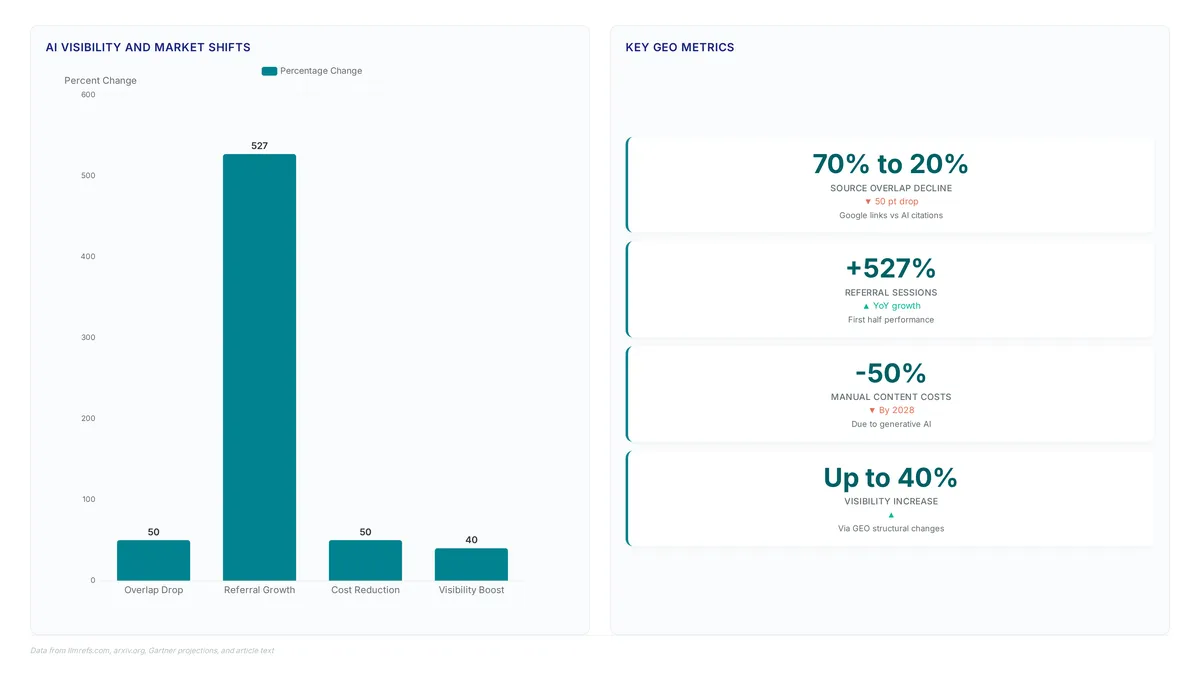
Over 40% of product discovery queries now originate in AI tools like ChatGPT and Perplexity, rendering traditional search strategies obsolete. Generative Engine Optimization is the mandatory practice of structuring software entities to ensure AI systems can verify, cite, and recommend your product. Without this shift from keyword indexing to entity citability, your SaaS effectively ceases to exist in the new search environment.
Traditional SEO loses here because LLM researchers weigh structured entity data and checkable evidence above backlinks and meta descriptions. The replacement work is concrete: architect machine-readable profiles in JSON-LD, publish the trust signals a model can validate without human intervention, and cover the five pillars of AI citability from entity identity through structured references to freshness.
The Shift from Keyword Indexing to Entity Citability in AI Search
GEO Definition: Structuring Entity Data for LLM Discovery
Generative Engine Optimization (GEO) structures product data into machine-readable profiles so AI systems can understand, cite, and recommend software. This approach replaces old keyword indexing with entity-based discovery for AI systems. Traditional SEO optimizes for crawlers indexing HTML code and rewards backlinks. GEO targets the structured entity data and machine-readable profiles that Large Language Models require to synthesize answers, and it competes on long conversational queries carrying deeper user intent rather than on positions in a results page.
A widening visibility gap defines the current market. The overlap between top Google links and sources cited by AI systems has dropped from 70% to below 20%, leaving brands relying solely on backlinks invisible to generative agents.
| Dimension | Traditional SEO | Generative Engine Optimization |
|---|---|---|
| Target | Indexing bots | LLM training & RAG |
| Signal | Keywords & backlinks | Structured entity data |
| Metric | SERP position | Citability score |
| Output | Blue links | Synthesized recommendations |
A citability score quantifies how effectively an AI system can parse, verify, and recommend a product based on evidence like JSON-LD schemas and public API documentation. Exposing detailed machine-readable feeds increases the surface area for data scraping. Competitors might replicate feature sets without equivalent R&D investment. Visibility now depends on semantic precision rather than domain authority alone. Traditional search volume is projected to contract as generative engines absorb more of that demand. Failing to provide the trust signals and classification data that LLMs verify results in functional obsolescence. Operators must treat documentation and metadata as primary deployment artifacts. AI agents need to resolve product capabilities without human intervention.
Implementing the 5 Pillars of AI Citability
Achieving a high citability score demands strict adherence to five technical pillars: Entity Identity, Evidence & Trust, Classification, Freshness, and Structured References. Builders must encode Entity Identity using JSON-LD to define name, category, and creator explicitly. AI systems analyze these semantic relationships to determine source selection. Content requires rich, explicitly defined entities. Products remain invisible to synthesis engines regardless of keyword density without this structured identity.
Trust signals function as verification mechanisms for Large Language Models. Public APIs, documentation links, and privacy policies serve as evidence. Models validate claims before citation using this data. The evidence layer distinguishes active products from abandoned repositories in the training data.
Correct Classification ensures LLMs categorize tools accurately within their internal knowledge graphs. Misclassification leads to irrelevant recommendations when users query for specific functional capabilities.
Freshness acts as a decay function for relevance. Models prioritize actively maintained software with recent version numbers. Static documentation often fails retrieval filters compared to frequently updated resources.
Structured References require existence across multiple trusted feeds. Implementing llms.txt files and RSS feeds creates the redundant pathways necessary for reliable discovery. These machine-readable profiles enable the clarity and accuracy that LLMs prioritize over traditional ranking factors. Open access without schema yields low citability. Perfect schema without distribution yields zero visibility. Deploying all five pillars simultaneously establishes a thorough machine-readable presence.
Exposing Product Data to Agents Through an MCP Gateway
JSON-RPC Endpoint and AI Plugin Manifest
Direct tool invocation requires exposing a JSON-RPC endpoint at /api/mcp implementing the Model Context Protocol. This gateway enables LLMs to move beyond static text retrieval by executing specific functions like search_projects or compare_projects to resolve user queries dynamically. Agents verify real-time data or perform comparative analysis across a product catalog using this interface. Developers must configure five distinct tools within the gateway allowing external systems to fetch stats, list categories, and retrieve detailed project metadata on demand. Placing an AI Plugin Manifest at /.well-known/ai-plugin.json signals compatibility to systems like ChatGPT.
Implementing a Five-Step GEO Strategy to Maximize Product Visibility
The Five-Step Citability Score Workflow
The workflow that scoring services such as citablehub.com run has five steps: an autofill step populates the initial fields of a project profile, after which the operator completes it with trust links like documentation and GitHub repositories. Step three generates a Citability Score calculated across five distinct dimensions, providing actionable recommendations for improvement.
- Submission of the project details to the listing portal.
- Completion of the profile with evidence and social verification.
- Scoring across the five dimensions, with an optimization roadmap.
- Optional badge embedded on the landing page.
- Monitoring of AI interactions through dashboard analytics.
The primary value of the platform lies in the underlying JSON-LD structure rather than the visual element itself. Consequently, operators must treat the score as a diagnostic for machine readability. The final implication for builders is clear: visibility now depends on structured entity data rather than keyword density alone.
Deploying SoftwareApplication JSON-LD and llms.txt Files
Place the SoftwareApplication schema on the homepage to define entity identity for retrieval systems. This structured data block explicitly declares the product name, operating system compatibility, and application category, allowing generative engines to parse software attributes without heuristic guessing. The JSON-LD format is a key machine-readable format that separates semantic metadata from visual presentation layers. Correct categorization ensures LLMs know what kind of tool a product is to recommend it in the right context.
Create an llms.txt file at the domain root to provide a machine-readable manifest of documentation and API endpoints. This emerging standard acts as a direct instruction set for crawlers, pointing agents toward high-value context windows rather than forcing them to scrape navigation menus.
A key consideration involves ensuring content is actively maintained, as LLMs prefer products with recent version numbers and update dates. High fact density is also critical, with recommendations to include statistics every 150-200 words to satisfy AI verification protocols. Validating these files against schema validators before deployment helps prevent syntax errors that could nullify the entity identity signal.
Validating Bot Access and MCP Gateway Configuration
Confirm robots.txt permits GPTBot, ClaudeBot, and PerplexityBot to prevent accidental exclusion of AI crawlers. Ensuring these agents can access the site is necessary, as blocking them severs the primary discovery path for generative search results.
- Inspect
robots.txtto ensure specific bot tokens remain allowed rather than disallowed. - Deploy
/.well-known/ai-plugin.jsonif the product exposes an API for tool use. - Verify the MCP Gateway endpoint responds to JSON-RPC requests for agent coordination.
| Component | Function | Requirement |
|---|---|---|
robots.txt |
Crawler Access | Must Allow AI Bots |
ai-plugin.json |
Tool Definition | Required for API Tools |
| MCP Gateway | Agent Context | JSON-RPC Compliance |
The MCP Gateway acts as a structured interface, allowing agents to query product metadata without hallucinating capabilities. This Model Context Protocol server exposes data directly to AI agents and tools, facilitating improved integration. Operators must balance openness for discovery with strict validation on function calling parameters. Without this configuration, products risk remaining invisible to orchestration layers regardless of content quality, especially as AI-referred sessions continue to grow exponentially.
Measuring ROI and Trust Signals in Generative Search Environments
Reading ROI Through the Citability Score
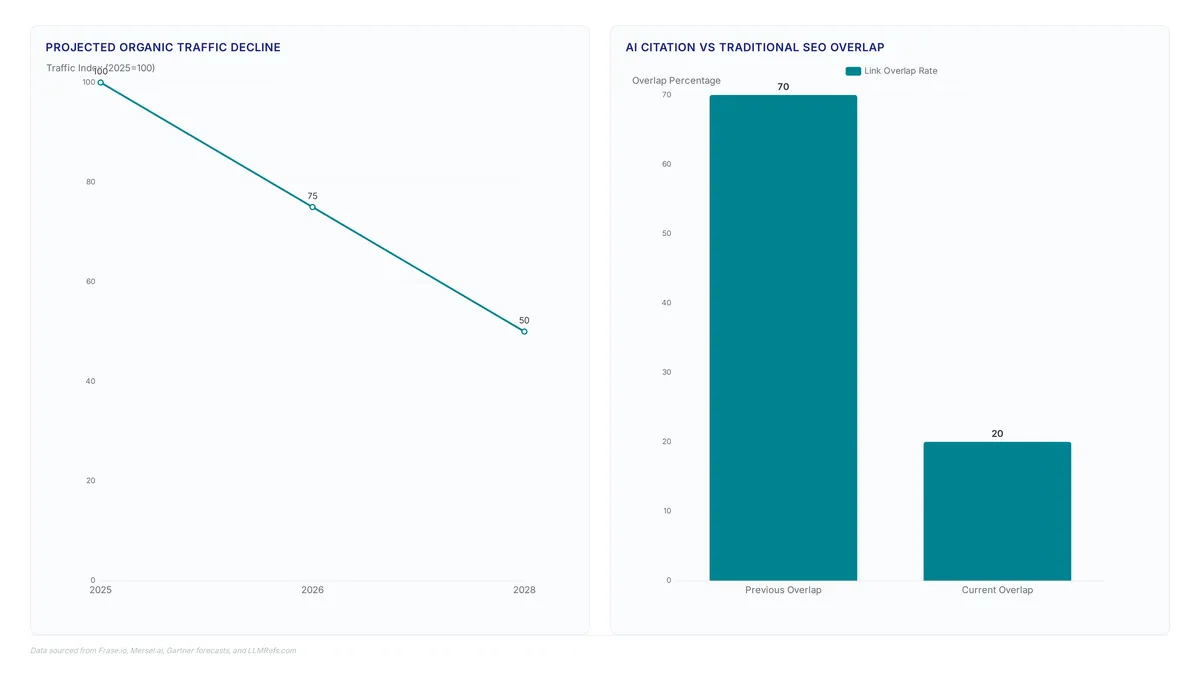
Return on investment in generative search now depends on the Citability Score, a 0-100 metric built from the five sub-scores set out below. Traditional SEO targets click-through rates on blue links, whereas Generative Engine Optimization (GEO) aims to position content as the primary source referenced by AI engines when generating answers GEO vs. SEO Goal. This shift is urgent because organic traffic from traditional search engines is expected to see a significant reduction by 2028 as generative engines capture user intent Organic traffic reduction. Operators must decide whether to optimize for AI search based on this divergence in traffic sources.
| Metric Dimension | Function in GEO |
|---|---|
| Entity Identity | Validates creator and product entity via JSON-LD |
| Evidence & Trust | Links documentation, code repositories, and privacy policies for verification |
| Classification | Ensures correct categorization for context-aware retrieval |
| Freshness | Tracks version numbers and last-updated timestamps |
| Structured References | Requires presence across llms.txt, RSS, and other machine-readable feeds |
However, relying solely on high scores without verifying actual citation frequency creates a false sense of security, as the Citability Score measures potential discoverability rather than guaranteed inclusion in model responses. The implication for builders is clear: visibility requires machine-readable feeds that satisfy all five sub-scores simultaneously.
Applying the GEO Checklist to SaaS Product Pages
SaaS teams should invest in Generative Engine Optimization (GEO) immediately when product discovery queries shift toward synthetic answers rather than blue links. Builders must transition from keyword optimization to structuring entity data that large language models can parse and cite directly.
Implementation begins with embedding SoftwareApplication JSON-LD schemas containing explicit version numbers and last-updated dates. This metadata satisfies the freshness requirement LLMs use to filter outdated references. Concurrently, hosting an llms.txt file at the domain root provides a standardized manifest for AI crawlers, separating machine instructions from human-facing HTML. Teams can verify these configurations by manually running discovery queries in ChatGPT and Perplexity daily, a labor-intensive but effective method for tracking visibility without specialized tooling.
| Component | Function | Target Agent |
|---|---|---|
| JSON-LD | Defines entity identity and versioning | All LLMs |
| llms.txt | Directs crawlers to the content | General Bots |
| MCP Gateway | Exposes real-time API state | Autonomous Agents |
A critical tension exists between open accessibility and server load; allowing GPTBot and ClaudeBot increases citability but consumes bandwidth. Operators must weigh this cost against the risk of invisibility in synthetic responses. Products investing in these machine-readable feeds today will dominate discovery tomorrow as the system matures. The window for establishing authoritative entity presence narrows as training datasets solidify.
About
Priya Nair, AI Industry Editor at AI Agents News, tracks the rapid evolution of autonomous systems and the platforms powering them. Her daily coverage of coding agents like Devin and Claude Code positions her uniquely to analyze Generative Engine Optimization (GEO). As software discovery shifts from traditional search engines to AI-driven synthesis, Nair observes firsthand how unstructured documentation renders SaaS products invisible to these new evaluators. At AI Agents News, where the team rigorously tests multi-agent frameworks and coding tools, the necessity for machine-readable clarity is not theoretical, it is an operational requirement for accurate framework reviews. This article translates those technical observations into actionable strategy, helping engineers ensure their tools are correctly cited by ChatGPT, Perplexity, and Gemini. By focusing on how agents parse and prioritize information, Nair connects current market shifts to practical steps for visibility, ensuring builders maintain relevance in an era where AI Overviews dictate product discovery.
Conclusion
The gap this shift creates is measurable rather than rhetorical: the overlap between top Google links and the sources AI systems cite has fallen from 70% to below 20%, and a product that publishes no machine-readable identity simply does not appear in the second set. Link equity keeps its old value only for the shrinking share of discovery that still ends in a blue link.
What replaces it is unglamorous infrastructure: a SoftwareApplication schema stating name, category and version, an llms.txt manifest at the domain root, an evidence trail of documentation and API links, and a robots.txt that actually lets GPTBot and ClaudeBot read all of it. Audit those artifacts against what a retrieval system can parse, and the citability score turns into a diagnostic instead of a scoreboard.
Frequently Asked Questions
The overlap between top Google links and AI citations dropped from 70% to below 20%. You must shift from keyword indexing to structured entity data to ensure AI systems can verify and recommend your software effectively.
Over 40% of product discovery queries now originate in AI tools like ChatGPT and Perplexity. Brands relying solely on traditional backlinks risk becoming invisible to generative agents that prioritize machine-readable profiles over standard HTML code.
Without JSON-LD schemas and recent version numbers, your product lacks the trust signals required for LLMs to synthesize answers about your capabilities.
No. Backlinks and domain authority no longer decide which sources an AI system quotes, because it selects by structured entity data. Implement evidence layers like public APIs and documentation links so AI researchers can validate your claims without human intervention.
Listing a project on the main citability platforms is free, and structured JSON-LD data and a citability score are generated without payment. Paid tiers cover extra visibility placements rather than the core markup.
References