Function calling overhead: real token counts
Function calling adds 346 tokens per call. That direct inflation hits operational costs hard for high-volume applications according to TokenMix data. The process turns static text generators into flexible agents that fetch live data or execute actions like form submissions. Instead of hallucinating answers, models such as Gemini 3.5 Flash and DeepSeek R1-0528 output structured JSON to trigger specific tools. Applications retrieve current weather data or orchestrate complex agentic workflows without manual intervention.
You face a choice between enhanced capability and inherent overhead. We explore the Agent Platform SDK for integrating real-time data streams and analyze the steps to define tools using the OpenAPI schema format. Understanding these mechanics is essential for deploying cost-effective AI agents that rely on external tool definitions rather than internal parametric memory alone.
The Role of Function Calling in Extending LLM Capabilities
Function Declarations and OpenAPI Schema Requirements
Function calling transforms static LLMs into flexible agents by enforcing strict OpenAPI schema contracts for external tool execution. Unlike standard prompting, this mechanism requires developers to define functions with precise parameter types and validation rules within a structured format. This structural rigor ensures the model outputs deterministic JSON rather than ambiguous text, enabling reliable orchestration across complex workflows.
Latency costs are measurable. Research indicates that function calling adds an average of 346 extra tokens per API call due to the inclusion of tool definitions and execution results in the context window. Developers must account for this overhead when designing systems with tight latency budgets or strict token limits.
Rigid schema validation reduces flexibility. Libraries like zod prevent incorrect execution by enforcing data types, yet they also require significant upfront engineering to maintain accurate descriptions for every available tool. If the schema definitions drift from the actual API behavior, the model may hallucinate parameters or fail to invoke tools entirely, breaking the agent loop. Consequently, maintaining synchronized function declarations becomes a critical operational burden as the number of supported tools scales.
Multimodal Responses and Streaming in Gemini 3 Pro
Gemini 3 Pro ingests images and PDFs within functionResponse messages, enabling agents to process visual diagnostics during tool execution loops. This capability allows the model to validate structural data against source documents, such as comparing a generated invoice total against a scanned PDF returned by a billing API. Unlike text-only return paths, this multimodal content support eliminates the need for separate vision models to interpret tool outputs, reducing orchestration complexity in document-heavy workflows.
Transmitting large binary blobs in every response cycle increases context window pressure and may exceed token limits for long conversation histories. Developers must implement logic to downsample images or truncate PDF pages before returning them to the model to maintain latency budgets.
The architecture also supports streaming function call arguments by setting streamFunctionCallArguments to true, allowing clients to render partial tool parameters as the model generates them. This configuration reduces perceived latency in user interfaces by displaying tool invocation progress before the model finishes reasoning. Builders should buffer streamed arguments locally until the end_stream signal arrives before triggering external side effects.
Gemini 3.5 Flash Versus Llama 4 Maverick Tool Support
Gemini 3.5 Flash and Llama 4 Maverick diverge in tool execution architecture despite shared OpenAPI schema requirements. Google's proprietary stack enables streaming function call arguments to reduce latency, whereas open-weight alternatives rely on standard completion loops. This distinction impacts real-time agentic workflows where partial argument visibility allows earlier downstream processing.
Cost optimization further differentiates the platforms, as cached tool definitions for Gemini 3.5 Flash incur notably lower input token charges compared to uncached requests. Function calling is supported across a range of Gemini models, including Gemini 3.5 Flash, Gemini 3.1 Flash-Lite, Gemini 3.1 Pro, Gemini 3 Flash (preview), and Gemini 2.5 Pro. Similarly, several open models support function calling, such as DeepSeek R1-0528, Llama 4 Maverick, Llama 4 Scout, and Llama 3.3.
Operators must weigh the convenience of native streaming against the deployment flexibility of self-hosted open models. The inability to return image-based function responses in open models forces builders to encode visual data as text descriptions, potentially degrading reasoning quality. Conversely, relying on managed services introduces dependency on external uptime and evolving price structures. Developers building high-frequency trading agents might prioritize the deterministic latency of local deployments. The choice ultimately hinges on whether the application demands the tight integration of a unified cloud platform or the sovereignty of local inference.
Internal Mechanics of Function Declarations and Argument Streaming
OpenAPI Schema Structure for Function Declarations
Defining a Tool demands strict compliance with the OpenAPI schema format to guarantee valid model interactions. Developers construct a JSON object where the name field uniquely identifies the function, such as get_current_weather, while parameters enforce type safety on inputs. The provided REST example sets the MODEL_ID to gemini-2.5-flash and the LOCATION to us-central1, establishing the specific deployment context for the request. Schema structures allow arguments to include a type, description, and optional default value to guide generation.
| Field | Requirement | Purpose |
|---|---|---|
name |
Mandatory | Unique identifier for the tool |
description |
Mandatory | Context for model selection logic |
parameters |
Mandatory | Defines input schema and validation |
Benchmarks like the Berkeley Function Calling Leaderboard serve as the standard for measuring model reliability in tool invocation and parameterization. Builders must balance descriptive richness with structural simplicity to maintain reliability across different model sizes. This tension requires iterative testing against target model capabilities rather than assuming universal schema compatibility.
Streaming Function Call Arguments with Gen AI SDK
Streaming function call arguments in the Gen AI SDK for Python begins by initializing the client with vertexai=True to access the Agent Platform backend. Developers define a Python function, such as get_current_weather, which the SDK automatically converts into an OpenAPI compliant schema when passed to the generation config. This approach eliminates manual JSON schema construction, allowing the model to populate arguments like location in real-time as tokens are generated. For Gemini 3 Pro and later models, users can stream function call arguments as they are generated by setting streamFunctionCallArguments to true in the functionCallingConfig. Implementation requires setting up the environment and invoking the model with the target function.
The from_func helper further simplifies this by deriving the complete tool definition directly from the function signature and docstring. This method reduces boilerplate code but introduces a dependency on strict type hinting. Such a constraint favors rapid prototyping over the granular control offered by manual Tool declarations. Enterprises using optimized strategies report significant efficiency gains, though developers must manage the context requirements of function definitions carefully.
Token Overhead Risks in High-Volume Function Calls
Function calling's per-call token overhead directly inflates operational expenses for high-volume agents. This token overhead accumulates rapidly when models invoke multiple tools sequentially, turning minor latency into substantial billing shocks. Research indicates that hybrid routing strategies, cheap models for simple calls and premium models for complex ones, cut function-calling costs by 50% to 70% in these high-frequency scenarios.
Developers often overlook how verbose OpenAPI schemas exacerbate this issue, as lengthy descriptions consume context window space before any user prompt is processed. The necessity to include tool definitions in requests creates a compounding penalty for long conversation histories.
| Factor | Impact on Cost | Mitigation Strategy |
|---|---|---|
| Schema Verbosity | Significant | Minimize description length |
| Call Frequency | High | Cache frequent definitions |
| Model Selection | Variable | Route simple tasks to cheaper models |
Reducing description granularity offers immediate relief, yet excessive truncation risks degrading model accuracy in tool selection. Teams must balance schema precision against token economy, perhaps reserving detailed documentation for complex functions only. Ignoring this constraint forces a choice between functional reliability and fiscal efficiency as scale increases. For further optimization techniques, TokenMix recommends auditing tool definitions regularly.
Implementing Real-Time Data Integration with the Agent Platform SDK
Defining the Two-Task Function Calling Workflow
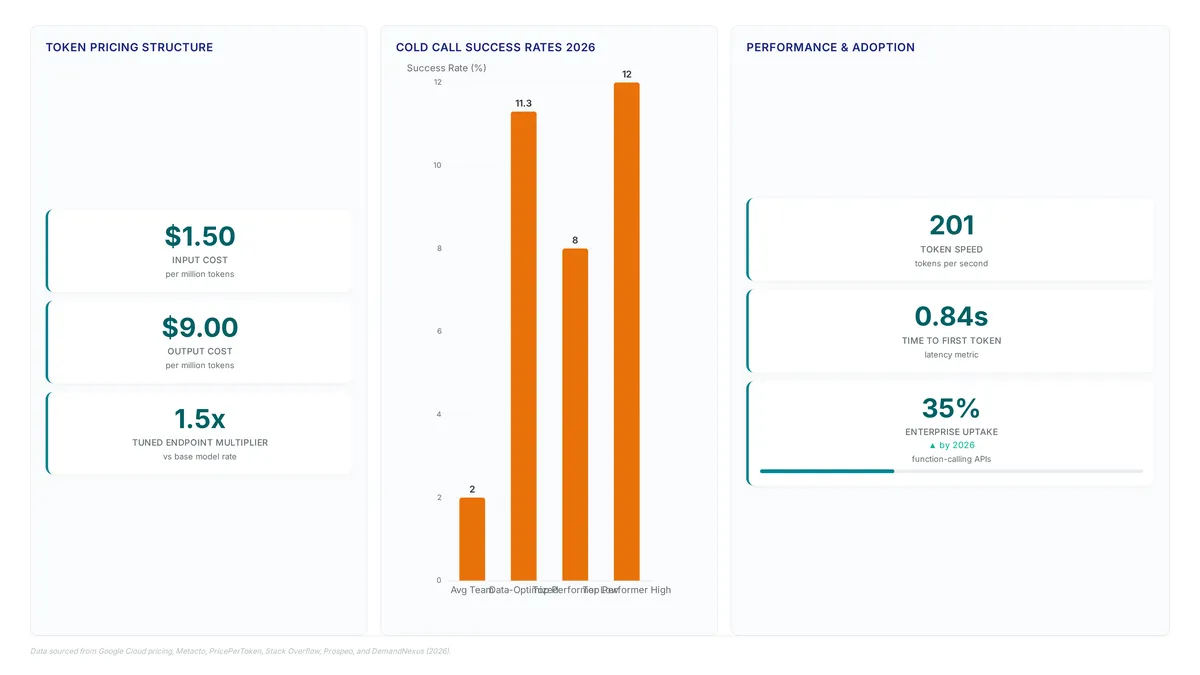
Submitting function declarations alongside prompts and returning API outputs constitutes the core loop for agent execution. Developers must declare a Tool using the OpenAPI schema format, ensuring the model receives structured definitions before generating content. The Gen AI SDK for Python simplifies this by initializing the client with vertexai=True, allowing direct function references in the generation config.
- Submit the user prompt and function declarations to the model.
- Execute the requested logic and provide the API output back to the model.
Schema detail competes directly with token usage. Detailed descriptions help define tools but consume input tokens that could otherwise hold conversation history. Builders balance descriptive richness against token economy to maintain cost efficiency.
Configuring Vertex AI Client and Model IDs in Python
Initializing the Python client with vertexai=True routes requests through the Agent Platform backend rather than the standard consumer API. This configuration enables access to models like gemini-2.5-flash within a secure project context. Developers must explicitly pass the project and location arguments during client instantiation to establish valid authentication credentials.
Selection of gemini-2.5-flash balances latency against capability, though pricing structures vary notably across the model family. Input tokens for the newer Gemini 3.5 Flash are priced at $1.50 per million, while output generation costs rise to $9.00 per million. These rates create a financial incentive to optimize prompt length and reduce unnecessary function call iterations. Proper configuration remains necessary so service account permissions suffice for intended operations.
Validating OpenAPI Schema Compliance for Tool Declarations
Define OpenAPI definitions clearly to ensure successful tool invocation. Function calling implementation requires schemas that define required inputs and validation logic to stop incorrect execution. Developers should verify that every parameter includes an explicit data type and description string.
- Define parameters using
type: objectwith explicitpropertiesfor each argument. - Mark necessary fields in the
requiredarray to enforce mandatory inputs. - Review declarations to catch structural errors early.
Rigid schemas create tension between flexible natural language prompts and deterministic API contracts. This potential failure mode encourages a choice between broad prompt engineering and narrow, reliable function signatures.
Operational Costs and Optimization Strategies for High-Volume Tool Use
Token Overhead Economics in Function Calling
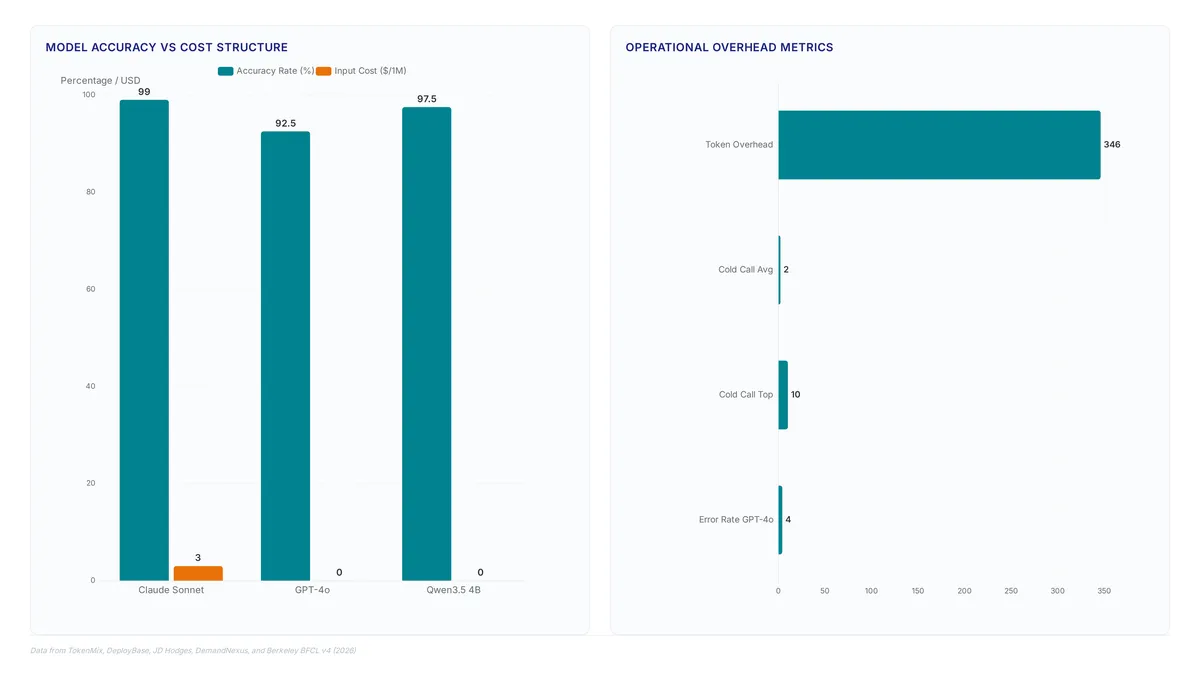
Schema transmission inflates operational expenditure before any user prompt is processed function calling guide. This fixed cost arises because the model must ingest verbose OpenAPI schemas and tool definitions in every turn to maintain context awareness. Pricing tiers compound this burden, as input tokens often carry different unit costs than output tokens, creating complex billing scenarios for high-volume agents.
Multi-step workflows multiply the base overhead by the number of tool invocations. High-frequency argument streaming shifts volume toward output pricing brackets.
Claude Sonnet offers a viable alternative for specific workloads, charging $3.00 for input and $15.00 for output per million tokens while benchmarking at 98.7% accuracy on simple tool calls, 96.9% on parallel calls and 95.1% on nested schemas function calling comparison. Relying solely on model selection ignores the architectural inefficiency of redundant schema transmission. Developers should prioritize argument streaming configurations, such as setting streamFunctionCallArguments to true in Gemini 3 Pro models, to reduce latency perception even if token counts remain static. The economic reality dictates that without aggressive caching or hybrid routing, agent costs will scale linearly with conversation depth rather than value delivered. AI Agents News recommends auditing tool definition sizes quarterly to prune unused parameters and minimize this baseline tax.
Cached Input Pricing as a Fragile Optimization
Cached input pricing creates a sharp economic incentive for developers to separate immutable schema declarations from flexible user prompts during API submission. The mechanism relies on the model recognizing repeated input prefixes, allowing the system to bill the lower cached rate for the bulk of the token count while charging standard rates only for variable query data.
Tool definitions and system instructions consume the majority of input tokens in agentic loops. User queries and function results remain uncached and billed at the higher non-cached tier.
This optimization introduces architectural friction because applications must strictly manage context boundaries to prevent cache misses. Volatility means that aggressive caching strategies can backfire in environments where tool schemas evolve frequently or where A/B testing requires constant prompt variations. Operational teams must therefore version their tool definitions carefully and monitor cache hit rates alongside token usage metrics. Ignoring this distinction leads to unpredictable billing spikes when cache invalidation events occur during high-volume processing windows. Builders should treat cached inputs as a fragile optimization that demands rigorous change management protocols around function declarations.
Routing Calls by Benchmark Accuracy
Sonnet's benchmark accuracy allows engineers to deploy high-fidelity agents without incurring the maximum token costs associated with top-tier models. In contrast, OpenAI's GPT-4o serves as a functional baseline, achieving 90-95% accuracy in similar benchmarks. A non-trivial error rate in GPT-4o necessitates strong retry logic and validation layers that increase latency. The cost is acceptable for Sonnet on critical paths where tool use reliability prevents downstream workflow interruptions. GPT-4o remains viable for non-critical data retrieval where occasional hallucinations do not compromise system state. Teams should route high-stakes function calls to the higher-accuracy model while reserving the mid-range benchmark for exploratory queries. This hybrid approach optimizes the balance between operational stability and token expenditure.
About
Priya Nair serves as AI Industry Editor at AI Agents News, where she tracks the business dynamics of autonomous systems and coding agents. Her daily coverage of platforms like Devin, Claude Code, and Cursor provides unique insight into function calling, the core mechanism enabling these tools to interact with external systems. As vendors compete to enhance agent capabilities, Nair analyzes how improved tool use definitions and structured data handling directly impact product viability for engineering teams. This article connects her market-level observations of agent-platform vendors to the technical realities builders face when implementing flexible data fetching and action execution. By grounding function calling developments in verified product launches and funding moves, she offers a neutral perspective on how this technology extends LLM utility beyond static text generation. Her reporting ensures that technical founders and engineers understand not just how function calling works, but why specific implementation strategies are becoming critical differentiators in the evolving AI agent environment.
Conclusion
Scaling function calling exposes a critical fracture where architectural complexity directly impacts financial predictability. As developer adoption of function calling accelerates, the operational burden of managing cache invalidation and model routing will outweigh raw token costs for many teams. The real cost lies not just in token pricing but in the engineering hours spent mitigating avoidable errors and debugging volatile cache states.
Organizations must implement conditional routing logic immediately to separate high-stakes transactions from exploratory queries. Deploy your most reliable models for critical function calling paths where failure interrupts business processes, while reserving cost-efficient options for non-critical data retrieval. This strategy is what delivers the 50% to 70% cost saving reported for hybrid routing in high-frequency scenarios. Start this week by auditing your current tool definitions to identify which schemas remain static enough for caching and which require flexible handling. Establish clear versioning protocols before your next deployment cycle to prevent accidental cache misses. Only by treating model selection as a flexible variable rather than a fixed configuration can teams sustain agent reliability without inflating their operational budget.
Frequently Asked Questions
Output generation costs rise to $9.00 per million tokens on Gemini 3.5 Flash, while Claude Sonnet charges $15.00 per million. This pricing creates a financial incentive to optimize argument streaming and reduce unnecessary tool calls in your workflow.
The model may hallucinate parameters or fail to invoke tools entirely. Such errors break the agent loop, which is why maintaining synchronized function declarations becomes a critical operational burden as the number of supported tools scales.
Only Gemini 3 Pro and later models support images and PDFs in function responses. Earlier versions require separate vision models, adding complexity to document-heavy workflows and increasing latency.
Streaming allows clients to render partial tool parameters as the model generates them. This reduces perceived latency, though it requires buffering locally until the end stream signal arrives.
You must define functions using the OpenAPI schema format to ensure compatibility. This structural rigor enforces precise parameter types but requires significant upfront engineering to maintain accurate descriptions.
References