Function call data: Managing 346 token overhead
Function calling adds an average overhead of 346 extra tokens per API call according to TokenMix data. This hidden tax transforms function tools from a simple convenience into a significant architectural cost driver that demands rigorous optimization. Without strict schema management, the token overhead inherent in tool calling will erode your budget quicker than the actual inference costs.
OpenAI models interface with external systems through JSON schema definitions, and gpt-5.4 remains the exclusive threshold for tool_search capabilities. The lifecycle from tool call to tool call outputs is where a reliable agent is won or lost.
The financial reality is stark: scaling to 100,000 function calls monthly incurs between $8 and $154 in pure overhead costs depending on your provider choice. Your application must handle the flow of tool call outputs without unnecessary latency or expense.
The Role of Function Tools in Modern AI Architecture
Distinguishing Function Tools from Abstract Tool Calls
Think of a function as a specific tool set by a JSON schema, enabling structured data passage to external applications. In modern agent architecture, tools represent the abstract functionality available to a model, whereas functions constitute a strict subset set by validation rules. A generic tool might accept free-form text, yet a function enforces a rigid contract, allowing code to reliably access data or execute actions like retrieving account details. Function tools allow the model to pass data to an application where code can access data or take actions. The cost is that function calling adds an average overhead of 346 extra tokens per API call across substantial providers.
Namespaces organize these definitions by domain, grouping related utilities under identifiers like billing, shipping, or crm. This logical separation prevents naming collisions when a single agent manages disparate systems. Without namespaces, a get_status command could ambiguously reference an order or a server.
| Feature | Abstract Tool | Function Tool |
|---|---|---|
| Input Format | Free text or unstructured | Strict JSON schema |
| Validation | Manual or heuristic | Automatic (via schema) |
| Use Case | General knowledge retrieval | Precise action execution |
The call_id links the initial request to the tool call output, ensuring the model correlates the correct response with its query.
Executing a Weather Query as a Tool Call
When a user asks "what is the weather in Paris?", a tool call executes by mapping that prompt to a get_weather function with Paris as the argument. This mechanism relies on strict schema adherence where the model outputs a structured request rather than natural language text. The application receives this request, executes the underlying code, and returns a call_id linked output containing the temperature data.
Function Tools Versus Direct Prompting and Custom Text Inputs
Structured function tools enforce JSON schema contracts unlike direct prompting which relies on unstructured text parsing. Direct prompting asks models to generate text containing data, whereas function calling separates intent from execution through set parameters. In addition to function tools, there are custom tools that work with free text inputs and outputs, yet they lack the strict validation guarantees of schema-bound functions.
The transition to structured tool calling introduces measurable token overhead. Developers must weigh this expense against the reduction in parsing errors.
The industry shift toward structured agents is accelerating as more teams standardize on function-calling APIs. Strict schemas increase prompt size, directly impacting latency and cost per inference. Operators must balance the need for deterministic outputs against the financial weight of expanded context windows.
Inside the Tool Calling Flow and Data Exchange Mechanics
The Five-Step Tool Calling Conversation Flow
Strict state machines govern how the OpenAI API handles tool interactions between application logic and model inference.
- The client submits a request populating the tools parameter with available function schemas.
- Generation halts as the model returns a structured tool call object containing parsed arguments instead of natural language.
- Local code executes using these extracted parameters to fetch data or perform specific actions.
- The system constructs a second request that appends the tool call output to the message history.
- The model processes this result to generate the ultimate user-facing response.
This sequence prevents the model from proceeding without explicit external validation. Reducing context window pressure comes at the architectural cost of maintaining conversation state across multiple round trips. Reasoning models require any reasoning items returned in responses with tool calls to be passed back with tool call outputs to ensure continuity in subsequent turns.
Round-trip latency inherent in this flow demands efficient execution to maintain responsive user experiences.
Implementing Tool Search for Large Ecosystems
Applications managing extensive function ecosystems should enable tool search when loading all schemas exceeds practical context limits. This optimization defers the inclusion of rarely used tools, allowing the model to dynamically query and retrieve only the definitions during runtime. The mechanism relies on capable models to interpret search queries and inject matching tool schemas into the conversation context on demand. Tool descriptions must contain sufficient semantic detail for the search algorithm to correctly identify candidates without false negatives.
Increased architectural complexity represents the primary limitation, as the application must now handle an additional resolution step before tool execution. Static declarations allow the OpenAI API to validate all tools upfront, whereas flexible loading introduces a potential failure mode where valid tools remain undiscovered if descriptions lack precision. Engineers should prioritize descriptive metadata over brevity to maintain high recall rates. This approach effectively mitigates token waste in large-scale deployments where most functions sit idle during typical user sessions.
Managing Token Limits and JSON Schema Overhead
Callable function definitions count against the model's context limit and are billed as input tokens, directly reducing available space for conversation history. Functions are usually declared in the tools parameter of each API request. These schemas are injected into the system message in a syntax the model has been trained on, meaning verbose descriptions or redundant parameter notes consume capacity without adding execution value. When schemas exceed available context, the system may truncate instructions, leading to errors in function arguments parsing where the model hallucinates required fields. Teams can resolve this by shortening text descriptions or applying strict mode to enforce concise, validated inputs that prevent malformed requests.
A separate failure mode occurs when application code fails to return a result, causing a missing tool call output scenario that stalls the agent loop. Descriptive clarity for the model conflicts with token efficiency for the budget. Overly brief schemas risk ambiguous tool selection, while verbose ones inflate costs and trigger context limits. Builders must balance these by iteratively testing schema length against successful execution rates, ensuring parameter descriptions are concise. This discipline keeps the agent both cost-effective and reliable under load.
Implementing Reliable Function Calling with JSON Schema
Defining Function Tools with JSON Schema Properties
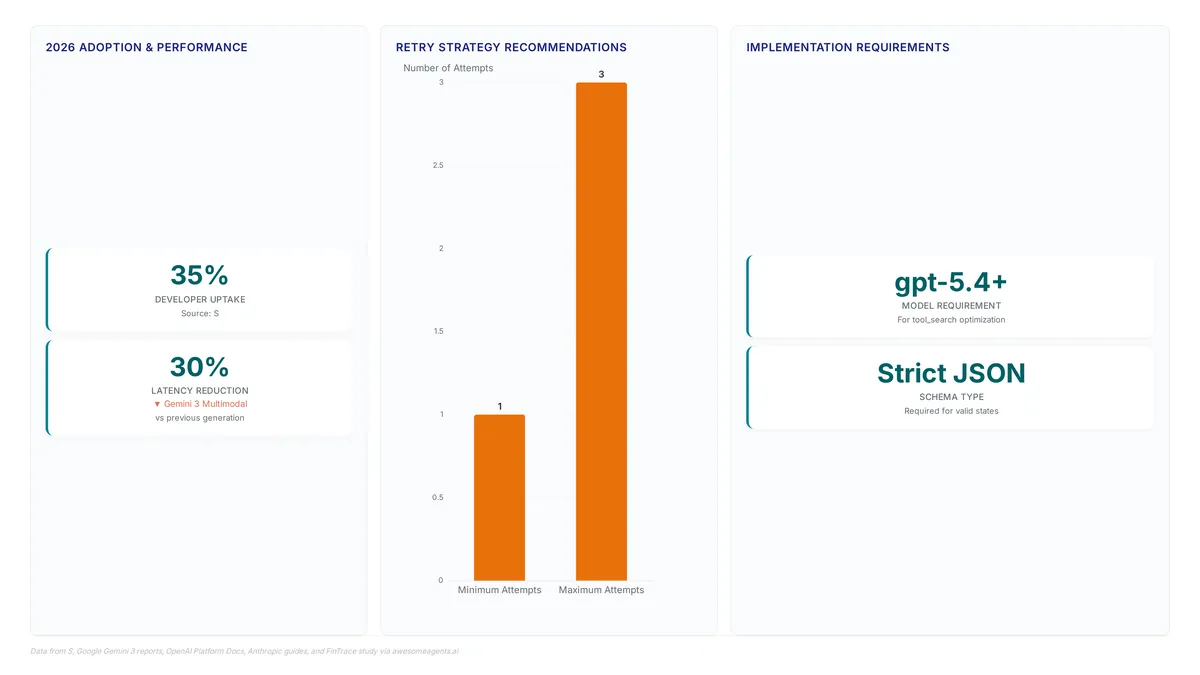
Construct every callable action using a rigid JSON structure containing type, name, description, parameters, and strict properties. The type field must always read "function," distinguishing schema-bound actions from free-text custom tools within the tools parameter. Developers assign the name as a unique identifier, such as get_weather, while the description details when and how to invoke the operation. The parameters object applies a strict JSON schema that enforces data types, required fields, and validation rules. For instance, a get_weather definition might specify location as a string argument. This method makes invalid states unrepresentable to the inference engine. Implementing strict mode further hardens this contract, forcing the model to adhere precisely to the set argument structure without deviation. Tension exists between providing enough semantic context for the model to choose the tool and keeping the schema tight enough to reject malformed requests. Over-describing behavior in the description field while leaving parameters loose invites ambiguity that strict typing alone cannot resolve.
Converting Pydantic and Zod Models to Tool Schemas
Direct conversion of BaseModel classes via pydantic_function_tool eliminates manual JSON schema transcription errors in Python stacks. JavaScript developers achieve identical schema fidelity for get_weather integration using zodFunction to change zod objects into valid tool definitions. These SDK helpers enforce the rigid structure required by the API, ensuring parameters strictly match the model's expectations without redundant boilerplate code.
- Define your data model using standard Pydantic or Zod syntax with clear type hints.
- Apply the specific converter helper to generate the function definition object.
- Pass the resulting schema directly into the tools list for the model.
Shifting the maintenance burden from schema strings to native code changes how teams operate. Model-facing types become stable interfaces rather than internal data structures to prevent unintended drift in agent behavior. Auto-generation trades flexibility for consistency, demanding rigorous version control over model classes.
Execution Loop Checklist for Tool Call Outputs
Parse the response array immediately to identify zero, one, or multiple tool_calls containing unique IDs. Each entry within this array specifies a function name and JSON-encoded arguments requiring strict validation before execution. Developers must iterate through these calls, executing the referenced code logic while capturing output or exceptions cleanly.
- Extract the id and function name from every object in the tool_calls list.
- Validate JSON arguments against the original schema to prevent runtime injection errors.
- Execute the local logic and capture the result as a string or structured object.
- Append a new message with role set to
tooland the matching tool_call_id.
The system appends results to the message history using the tool role, specific tool_call_id, and content, or as type function_call_output in the responses API. This strict pairing ensures the model associates specific outputs with original requests during the next inference pass.
| Step | Input Field | Output Role |
|---|---|---|
| Identify | tool_calls array |
N/A |
| Execute | arguments JSON |
Code Result |
| Return | id reference |
tool |
Omitting the correct tool_call_id breaks the correlation chain. A function call output or tool call output refers to the response a tool generates using the input from a model's tool call, and it should contain a reference to a specific model tool call (referenced by call_id). This architectural constraint prevents ambiguous state when handling parallel executions across complex agent workflows.
Strategic Trade-offs Between Function and Custom Tools
JSON Schema Constraints in Function Tool Definitions
Function tools demand a rigid JSON schema contract that strictly defines parameters, standing in sharp contrast to custom tools which accept flexible free-text inputs. This structural enforcement guarantees the model returns executable data types, such as restricting a units argument to a specific enum of "celsius" or "fahrenheit". Verbose schema definitions consume valuable context window capacity, forcing developers to balance description detail against token limits. Implementing tool search allows applications to defer loading infrequently used schemas, mitigating context bloat in large ecosystems. This optimization requires gpt-5.4 or later models, creating a version dependency for flexible tool management strategies.
Strict mode enforces the set schema yet demands precise schema engineering to avoid execution failures. Relying on flexible loading techniques documented in the OpenAI guides reduces initial payload size by deferring rarely used tools.
Calculating Token Overhead Costs for 100k Function Calls
High-volume implementations running 100,000 calls per month face overhead costs ranging from $8 to $154 per month solely due to the structural overhead of the function calling format. This financial variance stems from the rigid JSON schema injection required for function definitions, which consumes input tokens before any user query is processed. Unlike custom tools that operate on free text, schema-bound actions demand precise property descriptions and type constraints that inflate the context window.
Schema strictness ensures adherence to set parameters while requiring developers to account for descriptive verbosity in the context window. A more efficient architecture combines frequently used tools into a minimal initial set, loading niche capabilities only when namespace triggers occur. Builders should calculate whether the safety of enforced types justifies the recurring input tax on every API turn. AI Agents News recommends auditing parameter descriptions for brevity to mitigate these cumulative costs.
Structured Data Reliability Versus Custom Text Flexibility
The FinTrace benchmark published in April 2026 evaluated 13 different Large Language Models across 800 annotated financial task trajectories to measure function calling reliability. This study confirms that strict JSON schema enforcement provides structured data reliability compared to free-text parsing. Developers seeking structured data benefit from this rigidity as output formats remain predictable for downstream code execution. Significant context consumption occurs because every callable definition inflates the input payload regardless of invocation frequency.
Custom tools avoid this bloat by relying on natural language descriptions yet introduce ambiguity in complex workflows. Applications managing hundreds of integrations may encounter context limits when relying exclusively on schema-heavy definitions. Maximizing reliability through strict schemas directly opposes the goal of minimizing token latency. Builders must evaluate whether their priority is data fidelity or conversational efficiency. The overhead is a necessary tax for accuracy in financial or transactional systems. Conversely, exploratory agents benefit from the flexibility of unstructured text inputs. AI Agents News recommends hybrid architectures that reserve function tools for critical actions while delegating informational queries to lighter custom implementations. This balance prevents schema bloat from degrading response times in production environments.
About
Marcus Chen, Lead Agent Engineer at AI Agents News, brings direct production experience in building multi-agent systems to this analysis of function calling. His daily work involves orchestrating complex agent workflows using frameworks like CrewAI, AutoGen, and LangGraph, where defining precise tool schemas is critical for reliable execution. Because he routinely evaluates how models interface with external data sources, Chen understands the practical nuances of pairing function calling with tool search to manage large toolsets efficiently. This article reflects his hands-on familiarity with the limitations and capabilities of gpt-5.4 and later models when handling abstract tool definitions. At AI Agents News, an independent hub for technical founders and engineers, Chen focuses on separating verified capability changes from marketing hype. His explanation connects the theoretical mechanics of JSON schema definitions to real-world implementation challenges, ensuring builders can make informed decisions about integrating tool use into their own autonomous architectures without falling victim to unverified claims.
Conclusion
Scaling function tool usage exposes a harsh economic reality where structural overhead alone decides most of the monthly bill for 100,000 calls, and the provider decides how large that share grows. This disparity means that adopting strict JSON schemas for every interaction turns simple queries into expensive liabilities. The operational burden shifts from mere compute latency to managing cumulative token inflation, where unused parameter definitions drain budgets before a single action executes. Developers must stop treating schema enforcement as a universal default and start viewing it as a premium feature reserved for high-stakes transactions.
Adopt a hybrid architecture immediately by categorizing your current toolset into critical actions versus informational lookups. Reserve strict schema enforcement exclusively for financial or transactional operations where data fidelity prevents catastrophic downstream errors. For all other conversational flows, switch to lightweight custom text descriptions to eliminate unnecessary payload bloat. This segmentation ensures you pay the accuracy tax only when the business logic demands it.
Start this week by auditing your top ten most frequently called tools to measure their specific token overhead against their actual invocation success rate. If a tool provides context rather than executing state changes, rewrite its definition to use natural language descriptions instead of rigid parameters. This single adjustment reduces context consumption instantly without sacrificing the reliability needed for core system functions.
Frequently Asked Questions
Scaling to 100,000 calls creates pure overhead costs between $8 and $154 monthly. This variable spread depends entirely on your specific model choice and provider selection for the application.
Function calling adds an average of 346 extra tokens per API call, according to TokenMix data. Those tokens are billed as input because every callable definition counts against the context limit before the user query is processed.
Only gpt-5.4 and later models strictly support the tool search capability for deferring rare tools. Using older versions will prevent you from optimizing large schemas by loading tools only when needed.
Overlapping descriptions cause the model to hallucinate arguments or select the wrong tool entirely. This failure mode breaks reliability and forces developers to maintain distinct semantic definitions for each function.
Function tools enforce a strict JSON schema while custom tools accept free form text inputs. This distinction determines whether your application receives structured data for code execution or unstructured text for general knowledge.
References