Decision manifests stop 97% of AI security failures
97% of organizations cite access control failures as the root cause of AI incidents. This statistic alone should kill the idea that egress monitoring is enough. Egress filters and DLP tools watch traffic leave the network, but they arrive after a compromised model has already decided to act. Business Upturn projects that semi-autonomous systems with human-in-the-loop controls will dominate 74.40% of the market in 2026, yet most security stacks still lack the governed agent workflows required to manage them safely.
This gap between rapid adoption and mature safeguards is where LuisCore operates. It provides the substrate for Veloraith, its audit and vector-consensus layer, whose hooks validate choices in real-time, shifting security from post-hoc detection to pre-execution governance.
The critical separation runs between egress monitoring layers and true decision-time governance, and it is enforced in practice through the LuisCore CLI, whose audit trails carry reproducible evidence rather than raw logs.
Defining Decision-Time Governance and Egress Monitoring Layers
What a DM-1 Manifest Locks Down Before Execution
Decision-time governance captures the justification for an action before execution begins. This method separates valid authorization from simple logging by locking policy constraints, citations, and automated review verdicts into a DM-1 manifest before any data leaves the network. Traditional egress filters watch traffic only after the model decides, creating a latency gap where unauthorized actions originate.
Only 24% of enterprises maintain a dedicated AI security governance team to manage these pre-execution risks effectively. The DM-1 manifest acts as an immutable record holding proof URIs that enable third-party verification without administrative credentials.
Without pre-execution validation, organizations cannot reconstruct decision logic after an incident, making post-hoc audits incomplete. Operators lack the specific data required to prove compliance during regulatory review in the absence of a DM-1 manifest.
Why Egress Monitoring Fails Against Shadow AI Risks
Egress filters fail because 57% of employees bypass corporate controls using personal GenAI accounts for work. Shadow usage renders perimeter logging ineffective since traffic to unapproved tools never traverses the monitored enterprise gateway. Egress-time monitoring observes data leaving the network but misses the decision logic preceding transmission.
Relying solely on post-hoc detection ignores those same access control failures. A DLP filter might flag sensitive data in an outbound prompt, but the model has already processed the input and potentially formed a harmful output by then. This latency allows goal hijacking attacks, a failure mode catalogued in the OWASP Top 10 for Agentic Applications, to complete before defenders intervene. Competitors focusing only on AI usage discovery miss the runtime execution layer where agents coordinate actions autonomously.
Visibility without pre-execution control creates an unmanageable alert storm. Security teams cannot manually review every agent decision in real-time. Organizations lack the audit trail required to distinguish between authorized automation and rogue agent behavior without decision-time governance to enforce policy before an action occurs. Total loss of agency over autonomous systems is the price of this.
Architecture of the Veloraith Audit and Chorus Action Pipeline
LuisCore functions as a low-latency decentralized runtime substrate that replaces uncoordinated text prediction with structured execution logic. General LLMs often act as text predictors floating in an execution vacuum, lacking the native coordination required for complex, multi-step agent workflows. This substrate introduces the Chorus Field, an open coordination layer using MCP-native discovery to manage scoped write keys across distributed nodes. Consistency relies on the Structured Probability Forking Directive (SPFD): it spots the moment parallel branches diverge and collapses them back to one state before the audit trail is corrupted.
Implementing Vector-Variance Consensus in the Chorus Action Pipeline
Speculative parallel execution within the Chorus action pipeline generates reward-ranked branches that require vector-variance consensus to resolve conflicts before exporter gating. Operators implement cluster telemetry with NDJSON streams to feed the consensus engine so hardware pressure and network topology hints inform the selection process. The system ingests these sanitized events to calculate a cluster health score, aggregating latency and fork node data for real-time decision weighting.
Fixing missing audit hooks requires embedding NDJSON telemetry stream parsers directly into the agent lifecycle. These hooks capture pipeline events that traditional single-agent environments often ignore, providing the necessary data for verifier-gated exports.
Validating Cluster Health Scores via Protocol Watch Telemetry Ingest
Verifying audit integrity requires cross-referencing Protocol Watch NDJSON streams against the aggregated cluster health score to detect verifier-gated export failures before data loss occurs.
- Ingest raw GPU node metrics containing memory pressure hints.
- Map active fork nodes against the current SPFD state machine.
- Compare latency spikes in the telemetry stream with health score deviations.
- Trigger manual collapse orchestration if divergence exceeds tolerance thresholds.
| Metric Source | Data Format | Validation Target | Failure Signal |
|---|---|---|---|
| Protocol Watch | NDJSON | Memory Pressure | Export Gate Lock |
| Fork Nodes | State Vector | Branch Consistency | SPFD Collapse |
| Network Topology | Graph Hint | Latency Spikes | Consensus Timeout |
| Health Score | Aggregate | Global Integrity | Audit Gap |
The hardware telemetry link provides the necessary memory pressure and network topology hints to populate these rows accurately. Without this granular ingest, the cluster health score remains an abstract approximation rather than a grounded operational metric. Strict verifier gating conflicts with system availability. Overly aggressive export rejection can stall the entire action pipeline while waiting for consensus. This limitation forces operators to tune tolerance windows based on observed network volatility rather than static thresholds. Failure to align these inputs results in silent audit gaps where unverified actions bypass the Chorus Field coordination layer entirely. 2026 marks the year these constraints define production readiness.
Implementing Governed Agent Workflows with LuisCore CLI
Standing Up a Governed Agent with the luiscore-agent CLI
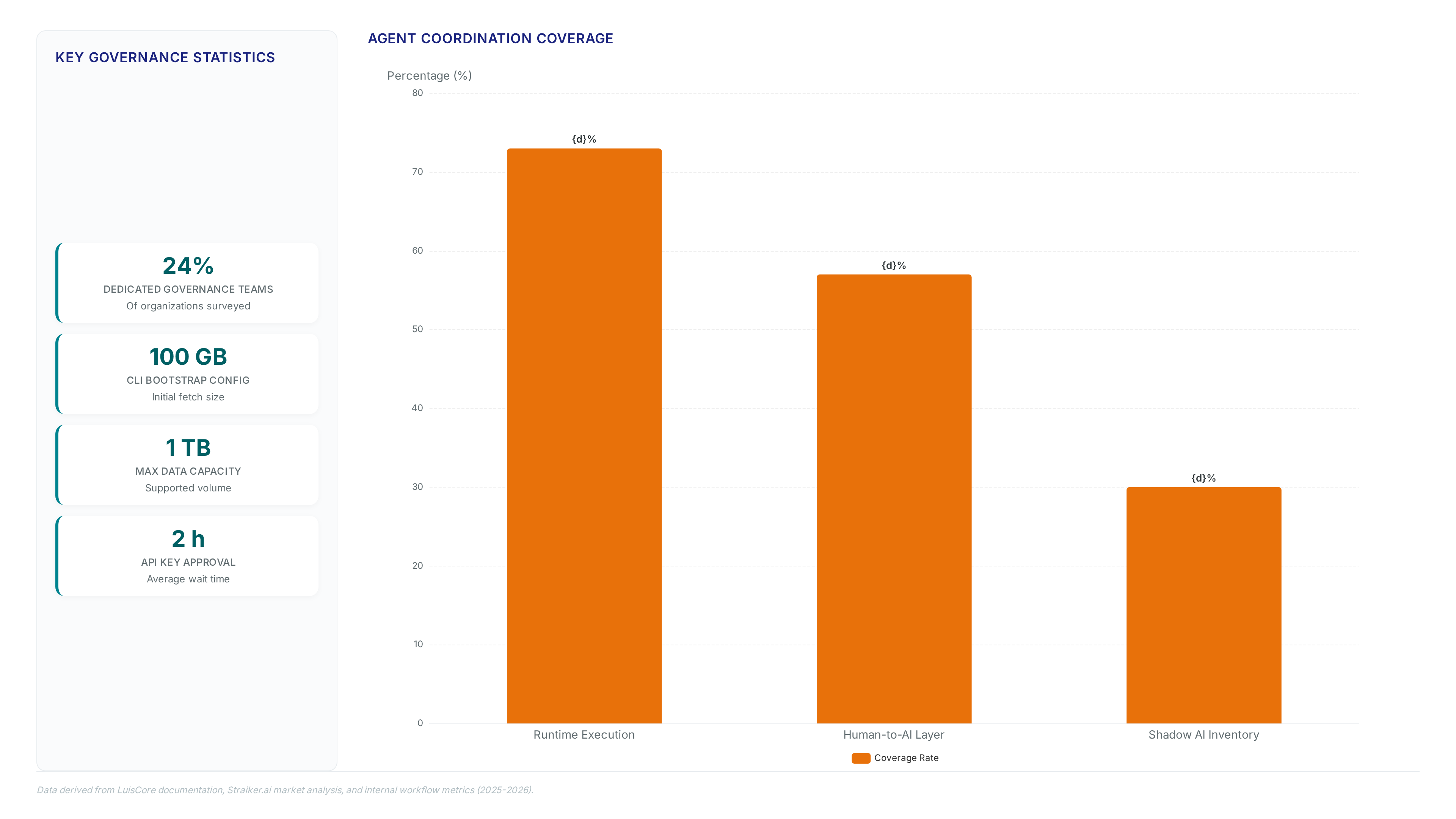
Four commands take an agent from an empty directory to a run that cannot commit to the substrate without a manifest behind it. The DM-1 manifest records the specific rationale for approval, letting auditors replay the exact decision context without admin credentials.
- Initialize the local environment with
luiscore-agent bootstrapto fetch the canonicalfor-agents.jsondiscovery surface. - Define policy constraints in the local manifest, specifying allowed tools and required citation formats.
- Execute
luiscore-agent deploy-agentto register the agent with the Chorus action pipeline for speculative parallel processing. - Run
pipeline-runto trigger Veloraith vector consensus, which validates the decision against the manifest before committing to the substrate.
Security shifts from passive observation to active verification at the moment of choice. Managing manifests adds complexity, yet this friction generates the audit trail that egress logging cannot.
Bootstrap pulls that discovery surface from for-agents.json, registers node identity and binds the local process to the decentralized substrate instead of leaving it an isolated text predictor. Configuration requires defining specific vector consensus parameters to align with the active reward-weighted mesh. Static files fail when network topology shifts, forcing operators to choose between manual rewrites or accepting stale routing hints. Skipping this handshake prevents agents from participating in the reward-ranked branching of the Chorus action pipeline. AI Agents News recommends validating the JSON schema against the latest manifest version to prevent silent failures during the approval window.
Strategic Adoption of Decision Manifests for Enterprise Agent Security
Complementary Security Layers: Egress Filters vs Decision Manifests
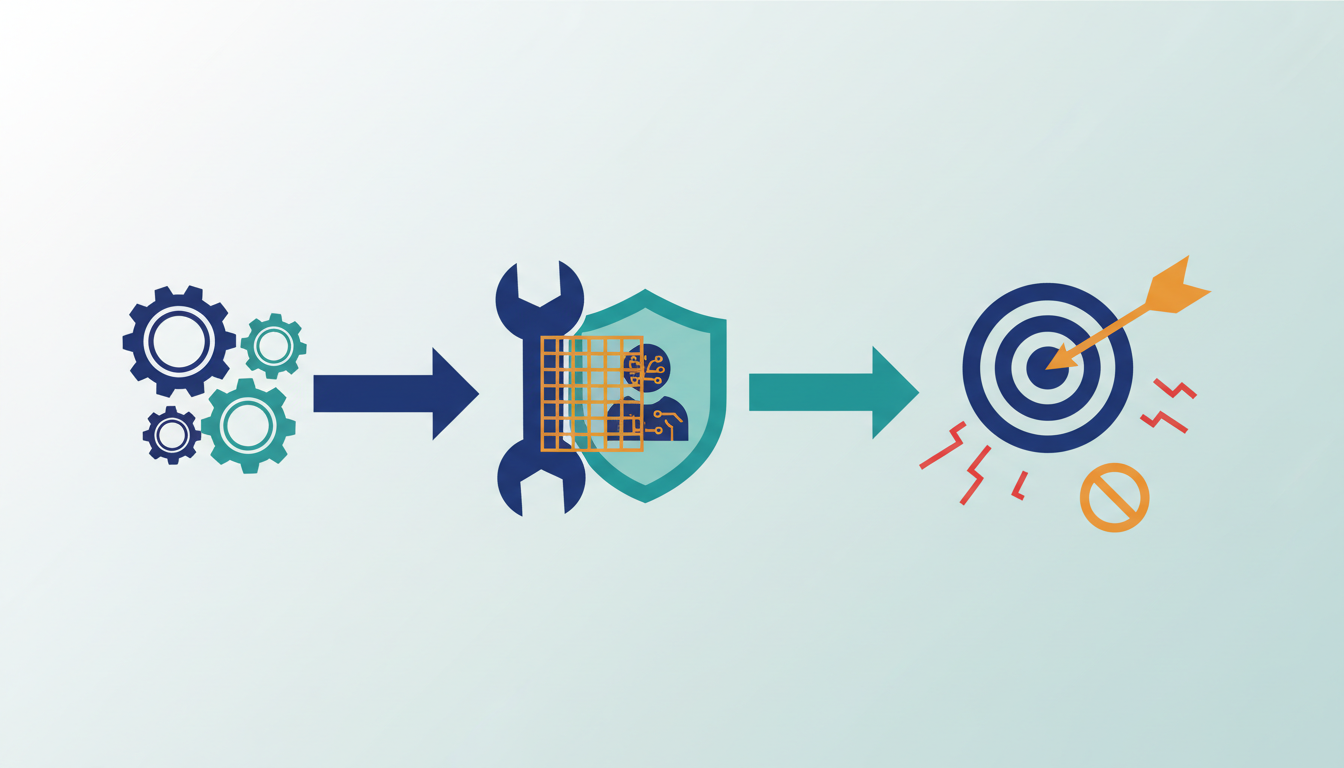
Data leaks trigger alerts, yet auditors demand a replayable envelope that only decision manifests supply. Security crews frequently confuse logging with governance because egress-time controls arrive after the model decides to act. This delay leaves the specific rationale for an action unrecorded until intervention becomes impossible.
LuisCore functions as the substrate where governed agents attach evidence at the exact moment of choice, operating distinctly from perimeter defenses. Traditional firewalls inspect traffic flow while the DM-1 manifest captures the policy constraints and citations authorizing the move. Enterprises relying solely on egress monitoring face a significant governance gap where agents operate without oversight. Remediation costs rise sharply when organizations lack pre-action records, a scenario made common by the high price of enterprise-grade AI SOC platforms reaching $500,000 annually. Integrating decision-time governance allows for cheaper, targeted audits using open standards instead. Operators must deploy both layers to achieve full visibility. Egress filters stop the bleed; decision manifests prove why the cut happened.
Adopting LuisCore for Audit-Ready Agent Governance in Regulated Industries
Regulated firms face a 73% concern rate regarding agent risks while only 30% possess mature safeguards. This gap forces organizations to adopt LuisCore when static egress filters arrive too late to prevent goal hijacking or memory poisoning events and never capture the rationale behind an autonomous action. Operators should deploy decision manifests alongside existing network controls to satisfy audit requirements under the EU AI Act.
While 80% of Fortune 500 companies apply active agents, most lack the inventory mechanisms to trace specific decision paths. DM-1 manifests solve this by providing a replayable envelope that auditors can verify without administrative credentials. The limitation is increased complexity in the agent bootstrap process, as each node must fetch and validate policy constraints prior to inference.
The luiscore-agent CLI enables this governance layer by attaching evidence at the exact moment of choice. Relying solely on traffic monitoring leaves the decision logic opaque to regulators. Integration of Veloraith audit hooks ensures that every autonomous branch contains verifiable proof of compliance.
Cost and Standardization: LuisCore Substrate vs Enterprise AI SOC Platforms
Microsoft's Agent Governance Toolkit covers open-source runtime security, while a proprietary substrate handles complex multi-agent orchestration. This distinction drives cost variance across deployment models. TrueFoundry lists a Pro plan at $499/month, suitable for small teams requiring basic policy hooks. Larger organizations often face steeper pricing for platforms that include pre-built compliance evidence. A dedicated governance layer avoids the bloat of monolithic security operations centers. Adoption of LuisCore makes sense when an organization needs to embed audit trails directly into the agent loop rather than appending them post-execution. This approach reduces the reliance on expensive, separate compliance subscriptions. Strategic investment depends on whether the goal is broad visibility or granular, pre-action control.
About
Marcus Chen, Lead Agent Engineer at AI Agents News, brings direct engineering rigor to the complex debate surrounding decision manifests versus egress monitoring. Having shipped production multi-agent systems using frameworks like CrewAI and LangGraph, Chen understands that simply logging LLM calls fails to capture the nuance of autonomous agent orchestration. His daily work involves dissecting how agents coordinate tool use and make real-time function calls, making him uniquely qualified to explain why DM-1 manifests are necessary for governing decisions before they execute. At AI Agents News, Chen evaluates the very frameworks discussed in this article, bridging the gap between theoretical security layers and practical implementation. This perspective ensures the analysis moves beyond high-level CISO concerns to address the specific mechanics engineers need to build mature safeguards. By connecting daily development challenges with emerging governance standards, Chen provides a factual roadmap for teams struggling to secure autonomous agents without stifling their utility.
Conclusion
Scaling autonomous agents reveals a critical fracture: post-hoc monitoring cannot stop unauthorized actions that originate inside the decision loop. While egress filters fail against determined bypasses, the real operational debt accumulates when legal teams cannot reconstruct why an agent chose a specific path without administrative credentials. Relying on monolithic AI SOC platforms creates a dependency on vendor-specific vocabularies that often lag behind emerging regulatory requirements. You must shift from observing traffic to embedding verifiable constraints directly into the agent bootstrap process.
The split is practical rather than ideological: traffic monitoring records what left the network, and the DM-1 manifest records why the action was authorized in the first place. If an agent can execute before it validates its policy constraints, no volume of egress logs will reconstruct that decision afterwards.
Frequently Asked Questions
Egress filters inspect traffic only after the model has already decided to act, so a harmful output exists before the filter sees anything. Shadow usage widens the hole: 57% of employees route work through personal GenAI accounts whose traffic never crosses the monitored enterprise gateway.
Only 24% of enterprises maintain a dedicated AI security governance team. The consequence surfaces after an incident: with nobody owning pre-execution validation, the decision logic was never recorded, so the audit cannot reconstruct why an agent acted.
97% of organizations that experienced an AI security incident name access control failures as the root cause. The limit of post-hoc tooling sits inside that number: a DLP filter can flag sensitive data in an outbound prompt, but the model has already processed the input and formed its output, so the flag documents the failure instead of preventing it.
Semi-autonomous systems with human-in-the-loop controls are projected to hold 74.40% of the market in 2026. A human in the loop does not remove the need for pre-execution checks, because security teams cannot review every agent decision in real time and visibility without control becomes an alert storm.
Decision-time governance records the justification before execution, while egress monitoring inspects traffic after it. Mechanically the difference is the DM-1 manifest: policy constraints, citations and review verdicts are locked into an immutable record with proof URIs, so a third party can replay the decision without administrative credentials.