AI Security Gate: Enforcing Deterministic Rules
The AI Security Gate enforces deterministic rules to validate artifacts before acceptance, operating independently of AI reasoning. As AI agents begin generating and reviewing code, security must shift from human-dependent checks to a mandatory, policy-based control layer. Unlike probabilistic AI reviewers offering subjective opinions on maintainability, this gate verifies objective facts like embedded API keys or committed private keys without exception.
Deterministic security is non-negotiable for AI-native architectures where human scale can no longer serve as the final checkpoint. A Secret Scanner is a tool; the AI Security Gate is a mandatory role in the pipeline, and that difference decides whether Infrastructure as Code, Kubernetes manifests, and CI/CD workflows are checked at all. Pre-acceptance validation is where the role is enforced: the artifact is judged before it enters the repository, not after.
The value of this layer is consistent rule enforcement, not cost savings. Security stays a property of the development workflow, unaffected by the volume of AI-generated output or the fallibility of human reviewers.
The Role of Deterministic Security in AI-Native Architectures
Defining the AI Security Gate as a Deterministic Control Layer
The AI Security Gate acts as a fixed validation barrier inspecting AI output before any workflow accepts it. Probabilistic reviewers ponder code quality; this control layer checks cold hard facts like embedded secrets or policy breaches without model inference. Validated artifacts reach far beyond source code to cover Infrastructure as Code, Dockerfiles, Kubernetes manifests, SQL scripts, and CI/CD workflows.
Enforcing Pre-Acceptance Validation in AI Code Workflows
Validation happens before artifacts enter the repository, halting workflows immediately when detecting violations like embedded secrets. This Pre-Acceptance property turns security from an optional review into a mandatory checkpoint where every artifact passes through the same gate regardless of origin. Intercepting requests as a stateless hop between the application and LLM provider prevents sensitive data exposure before code commitment. The AISG platform supports 28+ distinct entity types for PII redaction, ensuring scanning goes beyond simple regex matching.
Placing validation after AI generation but before human review creates a window where policy violations exist in the developer's local environment. Enterprises adopt this gateway-layer approach to prevent scenarios where individual applications fail to implement safety controls. Strict blocking introduces friction if policies lack granularity, potentially stalling legitimate development velocity. Operators must balance deterministic rejection with clear error messaging to avoid bypass behaviors. Security becomes an intrinsic workflow property rather than an external audit function.
Deterministic Rules vs Probabilistic AI Decisions in Security
Deterministic security mandates that every gate execution yields an identical outcome based on explicit rules rather than variable model inference. Probabilistic AI decisions fluctuate across runs, yet this architectural layer verifies objective facts like embedded credentials or policy violations with absolute consistency. Generative models reason about code quality, but they lack the rigidity required for compliance enforcement where binary pass-fail states are mandatory.
Relying on probabilistic reasoning for security controls costs measurable inconsistency, as model outputs shift with minor prompt variations or temperature settings. Operators must separate these concerns because autonomous AI agents now handle financial transactions requiring pre-execution risk checks that cannot tolerate variance. Bidirectional scanning for prompt injection demands static rule sets to reliably flag "ignore previous rules" commands without hallucination. Deterministic gates cannot evaluate novel attack vectors absent from their rule definitions, requiring parallel updates to policy logic. This separation ensures that while AI iterates on implementation, the security boundary remains fixed and auditable.
Architectural Distinctions Between Security Gates and Code Reviewers
Architectural Role of the AI Security Gate vs Secret Scanners
Secret scanners function as discrete utilities, while an AI Security Gate establishes a mandatory architectural role similar to authentication. This distinction separates specific implementation technologies from the broader architectural layer they serve. Secret scanning detects exposed credentials, yet the gate orchestrates multiple validation types including license compliance and Infrastructure-as-Code security checks.
| Dimension | Secret Scanner Tool | AI Security Gate Role |
|---|---|---|
| Scope | Source code text | Artifacts, manifests, workflows |
| Function | Pattern matching | Policy enforcement orchestration |
| Position | Optional CI step | Mandatory pre-acceptance layer |
Diverse technologies implement this role, yet the gate forces every artifact through identical deterministic rules before pipeline entry. This positioning prevents agents from executing unauthorized actions by validating intent against organizational policy. Deploying diverse scanning tools without a unifying gate creates fragmented coverage where agents bypass checks via alternative pathways. The gate resolves this by centralizing control so policy enforcement remains consistent regardless of the underlying scanning engine. Security remains a collection of point solutions rather than a system property without this abstraction.
Workflow Placement: AI Agent to AI Reviewer to AI Security Gate
Pipeline sequencing places the AI Agent before the AI Security Gate to enforce hard stops prior to probabilistic assessment. This ordering ensures deterministic policy enforcement occurs before an AI Reviewer evaluates code quality or maintainability. If an agent generates a Dockerfile containing a hardcoded credential, the gate blocks the artifact immediately. The reviewer never processes the violation because the workflow halts at the architectural boundary.
| Dimension | AI Security Gate | AI Reviewer |
|---|---|---|
| Logic Type | Deterministic rules | Probabilistic reasoning |
| Primary Goal | Policy compliance | Code quality |
| Failure Mode | False positive block | Missed nuance |
Rule enforcement first keeps organizations from relying solely on model inference for security-critical decisions: the reviewer analyzes logic flow and suggests refactors that may vary with temperature settings, which is useful advice and a poor basis for a hard stop. Routing requests through a stateless hop lets the system intercept payloads before they reach downstream services, eliminating the risk of embedding sensitive data into repository history at the cost of a synchronous step in the path. Skipping the checkpoint moves that cost onto human engineers verifying every AI suggestion by hand, which does not scale.
Risks of Relying Solely on AI Judgment for Security Decisions
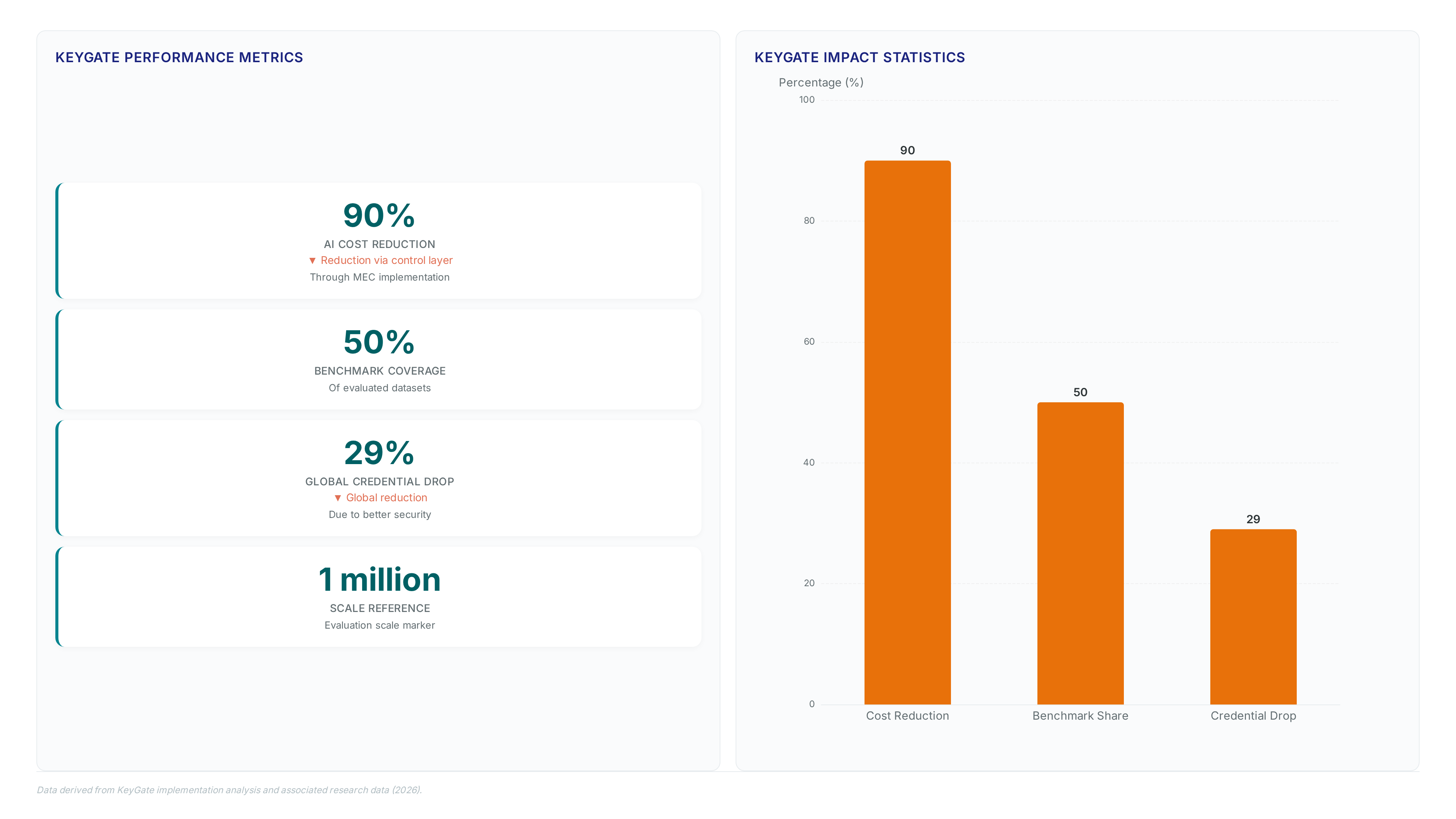
Probabilistic models cannot replace deterministic gates because reasoning engines lack the binary consistency required for policy enforcement. Organizations treating AI outputs as trusted components expose infrastructure to the "toxic cloud trilogy," where high-risk workload combinations persist in 29% of global deployments despite existing controls. This statistical reality shows why AI gateway security must govern interactions between agents and enterprise applications rather than delegating authority to the models themselves. Unlike human reviewers or LLMs that fluctuate with temperature settings, a deterministic security layer executes identical checks on every transaction without exception.
Severe operational consequences follow when bypassing this architecture as autonomous agents begin executing crypto payments and modifying production states without human intervention. Relying on an AI Reviewer for these decisions introduces unacceptable variance where a model might approve a credential leak one minute and flag it the next. Security-critical decisions demand a static truth source that does not reason, hallucinate, or drift over time. Builders must position the gate before the reviewer to ensure no artifact enters the pipeline without passing rigid validation first. This separation prevents the workflow from inheriting the volatility of the underlying generative model.
Operational Mechanics of Pre-Acceptance Validation Workflows
Mandatory Artifact Scanning for AI and Human Code

Security becomes an enforced workflow step rather than an optional review only when every artifact passes through the same gate regardless of origin. This Mandatory characteristic treats all AI-generated or community-sourced code as untrusted third-party components necessitating rigorous gateway scanning before acceptance. Validating manifests and scripts alongside source code prevents policy violations that probabilistic models might overlook.
Operators often assume human-written code carries lower risk yet embedded secrets frequently originate from manual copy-paste errors during rapid development cycles. Applying the gate universally eliminates this blind spot by enforcing deterministic rules on every commit. This rigorous approach introduces latency if the scanning engine cannot scale horizontally with agent output velocity. Builders must configure asynchronous processing queues to prevent the gate from becoming a bottleneck during high-volume generation events.
Why Logging a Violation Is Not Enforcement
True enforcement requires native Data Loss Prevention to block policy violations before artifacts enter the pipeline. Proxies built for routing or for observability sit in the same path but cannot intervene: they record the violation after the payload has already moved, and a record is not a block.
Observability-only tools detect leaks post-factum rather than preventing them creating a severe operational consequence. Operators relying on platforms without active intervention must accept that sensitive data may traverse public networks before alerts trigger. This latency creates an unavoidable window where deterministic security fails leaving organizations exposed to immediate data loss rather than protected by preemptive blocking. Logging a violation differs fundamentally from enforcing a hard stop at the network edge.
Implementing KeyGate for Automated Policy Enforcement
KeyGate as an Open-Source Secret Detection Implementation
KeyGate operates as a concrete open-source tool for secret detection, distinguishing itself from abstract architectural roles. Hosted at GitHub, this utility executes the deterministic security layer by targeting embedded credentials within AI artifacts exclusively. The broader conceptual AI Security Gate might handle license compliance or Infrastructure as Code validation, yet KeyGate narrows its scope to secret prevention.
The utility verifies objective facts. It checks whether an API key exists or a private key was committed. It does not reason like an AI Reviewer. Its function enforces security rules consistently across source code, Infrastructure as Code, Dockerfiles, Kubernetes manifests, SQL scripts, CI/CD workflows, and API specifications. Separating these concerns guarantees that policy violations halt workflows instantly instead of spawning comment threads. This method establishes a verifiable baseline where security stays independent of the generating model's reasoning capabilities.
Integrating Deterministic Secret Scanning into CI/CD Pipelines
Placing KeyGate right after the AI agent stage stops secret leakage before any probabilistic review starts. This positioning creates a hard stop for artifacts containing embedded credentials, keeping them out of the repository and away from downstream analysis. The proposed AI-native development pipeline moves from the AI Agent to the AI Security Gate, then to the AI Reviewer, ensuring rule enforcement happens before quality evaluation.
- Validate every artifact, whether generated by AI or written by a human, through the same mandatory gate.
- Configure rules to flag API keys and private tokens as immediate policy violations.
- Halt the workflow automatically if the scanner detects any violation, ensuring compliance never depends on developer attention.
Future implementations could cover Secret Protection, License Compliance, IaC Security, Policy Enforcement, Regulatory Compliance, and Data Privacy. The sequencing stays the same for each: the check runs before the artifact enters the repository, and compliance never depends on developer attention.
About
Marcus Chen, Lead Agent Engineer at AI Agents News, brings direct engineering rigor to the concept of the AI Security Gate. Having shipped production multi-agent systems using frameworks like CrewAI and LangGraph, Chen understands that traditional security tools often fail to validate the flexible, non-deterministic artifacts generated by autonomous agents. His daily work involves evaluating orchestration mechanics and tool-use patterns, giving him unique insight into where AI workflows introduce novel vulnerabilities that static analysis misses. At AI Agents News, an independent hub for technical builders, Chen focuses on practical infrastructure rather than hype. This article reflects his commitment to helping engineers implement deterministic controls within agentic pipelines. By connecting real-world deployment challenges to architectural solutions, he provides actionable guidance for securing the next-generation of software development where AI agents are primary contributors.
Conclusion
Deterministic and probabilistic checks answer different questions, and the architecture works only when they are asked in that order. The gate runs first and returns a binary verdict on facts that do not depend on a model's mood: an embedded API key, a committed private key, a policy breach in a manifest. The reviewer runs second and reasons about quality, where variance is tolerable precisely because nothing it says is load-bearing for compliance.
The failure this prevents is less a missed secret than an unowned one. Where the gate is an optional CI step, coverage fragments across scanners and agents route around it; where logging stands in for blocking, the payload has already moved by the time the alert fires. High-risk workload combinations persist in 29% of global deployments despite existing controls, which is what security looks like while it remains a collection of point solutions rather than a property of the pipeline.
Frequently Asked Questions
Between the AI agent and the AI reviewer, before any artifact enters the repository. If a generated Dockerfile carries a hardcoded credential, the gate blocks it at that boundary and the reviewer never processes the violation.
A deterministic gate flags a fixed pattern such as an ignore previous rules command on every run, while a probabilistic reviewer's output shifts with prompt wording and temperature settings, so the same artifact can pass once and fail the next time. The trade is that the gate cannot evaluate a novel attack vector absent from its rule definitions, which is why the rule set needs updating in parallel.
The AISG platform supports 28+ distinct entity types for PII redaction, which is what carries it past regex pattern matching. Redaction happens on a stateless hop between the application and the LLM provider, so the data is caught in transit rather than after it has reached the repository.
High-risk workload combinations persist in 29% of global deployments despite existing controls. Implementing a mandatory pre-acceptance gate addresses this gap by enforcing policy checks before any artifact enters the repository.
Deterministic rules return an identical outcome on every execution, so an embedded secret is caught the same way each run regardless of who or what wrote the code. Probabilistic review answers a different question, code quality, where the output legitimately shifts with prompt wording and temperature settings.
References