CrewAI vs AutoGen: Flexible Model Comparison
CrewAI reported powering approximately 2 billion agentic system executions in the 12-month period leading up to January 2026. This massive scale proves that role-based architecture has moved beyond experimental prototypes into critical enterprise infrastructure. The central thesis of this analysis is clear: while Microsoft's AutoGen offers superior conversational flexibility for research, CrewAI provides the structured reliability required for production business automation.
The divergence comes down to workflow mechanics: the role-based pipeline of CrewAI against the conversation-driven model of AutoGen. That single difference governs cost as much as capability, because sequential workflows terminate by construction while flexible message exchanges terminate only when a developer sets the condition.
Defining the Core Architectures of CrewAI and AutoGen
CrewAI Role-Based Agent Architecture vs AutoGen Conversational Model
CrewAI implements a role-based agent systems architecture where developers define specific personas like researchers or writers to execute sequential tasks. As of 2026, CrewAI is cited as the fastest-expanding multi-agent AI framework, generating over 14,800 monthly searches. In contrast, AutoGen, developed by Microsoft, uses a flexible conversational AI agents model where entities exchange messages to negotiate solutions and execute code. This structural divergence dictates deployment strategy: CrewAI enforces a top-down orchestration suitable for predictable business automation, while AutoGen supports organic, mesh-like interactions ideal for exploratory problem-solving, at the price of run-to-run variability that regulated environments cannot absorb.
CrewAI orchestrates sequential business logic through role-based agent systems designed for consistent output. In production environments scaling content operations, the framework manages set personas like Research Agent, Content Writer Agent, and Editor Agent, which collaborate to complete content creation workflows automatically. Operators deploying this model gain predictability, as the hierarchical workflow enforces a strict execution order. However, this rigidity limits adaptability; the system relies on predefined error handlers rather than flexible re-routing if an intermediate step fails.
| Feature | CrewAI | AutoGen |
|---|---|---|
| Orchestration | Top-down / Role-based | Organic / Conversational |
| Primary Use | Business Automation | Complex Reasoning |
| Structure | Sequential Flows | Flexible Messages |
Builders must recognize that CrewAI's strict hierarchy prevents logical drift but inherently limits adaptability when intermediate steps fail unexpectedly. In contrast, AutoGen's conversational approach allows for iterative refinement but requires careful management of conversation patterns to maintain control. The operational cost of this flexibility is increased token consumption during extended negotiation phases. Teams should select CrewAI for stable, repeatable tasks and reserve AutoGen for exploratory research where the solution path is unknown.
Comparing Workflow Mechanics and Flexibility Constraints
CrewAI Sequential Task Chains vs AutoGen Conversational Loops
Specialized tasks with known solutions fit CrewAI, while flexible exploration suits AutoGen. This mechanical divergence separates the two frameworks. CrewAI employs a top-down orchestration model where developers define cooperation through explicit crew and flow definitions. The workflow executes sequentially: agents are set, roles assigned, tasks created, and output generated in a structured pipeline. Predictability remains high, yet adaptability during runtime suffers. AutoGen operates through organic, conversational interactions resembling "chatbots on speed" rather than static automation scripts. Its process relies on message-driven negotiation: agents create communication rules, start dialogues, negotiate solutions, and produce results without predetermined steps. This flexibility allows for complex reasoning but introduces variability in execution time.
Determinism competes with discovery in this operational environment. CrewAI's rigid chains reduce debugging complexity for known workflows, while AutoGen's conversational approach offers greater flexibility for exploration. Builders choosing based on the question "should I use CrewAI or AutoGen" must assess if their problem space requires a fixed path or exploratory computation. Production systems demanding consistent output from known inputs favor the sequential model. Research or coding tasks requiring iterative refinement benefit from the conversational loop's depth.
Mapping Structured Content Pipelines and Flexible Coding Assistants
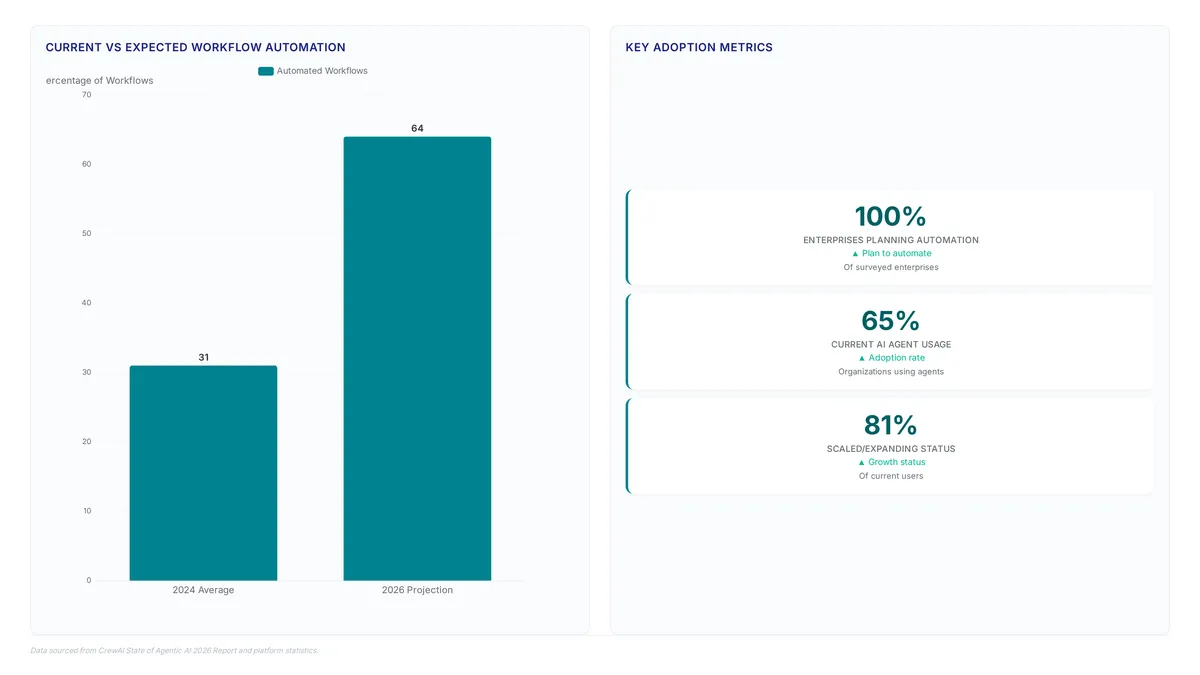
Predictable pipelines where the solution path is known demand CrewAI, whereas flexible problem-solving requiring autonomous code execution calls for AutoGen. Explicit crew and flow definitions make CrewAI a natural fit for structured content generation or research automation. This framework excels when tasks follow a rigid sequence, such as assigning specific roles to research, write, and edit content without deviation. Organizations adopting this approach have automated 31% of their workflows on average, and 81% of respondents in CrewAI's 2026 State of Agentic AI Survey describe their agentic AI adoption as scaling or fully deployed.
AutoGen instead earns its place where iterative feedback and solution exploration matter more than a fixed order. This architecture supports autonomous problem-solving where agents must negotiate outcomes rather than follow a script. Complexity is the price; excessive conversational loops can increase token usage, whereas CrewAI's sequential nature constrains cost variance. Developers must integrate tools based on these mechanical constraints: CrewAI connects to databases and search systems for data retrieval, while AutoGen uses Python environments for real-time code generation and execution. Choosing the wrong orchestration model forces unnatural constraints on the agent's reasoning capability or introduces unnecessary volatility into stable business processes. Task predictability dictates architecture selection.
Token Cost Spikes in AutoGen Conversations and CrewAI Rigidity
Conversational loops in AutoGen lead to higher token consumption during complex reasoning tasks compared to predictable role-based crews. Flexible message exchanges lack inherent termination constraints found in sequential flows, which may result in variable operational expenses. Implementing clear communication rules and understanding conversation management matters when agents negotiate solutions autonomously. CrewAI presents a different consideration where highly flexible interactions may require significant customization to fit the predefined sequential flows. The framework's reliance on structured workflows means it is best suited for tasks with clear solution paths rather than those requiring adaptation to unexpected input patterns without redesign. Teams attempting to force open-ended exploration into this structure may face additional engineering effort to maintain system stability.
| Failure Mode | AutoGen Risk | CrewAI Limitation |
|---|---|---|
| Cost Driver | Variable chat tokens | Customization labor |
| Trigger | Extended negotiation | Flexible input |
| Mitigation | Conversation rules | Workflow redesign |
Workload tolerance for financial variance or structural inflexibility drives the framework choice. Evaluating the predictability of your task sequence is critical before selecting an orchestration model. Applications requiring agents to explore different approaches dynamically accept the potential for higher token usage in AutoGen as a trade-off for flexibility. Workflows demanding strict cost controls and set outputs rely on the structural constraints of CrewAI to offer necessary guardrails despite reduced adaptability.
Implementing Multi-Agent Workflows with Practical Setup Guides
Defining CrewAI Role Assignment and AutoGen Conversation Rules
Configuration follows from the split described above: CrewAI asks the developer to name roles and wire them into a crew before anything runs, while AutoGen asks only for the rules that govern a conversation.
System behavior under load depends entirely on this architectural philosophy. CrewAI follows a structured workflow model that makes systems easier to understand and maintain. AutoGen uses conversational interactions that provide greater flexibility but can become more complex as projects grow. Builders must select the framework matching their workflow certainty: set processes favor CrewAI, while ambiguous problem spaces benefit from AutoGen's flexible negotiation capabilities.
Setup Steps: CrewAI Content Crews and AutoGen Coding Assistants
Strict role definitions allow CrewAI to excel at structured workflows such as content generation, research automation, customer support workflows, and marketing automation.
- Define Agent Roles: Instantiate agents with specific roles and goals to create a coordinated team for complex tasks.
- Assign Sequential Tasks: Link tasks to agents in a set order, ensuring output from one step becomes input for the next.
- Execute the Crew: Run the workflow to generate consistent, high-quality results without manual intervention.
Steps for creating AutoGen conversations prioritize flexible interaction over rigid sequencing. This framework favors exploration over fixed workflow automation.
- Initialize Agents: Create conversational agents capable of exchanging messages and executing code snippets.
- Configure Group Chat: Set up a manager to route messages dynamically between agents based on context.
- Start Conversation Loop: Allow agents to negotiate solutions autonomously until the problem resolves.
Addressing Operational Risks and Debugging Complex Interactions
Defining AutoGen Token Consumption and Conversation Length Risks

AutoGen generates higher costs when agents communicate frequently, conversations lengthen, and API calls multiply. Structured role-based systems constrain message flow by design, yet the conversational approach allows organic interaction that expands token consumption unpredictably. This architectural freedom introduces specific operational liabilities for production environments.
- Frequent Inter-Agent Messaging: Continuous feedback loops between agents drive up request counts compared to sequential workflows.
- Unbounded Context Growth: Lengthy conversations accumulate history, forcing the model to re-process extensive context windows with every turn.
- Code Execution Overhead: Flexible problem-solving often triggers additional verification steps, further inflating the total token bill.
- Verification Cycles: Redundant checks between agents add unnecessary latency and expense.
- Termination Gaps: Missing stop conditions allow loops to run indefinitely.
Monitoring token usage prevents budget overruns in large-scale deployments. A single complex query spirals into dozens of API calls without explicit termination conditions because rigid process controls are absent. This flexibility supports advanced reasoning but trades predictable pricing for adaptive capability. Operators must implement strict external guards or limits on conversation depth to mitigate these financial risks effectively.
Debugging Complex Agent Interactions in Flexible Decision-Making
Resolving interaction errors in flexible decision-making requires isolating conversation loops where agents recursively request clarification without reaching termination. Structured pipelines differ notably from AutoGen, which performs well when complex reasoning is required yet creates unbounded context growth that obscures root causes during failure analysis. The architectural freedom enabling collaborative methods for tackling challenges introduces specific debugging liabilities when agents negotiate solutions rather than following preset paths.
Builders must implement hard limits on turn counts or token windows to keep a debugging session from becoming a billing event. Flexible orchestration requires external guardrails that structured frameworks enforce by default. The cost of flexibility becomes prohibitive for sustained operations without these constraints.
Checklist for Validating CrewAI Cost Predictability vs AutoGen Volatility
Teams must validate token consumption patterns against workflow structure before selecting an orchestration model. Operational expenses in CrewAI typically include LLM API usage, hosting, vector databases, and external tools, yet structured roles constrain token usage within set boundaries. Conversely, AutoGen agents communicate frequently, causing conversations to become lengthy and triggering excessive API calls that spike costs. Production data indicates CrewAI validates its use in live enterprise environments alongside other frameworks through over 18 deployments between 2024 and H1 2026. Volatility risk arises when flexible exploration lacks termination criteria, leading to unbounded context growth.
- Monitor conversation length limits to prevent budget overruns.
- Define strict termination conditions for every agent loop.
- Audit tool call frequency during peak load testing.
- Calculate average tokens per successful task completion.
- Set alerts for conversation turns exceeding baseline thresholds.
Debugging organic interaction loops where agents negotiate solutions rather than following preset paths reveals hidden costs. AI Agents News recommends implementing hard token caps immediately if your architecture relies on conversational group chats. The flexibility of message routing directly correlates with financial exposure without these guards.
About
Marcus Chen serves as Lead Agent Engineer at AI Agents News, where he specializes in the architecture and evaluation of production-grade multi-agent systems. His daily work involves rigorously testing orchestration mechanics, tool-use patterns, and memory retention across frameworks like CrewAI and AutoGen to determine their viability for complex engineering tasks. This hands-on experience with agent coordination and function calling directly informs his comparative analysis, ensuring recommendations are grounded in actual deployment behavior rather than marketing claims. At AI Agents News, Marcus leads technical deep dives that help software engineers navigate the evolving environment of autonomous workflows. By focusing on concrete capabilities and version-specific changes, he provides the factual clarity engineers need to select the right framework for their specific architectural requirements without vendor bias.
Conclusion
Scaling agentic AI exposes a critical fracture: unbounded conversational loops in flexible frameworks rapidly inflate operational expenses through excessive token consumption. While flexible reasoning offers power, the ongoing cost of unmanaged message frequency creates financial volatility that structured role-based execution avoids by design. Enterprises must recognize that flexibility without termination criteria is not a feature but a liability that erodes budget predictability.
We recommend mandating hard token caps and explicit loop-termination logic for any deployment relying on organic agent negotiation before the next fiscal planning cycle. Organizations should prioritize frameworks that enforce structural constraints by default if their primary use case involves repetitive, high-volume workflow automation rather than open-ended exploration. The data confirms that cost predictability correlates directly with the rigidity of agent roles, making this architectural choice a financial imperative rather than a mere preference.
Start this week by auditing your current agent logs to calculate the average tokens consumed per successful task completion, then set immediate alerts for any conversation turns exceeding that baseline by twenty percent. That number settles the question the comparison opened with: workflows whose solution path is already known belong in CrewAI's sequential crews, and the ones that genuinely have to negotiate an answer belong in AutoGen with a hard turn limit attached.
Frequently Asked Questions
CrewAI supports structured reliability for critical enterprise infrastructure. It powered approximately 2 billion agentic system executions in the year to January 2026, proving its capacity for massive scale compared to conversational models.
CrewAI assigns fixed roles and runs them in a set order, while AutoGen lets agents exchange messages with no pre-set path. The first suits a process that must run the same way twice; the second suits a problem whose solution path is unknown at design time.
AutoGen excels in research flexibility but lacks the same reported production scale for repetitive, well-defined business processes today.
Deterministic tasks favor CrewAI's sequential chains, where the output of one step becomes the input of the next and cost variance stays inside known bounds. Tasks whose path is discovered during the run favor AutoGen, which buys that depth with variable token spend.
Reported deployment data rather than the execution count: 81% of respondents in CrewAI's 2026 State of Agentic AI Survey describe their agentic AI adoption as scaling or fully deployed, organizations report automating 31% of workflows on average, and the framework appears in over 18 production deployments recorded between 2024 and H1 2026.
References