crewAI 1.14.7a2: Tracing conversational flow events
With 2 billion agentic workflows executed in the last year, crewAI is forcing a reckoning on how we track conversational flow. The framework's latest pre-release, version 1.14.7a2, proves that opaque agent interactions are no longer acceptable in enterprise deployments. By surfacing raw LLM event data and decoupling lock stores, the update shifts the architecture from magical black boxes to auditable, transparent systems.
Version 1.14.7a2 surfaces real finish_reason values and response.id parameters directly within chat API implementations, so operators can tell a token limit from a logical completion without parsing raw text. Overridable lock stores remove the second blocker, letting these agents deploy inside complex monorepo structures where static file locks often fail in distributed build pipelines. Both changes serve the same audience: the 150 enterprise customers, PwC and NVIDIA among them, already running the framework.
The days of guessing why an agent stalled are ending. Gartner notes a staggering 1,445% surge in multi-agent inquiries, yet most tools still lack basic tracing. CrewAI's approach of splitting flow decorators and enforcing type-safe triggers ensures that debuggability does not collapse as adoption spikes, which is the practical constraint on production-grade agent orchestration.
Conversational Flow and LLM Event Transparency in crewAI 1.14.7a2
Lorenzejay published the 1.14.7a2 pre-release on 05 Jun at 21:19 to define conversational flow traces as explicit event logs that replace opaque execution loops. This update surfaces real finish_reason values and response.id parameters within LLM events, creating a verifiable chain of custody for agent decisions. Previously, operators could not distinguish between a token limit stop and a logical completion without parsing raw text outputs. The new architecture exposes these sampling parameters directly, allowing engineering teams to audit why a specific agent terminated its turn.
Visibility now replaces the abstraction of underlying LLM events into generic success flags. By surfacing the actual finish_reason, the system reveals whether a model halted due to content filters or completed its assigned task. This shift enables precise debugging of hierarchical processes where a manager agent delegates to role-playing sub-agents. Without this visibility, tracing failure modes across complex conversational flows remains guesswork rather than engineering.
Cost is increased verbosity in logging pipelines, as every token generation now emits detailed metadata. Operators must adjust log aggregation strategies to handle the expanded event schema without losing Signal-to-Noise ratio. Adoption has reached millions of downloads, yet many deployments still rely on legacy polling methods that ignore these new trace identifiers. Ignoring response.id prevents correlation between upstream prompts and downstream actions in distributed monorepos. True observability requires ingesting these structured events rather than scraping console output for errors.
Flow DSL Architecture and Chat API Implementation Mechanics
Flow DSL Monolith Split and Route-Aware Decorator Mechanics
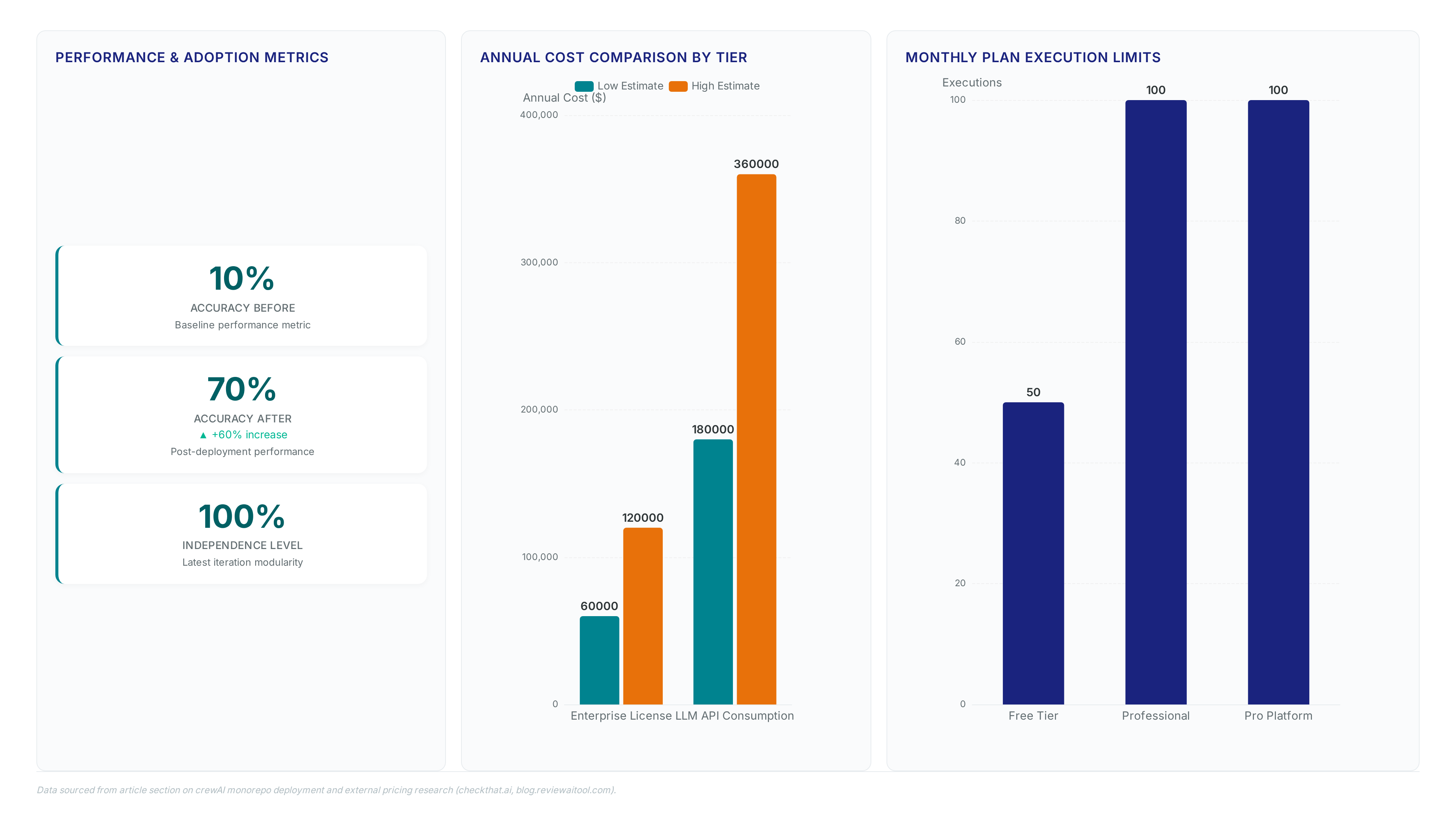
Version 1.14.7a2 splits the monolithic Flow DSL into focused decorator modules to reduce graph complexity. Previously, a single file set all triggers, creating a brittle dependency chain where minor route changes required full redeployment. The new architecture isolates logic, allowing operators to apply route-aware decorators that validate agent handoffs against path constraints before execution. This structural shift addresses the state management overhead found in lower-level graph implementations. Migrating codebases to this modular pattern yields substantially less code compared to traditional graph-based approaches. The reduction stems from removing boilerplate state handlers that higher-level abstractions now manage automatically. PwC consultants utilized similar workflow optimizations to increase code generation accuracy from 10% to over 70%.
Builders construct a FlowDefinition object by extracting metadata directly from these decorated functions. This process converts static configuration into flexible routing logic without external orchestration layers. The handle_turn callback maps conversational state transitions, ensuring that every agent interaction carries explicit context.
| Feature | Monolithic DSL | Modular Decorators |
|---|---|---|
| Trigger Scope | Global, untyped | Local, route-aware |
| Deployment Unit | Full flow rebuild | Single module update |
| Code Overhead | High state boilerplate | Minimal decorator syntax |
The trade-off is strict adherence to typed triggers; untyped functions fail validation at runtime. Teams must define explicit return types for every decorated method to satisfy the new parser. This constraint prevents ambiguous pathing but increases initial scaffolding requirements. The architectural pivot favors maintainability over rapid prototyping speed.
The handle_turn function acts as the mandatory entry point for capturing finish_reason and response.id within LLM events. Operators implement this by attaching the callback to conversational flows, ensuring every agent interaction logs specific sampling parameters rather than opaque text blobs. This mechanism surfaces real data required for debugging complex chains where token limits often mask logical failures.
Adoption requires re-architecting legacy listeners to consume structured event objects instead of raw strings. The release notes confirm that version 1.14.7a2 makes these traces mandatory for full Chat API compliance.
Deploying crewAI in Monorepos with Overridable Lock Stores
Custom Backends and GPG Asset Verification
Decoupling state serialization from the core runtime resolves monorepo dependency conflicts through overridable lock store backends. Engineers replace the default JSON checkpointing mechanism with custom storage solutions tailored for shared repository constraints. Making the locking backend overridable prevents race conditions where multiple packages attempt to modify global state simultaneously. Operators configure this by subclassing the base lock store and injecting the new class into the runtime environment. This approach directly supports the requirement to document monorepo deployments effectively, as static file locks often fail in distributed build pipelines. The release package includes 3 assets associated with this version, containing the necessary binaries and signatures for verification. GPG verification assets remain distinct from these three release components to maintain a clear separation between code integrity and state management logic. Custom backends must implement explicit lifecycle events to avoid orphaned locks during agent forks. Workflows deadlock without these handlers and require manual intervention to clear. Increased implementation complexity is the cost of this flexibility compared to single-repository setups.
Verifying the commit hash 913a3ab against official tag metadata resolves GPG signature mismatches for the three release assets. Operators encountering error loading GitHub release assets must validate the signing key ID B5690EEEBB952194 before attempting installation. This step confirms the binary integrity of the conversational flow traces introduced in the pre-release. Package managers reject the update without this verification, leaving systems vulnerable to unpatched dependency chains. Version 1.14.7a1 changelog updates must explicitly list the new NVIDIA Nemotron LLM guide alongside monorepo deployment documentation. Acknowledging contributors mattatcha, gvieira, and four others maintains accurate attribution records required for enterprise audit trails. Documentation shifts support the broader strategy to document monorepo deployments effectively within shared codebases. Ambiguity regarding which agent behaviors stem from configuration versus code defects arises when these records remain stale. Annual GPG key rotation demands constant vigilance during upgrade windows. Automated tools lacking manual hash verification risk accepting compromised artifacts if the supply chain is breached. AI Agents News recommends integrating these checks into CI/CD pipelines to enforce security policies automatically.
About
Priya Nair, AI Industry Editor at AI Agents News, brings a specialized focus on the business and technical evolution of autonomous systems to her analysis of conversational flow. As the lead covering product launches and platform shifts for substantial agent frameworks, she tracks how orchestration mechanics directly impact user interaction patterns. Her daily work involves evaluating multi-agent coordination and tool use across ecosystems like crewAI, providing her with unique insight into how release updates, such as version 1.14.7a2, refine dialogue management. At AI Agents News, an independent hub for engineers building with agents, Nair connects raw commit data to broader industry trends in function calling and state retention. This specific expertise allows her to explain why incremental framework improvements are critical for maintaining coherent conversational flow in complex, production-grade deployments. Her reporting bridges the gap between low-level code changes and the high-level reliability required by technical founders and engineering leaders.
Conclusion
The through-line of 1.14.7a2 is auditability. Real finish_reason and response.id values in LLM events replace guesswork about why an agent stopped, split flow decorators make routing explicit instead of implicit, and overridable lock stores let the same crew run inside a shared monorepo without racing on global state. Each of those has a price: more verbose logging pipelines, explicit return types on every decorated method, and custom lifecycle handlers that release locks when an agent forks. Teams that pay it get a verifiable chain of custody for agent decisions; teams that skip it keep the opaque execution loops this release was written to end.
Frequently Asked Questions
Teams can significantly boost code generation accuracy using these workflow optimizations. PwC consultants utilized similar methods to increase code generation accuracy from 10% to over 70% in their specific case studies.
Adoption has reached millions of downloads, though many deployments still rely on legacy polling methods that ignore the new trace identifiers. Those pipelines cannot correlate a prompt with the action it produced.
Gartner notes a staggering 1,445% surge in multi-agent inquiries, yet most tools still lack basic tracing. Conversational flow traces in 1.14.7a2 are the framework's answer to that gap.
The platform has processed an immense volume of workflows to prove its enterprise readiness. With 2 billion agentic workflows executed in the last year, crewAI is forcing a reckoning on how we track conversational flow.
Legacy polling methods fail because they ignore specific trace identifiers required for modern analysis. Ignoring response.id prevents correlation between upstream prompts and downstream actions in distributed monorepos, making true observability impossible.