OpenHands event filters cut agent noise in cloud1.34.0
With OpenHands hitting 247,000 stars, the new event callback filters in version cloud-1.34.0 finally stop agents from drowning in noise. This release argues that raw event streams are unsustainable for the 52% of executives now deploying task-specific AI agents, necessitating a shift toward architectural simplification.
The mechanics are narrow. Commit 45b4c6f replaces nested conditional evaluation with flat metadata rules, so a filter inspects an event header and routes it straight to a handler instead of walking a recursive chain, and the compute cost of filtering drops because redundant checks disappear on every message pass.
What that costs is visibility. Flat rules cannot accumulate context across multi-step sequences, a malformed event passes when its header looks valid, and an empty filter set surfaces as a rendering error rather than a silent default. Everything below is about keeping those failure modes inside the sandbox where they belong.
The Role of Event Callback Filtering in Cloud Development Platforms
OpenHands Cloud and Event Callback Filtering Architecture
OpenHands functions as a cloud-native development environment evolving from the OpenDevin research initiative launched in Spring 2024. The platform uses event callback execution filters to manage asynchronous agent actions within its distributed V1 architecture. These filters inspect incoming event metadata before triggering specific handler functions, preventing race conditions during high-concurrency workflows. Operators configure these rules to drop non-necessary telemetry, reducing compute overhead on the central scheduler. The transition to cloud-1.34.0 simplified this logic by removing nested conditional checks that previously increased latency. This update supports the platform's growth to approximately 247,000 stars by March 2026, demanding stricter resource governance. Deployment options now include Self-hosted Kubernetes via Helm Charts for enterprise isolation. A critical limitation exists: aggressive filtering can suppress debug events needed for post-mortem analysis of agent failures. Network teams must balance noise reduction against observability requirements when defining callback policies. Without granular allow-lists, valid agent responses risk rejection during transient network partitions. The architectural shift prioritizes throughput over exhaustive logging by default.
Sandbox Execution in OpenHands Release cloud-1.34.0
Release cloud-1.34.0 implements sandbox execution to isolate agent runtimes using Docker containers. This update, titled 'Simplify event callback execution filters (#14557)', replaces complex nested conditions with a simplified filtering that inspects event metadata before triggering handlers. The transition to a distributed V1 architecture enables this secure isolation, preventing runaway processes from affecting the central scheduler or peer agents. However, the cost of strict isolation is measurable: hitting the maximum number of concurrent runtimes triggers rate limiting, returning 429 errors while older sandboxes pause. This behavior contrasts with the permissive defaults of the monolithic V0 predecessor. Failure to account for this pause-and-resume cycle during peak loads results in visible latency spikes for end users. Isolation also carries inter-container communication overhead that the shared-memory V0 design did not have.
Inside the Architecture of Simplified Event Callback Execution
Simplified Event Callback Execution Filters in cloud-1.34.0
Release cloud-1.34.0 replaces nested conditional logic with direct metadata inspection to route agent events. The update, tagged by neubig on 26 May at 13:55, removes recursive evaluation layers that previously slowed the central scheduler. Operators now define flat rules that match specific event types before triggering handlers. This change reduces the compute cost of filtering by eliminating redundant checks on every message pass. The architectural shift supports the broader migration to a distributed V1 architecture where agents run in isolated containers. Unlike the monolithic V0 design, this model requires strict event boundaries to prevent race conditions across sandboxed environments. Developers building custom workflows can reduce custom coding by 30% compared to frameworks like AutoGen that lack native filtering primitives. The trade-off is reduced flexibility for complex, state-dependent routing that requires full payload inspection.
| Feature | Legacy Nested Logic | Simplified Metadata Rules |
|---|---|---|
| Evaluation Depth | Recursive | Flat |
| Latency Impact | High | Low |
| Complexity | O(n²) | O(1) |
The limitation of flat rules becomes apparent when handling multi-step sequences requiring context accumulation. A single malformed event can bypass simple filters if the metadata header appears valid, so teams must supplement these rules with downstream validation to catch payload anomalies that headers miss. When no filter matches, the event is discarded immediately rather than queued, which keeps memory pressure down during spikes and makes an over-broad rule a silent path to dropped work.
Handling Filter Loading Errors During Asset Retrieval
Asset retrieval failures displaying "Sorry, something went wrong" occur when the simplified filter logic in cloud-1.34.0 encounters undefined metadata during tag loading. The release notes list exactly 2 assets, yet users report persistent "Uh oh! " messages when the UI attempts to parse empty filter sets. This behavior indicates that the new execution flow exposes race conditions previously hidden by complex nested logic in the monolithic design. Sandbox execution isolates these failures within specific Docker containers rather than crashing the global scheduler, which improves stability but shifts the failure-visibility burden to whoever is watching individual sandbox logs. Operators must recognize that simplified filters demand stricter validation of input data before event triggering. The cost of this architectural purity is reduced tolerance for malformed requests during the initial asset fetch phase. Deployments relying on streaming JSON responses for conversation starts must ensure upstream systems do not send incomplete filter definitions.
Configuring Event Callback Setup in OpenHands Cloud Environments
Defining Flat Metadata Filters in cloud-1.34.0
Administrators define these execution paths as simple key-value pairs rather than boolean chains, and operators configuring self-hosted instances via Helm Charts gain immediate visibility into filter matches without parsing deep call stacks. Operators must define these execution paths explicitly to use the security boundaries of the distributed V1 architecture:
- Identify the specific event type requiring isolation within the agent workflow.
- Deploy the Self-hosted Kubernetes manifest to establish the sandbox environment.
- Apply the new flat metadata tags to route events without nested conditionals.
- Verify container isolation to prevent cross-agent interference during execution.
The trade-off is reduced visibility: simplified logs omit the deep call stacks found in monolithic V0 designs, and the UI may still display loading errors when parsing empty filter sets. Monitor container health metrics rather than asset loading screens, because the agent logic keeps running even when the interface does not render.
Recovering From a Failed Filter Load
Recovery from that failure is short, and the order matters.
- Inspect Docker container logs for undefined metadata tags that trigger the Uh oh! loading failure.
- Reload the page immediately to bypass transient state mismatches in the distributed V1 architecture.
- Verify that the streaming JSON responses are not hitting rate limits which pause older sandboxes.
Operators must distinguish between a transient UI glitch and persistent configuration drift: the shift to flat metadata tags means a missing value now halts rendering instead of defaulting silently. For persistent failures, check network connectivity to the conversation start endpoints before restarting the scheduler.
Measurable ROI from Optimized Callback Execution in Enterprise Deployments
Defining cost efficiency metrics for self-hosted agent tasks requires anchoring the resolved task unit to infrastructure spend rather than API token consumption. Enterprises processing over 100 million tokens monthly feel this shift most acutely. The economic delta becomes clear when contrasting the per-task expense against subscription-based alternatives that charge regardless of outcome efficiency.
| Metric | Self-Hosted Model | Premium API Model |
|---|---|---|
| Cost Basis | Infrastructure usage | Token consumption |
| Annual Savings | $5M to $50M | N/A |
| Scalability | Linear hardware cost | Exponential token cost |
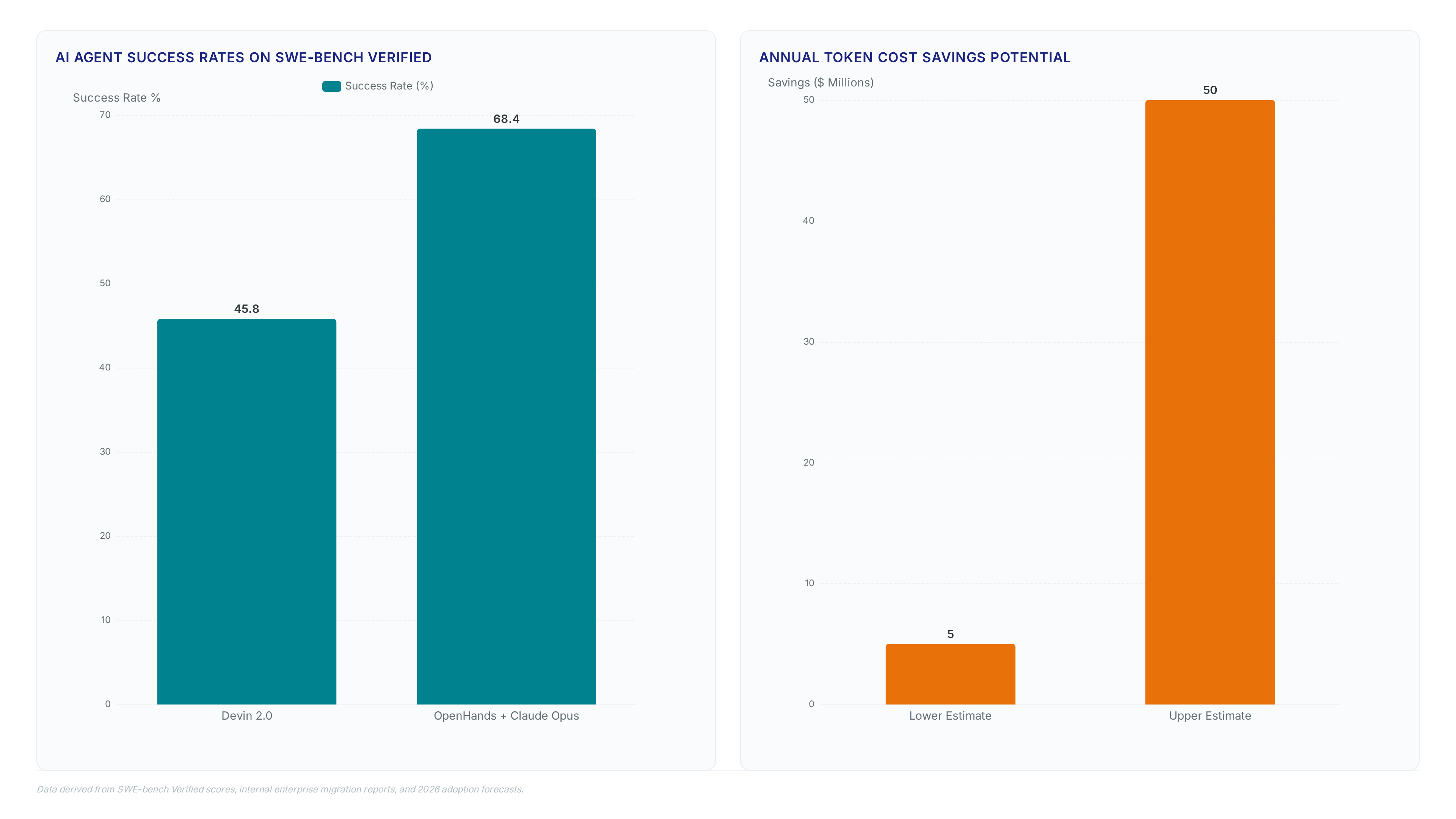
Organizations migrating from proprietary tooling report annual savings ranging from $5 million to $50 million. This financial relief stems from decoupling compute cycles from vendor-specific pricing tiers. However, realizing these gains demands rigorous capacity planning to avoid under-utilized GPU assets that erode margin benefits. The operational trade-off shifts from managing API budgets to optimizing hardware utilization rates. Teams must monitor sandbox density to ensure the fixed costs of GPU cloud instances do not exceed the variable costs they replace.
SWE-bench Verified Performance: Claude Opus 4.6 vs Devin 2.0
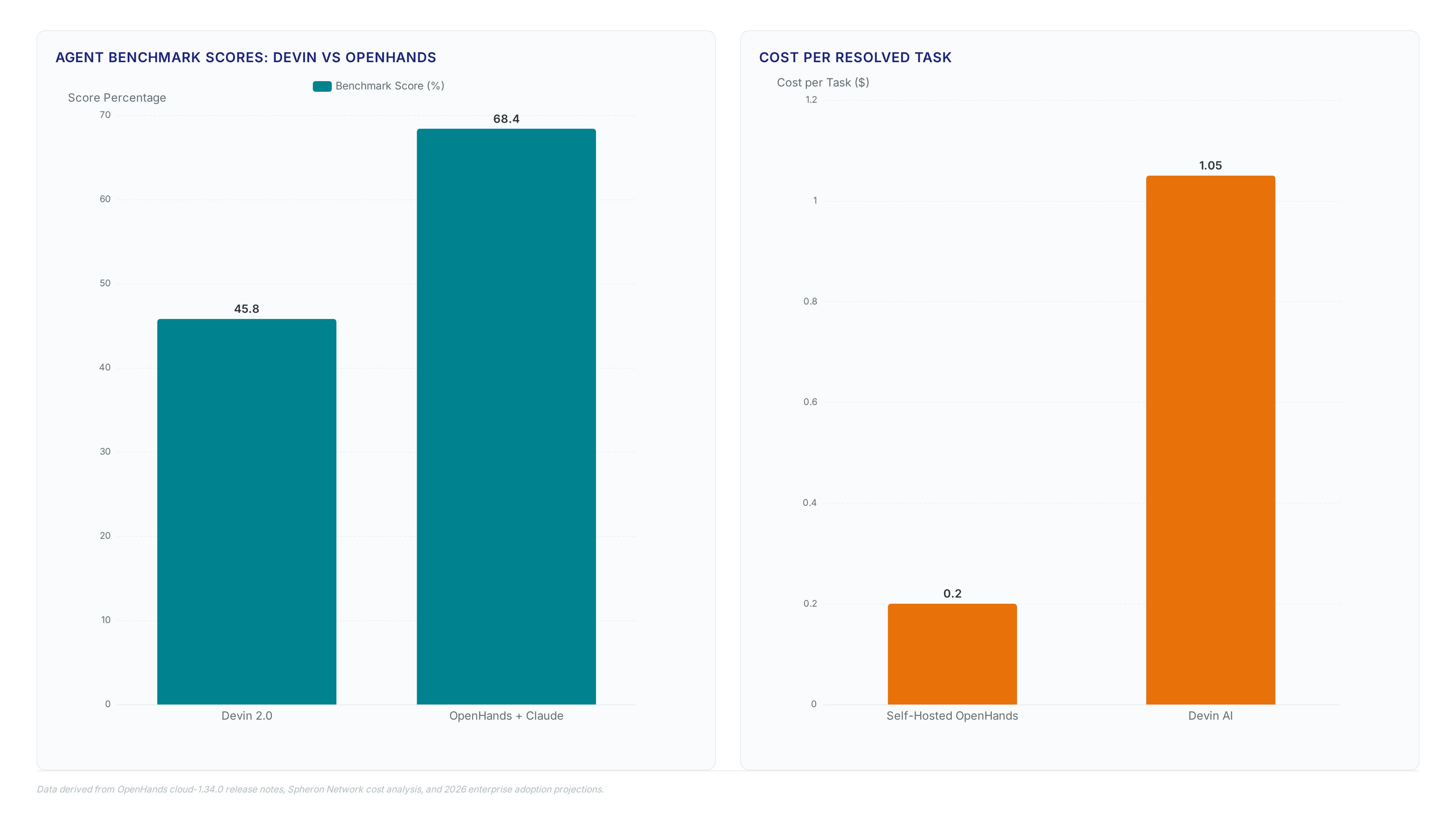
OpenHands running Claude Opus 4.6 achieves a 68.4% success rate on SWE-bench Verified, significantly outperforming the proprietary Devin 2.0 system which scores approximately 45.8%. This 22.6 percentage point differential quantifies the advantage of model-agnostic architectures over closed-loop competitors in complex software engineering tasks. While Devin 2.0 relies on a fixed internal model, operators configuring OpenHands can select optimal inference engines via GPU cloud deployments to maximize resolution probability. However, realizing these gains requires engineers to manage their own deployment infrastructure rather than relying on turnkey SaaS solutions. The operational burden of maintaining Docker containers and API keys offsets the raw performance benefit for teams lacking dedicated platform support. Production networks must weigh the success rate gain against the increased complexity of self-hosted maintenance schedules.
About
Diego Alvarez, Developer Advocate at AI Agents News, brings a practical, code-first perspective to the complexities of event callback execution filters. As a technical writer who daily constructs and benchmarks multi-agent systems using frameworks like CrewAI and LangGraph, Diego understands that uncontrolled callbacks can quickly lead to race conditions or infinite loops in autonomous agents. His role involves rigorously testing these failure modes, making him uniquely qualified to dissect the cloud-1.34.0 update for OpenHands. This release simplifies how developers filter callback events, a critical improvement for maintaining stability in large-scale coding agent deployments. At AI Agents News, Diego's mission is to translate raw repository updates into actionable engineering insights. By connecting OpenHands' structural changes to real-world orchestration challenges, he ensures that engineers can implement these filters with confidence, avoiding common pitfalls while building reliable, self-correcting agent workflows.
Conclusion
Event filtering is where cloud-1.34.0 pays for itself, and also where it can quietly cost you. Flat metadata rules drop non-necessary telemetry before it reaches the scheduler, but the same flatness means a malformed event with a plausible header gets through, an over-aggressive rule suppresses the debug events a post-mortem needs, and an empty filter set surfaces as a rendering error instead of a safe default.
Treat filter definitions as production configuration rather than tuning knobs. Allow-list the event types you actually handle, add downstream validation for the payload anomalies a header cannot catch, and put a health check on the asset loading path so a parse failure arrives as a signal rather than a support ticket. Sandbox execution contains the blast radius of a bad filter, which also means the operator, not the scheduler, is now the one who has to notice.
Frequently Asked Questions
Over-filtering suppresses the debug events a post-mortem needs, and valid agent responses get rejected during transient network partitions. The loss is silent: an unmatched event is discarded immediately rather than queued, so nothing downstream records that it arrived.
A filter reads the event header and routes straight to a handler instead of walking a shared recursive chain, which removes the contention point rather than guarding it. The guarantee stops at the header: a payload anomaly still needs downstream validation.
Each agent runtime gets its own Docker container, so a runaway process cannot reach the central scheduler or peer agents. The cost is visibility: a failure now stays inside that container and shows up only in its sandbox log.
The Cloud API returns 429 once the maximum number of concurrent runtimes is reached, and older sandboxes pause until capacity frees up. What users see is the pause-and-resume cycle: latency spikes at peak load rather than an explicit failure.
Non-essential telemetry is dropped before it reaches the central scheduler, and the filter itself costs less because flat metadata matching replaces recursive evaluation on every message pass. The saving comes from removed redundant checks, not from running fewer agents.