Codex for enterprise: nondevs adopt 3x faster
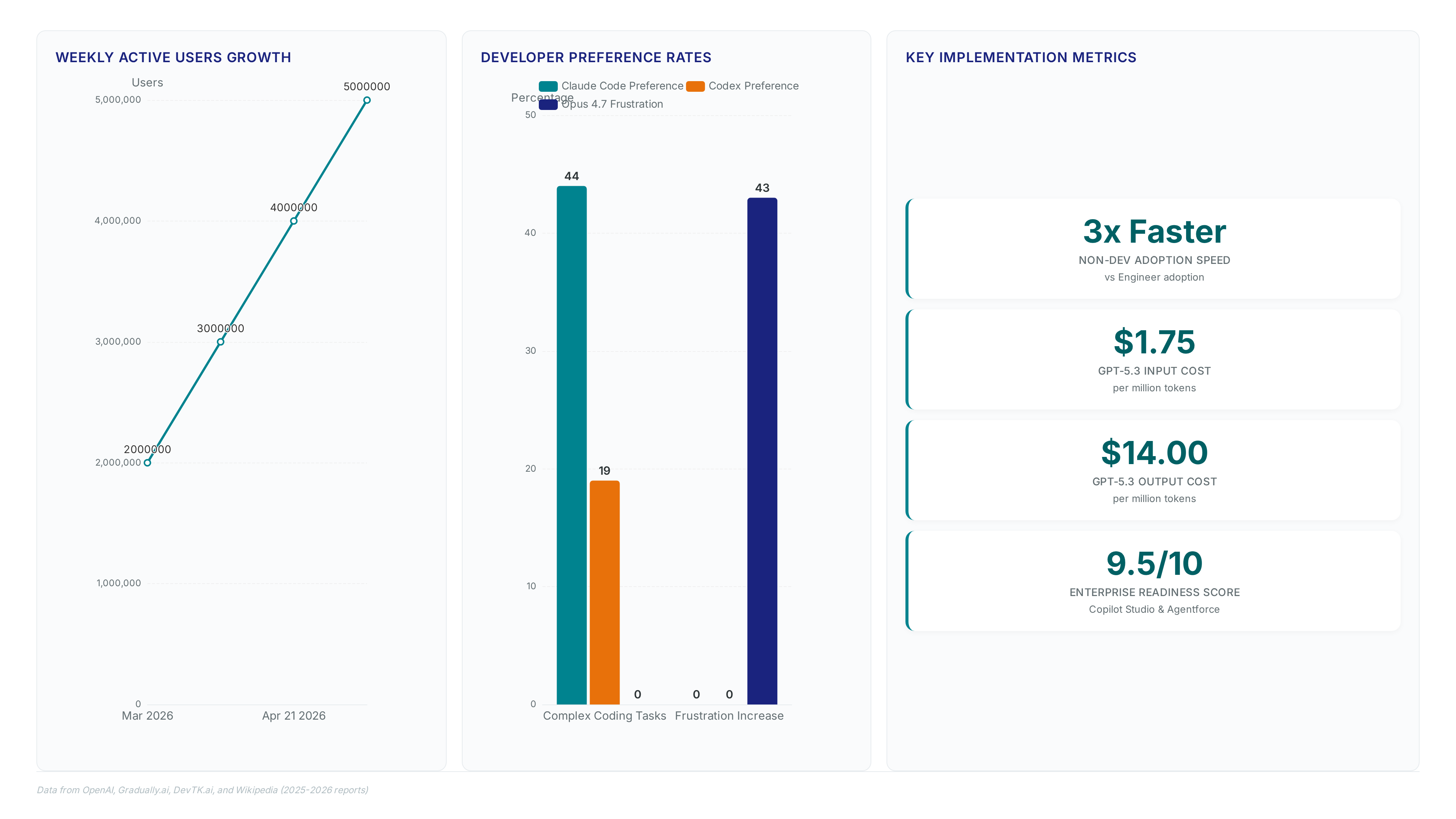
OpenAI Codex hit 5 million weekly users by June 2026. Non-developers are adopting the platform 3x faster than traditional engineers. This isn't just a surge in usage; it marks the moment enterprise agent platforms graduated from experimental coding assistants to essential infrastructure. The era of the solitary developer tool is dead. The new reality demands scalable, secure workflows for a workforce that increasingly lacks deep technical training.
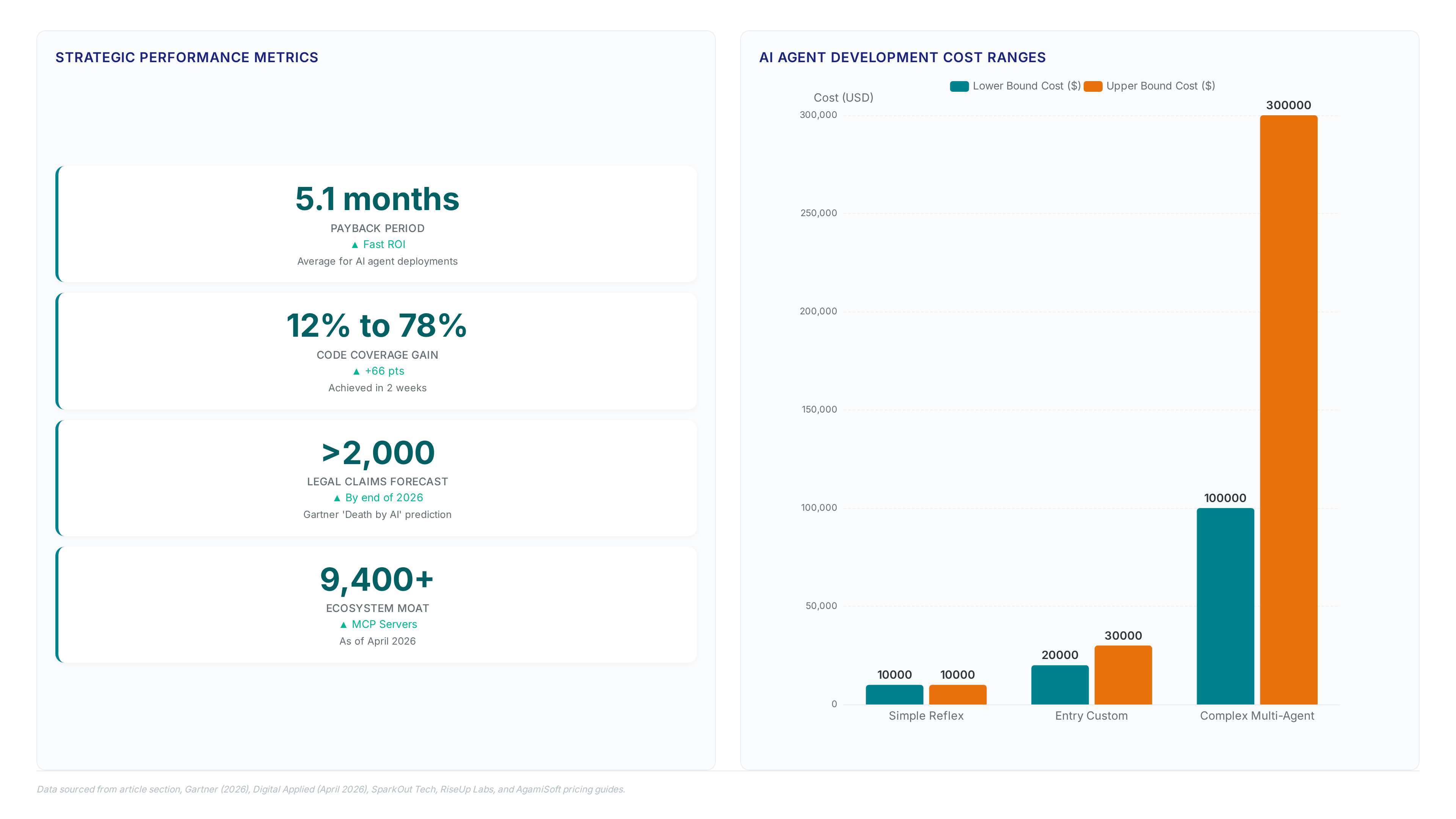
Gartner predicts "death by AI" legal claims will exceed 2,000 by 2027 due to insufficient guardrails. Organizations can no longer afford ad-hoc implementations. The environment has evolved from simple code generation to thorough automation. Integration engineering now consumes up to 55% of total project costs. The binding constraint is governance: agent identities need the same scoping and audit discipline as human service accounts before agent count leaves the pilot phase.
The Evolution of Codex from Developer Tool to Enterprise Agent Platform
Non-developers now comprise 20% of the total user base on this AI agent platform. This demographic shift indicates that non-developer adoption is occurring three times quicker than traditional engineer uptake, fundamentally altering the tool's operational profile. Enterprise revenue currently accounts for more than 40% of total income, a trajectory pointing toward parity with consumer streams by late 2026.
Direct import capabilities for settings and plugins from competitors like Claude Cowork drive this transition. Such interoperability reduces migration friction for teams deploying workflow automation. Rapid expansion introduces governance complexity; synthetic users employed for testing core flows require strict access controls to prevent privilege escalation. A synthetic user simulates real browser interactions to validate application signups and logic without human intervention.
Speed of deployment often conflicts with security posture. Unmanaged agent proliferation exposes API keys and enables unvalidated data access. Mitigation requires granular permission scopes rather than broad administrative tokens. Failure to implement these controls risks data leakage through automated agents acting on stale or excessive credentials.
Shared Brain functions as a collective knowledge vault where teams centralize context for autonomous task execution. Unlike static databases, Shared Brain by Zapier ingests organizational history to fuel AI-native CRM actions without manual prompting. Lightfield exemplifies this shift by allowing operators to describe complex sales workflows in plain English for immediate automation. This approach bypasses the prohibitive capital expenditure of custom development, which typically ranges from $25,000 to $300,000+ per agent.
Governance is the limiting factor; without strict access controls, shared knowledge bases risk leaking sensitive prompt history across tenant boundaries. Enterprises must prioritize platforms with granular permissioning to prevent context poisoning. High-tier agent deployments now command pricing up to $20,000 monthly, reflecting the premium on reliable, governed automation. Operators should evaluate whether pre-built solutions like Lightfield offer sufficient flexibility compared to the cost of building proprietary systems. The operational risk shifts from code bugs to context corruption, requiring new monitoring strategies for agent behavior.
Grok 4.3 delivers a 1M context window at $1.25/$2.50 per million tokens, undercutting GPT-5.5's $5.00/$30.00 structure. This price disparity forces enterprises to weigh raw token throughput against governance readiness for production agents. GPT-5.5 commands a premium that includes tighter integration controls for regulated environments, so the decision is whether cheap tokens justify building those guardrails yourself. Cheap inference risks uncontrolled spending if agent loops fail to terminate efficiently.
Architectural Mechanics of Secure AI Agent Workflows
Git-Sync as a Read-Only Baseline for Agent Operations
Entire's git-sync utility mirrors repositories without local cloning, establishing a read-only state baseline for agent operations. This mechanism prevents agents from mutating source code directly during analysis phases. Synchronizing state introduces latency, meaning agents acting on stale commits may generate irrelevant patches. Network operators must treat the sync interval as a strict security boundary rather than a simple performance metric. Webhooks trigger these actions, yet uncontrolled API connections create significant exposure if not gated by rigorous authentication checks.
Implementing DeepSec and Persistent Cloud Agents
Deploying the deepsec harness from Vercel immediately isolates coding agents to prevent unauthorized repository mutations during vulnerability scans. Without automated security harnesses, the cost of manual validation renders continuous agent deployment financially unviable.
Sustaining these workflows requires infrastructure that outlasts local session limits. The Manus Cloud Computer provides an always-on environment where bots, scripts, and databases persist indefinitely, ensuring scheduled jobs execute even when operator laptops remain offline. Unlike ephemeral local containers, this setup maintains installed tools and file states across restarts, eliminating the reboot penalty common in developer-centric setups. Relying on persistent cloud machines introduces a new attack surface. If the deepsec policy fails to restrict filesystem permissions, a compromised agent retains indefinite access to production data.
Operational strategy shifts from ad-hoc scripting to governed, persistent services. Enterprise Integration platforms now score notably higher on readiness metrics when they embed these native sandboxing controls rather than relying on external wrappers. AI Agents News recommends treating the cloud agent as a privileged service account, not a temporary utility.
Mitigating Governance Risks in Multi-API Agent Architectures
Siloed API governance creates financial exposure when agents act without unified policy enforcement. The mechanism of failure involves independent agent instances inheriting disparate access tokens, creating an expanded attack surface that manual audits cannot track. Centralized tools like those from Gravitee reduce these silos by enforcing consistent security policies across all event streams. Ignoring this consolidation carries a measurable cost: integration work already absorbs the budget that would otherwise fund remediation after a breach. Fragmented governance directly correlates with liability volume.
Current deployments often rely on native platform controls that lack cross-API visibility, so workflow automation without external orchestration becomes a vector for unauthorized data exfiltration. Unified governance is therefore a precondition for scaling agent count, not a follow-up project.
Practical Implementation of Codex Integrations and Automation
Keeping Sessions Alive: the /pet Command and Webhook Triggers
OpenAI Developers introduced the /pet command to revive dormant agent sessions, addressing idle-timeout failures that plague long-running workflows. This mechanism depends on the agent loop building JSON payloads that POST to the OpenAI Responses API, pulling prompts from system messages and client tools. Agent Loop Architecture dictates that without these keep-alive signals, context windows collapse and session state vanishes. Maintaining persistent connections drives up compute costs, creating a direct conflict between session reliability and operational expenditure. Network operators must tune heartbeat intervals precisely to balance resource consumption against task continuity requirements. Logan Kilpatrick observed that webhooks in the Gemini API notably improve developer experience for batch processing and asynchronous agents. Implementing this requires mapping external events to specific webhook triggers that initiate Codex actions without polling.
- Define the
/petcommand within the agent configuration to reset idle timers. - Register a unique endpoint URL for receiving asynchronous event notifications.
- Configure the sandboxing layer to validate incoming webhook signatures before execution.
A drawback is that webhook delivery guarantees vary by provider; lost packets result in stranded threads. Production deployments must pair sandboxing and security controls with retry logic to prevent unauthorized code execution during re-triggering. This architecture shifts integration complexity from continuous polling to event-driven governance.
Executing Local Terminals and Feedback Loops via Browser Extensions
Running npx localterm@latest start renders a functional terminal directly inside the browser viewport to bypass mobile access restrictions. This approach eliminates the need for native applications while maintaining full shell interactivity for remote operations. Browser-based execution introduces latency that can degrade the user experience during high-frequency command sequences. Network operators must weigh the convenience of universal access against the performance penalties inherent in WebSocket-based terminal emulation. Geoff Goodman introduced the /feedback extension to close the loop between model output and editor context without manual copy-pasting. The mechanism writes the last message to a.md within the session directory and opens the file in $EDITOR for immediate modification. If the operator saves changes, the tool injects a [Feedback] token containing the diff back into the prompt stream. This process transforms static outputs into iterative cycles, though it requires the local filesystem to be accessible by the browser extension.
- Initialize the local environment using the
npxcommand to spawn the terminal instance. - Install the
/feedbackextension to enable automatic context injection upon file saves. - Configure the
.codex/config.tomlfile to restrict workspace writes and require approval before escalation.
A constraint is that not all browser environments support the necessary file system access permissions for smooth injection, which is why these loops belong in staging before they reach production.
Local Execution Versus Cloud Persistence
| Feature | Local Execution | Cloud Persistence |
|---|---|---|
| Uptime | Session-bound | Always-on |
| State | Ephemeral | Persistent |
| Cost Model | Hardware CapEx | Operational OpEx |
Remote state synchronization introduces delays that local execution avoids entirely, so enterprises must decide whether consistency outweighs speed for a given automation. Persistent storage configurations still need validation to prevent state loss during session restarts.
Strategic ROI and Risk Assessment for AI Agent Adoption
Samsung and Cognizant: Governance and Technical Debt as the Payoff
Samsung executed one of OpenAI's largest enterprise rollouts by deploying ChatGPT Enterprise and Codex after previously banning AI tools. This reversal defines strategic ROI as the mitigation of shadow IT risks through governed access rather than mere productivity gains. The mechanism involves replacing unmonitored consumer accounts with audited enterprise sessions that enforce data retention policies. Transitioning requires significant cultural adaptation to shift engineering habits from prohibited experimentation to compliant usage. Network operators must prioritize identity provider integration to prevent credential sprawl during such massive scale-ups.
Cognizant announced a partnership in April 2026 to apply Codex for legacy modernization and code refactoring. This deployment targets the reduction of technical debt in monolithic systems where manual migration carries prohibitive costs. The legacy modernization workflow automates syntax translation while preserving business logic integrity across distributed architectures. A constraint exists in the complexity of interdependent modules that still require human architectural oversight. Operators should evaluate Codex for workflows involving high-volume repetitive coding tasks where consistency outweighs the need for novel algorithmic design.
| Deployment Focus | Primary ROI Driver | Risk Factor |
|---|---|---|
| Samsung | Governance & Compliance | Cultural Resistance |
| Cognizant | Technical Debt Reduction | Logic Preservation |
Strategic value emerges where agent capability meets a specific friction point: compliance in one rollout, technical debt in the other.
Accelerating Code Coverage from 12% to 78% with Codex Unit Test Generation
One enterprise team raised code coverage from 12% to 78% in two weeks using Codex for unit test generation, a task previously estimated at three months. The mechanism uses large-context models to synthesize assertions based on existing function signatures and edge-case heuristics. Operators should use Codex for workflows requiring rapid iteration where manual test writing creates a bottleneck. Evidence from Grandlinux confirms this specific code coverage jump occurred within a single sprint cycle. Generated tests often lack deep domain context, requiring human review to prevent false positives in production pipelines. This acceleration forces a shift in engineering roles from writing boilerplate to validating logic quality.
Financial implications align with broader market data showing the median payback period for AI agent deployments is 5.1 months. Test generation is also where the non-developer majority lands first: staff without deep coding knowledge lean on generated suites to validate their contributions, which moves the bottleneck from developer availability to review capacity.
| Metric | Traditional Manual Effort | Codex-Assisted Workflow |
|---|---|---|
| Time to Majority Coverage | 3 Months | 2 Weeks |
| Primary Bottleneck | Developer Availability | Review Capacity |
| Cost Focus | Labor Hours | Compute Tokens |
High-velocity test generation can inflate repository size and complicate maintenance if not governed by strict naming conventions. AI Agents News recommends implementing pre-commit hooks to filter low-quality generated tests before they enter the main branch.
Lock-In Risk from Proprietary Licensing and Deep Partner Integration
Buyers increasingly cite proprietary licensing as a barrier compared to open-weight alternatives, forcing a choice between convenience and flexibility. Rapid scaling complicates this choice; weekly active users hit 3 million by April 2026, accelerating dependency before exit strategies mature. Large partners like Cognizant apply the tool to legacy modernization, embedding Codex deeply into client delivery cycles and increasing switching costs. Re-architecting workflows for a different model provider compounds those switching costs. Firms must evaluate whether short-term velocity justifies long-term negotiation weakness, and demand data portability clauses before signing. Treating workflow automation as temporary when it becomes permanent infrastructure represents a strategic error. Migration paths rarely exist once proprietary agents manage critical business logic.
About
Marcus Chen, Lead Agent Engineer at AI Agents News, brings deep technical scrutiny to the rapid ascent of OpenAI Codex. Having shipped production multi-agent systems, Chen understands the critical shift from static code completion to flexible, conversational development environments. His daily work evaluating orchestration frameworks like CrewAI and LangGraph positions him to analyze why Codex's jump to 5 million weekly active developers signals a fundamental change in developer workflow. At AI Agents News, Chen tracks how tools evolve from niche utilities to essential infrastructure. This article dissects Codex's expanding adoption among non-developers not merely as a metric, but as evidence of changing abstraction layers in software engineering. By connecting his hands-on experience with agent coordination to Codex's expanding capabilities, Chen provides a factual assessment of how mobile accessibility and natural language interfaces are reshaping the builder environment for engineers and technical founders alike.
Conclusion
Scaling Codex beyond pilot programs reveals a critical fracture: the shift from labor constraints to compute governance. While token prices drop, uncontrolled agent loops generate exponential operational overhead that erodes initial savings within quarters. The real expense emerges not in generation, but in the review capacity required to validate millions of synthetic assertions. Organizations treating these tools as permanent infrastructure without establishing exit protocols face severe lock-in, especially as partners embed proprietary logic deep into legacy modernization cycles. The window to negotiate data portability closes rapidly once business logic depends on vendor-specific patterns.
That is what the 3x adoption gap actually buys: not fewer engineers, but a larger population producing changes that engineers still have to certify. Two levers hold under that load. The contractual one is data egress guarantees and open-standard interfaces, negotiated while the workflows are still replaceable. The mechanical one is a pre-commit filter that rejects generated test suites lacking ownership metadata, so review capacity goes to logic instead of bloat.
Frequently Asked Questions
Custom development typically ranges from $25,000 to $300,000 per agent. This high capital expenditure often drives enterprises toward pre-built solutions like Lightfield that offer immediate workflow automation without prohibitive upfront costs.
High-tier agent deployments now command pricing up to $20,000 monthly. Read against custom builds at $25,000 to $300,000 per agent, that monthly figure is what a team pays to not maintain its own permissioning and audit layer.
Integration engineering now consumes up to 55% of total project costs. That is the same budget line that would otherwise fund remediation after a breach, which is why siloed API governance surfaces as a cost problem before it surfaces as a security one.
Grok 4.3 costs $1.25 per million input tokens, significantly undercutting GPT-5.5's $5.00 rate.
Non-developers now comprise 20% of the total user base on the platform, adopting three times faster than traditional engineers. The consequence lands downstream: those users validate their work with generated tests, so the bottleneck moves from developer availability to review capacity.