Arcade gateway fixes Hermes MCP config sprawl
Connecting to 81 distinct MCP servers through a single endpoint solves the configuration sprawl plaguing Hermes Agent deployments. The Arcade MCP Gateway eliminates static credential risks by vaulting downstream tokens and enforcing native OAuth flows before any tool execution occurs.
Raw API wrappers force language models to hallucinate parameters, burning tokens on failed calls. By centralizing access through Arcade.dev, teams leverage a catalog of over 7,500 prebuilt tools without exposing sensitive keys to the agent process. This architecture ensures that Hermes profiles remain isolated while the gateway handles the complex handshake required for secure tool invocation.
This guide details how OAuth token vaulting replaces fragile static Bearer tokens in production. You will learn to configure the mcp_servers block for flexible client registration and restrict tool exposure using tools.include filters. We also examine why multi-user services require container-level isolation rather than relying solely on Arcade User Sources for security boundaries.
The Role of the Arcade MCP Gateway in Secure Agent Architecture
Arcade MCP Gateway: Single-Endpoint Tool Federation
Consolidating 81 distinct servers into one managed collection defines the Arcade MCP Gateway, effectively ending configuration sprawl for the Hermes Agent. This design swaps fragile point-to-point links for a single entry point that unifies over 7,500 prebuilt tools across the system. Routing every request through a single secure gateway lets operators skip the hassle of hundreds of individual API integrations while keeping tight control over tool exposure. The system permits mixing specific utilities from various back-end servers without forcing the agent to face the full attack surface of every connected service.
Standard MCP clients often differ from this gateway approach regarding URL-mode elicitation. Typical clients expect the server to push an interactive authorization URL directly into the chat interface for user interaction. Hermes currently lacks this native URL-mode rendering capability. This limitation necessitates an out-of-band authorization flow where the operator employs the tools.authorize API separately. The gateway must therefore manage authentication state externally instead of depending on the chat UI to complete OAuth handshakes dynamically.
| Feature | Direct Connection | Arcade Gateway |
|---|---|---|
| Endpoint Count | One per service | Single URL |
| Credential Storage | Local config files | Vaulted upstream |
| Tool Discovery | Manual per server | Centralized catalog |
Centralization brings a specific cost: loss of direct visibility into individual server health metrics because the gateway masks the underlying connection status of each federated tool source. Operators gain simplified tool routing but must rely on gateway telemetry to debug upstream failures.
Token Vaulting and OAuth Isolation in Hermes Profiles
Token vaulting keeps downstream credentials stored in Arcade so raw secrets never touch the Hermes process or model context. This mechanism swaps fragile static API keys for a centralized OAuth flow where Arcade handles acquisition and refresh. Configuring auth: oauth ensures sensitive tokens for services like Gmail stay isolated within the gateway rather than sitting exposed in configuration files. The system applies per-call scoping, meaning the language model receives only the specific authorization needed for an action without accessing the underlying credential. This architectural choice directly tackles credential leakage, a frequent failure mode where tens of thousands of secrets appear in public repositories.
This security model inherits the constraint described above: scopes must be authorized out-of-band before runtime, not from the chat interface. Operators should validate that all necessary scopes are pre-authorized for the target user_id to prevent runtime failures when the agent attempts tool use. Enhanced security through isolation demands rigorous pre-deployment verification of access rights.
Raw API Wrappers vs Intent-Level Tools: Hallucination Risks
Intent-level tools translate natural language directly into precise API calls, whereas raw wrappers force models to guess parameters from complex schemas. Agents consuming raw API definitions frequently hallucinate required fields, enter retry loops on malformed JSON payloads, and burn tokens correcting self-inflicted errors. This inefficiency stems from deterministic interfaces clashing with probabilistic generation. Agent-optimized tools abstract these complexities, substantially cutting response token usage while lowering parameter hallucination rates compared to raw passthrough.
Security risks compound these operational failures. Storing keys in environment files invites leakage; reports from GitGuardian identified tens of thousands of unique secrets exposed in public MCP configuration files. The gateway pattern mitigates this by vaulting downstream credentials so they never reach the model context.
| Feature | Raw API Wrappers | Intent-Level Tools |
|---|---|---|
| Parameter Accuracy | Low (high hallucination) | High (schema-enforced) |
| Token Efficiency | Poor (retry loops) | Optimized |
| Credential Exposure | High (local config) | None (vaulted) |
| Integration Scope | Point-to-point | Federated gateway |
Development overhead versus runtime safety defines the constraint here. Raw wrappers offer immediate access to any endpoint yet lack the guardrails necessary for autonomous operation. Operators must choose between the flexibility of direct connection and the stability of curated abstractions. For production Hermes deployments, the single secure gateway architecture provides the necessary isolation boundary. Relying on uncurated schemas effectively delegates schema validation to the language model, a task where it consistently underperforms relative to structured tool definitions.
How OAuth Token Vaulting Replaces Static Credentials in Hermes
Arcade Gateway Token Vaulting Mechanics
At runtime, when Hermes invokes a tool, the request routes to the Arcade gateway for immediate credential validation. This flow prevents raw secrets from entering the model context by keeping downstream tokens vaulted within the gateway boundary rather than exposed to the agent process.
- Hermes sends a tool execution request to the centralized endpoint.
- Arcade verifies the session and retrieves the valid, scoped token from its secure store.
- The gateway executes the upstream API call and returns only the result data.
Unlike standard implementations where clients manage refresh logic, Arcade handles token acquisition and expiration internally. This architecture implements per-call scoping to strictly limit token visibility to the specific action required. Centralizing these cross-cutting concerns removes the requirement for multiple distinct connections in MCP clients. Hermes stores its own gateway OAuth token locally under ~/.hermes/mcp-tokens/, yet the downstream service credentials remain inaccessible to the local filesystem. Such separation guarantees that compromising the agent host does not immediately expose connected SaaS platforms.
Executing hermes mcp login for Extended Auth Windows
Run hermes mcp login from a fresh terminal to secure a five minutes authentication window, bypassing the restrictive 30-second limit imposed during automatic configuration reloads. Standard reload sequences often fail because the browser interaction exceeds the brief timeout allocated for background processes. This specific command isolates the OAuth handshake, allowing operators to complete secure OAuth flow steps without triggering authorization URL errors. Once the terminal confirms successful token acquisition, restart the Hermes agent or execute /reload-mcp within the chat interface to register the updated toolset.
| Scenario | Command Method | Time Limit | Outcome |
|---|---|---|---|
| Config Reload | Automatic | 30-second | Frequent timeout |
| Manual Login | hermes mcp login |
five minutes | Successful auth |
Token acquisition and agent runtime operate as distinct concerns. The gateway handles token refresh automatically post-authentication, yet the initial human-in-the-loop verification requires this extended manual window to prevent session dropouts. Verify the loaded inventory by running hermes mcp test against the target server. Manual intervention remains necessary for the initial profile setup or when rotating gateway credentials.
Verifying OAuth Configuration and Tool Discovery
Add an mcp_servers entry containing the gateway URL and the auth: oauth flag to begin verification. This configuration directs Hermes to initiate a native OAuth handshake rather than transmitting static credentials. Operators must distinguish this flow from legacy API key usage; static keys function as administrator credentials, whereas OAuth provides user-bound sessions with automatic refresh cycles. The Arcade gateway ensures downstream tokens remain vaulted, preventing exposure even if the agent process is compromised.
- Execute
hermes mcp testto confirm the gateway returns the expected tool catalog. - Inspect
~/.hermes/logs/errors.logif the tool count remains zero after testing.
Rapid iteration conflicts with security posture. Enabling broad tool access accelerates prototyping but increases the attack surface if the local token store at ~/.hermes/mcp-tokens/ is breached. Running the test command immediately following any config.yaml modification validates connectivity before attempting complex agent workflows.
Deploying Hermes with Centralized OAuth Configuration
Defining Native OAuth 2.1 Configuration in config.yaml
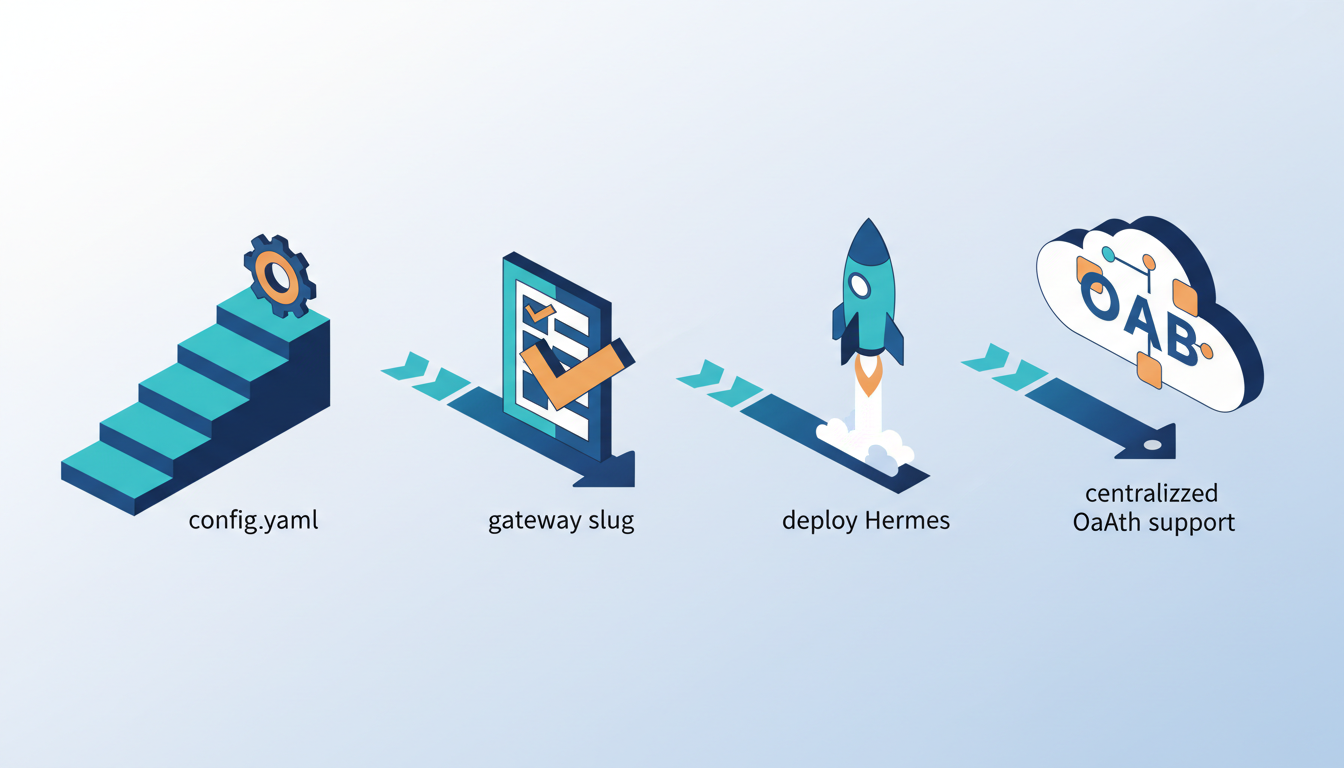
Placing auth: oauth inside the mcp_servers block creates a session bound to a specific user instead of broadcasting administrator credentials. Static keys act as global secrets that offer unrestricted access if leaked, while the native OAuth 2.1 flow limits scope to verified identities. Operators define the gateway URL and set the authentication mode explicitly within ~/.hermes/config.yaml. This setting triggers Hermes to manage flexible client registration and token refresh cycles without human intervention. The auth field accepts the symbolic value oauth, not a credential string. Injecting a static ARCADE_API_KEY into the headers bypasses the security model entirely and reverts the system to a fragile, non-rotatable credential state. Enhanced security requires interactive browser completion during the initial handshake. Operators cannot rely on headless environment variables for the primary gateway connection since the initial token acquisition demands a valid user session to establish the trust boundary correctly.
Executing Out-of-Band Authorization via tools.authorize API
Downstream scopes require preauthorization via the Arcade SDK before Hermes Agent executes protected tool calls. Hermes does not support URL-mode elicitation as of June 2026, so authorization URLs returned by the gateway will not appear in the chat interface. An out-of-band workflow is necessary. The process starts by installing the Python client via pip install arcadepy and exporting a temporary administrator key. Developers run a script invoking client.tools.authorize with a specific tool_name (e.g. "Gmail.ListEmails") and a user_id matching the gateway identity. If the status returns pending, the operator must visit the provided link and poll client.auth.wait_for_completion to finalize the handshake. This separation keeps raw tokens out of the agent process. The SDK uses dotted notation for tool names, whereas Hermes filters require underscore-separated formats. The administrator key used for this script grants broad access and must never reside in the persistent config.yaml file. Manual steps add friction to initial deployment but prevent accidental exposure of global credentials that static configurations often invite. The architecture relies on per-call scoping to ensure tokens are never exposed to the LLM or the client, a critical security metric for enterprise deployment.
Enforcing Least Privilege Access Through Tool Filtering Rules
tools.include and tools.exclude Precedence in config.yaml
Hermes applies least privilege by filtering available tools through a single secure gateway using tools.include and tools.exclude blocks. The MCP layer converts canonical dotted names to underscores, requiring filter rules to use underscores like Gmail_ListEmails instead of Gmail.ListEmails. Include rules take strict precedence over exclude rules when both blocks appear in config.yaml. This hierarchy creates an allow-list architecture that overrides any broader deny-list entries.
| Configuration Block | Function | Precedence Level |
|---|---|---|
tools.include |
Explicitly permits specific tool names | High (Allow) |
tools.exclude |
Blocks specific tool names from catalog | Low (Deny) |
Accidental exposure risks vanish when migrating from permissive to restrictive policies because of this precedence. An operator might add a broad exclude pattern yet forget a specific include entry for a critical workflow, leaving the tool inaccessible despite the exclusion rule. Production environments demand explicit include lists to guarantee deterministic tool availability rather than relying on negation logic.
Restricting Agents to Read and Draft Access Only
Limit agent capabilities to Gmail_ListEmails and Gmail_WriteDraftEmail to prevent irreversible data loss or unintended external communication. This configuration enforces a safety boundary where the agent inspects mailboxes and prepares responses but cannot execute final send or delete actions. Operators define these constraints using tools.include in the Hermes config.yaml, ensuring the model only sees permitted functions like Gmail_ListEmails and Gmail_WriteDraftEmail. Filters must use underscores rather than dots because the MCP layer normalizes tool names.
Apply tools.include when the agent role remains strictly observational or preparatory, such as drafting summaries for human review. Apply tools.exclude when the agent requires broad utility but must avoid specific destructive actions like calendar deletion. Builders balance strict safety against the need for flexible tool discovery, often requiring manual intervention to expand scope for new tasks. The read-draft pattern ensures that while the single URL gateway provides vast potential, the agent remains bound to non-destructive intent until explicit human approval.
Troubleshooting Missing Tools and OAuth Timeouts
Start validation by inspecting ~/.hermes/logs/errors.log to distinguish between gateway selection errors and discovery failures. Verify that include rules do not inadvertently exclude required capabilities before checking network reachability if the log indicates a Connection rejected status.
Authorization errors usually trace back to the narrow OAuth window rather than to the filters. Execute hermes mcp login from a separate terminal session to resolve this Headless environment failure before rewriting any rules.
| Symptom | Primary Cause | Resolution Strategy |
|---|---|---|
| Tool not found | Filtering mismatch | Verify underscore naming in tools.include |
| Connection rejected | Invalid URL or auth | Re-run login sequence with extended window |
| Authorization error | Scope missing | Use tools.authorize API for specific scopes |
Strict least-privilege filtering conflicts with successful tool discovery in some operational scenarios. Overly aggressive exclude blocks can mask valid tools, causing the agent to report capabilities as unavailable even when the single secure gateway remains reachable. Validating filter logic against the full tool list before applying production constraints helps prevent silent capability loss.
About
Sofia Berg serves as Research Editor at AI Agents News, where she specializes in translating complex multi-agent research into actionable insights for engineers. Her deep literacy in agentic architectures and tool-use evaluation makes her uniquely qualified to analyze the Arcade MCP Gateway. In her daily work dissecting papers on agent planning and function calling, Berg frequently encounters the practical friction of credential sprawl and API hallucination that plagues real-world deployments. This article connects her theoretical understanding of multi-agent coordination with the tangible engineering solution provided by Arcade.dev. By using Arcade's centralized gateway, developers can mitigate the exact configuration risks Berg identifies in academic benchmarks, ensuring Hermes Agent implementations remain secure and token-efficient. Her analysis bridges the gap between abstract research on autonomous systems and the reliable infrastructure required to run them reliably in production environments.
Conclusion
Scaling the Arcade MCP Gateway reveals that rigid safety filters create a hidden operational tax: silent capability loss. When exclude blocks become overly aggressive, they mask valid tools, forcing teams to choose between strict security and functional completeness. This friction intensifies in headless environments where the default 30-second token exchange window frequently expires before browser redirection completes. The resulting authorization failures are not network defects but timing mismatches that demand a shift in deployment strategy.
Operators must stop treating the automatic configuration reload as the primary authentication path for non-interactive sessions. Instead, adopt a hybrid approach where manual login triggers precede any automated agent startup in containerized or headless setups. This ensures the extended five-minute window is available for the initial handshake, preventing premature timeout errors that stall production workflows. Relying on the default narrow window for all scenarios invites avoidable instability.
Start this week by executing hermes mcp login in a separate terminal session before launching your agent in any headless environment. This single manual step bypasses the restrictive automatic limit and secures a stable token for the duration of your session. By decoupling the authentication trigger from the agent startup sequence, you preserve strict least-privilege filtering without sacrificing the reliability required for flexible tool discovery.
Frequently Asked Questions
Filters must use underscores, such as Gmail_ListEmails, because the MCP layer converts canonical dotted names. Include rules take strict precedence over exclude rules when both blocks appear in the same configuration file.
The gateway consolidates access to 81 distinct MCP servers into one endpoint. This federation solves configuration sprawl by unifying server access for developers. It eliminates the need for hundreds of individual API integrations.
Developers can use a catalog containing over 7,500 prebuilt tools. This extensive library of agent-optimized tools prevents exposure of sensitive keys. It allows agents to perform actions across multiple external systems simultaneously.
Automatic configuration reload imposes a strict 30 seconds limit for token exchange. This short window often causes failures during automatic configuration attempts. Operators should use the manual login command to avoid this restriction.
Hermes lacks native URL-mode elicitation for interactive authorization flows. Administrators must authorize tool scopes out-of-band using the API before runtime execution. This prevents runtime failures when the agent attempts tool use.