Agent personas boost value 2-3x over default settings
Configured AI agents drive a 2-3x increase in value compared to default settings, according to observations from the AI Engineer World's Fair. Generic model behavior collapses in complex environments. You need specialized personas to correct output and manage context. Developers sticking to standard configurations are leaving performance on the table.
Distinct agent personas like the Caveman fundamentally alter token consumption: a system-level instruction that penalizes verbose output cuts what the model writes, not what it knows. That is the entire mechanism behind token reduction, and it is why persona choice belongs to context management rather than to prompt cosmetics.
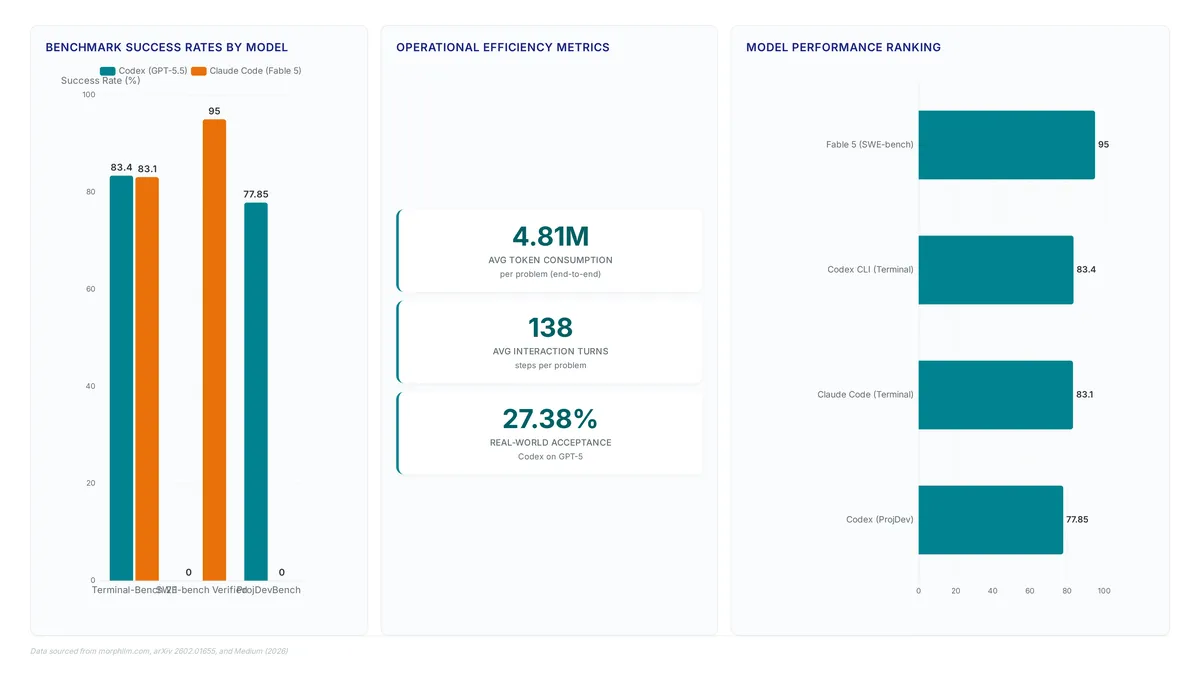
The average AI coding agent in 2026 consumes approximately 4.81M tokens per problem and averages 138 turns to finish one, which is where context control and strategic selection of agent types stop being optional morphllm.com. Frameworks like CrewAI apply a "Role-Playing" architecture to orchestrate autonomous agents that outperform single-agent systems.
The Role of Specialized Personas in Correcting Default AI Behavior
AI Agent Personas as System-Level Overrides
The economic impact is measurable against the baseline consumption of 4.81M tokens per problem observed in 2026. Operators employing specialized personas report a 2-3x increase in value delivery compared to out-of-the-box settings. This efficiency gain stems from reducing unnecessary reasoning steps rather than altering the underlying model weights.
However, apply a rigid persona like "Caveman" to complex design tasks and you risk degrading solution quality by stripping necessary context. Token usage drops sharply, yet the agent may miss detailed dependencies required for safe refactoring. Builders must map persona selection to task complexity, reserving high-constraint modes for mechanical work.
| Feature | Default Agent | Configured Persona |
|---|---|---|
| System Prompt | Generic, verbose | Specialized, constrained |
| Token Efficiency | Low (high waste) | High (optimized) |
| Best Use Case | Exploratory chat | Repetitive engineering |
The ProjDevBench benchmark now evaluates these end-to-end workflows, confirming that workflow integration outperforms raw model capability in sustained development cycles. AI Agents News tracks this shift as the primary differentiator in modern engineering stacks.
CEO, Designer, and Release Manager Agent Roles
At the AI Engineer World's Fair, a demonstrator named Matt exhibited a Claude Code stack using distinct tools acting as a CEO, Designer, and Release Manager to orchestrate complex workflows. This configuration solves the problem of default agents misunderstanding project scope by distributing cognitive load across specific functional roles rather than relying on a single monolithic prompt.
The gstack architecture organizes twenty-three tools into six roles, ensuring that strategy, visual design, and deployment logic remain decoupled during execution.
| Role | Primary Function | Operational Constraint |
|---|---|---|
| CEO | Strategy and Prioritization | Defines scope before code generation |
| Designer | Visual Systems | Enforces design system compliance |
| Release Manager | Versioning and Changelog | Validates build stability pre-commit |
Latency increases with this multi-agent approach. Coordination overhead requires more interaction turns than single-pass coding attempts. Standard agents might rush to output, but this stack forces a deliberation phase that consumes additional context window space before producing artifacts.
Adopting a CEO Suite persona shifts the bottleneck from code generation quality to orchestration logic management. Developers must tune the handoff protocols between the Designer and Release Manager roles to prevent circular reasoning loops. The human operator transitions from writing code to auditing the decision chain of the autonomous team.
Token Bloat Risks in Unconfigured Agent Workflows
Unconfigured agents waste massive context on verbose reasoning before generating code. Default AI workflows often misunderstand architectural constraints, leading to excessive token consumption and low code acceptance. The mean acceptance rate for code generated by Codex on GPT-5 sits at just 27.38% in real-world scenarios.
Unguided agents continue producing output that requires significant human correction. Economic pressure becomes tangible as pricing models shift toward usage-based metrics tied to task complexity. Operators relying on default settings face hidden infrastructure costs driven by agents that consume millions of tokens without delivering functional results.
A significant limitation of this approach is the lack of specialized personas that enforce brevity or architectural discipline during generation. Without these system-level overrides, agents default to verbose explanations that inflate costs while failing to solve the core engineering problem. Token bloat is not merely a cost issue; it signals misaligned reasoning paths. AI Agents News recommends evaluating agent configurations against specific project constraints rather than accepting default behaviors.
Operational Mechanics of Token Reduction and Context Management
Caveman Persona Token Reduction Mechanics
The Caveman persona enforces prehistoric communication by injecting a system-level instruction that penalizes verbose output. This configuration overrides default conversational patterns to strip responses to necessary tokens.
In a medium-sized TypeScript refactoring task, standard Claude Code consumed 4,287 tokens, whereas Caveman mode used only 1,498 tokens. This represents a 65% reduction in output volume on that specific task. The mechanism functions by forcing the AI to communicate like a prehistoric human, removing full sentences and detailed explanations in favor of direct imperative statements.
Developers increasingly favor tools that integrate this type of workflow intelligence, as seen in surveys where Claude Code and Cursor dominate preference rankings despite broader adoption of legacy models. Reducing output volume does not always minimize cost if the initial solution requires complex debugging later. By forcing the agent to question whether code needs writing at all, organizations avoid accumulating technical debt disguised as productivity. Architectural restraint prevents the proliferation of unmaintainable, bespoke functions that standard agents frequently generate when left unchecked.
Token Savings: Caveman vs Lazy Senior Dev Economics
Token economics favor the Caveman persona for mechanical tasks, saving roughly $0.42 per task against standard baselines.
Aggressive token trimming risks losing critical reasoning steps required for complex system design. Caveman excels at refactoring known patterns yet fails when novel architectural synthesis is required. The Lazy Senior Dev mitigates this by using additional input tokens to verify necessity before writing code. This shift moves cost centers from output generation to input reasoning, a structural change in how agents consume resources.
Teams can deploy Caveman for high-volume, low-complexity loops while reserving senior-tier personas for initial system scaffolding. This bifurcated strategy helps balance speed with structural integrity.
Strategic Selection of Agent Personas for Development Tasks
CEO Suite Handoff Protocol vs Full Use Memory Architecture
The CEO Suite executes sequential role handoffs, whereas the Full Use maintains persistent state across sessions. The garrytan/gstack architecture forces a linear progression where the CEO produces a PRD before the Designer generates specs. This rigid handoff protocol prevents context collapse but requires manual role switching for every task phase.
In contrast, the Full Use from affaan-m/ECC defines Skills, Instincts, and Memory to retain institutional knowledge rather than resetting between interactions. This persistence allows agents to build long-term context, addressing the high token cost of re-explaining codebases during the 138 interaction turns typical of end-to-end development.
| Feature | CEO Suite | Full Use |
|---|---|---|
| State Model | Ephemeral per role | Persistent via Memory |
| Workflow | Sequential handoff | Continuous context |
| Primary Gain | Structural discipline | Institutional knowledge |
Role-based handoff systems discard intermediate reasoning when switching personas, while persistent memory models risk context pollution over time. Operators choosing gstack gain strict architectural guardrails but lose the ability for the agent to recall previous session nuances without explicit re-injection. Conversely, ECC configurations enable deep context retention but require careful curation of Security guardrails to prevent hallucinated instincts from compounding. Selecting between them depends on whether the workflow demands rigid process adherence or cumulative learning. AI Agents News recommends the handoff model for greenfield feature creation and memory architectures for legacy codebase maintenance.
Knowledge Graph Persona Versus Standard Agent Queries
Parsing a 500K line TypeScript monorepo reveals that standard agents often miss critical dependency chains without multiple query iterations. Testing the Knowledge Graph persona on a codebase with 47 services showed that building the graph requires 2-5 minutes but resolves complex dependency queries in a single attempt. Standard Claude Code typically needs 3-4 queries to trace the same SQL schema or config file relationships, consuming significant context window capacity.
| Feature | Standard Agent | Knowledge Graph Persona |
|---|---|---|
| Query Count | 3-4 iterations | 1 attempt |
| Setup Time | Instant | 2-5 minutes |
| Context Scope | Local file | Full monorepo |
| Best Use Case | Small fixes | Architectural refactoring |
The trade-off is temporal: operators must tolerate the initial indexing delay and rebuild the graph when the codebase changes significantly. This approach suits large-scale refactoring where understanding global state outweighs the cost of index maintenance. For routine feature development, the CEO Suite remains preferable due to its structured handoff protocol, whereas the Caveman persona excels at mechanical, well-scoped tasks. Builders should deploy the graph specifically when dependency resolution failures occur across service boundaries.
Matching a Persona to the Task at Hand
Ponytail works as a daily driver: it filters unnecessary abstractions before they consume output capacity. Pick it for daily tasks, the gstack suite for end-to-end features, and the Graphify Knowledge Graph persona with ECC for large codebases. For structured feature development, the CEO Suite enforces a rigid handoff protocol that reduces architectural drift compared to unstructured prompting.
| Task Scope | Recommended Persona | Primary Constraint Addressed |
|---|---|---|
| Routine Refactoring | Ponytail | Token waste reduction |
| Feature Implementation | gstack | Strategic alignment |
| Monorepo Navigation | Graphify + ECC | Context window limits |
Operators managing substantial commitments should combine Graphify with the Full Use to maintain institutional memory across sessions. A distinct tension exists between the speed of Caveman-style brevity and the strategic depth of multi-role architectures; choosing the wrong tool for a complex dependency chain forces redundant queries. The decision logic ultimately depends on whether the bottleneck is token cost, architectural coherence, or context retention. AI Agents News recommends matching the agent configuration to the specific development constraint rather than relying on a single default setup.
Implementing a Multi-Agent Workflow for Codebase Optimization
Defining the gstack End-to-End Feature Architecture
The gstack configuration by Garry Tan functions as a multi-role management team for autonomous development rather than a simple persona. Unlike Ponytail, which acts as a daily driver for minimizing code volume, or Graphify, which maps dependencies in large codebases, gstack orchestrates twenty-three distinct tools across six functional roles including CEO, Designer, and Release Manager. This architecture shifts the developer role from direct code generation to overseeing autonomous AI teams that handle strategy and execution simultaneously.
Setting up gstack requires installing the specific GitHub repository and configuring the six agent roles to manage the full software lifecycle. By distributing cognitive load across specialized sub-agents, the system reduces the interaction turns needed for complex feature delivery.
However, this thorough orchestration introduces latency not present in single-agent workflows. The cost is increased coordination overhead; the system must resolve conflicts between the QA agent's test results and the Eng Manager's sprint goals before proceeding. For builders, this means gstack excels at defining and shipping complete features but adds unnecessary complexity for quick mechanical edits where Caveman or standard Claude Code suffices. AI Agents News recommends reserving this heavy configuration for greenfield feature work.
Integrating Graphify and ECC for Large Codebase Navigation
Setting up the Knowledge Graph persona means parsing SQL schemas, config files, and documentation into a static entity graph before any query runs. That index is what lets developers resolve complex import paths in a single attempt, where default configurations fail to recognize indirect relationships without iterative prompting.
That build step is what makes the persona a pre-flight analysis stage rather than a real-time completion engine. Operators should trigger graph generation only after merging structural changes, scheduling the rebuild at natural break points or wiring it into CI after substantial merges. Skipping that refresh leaves stale dependency maps and incorrect import path resolutions.
The trade-off is strict coordination; the parser cannot infer relationships that lack explicit imports or configuration declarations. Unlike heuristic search, the graph fails silently if the schema definition is missing, returning no result rather than an approximate match. This behavior demands rigorous file hygiene from the engineering team.
Token efficiency improves drastically when the agent references the graph index instead of scanning raw files. While specific savings vary by repository density, eliminating redundant context loading reduces the probability of context window exhaustion during deep navigation tasks. Teams managing microservice architectures should prioritize this integration to maintain visibility across service boundaries without manual map maintenance. For updated comparisons on agent performance metrics, review the latest benchmark performance case data.
About
Sofia Berg serves as Research Editor at AI Agents News, where she specializes in translating complex multi-agent research into actionable insights for builders. Her deep literacy in agentic evaluation frameworks and benchmarking makes her uniquely qualified to analyze the efficacy of specific AI agent personas. While many reports hype configuration tweaks, Sofia's daily work involves rigorously separating genuine performance gains from marketing noise by examining eval setups and tool-use patterns. This article stems directly from her professional mandate to test claims against reality; she applied her research methodology to five top-rated persona configurations, moving beyond anecdotal evidence to measure actual value delivery. At AI Agents News, an independent hub dedicated to technical truth over vendor hype, Sofia ensures that engineers understand not just what works, but why. Her analysis connects observed 2-3x productivity increases to specific orchestration strategies, providing the concrete, benchmarked data developers need to optimize their own agent stacks without falling for unverified SOTA claims.
Conclusion
Scaling unguided agents reveals a critical breakpoint where raw token volume destroys economic viability, not just performance. At 4.81M tokens and 138 turns per problem, the default configuration is the expensive one, and a persona that penalizes verbose output is the cheapest correction available: 1,498 tokens against 4,287 on the same TypeScript refactor, roughly $0.42 saved per task. Organizations ignoring this gap will face unsustainable operational costs as they attempt to scale beyond pilot programs.
Deploy persona-constrained agents for all mechanical and repetitive coding tasks immediately, reserving unguided models only for open-ended exploration where constraint is counterproductive. This approach ensures you capture the $0.42 per task savings while maintaining high accuracy in dependency resolution. Do not wait for a fiscal quarter review to adjust your architecture; the margin for error vanishes at scale.
Start by auditing your current agent workflows this week to identify high-volume, low-complexity tasks where output verbosity drives up costs without adding value. Replace those specific instances with role-playing configurations to lock in immediate efficiency gains before expanding the pattern to your broader CI pipelines.
Frequently Asked Questions
Specialized personas save roughly $0.42 per execution against standard baselines. The saving comes out of output volume, so it compounds on high-volume mechanical loops and disappears on exploratory work where stripping context degrades the result.
On a medium-sized TypeScript refactor, Caveman mode used 1,498 tokens against 4,287 for standard Claude Code, a 65% cut in output volume. The Lazy Senior Dev trades the other way, spending extra input tokens to check whether the code needs writing at all.
Without a tuned persona, an agent runs unconstrained and tends toward verbose, unoptimized output. Specialized personas correct these architectural misunderstandings by enforcing tight output constraints before token generation begins to reduce waste.
Using rigid personas for complex design tasks can degrade solution quality by stripping necessary context. While token usage drops sharply by 65%, the agent may miss detailed dependencies required for safe refactoring work.
Configured AI agents drive a 2-3x increase in value compared to default settings. This gain stems from reducing unnecessary reasoning steps rather than altering the underlying model weights or increasing raw capability.
References