Voice profile: Stop generic AI with 7 samples
Stop feeding adjectives to a machine and expecting personality. You need exactly seven real writing samples to stop an AI from sounding like a robot. Generic prompts fail because large language models default to an average of billions of documents. They smooth out the edges. They kill the quirks. The fix isn't a better prompt; it's a structured voice profile that enforces human irregularity. This guide details how to build that profile, implement pattern banning to scrub robotic phrasing, and create a feedback loop where every human edit hardens into a permanent rule.
Most attempts at personal voice AI drown in mediocrity. The model mimics the statistical center of its training data, producing grammatically perfect but soulless text filled with balanced conclusions and clichés. The solution requires feeding the agent distinct samples, process blogs, cold intros, technical rants, to capture specific habits like starting sentences with conjunctions or strictly limiting exclamation points. Without this data, the output remains indistinguishable from the generic noise saturating the web.
We move beyond vague descriptors like "friendly" or "conversational." Instead, we define hard constraints on grammar and structure. We explore real-time voice interaction frameworks that prioritize newer writing samples over older ones to reflect current habits. Finally, we establish a system where every edit made by the human author becomes a permanent rule. The voice cloning effect persists and evolves without constant manual intervention.
Defining the Core Components of an Authentic AI Writing Agent
Defining the AI Writing Agent and SKILL.md Onboarding
An AI writing agent is an orchestrated system bound by a SKILL.md onboarding document, not raw model capacity. This definition shifts the operational unit from the large language model to the specific configuration file governing behavior. Agents fail because instructions remain vague, not because models are weak. Generic prompts yield grammatically perfect but voice-less drafts. The agent skill serves as the primary control plane, loading step-by-step instructions that override the model's tendency to average its training data. Simple prompting lacks this structure. This approach enforces a workflow where the agent operates within strict boundaries set in markdown.
| Component | Function |
|---|---|
| Voice Profile | Extracts mechanical writing rules from real samples |
| Kill List | Bans specific generic phrases and patterns |
| Feedback Loop | Converts human edits into permanent agent rules |
The shift toward multi-agent AI writing systems proves that single instances cannot replicate human nuance without these constraints. Intelligence must reside in the files, not the model. Builders must curate high-fidelity samples. If the SKILL.md lacks precise mechanical rules, the system reverts to the statistical average of its training corpus. This architecture demands that operators define explicit failure modes rather than hoping for stylistic alignment through natural language requests alone.
Constructing a Voice Profile from Seven Real Writing Samples
A functional voice profile emerges only after ingesting seven distinct writing samples to capture specific syntactic quirks. This dataset size allows the system to distinguish between occasional errors and intentional stylistic choices, moving beyond the generic output of standard ai writing models. The process requires diverse inputs, such as process blogs, tutorials, and cold intros, to map the author's unique rhythm accurately. Without this granular data, an ai writing agent defaults to averaging billions of documents, resulting in sterile prose.
Mechanics matter more than adjectives. Operators must prioritize newer samples, ensuring the agent skill reflects current habits over outdated patterns from 2023. Collaborative workflows that split drafting across specialized roles yield higher fidelity than single-model generation. Yet a rigid sample count creates a bottleneck. If an author's style evolves rapidly, the fixed dataset may lag behind their actual voice. This latency means the system enforces a historical version of the writer, not the present one. Builders must treat the profile as a living document, regularly pruning old samples to prevent the model from recycling past mannerisms.
| Sample Type | Purpose |
|---|---|
| Process Blogs | Capture narrative flow |
| Tutorials | Define instructional tone |
| Cold Intros | Establish hook mechanics |
SKILL.md files containing these profiles act as the primary constraint layer. Without continuous updates, the profile becomes a static artifact. AI Agents News suggests that static profiles eventually degrade output quality as the author's natural style drifts.
Avoiding the Artificial Vibe of Average LLM Output
LLMs trained on billions of documents produce balanced conclusions that reflect an average of all sources rather than a distinct perspective. This statistical averaging creates the recognizable artificial vibe where models avoid taking sides or breaking grammar rules for effect. Standard outputs frequently include hollow phrases like "in today's fast-paced world" because the training data favors safe, generic patterns over unique admissions. A kill list in AI writing functions as a zero-tolerance filter that bans these specific artificial patterns before publication. Unlike simple prompting, this mechanism forces the system to rewrite sentences containing banned terms like "examine" or "advance" entirely.
The constraint is rigid. The system cannot generate content that violates the kill list even if contextually appropriate for other voices. Enforcing authenticity requires sacrificing the model's natural tendency toward broad consensus. Without such explicit bans, an ai writing agent defaults to the path of least resistance, replicating the sterile tone found across most online content.
| Risk Factor | Default Behavior | Mitigation Strategy |
|---|---|---|
| Tone | Neutral averaging | Kill list bans |
| Structure | Predictable flows | Voice profile rules |
| Claims | Vague generalizations | Mandatory receipts |
Operators must define these constraints explicitly because vague instructions cause agents to fail regardless of underlying model strength.
Mechanics of Voice Profiling and Pattern Banning Systems
The Structural Rules a Profile Enforces
A voice profile does more than record tone. It lets the system extract mechanical patterns instead of vague stylistic adjectives.
The resulting profile enforces strict structural constraints on sentence openings and claim verification.
- Sentences must frequently begin with conjunctions like "And," "But," or "So."
- Every significant assertion requires a numeric receipt, eliminating vague references to "many developers."
- Exclamation marks are capped at two per post, with the system counting each instance.
This approach shifts personal voice AI from a prompt engineering exercise into a deterministic rule set. Tension exists between sample volume and diversity; coverage across different content types yields better results than submitting multiple samples of a single format.
Fact fabrication remains a risk if the agent lacks access to a canonical truth file. Without a hard rule forcing the agent to query humans for missing anecdotes, the system may invent plausible but false personal stories.
Zero-Tolerance Pattern Banning and Sentence Rewriting Logic
Banned patterns like "examine" trigger an automatic sentence rewrite rather than simple deletion. The kill list functions as a strict filter against generic AI artifacts, including "smooth," "advance," and em-dash chains. When the agent detects a prohibited sequence, it reconstructs the syntax to match the canonical voice profile. This method prevents the generic tone common in large language model outputs trained on average internet text.
| Pattern Type | Examples | Agent Action |
|---|---|---|
| Vocabulary | examine, smooth, advance | Rewrite sentence |
| Structure | Rule-of-three, em-dash chains | Restructure syntax |
| Sentiment | Hedged conclusions, emojis | Remove and clarify |
Preventing fact fabrication requires enforcing a rule where the agent halts if a required personal anecdote is missing from its knowledge base. Instead of inventing stories, the system queries the human operator for verification. This discipline helps multi-agent AI writing systems maintain technical credibility without hallucinating credentials or experiences. Logic extends to structural tics; for instance, the system bans rule-of-three sentences entirely. Converting edits into permanent constraints means a pattern observed twice becomes a confirmed rule for all future drafts. Such a mechanism stops the model from reverting to safe, average phrasing when under pressure to complete a thought.
Sample Diversity Checklist and Cost-Effective Model Deployment
One tutorial, one opinion, one comparison, and one narrative beat ten copies of the same type. Sample diversity prevents the agent from overfitting to a single rhetorical structure while ignoring others. Coverage across distinct formats ensures the resulting voice profile captures mechanical variance rather than just topic-specific vocabulary. Breadth allows the system to generalize styles accurately without requiring massive datasets.
Deploying this architecture prioritizes cost-effective execution by reserving capable models for system construction. Expensive models build the rules, but cheaper inference engines run the daily drafts because the intelligence resides in the canonical files. Separation allows production workloads to scale without proportional cost increases, as the logic is encoded in constraints rather than model parameters. Specialized roles like Architect and Fact-Checker agents enforce these rules during generation, ensuring adherence to the set style without needing top-tier reasoning for every token.
The system operates with a hard cap of 30 active rules because smaller models follow 30 rules well but drown in 80. A narrow dataset leads to repetitive outputs that fail to capture the specific mechanics of the author's voice. Validating sample coverage against intended output types helps avoid this stagnation.
Implementing a Feedback Loop to Train AI on Editing Patterns
Hypothesis-to-Rule Conversion in Feedback Loops
Treating every human edit as a tentative hypothesis stops the system from chasing ghosts. A single modification does not become law. The architecture diffs the final text against the draft to spot meaningful shifts in pattern. One occurrence stays a hypothesis. Two occurrences trigger a confirmed rule. This double-observation gate keeps the agent from overfitting to a bad mood or a one-off fact correction that has nothing to do with style. Static prompts fail here because they cannot learn. The voice profile and kill list handle the heavy lifting, yet the feedback loop captures the remaining nuance through iteration. Smaller models crumble under excessive complexity, so the design caps active rules intentionally. Team orchestration frameworks exist, but the logic for confirming rules remains a custom detail. Topic-specific rephrasing gets logged and forgotten immediately.
- Capture the human-edited final draft.
- Generate a diff against the original agent output.
- Tag recurring changes as hypotheses in a temporary store.
- Promote hypotheses to confirmed rules upon second observation.
Noise disappears while consistent authorial preferences stick.
Implementing Rule Caps for Smaller Models
Smaller, cheaper models follow strict constraints well but drown when rules pile up. Enforcing a hard limit on active rules keeps the system functional. This choice forces intelligence into the files rather than the model architecture.
- Maintain a maximum number of active rules to prevent smaller models from becoming overwhelmed.
- Deploy a secondary diff skill to compare the final edited version against the initial draft output.
- Log unique edits as hypotheses; promote them to confirmed rules only after observing the same modification twice.
Discarding one-off fact fixes prevents the system from memorizing a specific mood. Valid stylistic preferences that appear only once also vanish if they fail the double-observation threshold. Patterns become rules; temporary adjustments do not permanently alter the voice profile. This constraint creates a hierarchy where only the most impactful mechanics govern generation. The cost is losing rare quirks. The benefit is a stable voice that does not fracture under conflicting instructions.
Overfitting Risks and Initial Setup Effort
Building this architecture demands more upfront labor than manually drafting several posts before returns appear. The mechanism promoting hypotheses to confirmed rules stays inactive until edits accumulate across multiple sessions, so a freshly configured profile starts with no learned rules at all. This dormant state risks failure to generalize style if the initial calibration lacks varied examples. Rushing deployment yields an agent that reverts to generic averages. Long-term stylistic fidelity requires patience during the data-gathering phase. Output lacks specific mechanical quirks until recurring edit patterns emerge.
- Allocate resources for an initial batch of distinct writing assignments to seed the voice profile effectively.
- Monitor the diff output closely, understanding that one-off changes regarding facts will not trigger rule creation.
- Accept that the system requires repeated patterns before enforcing new constraints on the generation model.
Treating the initial phase as data collection rather than a production shortcut avoids generic results.
Strategic Application of Model Sizes and Drafting Workflows
Defining the Human-AI Drafting Boundary
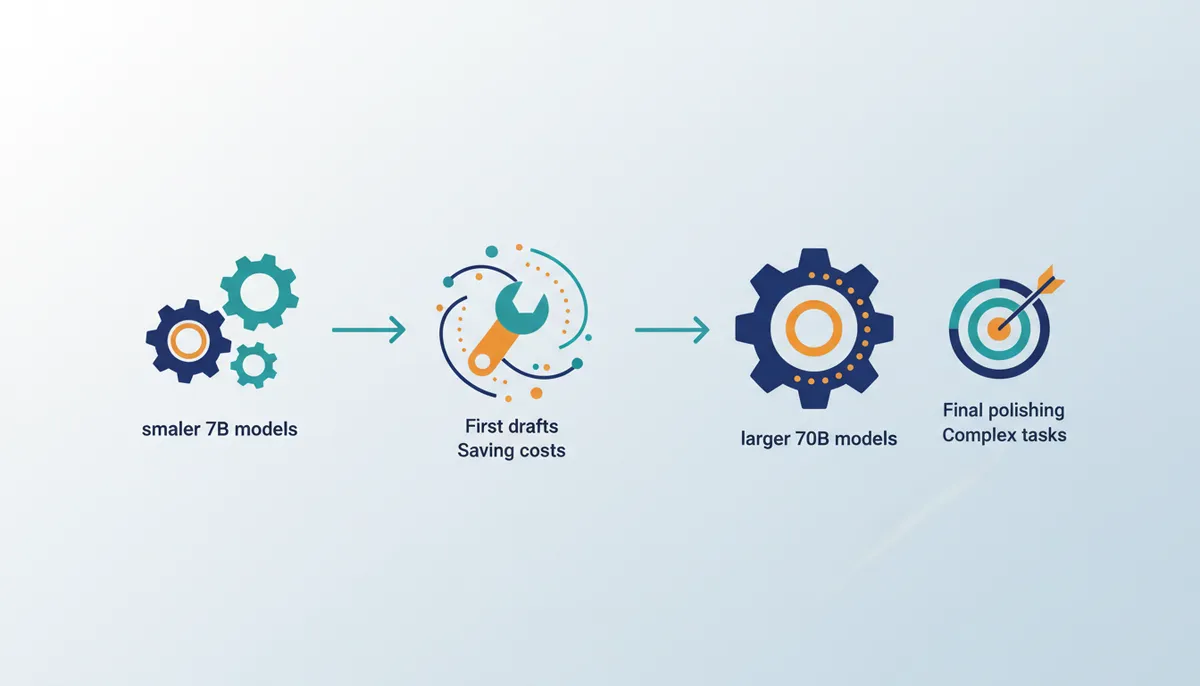
Assign first drafts and SEO chores to the machine. Reserve human intellect for opinions and final edits. Large language models generate structure efficiently yet lack the specific context needed for authentic technical argumentation. Advanced implementations often orchestrate a team of specialized agents, including an Architect, Researcher, Writer, and Fact-Checker, to handle the initial heavy lifting. These systems replace mechanical writing tasks while leaving core narrative authority untouched. The design ensures replacement of writing applies only to the draft layer so final output retains human verification. An author manually correcting a specific sentence marks the boundary where the machine stops and the human starts. Paying for expensive models to run this entire process is wasteful. Intelligence lives in the voice profile and kill list files, letting cheaper models execute the workflow. Trust the agent with volume. Guard the final editorial pass with rigor.
Preventing Fact Fabrication with Canonical Profiles
Fact fabrication stops when a canonical profile file mandates asking the human operator if a specific fact is missing. This hard rule prevents the model from inventing personal anecdotes or technical metrics that lack verification. Agents can orchestrate complex workflows to generate content, yet they cannot validate truth without explicit data sources.
| Workflow Stage | Responsibility | Constraint |
|---|---|---|
| First Draft | AI Agent | Structural generation only |
| Fact Verification | Human Operator | Must confirm missing data |
| Final Edit | Human Operator | Opinions and tone |
Static files for intelligence allow cheaper models to execute these safety checks effectively. The cost involves a hard stop in production whenever the voice profile lacks a required data point. Builders must accept that workflow interruption is a feature, not a bug, ensuring no unverified claim reaches publication. Maintaining this boundary ensures that all personal facts exist in a single profile file. The agent cannot invent stories.
About
Marcus Chen, Lead Agent Engineer at AI Agents News, brings direct engineering rigor to the challenge of replicating human voice in AI agents. Having shipped production multi-agent systems and evaluated frameworks like CrewAI and LangGraph release-by-release, Chen understands that orchestration extends beyond tool use to include stylistic consistency. His daily work involves dissecting agent memory and feedback loops, making him uniquely qualified to engineer a system that converts editorial edits into permanent behavioral rules. At AI Agents News, where the mandate is to provide technical credibility over hype for engineers building autonomous systems, Chen applies this same precision to voice profiling. By treating style as an engineering constraint rather than a creative abstraction, he demonstrates how builders can eliminate artificial "vibes" using concrete data samples and strict evaluation harnesses. This approach mirrors the site's commitment to practical build guides that help developers deploy reliable, human-aligned agents without relying on vendor marketing or unverified claims.
Conclusion
Scaling voice-driven agents reveals a critical breaking point where rule density overwhelms model coherence. When an agent manages more than 30 active constraints, output quality degrades rapidly unless operators prioritize high-impact patterns over exhaustive lists. This operational reality demands a shift from accumulating instructions to curating a strict canonical profile that halts generation when data is missing. You must treat workflow interruption as a necessary safety mechanism rather than a system failure. The ongoing cost of this approach is the discipline required to keep personal facts isolated in static files, ensuring the agent never fabricates anecdotes to fill gaps.
Adopt a hybrid workflow immediately where the AI handles structural drafting while humans retain absolute authority over fact verification and tone. This division of labor allows cheaper models to function effectively without compromising truth. Do not attempt to automate the validation of personal metrics or technical claims. Start this week by auditing your current prompt rules to identify and remove any low-frequency constraints that dilute the core voice profile. Limit your active rule set to only those patterns that recur daily. By enforcing a hard stop on unverified data, you create a resilient system that scales reliability instead of just output volume.
Frequently Asked Questions
You need exactly seven distinct samples to capture your specific syntactic quirks accurately. This dataset size allows the system to distinguish between occasional errors and your intentional stylistic choices effectively.
The initial profile and kill list handle the bulk of the alignment work automatically. The rest comes from a feedback loop where your manual edits become permanent rules for future drafts.
Newer writing samples always outrank older ones to ensure the agent reflects your current voice. This prioritization prevents the model from recycling outdated mannerisms you may have dropped since 2023.
The agent exhibits zero tolerance by rewriting any sentence containing a banned pattern immediately. It does not just delete the offending phrase but reconstructs the sentence using your specific mechanical rules.
Generic prompts fail because models default to the statistical average of billions of documents. This results in grammatically perfect text that lacks the specific rule-breaking quirks defining your authentic personal style.
References