Visual grounding fails in JSON configs
A single valid JSON config often renders as visual garbage because agents lack the spatial reasoning to debug what they cannot see. The industry's obsession with schema-validated outputs has created a production gap where high parsing success rates fail to guarantee usable video results. While structured data boasts 95% to 99% action success compared to 70% to 85% for unstructured text, SeeAct-V research confirms this approach creates a "fundamental capability gap" for visual tasks.
Unlike arbitrary coordinate systems, standard web technologies enable agents to intuitively understand layout properties like text-align or margin-top. Readers will learn why HyperFrames achieved 30,100 stars in just two months by treating the browser as the agent's canvas rather than a post-processing step.
The Definition of Visual Grounding and the Failure of JSON Configurations
Why JSON Lacks Visual Semantics for Agent Grounding
Visual grounding breaks inside JSON because the format encodes data hierarchy while ignoring spatial layout or rendering context. Structured output provides agents with 95% to 99% action success rates, compared to 70% to 85% for unstructured text, yet these numbers fall apart when the agent cannot verify physical placement. The definition of data-* attributes allows HTML to embed timing and style directly into the DOM, giving the model immediate access to visual rules. JSON separates structure from presentation, forcing the agent to guess how x: 100 translates on a specific screen resolution.
After Effects requires manual keyframing and proprietary templates, whereas HyperFrames exposes an API accepting structured instructions and returns rendered video layers. An agent working with raw coordinates operates blindly, while one reading CSS properties understands margin-top as a visual offset. JSON schemas validate syntax types but cannot enforce aesthetic coherence or detect overlapping elements before render time.
Operators face a choice between type safety and visual predictability, as current JSON specs offer no mechanism to describe how a box looks. AI Agents News identifies this gap as the primary blocker for production video workflows.
The Visual Garbage Problem in JSON Video Configs
Visual garbage appears when agents generate schema-valid JSON with correct keyframes that render as broken layouts due to missing spatial context. The agent writes "correct" instructions for something it cannot see, creating a disconnect between data validity and visual output. This happens because the model lacks direct access to the rendering engine's logic when working in abstract text formats. Without native access to layout rules, the agent guesses at coordinates, often resulting in overlapping elements or off-screen content. HTML allows agents to use browser-native semantics they understand from training data, unlike JSON. HyperFrames exploits this by having agents write standard HTML and CSS instead of abstract configuration objects. The framework uses a headless browser to capture frames, ensuring the agent's output matches the final render. This approach supports multiple animation runtimes like GSAP and Three.js without complex adapters.
| Feature | JSON Configuration | HTML + CSS |
|---|---|---|
| Spatial Reasoning | None (Abstract) | Native (Browser) |
| Agent Training Data | Low Exposure | High Exposure |
| Rendering Gap | High | Zero |
The cost of ignoring this gap is measurable: agents produce valid but unusable video assets at scale. Organizations deploying terminal-first environments for video generation hit high failure rates despite perfect schema validation, and the exposure grows as Gartner forecasts task-specific agent adoption reaching 40% of enterprise applications by year-end. HeyGen focuses on the media output layer, yet orchestration tools often lack this visual feedback loop. Operators must shift from abstract configs to rendering-aware formats to close the production gap.
Implementing HTML-Based Video Generation with Puppeteer and GSAP
Defining the Puppeteer and GSAP 3 Rendering Stack
Node.js 22+ serves as the mandatory runtime environment because earlier versions lack the event loop stability required for deterministic headless rendering. The architecture couples Puppeteer to control Chrome instances, capturing raw frames that FFmpeg 7 encodes into a standard 30 fps video stream. This pipeline bypasses JSON translation layers entirely, feeding agent-generated HTML directly into the browser engine for immediate visualization. Animation logic relies on GSAP 3 timelines rather than CSS keyframes to manage complex interpolations across multiple DOM elements. HyperFrames supports this through dedicated animation adapters that synchronize GSAP tweens with the frame-capture clock. Unlike React-based systems, this stack requires no build step or Babel transpilation, allowing agents to inject valid markup instantly.
- Initialize a Node.js 22 project and install
puppeteeralongsidegsap. - Configure the headless browser to accept raw HTML strings containing
data-durationattributes. - Execute the GSAP timeline within the page context before triggering the frame grabber.
The rendering stack prioritizes browser-native execution over abstract configuration files. A significant limitation is that every visual change demands a full DOM re-calculation, which can spike CPU usage during high-resolution exports. AI Agents News recommends monitoring memory consumption when scaling beyond simple single-scene compositions.
Implementing Multi-Composition Projects with Claude Code
HeyGen produced its launch video using Claude Code to orchestrate 4-8 sub-compositions within a single project. This workflow avoids JSON abstraction by writing standard HTML where agents apply spatial reasoning to nested divs.
- Initialize the project via CLI to create the root composition directory.
- Define each scene as a distinct sub-composition file containing GSAP timelines.
- Link scenes using data attributes that reference specific DOM elements for transitions.
The system relies on animation adapters to manage complex interleaving of Lottie and shader assets across these sub-layers. Unlike manual editing tools, this method exposes an API accepting structured instructions for element timing and style returns. The limitation is that deep nesting increases render time linearly, requiring careful asset optimization. Operators must structure projects to minimize DOM depth while maintaining logical separation. This approach enables non-interactive generation where agents plan and lint video compositions without human intervention. The result is a reproducible pipeline where visual output matches the agent's semantic intent. AI Agents News confirms that such deterministic workflows are becoming standard for production video tasks.
Validation Checklist for Agent Skill Integration
Verify Puppeteer installation matches Node.js 22+ requirements to prevent headless Chrome crashes during frame capture. Developers must confirm the environment supports the specific CLI skills for Claude Code or Gemini CLI before attempting render loops. The Hermes Agent integration announced on May 6, 2026, enables terminal-first video generation but demands strict adherence to HTML semantics over JSON configs.
- Execute the skill initialization command to register the HyperFrames adapter within the agent context.
- Render a test scene containing nested flex containers to validate CSS layout reasoning.
- Inspect the output video for spatial alignment errors indicative of missing visual grounding.
| Check Point | Failure Symptom | Required Fix |
|---|---|---|
| Runtime Version | Event loop instability | Upgrade to Node.js 22+ |
| Skill Registration | Agent ignores video commands | Re-run initialization script |
| Visual Output | Overlapping text elements | Replace coordinates with CSS |
A common oversight involves skipping the flexbox test, leading to garbled outputs when agents default to absolute positioning logic. The limitation here is that GSAP 3 timelines require explicit DOM references; missing anchors cause silent animation failures. AI Agents News recommends verifying data attributes before full sequence rendering to avoid wasted compute cycles.
Strategic Advantages and Economic Impact of HTML-First Agent Architectures
Defining the High-Grounding HTML Model for Video Agents
Operators deploy HTML over JSON because language models hold native visual intuition for web semantics that abstract data structures lack. Low-grounding JSON configs force agents to reason about spatial layout blindly, often producing syntactically valid but visually broken output. High-grounding architectures replace this with standard HTML, CSS, and data-\* attributes, allowing models to apply learned knowledge of flexbox and margins directly to video generation. This shift aligns output formats with the training distribution of modern LLMs, which have ingested billions of web pages rather than arbitrary coordinate systems.
Technical implementation relies on headless Chrome to render agent-written DOM structures deterministically before frame capture. Unlike JSON parsers that validate schema without understanding render results, this approach uses the browser engine as the single source of truth for layout. Supporting runtimes include GSAP adapters that synchronize tweens with the frame-capture clock. Dependency on browser consistency remains a constraint; rendering differences across Chrome versions can introduce frame-perfect drift not present in pure computational graphics pipelines.
Moving to HTML-first workflows trades configuration simplicity for semantic reliability. JSON offers strict type safety yet fails to guarantee visual correctness, leading to higher iteration costs during prompt engineering. Industry trajectory suggests that spatial reasoning gaps will widen as video complexity increases, making browser-native rendering the only viable path for scalable agent media production.
Trivago's 80% Cost Reduction via HeyGen Localization
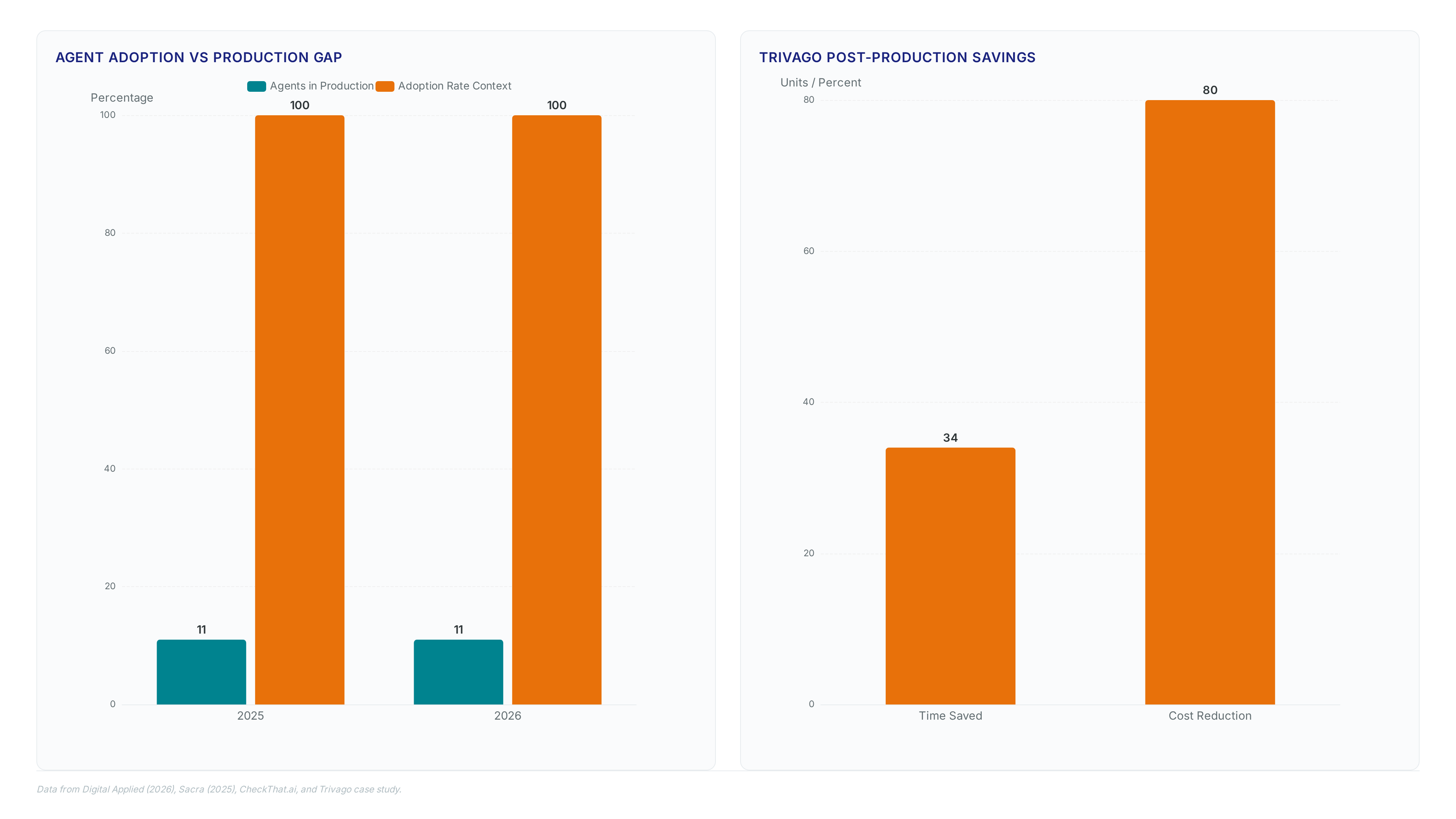
Trivago achieved an 80% reduction in production costs by deploying HTML-first generation to localize advertisements for 30 markets. This deployment saved 3-4 months of post-production time compared to traditional filming methods. The mechanism relies on agents writing standard HTML with CSS rather than abstract JSON configs, enabling direct visual reasoning. Evidence shows HeyGen's platform serves over 85,000 customers globally, including OpenAI, HubSpot, and Ogilvy, validating the scalability of this approach. A limitation exists: operators must shift from timeline-based editing tools to scriptable media generation workflows. Video infrastructure must now support high-throughput, deterministic rendering pipelines using headless browsers instead of simple file storage.
Engineers select HyperFrames for video agents when spatial accuracy and rapid iteration outweigh the need for legacy editing software integration. HTML natives eliminate friction by using the browser engine as the rendering standard. AI Agents News identifies this shift as a critical economic driver for 2026 deployments. The cost involves requiring engineers to master CSS layout properties alongside traditional networking protocols. This skill gap represents the primary barrier to entry for adopting high-grounding architectures in enterprise environments.
The same split repeats outside video: every domain has a low-grounding format the model has to imagine and a high-grounding one the browser can resolve for it.
| Domain | Low-Grounding Format | High-Grounding Format |
|---|---|---|
| Video | JSON config | HTML + data-* |
| Diagrams | DOT/Graphviz | SVG |
| Dashboards | Chart.js JSON | HTML grid |
| Presentations | Slide JSON | HTML slides |
HyperFrames targets this specific failure mode by using standard web semantics that LLMs understand implicitly. Unlike Remotion, which requires React and Babel, HyperFrames lets agents write plain HTML and CSS. This reduces the cognitive load on the model during generation tasks. Operators must abandon timeline editors for scriptable, code-first workflows.
Teams evaluating format switches must assess tolerance for visual debugging. If an agent generates a circle using JSON coordinates, a single float error breaks the shape. This shift enables reliable spatial reasoning for video, diagrams, and dashboards alike. The cost is a mandatory migration to headless Chrome pipelines for frame capture. Organizations prioritizing deterministic output over legacy tool compatibility gain significant efficiency. AI Agents News recommends this architecture for teams fixing visual garbage in autonomous agent output.
About
Marcus Chen serves as Lead Agent Engineer at AI Agents News, where he daily architects and evaluates production multi-agent systems using frameworks like LangGraph and AutoGen. This hands-on experience directly informs his analysis of why agents struggle with visual grounding when restricted to JSON outputs. While building tools for autonomous coding and video generation, Chen frequently observes that schema-valid JSON often yields visually broken results because the agent cannot "see" spatial relationships. His work requires bridging the gap between structured data and rendered reality, making him uniquely qualified to advocate for HTML-based visual prompting. At AI Agents News, Chen tracks how orchestration mechanics impact real-world agent performance. By connecting his daily debugging of tool-use failures to broader architectural patterns, he provides engineers with actionable insights on moving beyond blind text generation to achieve reliable, visually coherent agent outputs.
Conclusion
Scaling HTML-based agent workflows reveals a critical breaking point: memory consumption spikes when headless Chrome instances exceed concurrent thresholds, often destabilizing pipelines that worked perfectly in proof-of-concept stages. While structured output drastically improves action success, the operational cost shifts from prompt engineering to managing heavy browser orchestration. Teams ignoring this infrastructure tax will face diminishing returns as deployment expands beyond single-user tests.
Adopt high-grounding architectures immediately if your current agent success rate stalls below a high threshold on visual tasks, but only commit fully if you can allocate resources for reliable container orchestration by next quarter. Do not attempt this migration while relying on shared CI/CD runners, as resource contention will negate fidelity gains. The window to establish these pipelines before market saturation occurs is narrowing, making early adoption a distinct competitive advantage rather than a mere technical upgrade.
Start by auditing your team's CSS competency this week against layout-heavy generation tasks. Identify exactly which flexbox or grid properties cause the most frequent rendering failures in your current logs. This specific data point determines whether you need targeted upskilling or a complete pipeline refactor before attempting production scale.
Frequently Asked Questions
Agents lack visual semantics in JSON, causing layout errors despite valid syntax. HTML gives the model browser-native layout rules it already learned from web pages, so the rendered frame matches the instruction instead of merely passing schema validation.
Agents recognize that border-radius: 50% creates a circle without needing complex schema definitions. This visual intuition lets models rely on familiar web standards instead of guessing abstract coordinate systems.
It uses headless Chrome to render HTML directly, ensuring zero rendering gap between code and video. The agent sees the same layout rules the renderer applies, which blind JSON generation never exposes.
Specific AI agent adoption is predicted to reach 40% of enterprise applications by late 2026. This shift occurs because HTML-first architectures solve the visual grounding problems that previously limited reliable video production in automated workflows.
Yes, it supports GSAP and other libraries natively because agents write standard HTML and CSS. This compatibility lets the agent's web training data apply directly, avoiding the disconnect found in abstract configuration formats.