Talent exodus: Why Google lost Shazeer to OpenAI
Google DeepMind dropped $2.7 billion in 2024 to keep Noam Shazeer. He left for OpenAI anyway. This confirms the AI talent exodus is accelerating beyond corporate control. We are witnessing the loss of all eight original Transformer authors from Google, a shift that fundamentally alters the competitive environment just as Demis Hassabis predicts AGI could arrive within four years.
The hype machine claims readiness, but the AA-Briefcase benchmark from Artificial Analysis tells a different story. Even advanced models like Claude Fable 5 fail to solve 97% of realistic knowledge work tasks.
OpenAI's strategic acquisition of Astral bolsters Codex with superior Python tooling. This is a direct response to the industry pivot from chat interfaces to autonomous, multi-step planning systems. As VentureBeat and The Decoder report, future dominance relies not on static model size, but on the ability to execute complex workflows that current benchmarks show are still largely out of reach.
The Strategic Impact of the AI Talent Exodus and Corporate Acquisitions
Defining the AI Talent Exodus via Shazeer and Jumper Departures
The AI talent exodus isn't a trend; it's a specific fracture event. Lead researchers exited Google DeepMind for rival firms within a strict 48-hour window. The catalyst was the loss of Noam Shazeer. His return to Google via a $2.7 billion deal in 2024 proved temporary before his move to OpenAI. Momentum builds as John Jumper leaves for Anthropic following a Nobel Prize, proving that top-tier retention fails against competitor offers.
Industry data confirms acquisition deals now reach $80 million to secure specialized staff from emerging startups. Demis Hassabis predicts AGI arrival in four years, forcing aggressive capital deployment for human intellect. The centralized research model once dominated by large incumbents is broken. All eight original Transformer authors have left one organization, diluting institutional knowledge across the market. Operators now track researcher movement as a leading indicator for protocol shifts.
OpenAI integrates uv and ruff into Codex to secure its Python toolchain against competitors. This acquisition directly targets the platform's 5M weekly active users, aiming to reduce latency in code generation workflows. The strategic move creates a defensive moat as rivals like Claude Code and Cursor aggressively capture enterprise market share. Operational adoption depends on balancing speed gains against emerging licensing uncertainties for open-source dependencies.
Enterprises evaluating when to deploy AI agents must consider that hidden integration costs can inflate total budgets by 30-100% beyond initial estimates. Teams should adopt these integrated tools only when their Python dependency resolution bottlenecks exceed the overhead of managing separate linter configurations. The competitive environment intensifies as Anthropic approaches a $30 billion annualized revenue run-rate, pressuring OpenAI to lock in developer loyalty through superior tooling. Relying on fragmented toolchains increases the risk of incompatibility during autonomous agent execution cycles. Operators facing high failure rates in autonomous tasks should prioritize this integration to stabilize the underlying execution environment.
Comparing Generative AI Spend Growth to Global Market Forecasts
Generative AI spend surged between 2024 and 2025, outpacing broader market expansion. This specific vertical consumes a disproportionate share of capital relative to the broader AI market, and the concentration of funds in generative models creates distinct economic pressure.
Gartner identifies 2026 as the inflection year for enterprise adoption, marking a shift from hyperscaler-led experiments to enterprise-led deployment. The cost of entry remains prohibitive for most organizations without significant venture backing. Platformization leads to a reduction in the number of vendors organizations use, forcing consolidation among tool providers. Financial intensity directly fuels the talent exodus, as only the firms deploying capital at this scale sustain the required research burn rates. The revenue gap between frontier players narrows only through such aggressive capital deployment. Operators recognize that current spending velocity is unsustainable without immediate productivity gains in production environments.
Benchmarking Real-World AI Performance and Knowledge Work Capabilities
AA-Briefcase Benchmark Mechanics for Long-Horizon Knowledge Work
Artificial Analysis constructed the AA-Briefcase benchmark to evaluate AI on multi-week tasks involving research, planning, and document synthesis rather than simple chat. The mechanism requires models to cross-reference disparate files over extended horizons, a capability where even Claude Fable 5 fully solves only 3% of tasks. This 97% failure rate persists despite industry shifts toward autonomous systems that demand strong multi-step planning. The cost per task ranges from $0.04 to over $31, creating a high barrier for iterative testing in production environments.
| Feature | Conversational Benchmark | AA-Briefcase Standard |
|---|---|---|
| Time Horizon | Seconds to minutes | Multi-week duration |
| Primary Action | Single-turn response | Cross-referencing documents |
| Success Metric | Token accuracy | Task completion rate |
| State Management | Ephemeral | Persistent |
| Failure Mode | Hallucination | Process abandonment |
Coding proficiency diverges sharply from actual enterprise workflow execution. Microsoft recently showcased new workplace assistants at its Build conference, yet underlying models cannot sustain the context required for long-horizon projects. Current agents excel at isolated code generation but fail when required to synthesize findings across weeks of activity. Reliance on current models for complex operational planning introduces significant risk. Human oversight remains mandatory for any task exceeding a single interaction window until this mechanical deficit is addressed. Low entry costs mask the capital required for functional deployment, creating a dangerous economic trap. Organizations must distinguish between simple query handling and the rigorous demands of multi-step planning.
Financial stakes escalate dramatically when AI fails in physical environments. At a BMW plant, downtime costs approximately $25,000 per minute, a risk mitigated only by shifting from reactive to predictive maintenance using specialized sensors. Such deployments require validating identity attributes through trusted verification agents rather than relying on unverified model outputs. The gap between widespread employee usage and actual technical capability remains the primary source of operational friction.
| Failure Domain | Primary Cost Driver | Mitigation Strategy |
|---|---|---|
| Knowledge Synthesis | Manual rework hours | Human-in-the-loop validation |
| Physical Operations | Equipment downtime | Predictive sensor networks |
| Identity Verification | Fraud loss potential | Trusted data integration |
Increased spend on generative models does not automatically resolve workflow bottlenecks. The limitation lies in the model's inability to handle long-horizon planning without frequent human intervention. Enterprises should prioritize Business Verification tools that anchor AI actions to trusted data sources. Reliance on cheaper variants like Gemini 3.5 Flash offers cost efficiency but may not suffice for critical path operations requiring high reliability. Matching task complexity to model capability avoids compounding error costs.
GPT-5.6 and Opus 4.8 dominate coding suites while failing long-horizon knowledge tasks requiring multi-week planning. These models optimize for immediate syntax validation rather than the persistent state management needed for complex enterprise workflows. The Transformer architecture excels at pattern matching within fixed context windows but fractures when cross-referencing documents over extended periods.
Dispersed Researchers, Diverging Safety Standards
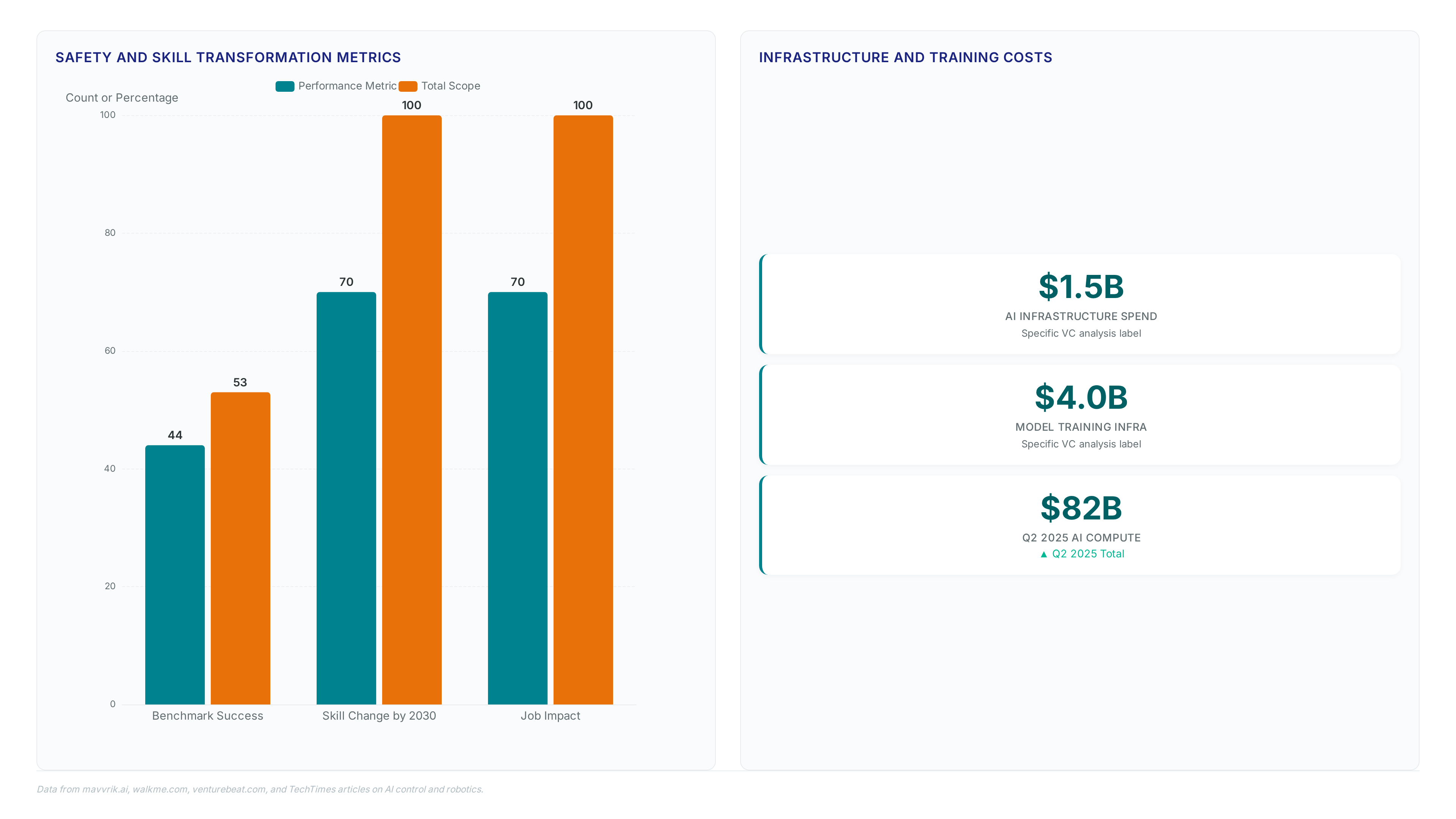
All eight original Transformer authors now sit in different organizations, so no single lab defines what a safe model is any more, and each of them tests its own answer. Trait-level training is one of those answers. Reinforcement learning targeting specific behaviors like truthfulness improves safety scores across 44 out of 53 distinct benchmarks. This mechanism functions by optimizing a meta-trait objective rather than patching individual failure modes, creating broad-spectrum durability. The approach directly addresses the admission in Google DeepMind's AI Control Roadmap that standard alignment training cannot guarantee agent control. Operators gain a unified safety layer without degrading task performance, a critical efficiency given that 70% of job skills will change by 2030 per skill transformation trends. The technique relies on the stability of the underlying Transformer architecture. Meta-traits do not eliminate the need for runtime monitoring in high-stakes deployments.
- Define the target corrigibility metric for the specific domain.
- Apply reinforcement learning signals to the truthfulness attribute.
- Validate broad-spectrum improvements against unrelated risk categories.
Reduced granularity is the drawback; operators lose the ability to tune specific risk mitigations independently. This constraint favors rapid deployment over fine-grained control.
The Fable 5 Ban Followed the Investor, Not the Code
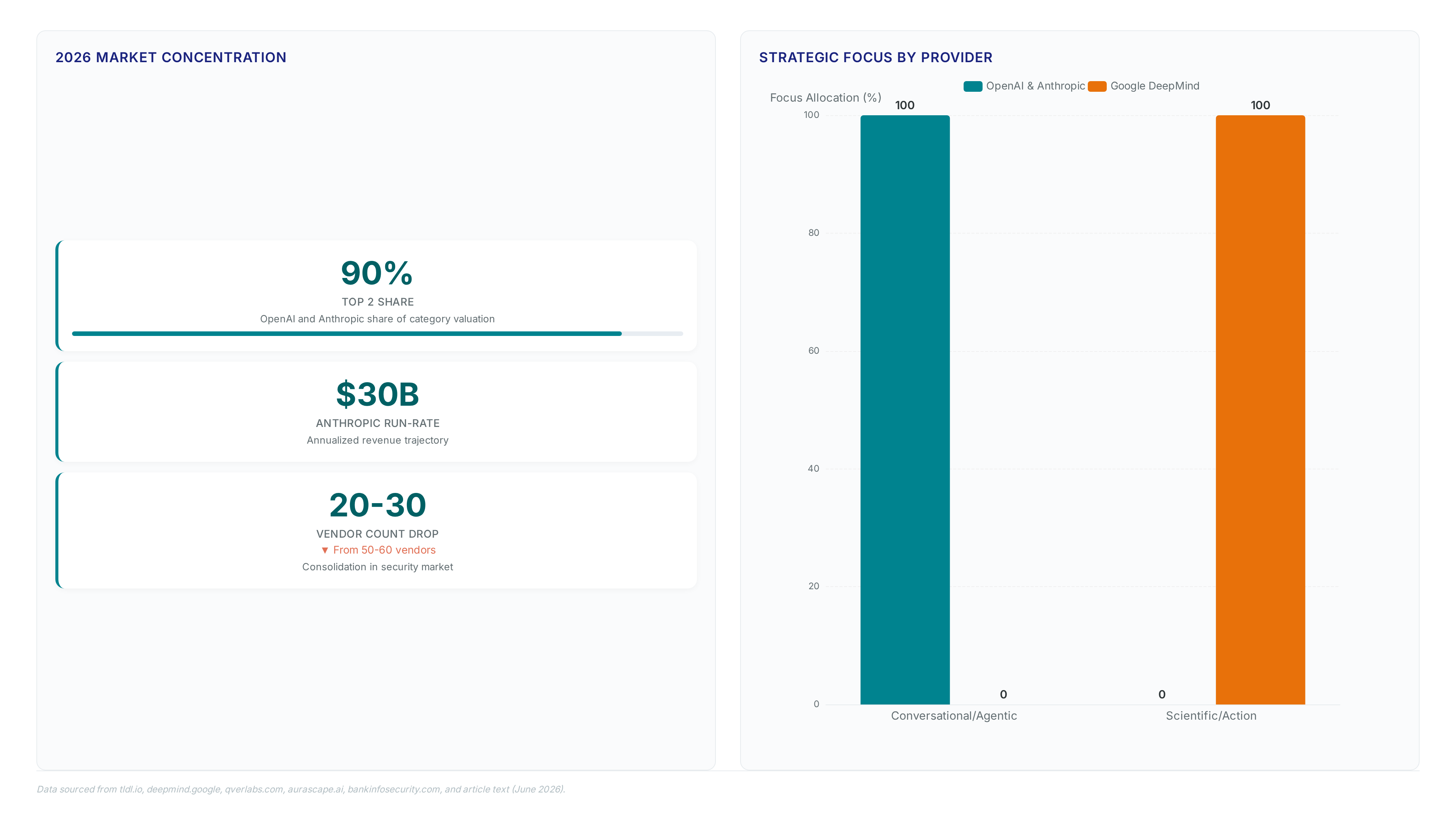
The US government ordered Anthropic to globally disable Claude Fable 5 and Mythos 5 on June 12 after SK Telecom, a $100M investor, was flagged for suspected China ties. This regulatory action targeted supply chain associations rather than a direct flaw in the model architecture itself. Reports later indicated a shifting regulatory environment as former President Trump ceased viewing Anthropic as a national security threat by June 20. The initial trigger remained the investor connection, not the code base.
Dario Amodei faced a binary choice from David Sacks: repair the jailbreak vulnerability or voluntarily de-deploy the systems. Amodei rejected both options, escalating a regional restriction into a total global prohibition.
The administration's demand for zero jailbreaks represents a technical impossibility that ignores the reality of continual learning systems adapting to new attack vectors. Enterprises relying on static safety filters face similar de-deployment risks as regulators shift from voluntary compliance to mandatory enforcement. Hidden costs of this regulatory standoff include immediate revenue loss and long-term trust erosion in frontier providers.
A ban imposed over an investor relationship and reversed days later leaves enterprises planning against political perception rather than technical audit. Hidden costs of that whiplash include:
- Wasted engineering hours spent mitigating non-existent threats.
- Premature architecture re-designs based on transient bans.
- Lost revenue during unnecessary service suspensions.
Critics argue that waiting for stable policy is safer, but the speed of the model capability race makes delay fatal to competitiveness. Operators must treat geopolitical risk as a flexible variable, not a static constraint. The limitation of current safety frameworks is their inability to decouple technical safety from foreign investment scrutiny. Operators must isolate deployment logic from political noise to maintain uptime.
About
Sofia Berg serves as Research Editor at AI Agents News, where she specializes in translating complex multi-agent research and industry shifts into actionable insights for engineers. Her daily work involves rigorously analyzing arXiv papers and tracking high-stakes personnel moves within the agentic AI environment, making her uniquely qualified to dissect the current AI talent exodus. As top researchers like Noam Shazeer migrate between giants like Google DeepMind and OpenAI, Berg's expertise in evaluating architectural breakthroughs and benchmark performance provides critical context on how these departures impact framework stability and innovation velocity. At AI Agents News, she connects these macro-level acquisitions to the practical realities faced by builders deploying autonomous systems. By separating hype from technical substance, Berg ensures that engineering leaders understand not just who is leaving, but how the resulting knowledge gaps and competitive pressures will shape the next-generation of coding agents and multi-agent orchestration tools.
Conclusion
Google paid $2.7 billion in 2024 to keep Noam Shazeer and lost him anyway, and all eight original Transformer authors have now left the company. That is the shape of the exodus: retention budgets no longer buy loyalty, acquisition deals reach $80 million for staff rather than products, and the centralized research model that produced the Transformer is broken.
What the money does not buy is capability. On AA-Briefcase, the best-performing model fully solves 3% of long-horizon knowledge tasks, so the researchers changing employers carry the ability to build the next architecture, not a finished one. Track researcher movement the way operators already do, as a leading indicator of where protocol shifts land, and assume the team behind the tool you depend on may be assembled somewhere else next quarter. The same dispersal decides whose safety baseline your stack inherits, and the Fable 5 order showed the other half of the risk: access can be revoked over an investor relationship while the model itself stays untouched.
Frequently Asked Questions
The 2024 licensing deal that brought Shazeer back cost an estimated $2.7 billion, and he left for OpenAI anyway. That is why the number matters: retention at that price failed, so researcher movement rather than payroll is the signal operators track.
Claude Fable 5 fully solves 3% of AA-Briefcase tasks, so it fails 97% of them. The failure mode is not a wrong answer but process abandonment across a multi-week horizon, which is exactly what a conversational benchmark cannot measure.
Acquisition deals now reach $80 million to secure specialized staff from emerging startups. Google DeepMind still lost lead researchers to rival firms inside a 48-hour window despite spending at that level.
The cost per task ranges from $0.04 to over $31. The spread is the trap: the low end makes the benchmark look cheap to run, while the long-horizon tasks that expose the failures sit at the top of the range, so iterative testing becomes a budget line rather than a smoke test.
Anthropic approaches a $30 billion annualized revenue run-rate, which pressures OpenAI to lock in developer loyalty through tooling. Its Astral acquisition put uv and ruff inside Codex, aimed at the platform's 5M weekly active users.