OpenAI Jalapeño chip cuts inference costs by half
OpenAI's Jalapeño chip slashes inference costs by 50% while shrinking ASIC design cycles to just nine months. The modern AI infrastructure stack has decisively shifted from renting general-purpose GPUs to owning bespoke silicon and asynchronous memory architectures. Hyperscalers no longer view hardware as a commodity but as a strategic moat necessary for supply chain independence.
Custom AI silicon shipments are projected to triple the GPU rate in 2026, a structural pivot driven by OpenAI's collaboration with Broadcom to bypass merchant supply constraints. This move forces a reevaluation of inference economics, where controlling the full-stack from 3nm fabrication to scheduling kernels dictates market viability. Simultaneously, the race for scalable agent architectures demands new approaches to asynchronous memory and capability-based security to manage autonomous workflows safely.
Readers will learn how fine-tuned models and optimized decode paths are now prerequisites for deploying self-hosted agents without latency penalties. We examine the technical specifics of Jalapeño's reported 216GB HBM3E bandwidth and the broader implications of Qualcomm acquiring Modular on the compiler environment. Finally, the analysis covers how organizations must adapt their security postures when agents possess independent credentials and auditable identities within enterprise systems.
Custom AI Chips Redefine Inference Economics and Supply Chain Independence
OpenAI's first custom silicon, the Jalapeño chip, arrives fabricated by TSMC on a 3nm process with a singular focus: LLM inference. The target is aggressive, a 50% reduction in cost per token compared to merchant GPU baselines. By collaborating with Broadcom, OpenAI compressed a traditional 18, 24 month ASIC timeline into a mere 9-month design cycle. This speed allows hardware to chase algorithmic shifts, integrating HBM3E memory specifically to resolve bandwidth bottlenecks that cripple general-purpose GPUs on long-context workloads.
Microsoft is projected to absorb 40% of initial output, securing supply for its OpenAI integration. Unlike NVIDIA offerings, this silicon remains proprietary infrastructure, never available as merchant hardware. The shift to FP4 precision sacrifices training flexibility for massive inference density gains. Vertical integration creates a hard dependency on OpenAI's specific kernel stack, limiting portability for tenants. Operators relying on standard CUDA ecosystems face immediate incompatibility without costly translation layers. The 3nm node choice maximizes power efficiency but introduces supply chain fragility if TSMC yields fluctuate. This approach prioritizes inference economics over hardware agnosticism. Control of the full-stack prevents commodity pricing pressure from dictating roadmap decisions. The trade-off is total vendor lock-in for any service depending on this specific silicon generation.
Deploying Jalapeño for ChatGPT and Agent Workloads
Jalapeño serves ChatGPT, Codex, and API traffic as a dedicated inference engine optimized for agent memory architectures. This deployment strategy shifts focus from general compute to specific workload economics where latency matters most. Operators should deploy custom AI chips when merchant GPU costs exceed budget thresholds for high-volume token generation. The 9-month design cycle enables rapid iteration on silicon features that match evolving model structures like sparse MoE layers. Such speed contrasts with the conventional 18, 24 month ASIC timeline, allowing hardware to keep pace with algorithmic changes. Accelerated development relies on using internal models to draft and optimize internal layouts during the design phase.
Meanwhile, jalapeño executes a vertical integration strategy to eliminate merchant GPU supply bottlenecks through full-stack ownership. Unlike Google's TPU, which serves as merchant silicon available via cloud rental, OpenAI's custom chip remains strictly internal infrastructure. This deployment model means competitors cannot purchase the hardware, only compete against the lower API prices it enables. The strategic goal encompasses owning chips, kernels, memory, networking, scheduling, and deployment While TPUs offer broad compatibility for varied workloads, Jalapeño targets specific LLM inference economics with aggressive cost reduction. Microsoft's expected purchase of a large portion of initial output represents a real-world supply chain shift where a substantial cloud provider secures exclusive access to high-efficiency inference hardware to support its OpenAI integration
| Feature | Jalapeño Strategy | Merchant GPU / TPU Model |
|---|---|---|
| Availability | Internal Only | Commercial Rental |
| Design Goal | Cost Per Token | General Compute |
| Supply Chain | Dedicated Fabrication | Shared Market Pool |
| Optimization | Model-Specific Kernels | Broad Framework Support |
The limitation of this approach is total vendor lock-in; operators relying on OpenAI's stack cannot migrate workloads to other providers without significant refactoring. This contrasts with open-source inference setups where portability remains a primary design constraint. : maximum efficiency requires sacrificing hardware agnosticism. Operators must choose between the performance-per-watt gains of bespoke silicon and the flexibility of merchant.
Asynchronous Memory and Capability-Based Security Power Scalable Agent Architectures
Capability-based security assigns fine-grained, task-scoped tokens rather than broad agent identity permissions. @KentonVarda argued that explicit per-agent permissioning "does not scale" because static roles cannot match flexible workflow requirements. The mechanism relies on transient credentials that expire after single operations, reducing the blast radius of compromised agents. However, implementing this model requires application-level enforcement logic that many current orchestration frameworks lack. Operators must build middleware to intercept and validate these capabilities before execution.
Asynchronous memory consolidates context updates outside the critical inference path to maintain low latency. @gallabytes described the shift from Claude Code as a "pairing partner" to Tags as "managing a team," necessitating state separation. This architecture extracts and deduplicates memories during idle cycles, a process Weaviate's Engram GA frames as essential infrastructure. The design targets the memory bottleneck limiting GPU efficiency on long-context workloads.
| Feature | Explicit Permissioning | Capability-Based |
|---|---|---|
| Scope | Broad agent identity | Single task action |
| Lifecycle | Static until revoked | Transient expiration |
| Scalability | Fails at team scale | Supports flexible teams |
The limitation is increased complexity in debugging permission failures across distributed services. Memory consolidation introduces eventual consistency, meaning agents may act on stale data during high churn. These trade-offs dictate that high-frequency trading systems avoid asynchronous patterns while batch processing adopts them. The implication for network engineers is clear: infrastructure must support both synchronous validation paths and background data movement without blocking foreground tasks.
Implementing Qwen-AgentWorld's 256K Context and Seven-Environment Simulation
Qwen-AgentWorld deploys a 35B MoE architecture with 3B active parameters to simulate seven distinct environments including MCP, Search, and Android. This native language world model uses a massive 256K context window to maintain state across complex, multi-turn agent tasks without external retrieval bottlenecks. By optimizing specifically for memory movement patterns common in long-context agentic workflows, the design reduces data transfer overhead that typically plagues general-purpose GPU inference. The system demonstrates that single-turn environment prediction effectively transfers to multi-turn agent tasks, yielding performance gains across both in-domain and out-of-domain benchmarks.
| Environment | Function |
|---|---|
| MCP | Model Context Protocol integration |
| Terminal | Command line execution |
| SWE | Software engineering tasks |
| Web | Browser interaction |
Operators must recognize that simulating seven environments within one model increases the demand for high-bandwidth memory subsystems. The architecture type required to support such wide context windows often exceeds standard H100 configurations optimized for shorter prompts. While the transfer of single-turn prediction to multi-turn tasks offers significant efficiency, the trade-off is increased complexity in managing asynchronous memory updates across the simulated environments. This approach positions asynchronous memory as a critical scaling axis rather than a simple cache layer. AI Agents News notes that such deep integration of simulation and inference reshapes how operators plan for capability-based security boundaries.
Mitigating Prompt Injection Risks and Tacit-Knowledge Lock-In Team Workflows
Prompt injection in team workflows exploits the shared context of agents like Claude Tag, which @random_walker warns creates "tacit-knowledge lock-in" while billing by the thought. The mechanism allows malicious inputs to overwrite system instructions, compromising the agent identity model where credentials are centrally managed. Evidence suggests that without strict isolation, a single poisoned message can persist across the entire organizational memory layer. However, the cost of rigid permissioning is that explicit per-agent controls often fail to scale with flexible team requirements. Operators must balance auditability against the friction of constant re-authorization.
Anthropic addresses this by ensuring actions are auditable under a specific identity and access can be revoked centrally. This approach contrasts with general-purpose hardware where inference workloads compete for bandwidth on shared memory architectures. Unlike merchant silicon designed for broad compatibility, dedicated agent infrastructure can enforce stricter capability-based security boundaries at the kernel level. The limitation remains that legacy Slack integrations often lack these native revocation hooks.
| Risk Factor | Traditional Bot | Agent Native |
|---|---|---|
| Identity Scope | Shared Service Account | Unique Credential per Agent |
| Audit Trail | Log File Only | Action-Level Attribution |
| Revocation | Manual Key Rotation | Centralized Policy Engine |
AI Agents News recommends deploying agents with transient, task-scoped tokens rather than persistent admin rights. The strategic implication is clear: organizations relying on vendor clouds must trust external pricing and security models they cannot inspect. Self-hosted alternatives offer control but require significant engineering overhead to replicate these safety features.
Deploying Self-Hosted Agents Requires Fine-Tuned Models and Optimized Decode Paths
Fine-Tuning Agentic Models with Diverse Datasets
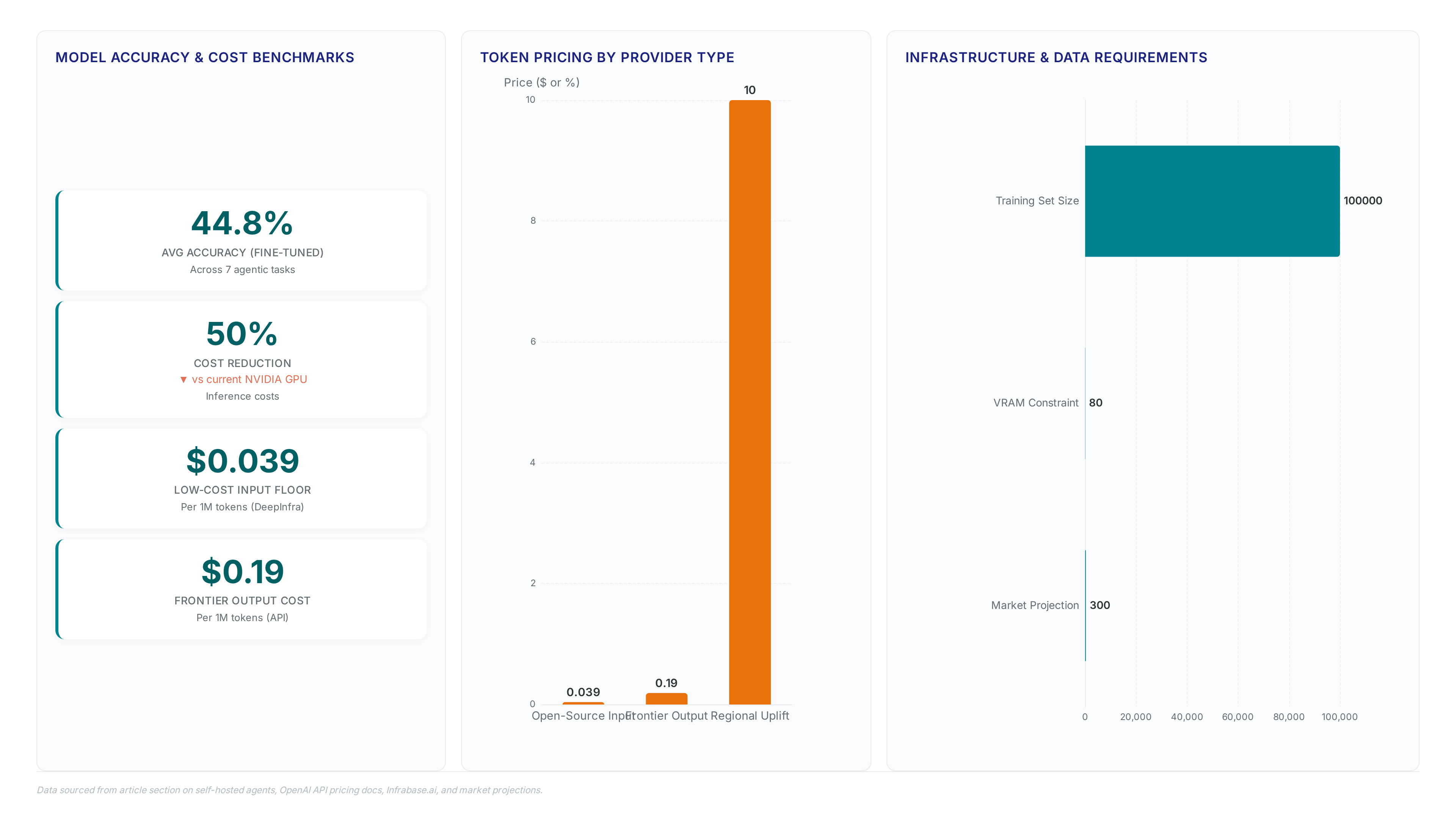
Constructing a 100K-example training set with source diversity beats over-repetition for building reliable agent behaviors. Operators must curate data spanning multiple execution traces to prevent models from overfitting to narrow workflow patterns. The OpenThoughts-Agent pipeline demonstrates that instruction choice matters disproportionately when targeting specific agentic benchmarks. Recent ablation studies show that fine-tuning on varied sources yields a 44.8% average accuracy across seven distinct agentic tasks. This approach directly addresses the shift from single-turn tools to managing a team of autonomous workers.
However, sourcing high-quality execution traces incurs a tangible cost in data engineering labor.
Reducing latency for self-hosted agents requires deploying draft models that speculate token sequences before the primary model verifies them. Operators configure a smaller, quicker model to generate candidate tokens which the main model then accepts or rejects in a single forward pass. This speculative decoding mechanism effectively parallelizes the serial bottleneck of autoregressive generation. The specific advantage lies in minimizing idle compute cycles during the memory-bound phases of inference.
However, the computational overhead of running two models simultaneously increases peak memory pressure, potentially limiting batch sizes on hardware with constrained VRAM.
Engineers must replace explicit per-agent lists with task-scoped tokens to avoid scaling bottlenecks.
- Define granular capability tokens bound to specific API endpoints rather than broad user roles.
- Implement short-lived leases that expire automatically after task completion to limit blast radius.
- Audit token usage against memory movement patterns to detect anomalous data exfiltration attempts.
- Centralize revocation logic to instantly invalidate credentials across the entire agent fleet.
| Feature | Role-Based Access | Capability-Based Access |
|---|---|---|
| Scope | User Identity | Task Context |
| Duration | Persistent | Ephemeral |
| Scaling | Linear Friction | Exponential Efficiency |
| Revocation | Manual Per-Agent | Centralized Global |
The architectural tension lies between audit granularity and latency; excessive validation checks degrade inference throughput. Global spending on AI systems is projected to surpass $300 billion in 2026, making inefficient permission checks a costly drag on economics. Unlike static roles, flexible capabilities prevent tacit-knowledge lock-in by ensuring no single agent accumulates permanent privileges. As noted by AI Agents News, operators should prioritize self-hosted validation layers to maintain control over organizational intelligence.
Strategic Model Selection Balances Open-Weight Performance Against Proprietary System Lock-In
Defining Open-Weight Contenders Like GLM-5.2 vs Proprietary Ecosystems
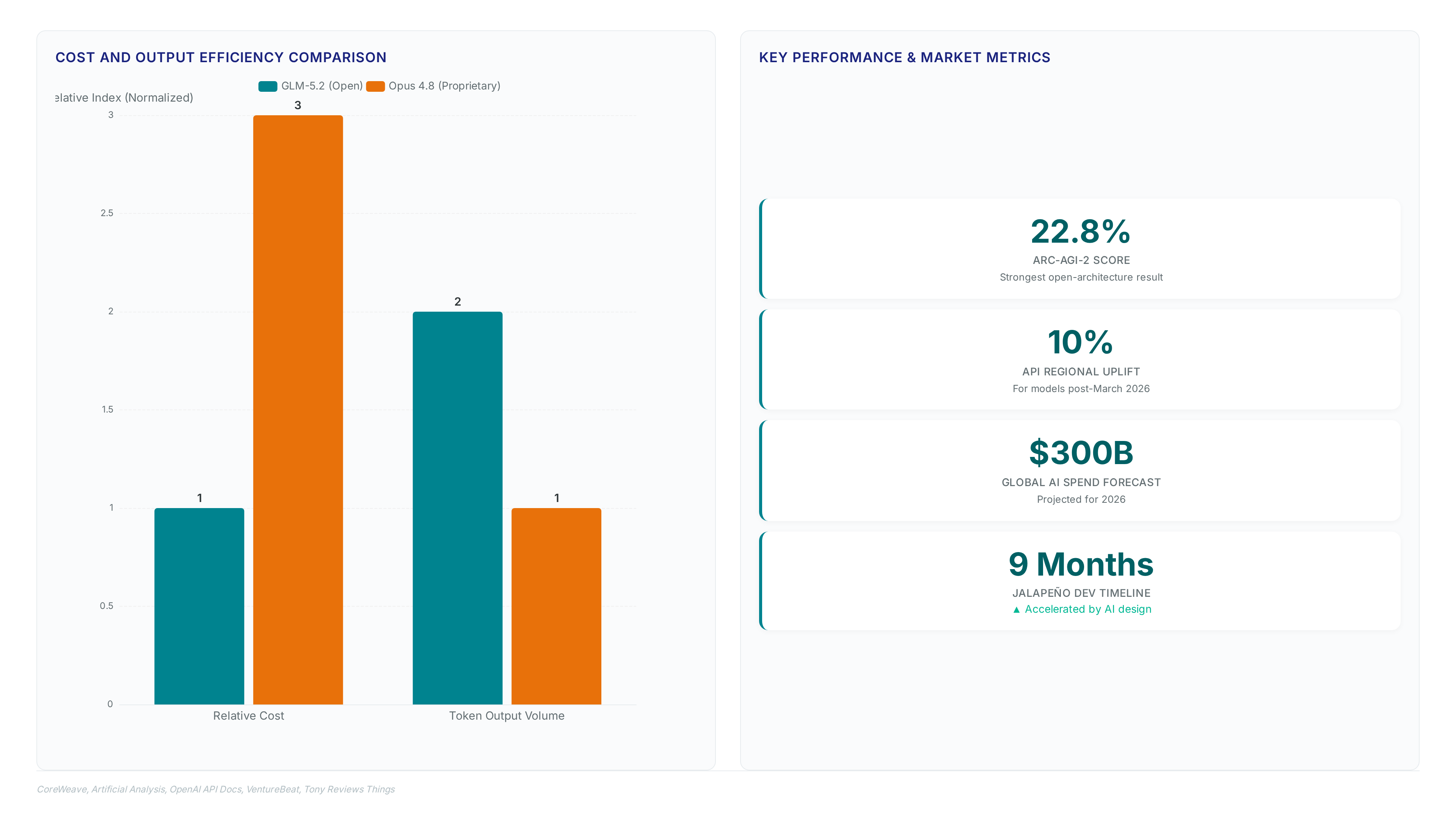
GLM-5.2 leads open-weight rankings on Artificial Analysis and Agent Arena per CoreWeave, establishing a high bar for self-hosted inference. This model achieves a 22.8% score on ARC-AGI-2, marking the strongest result to date for an open architecture. Operators comparing deployment options face a stark economic divergence between owning weights and renting API access. The mechanism here is simple: self-hosting converts variable operational expense into fixed capital expenditure, while APIs retain flexibility at a premium. However, the limitation of open-weight adoption remains the operational burden of managing memory movement and kernel optimization without vendor support. Unlike merchant GPUs, custom silicon like Jalapeño remains an internal play, forcing competitors to rely on efficiency gains rather than hardware procurement. This flexible means inference economics now dictate architectural choices more than raw parameter counts. Teams must decide whether to absorb the complexity of capability-based security management or pay for centralized audit trails. : total control demands total responsibility for the serving stack.
Applying GLM-5.2 and Opus 4.8 in Real-World Deployment Scenarios
In practice, gLM-5.2 delivers ~2x token output at 3x lower cost than Opus 4.8 while maintaining similar quality per @nutlope. This economic disparity forces operators to segregate high-volume, low-complexity tasks like summarization or basic translation to open-weight models. Proprietary API traffic remains necessary for complex reasoning where proprietary alignment justifies the premium. The mechanism relies on routing logic that dispatches requests based on prompt entropy rather than blanket provider selection. However, self-hosting introduces hidden operational overhead in GPU orchestration and model quantization that erodes initial savings. The limitation is clear: organizations lacking dedicated ML platform teams face higher total cost of ownership despite lower token pricing.
Legal precedent now challenges whether hosted model access equates to exporting weights, creating uncertainty for cross-border agent deployments. The first substantial legal challenge to Trump-era AI export controls argues that hosted model access differs fundamentally from exporting weights, leaving operators reliant on foreign APIs vulnerable to sudden regulatory shifts. This regulatory fog complicates the decision to outsource agent memory versus maintaining self-hosted sovereignty.
Beyond policy, direct capability theft via large-scale distillation poses an immediate threat to proprietary moats. Anthropic accused Alibaba-linked operators of using ~25,000 fraudulent accounts and 28.8 million Claude exchanges to distill capabilities into Qwen-class systems. Such attacks validate the fear that tacit-knowledge lock-in exposes training data to exfiltration rather than just inference costs.
| Risk Vector | Proprietary Dependency | Self-Hosted Open Weight |
|---|---|---|
| Regulatory Exposure | High (Export controls) | Low (Local execution) |
| Distillation Target | Primary (API accessible) | Minimal (Weights static) |
| Cost Volatility | High (Vendor pricing) | Fixed (Hardware CapEx) |
The cost of avoiding these risks involves navigating complex usage-based billing structures that penalize high-volume agents. Operators must weigh the convenience of vertical integration against the strategic danger of capability distillation. Relying on a single vendor for both infrastructure and intelligence creates a single point of failure that extends beyond uptime. The optimal path forward requires hybrid architectures that isolate critical memory states from external inference engines. AI Agents News recommends segregating sensitive agent workflows to mitigate these compounding vulnerabilities.
About
Sofia Berg serves as Research Editor at AI Agents News, where she specializes in translating complex multi-agent research and infrastructure developments into actionable insights for builders. Her daily work involves rigorously evaluating the underlying frameworks and hardware constraints that govern autonomous systems, making her uniquely qualified to analyze OpenAI's new Jalapeño chip announcement. By constantly assessing how shifts in compute availability impact agent orchestration and latency, Sofia connects high-level infrastructure moves to practical engineering realities. At AI Agents News, an independent hub dedicated to covering the full-stack of agentic AI, she ensures that news about custom silicon and kernel optimization is contextualized for software engineers and technical founders. This specific focus on the intersection of hardware capabilities and agent performance allows her to dissect why owning more of the stack matters for the future of scalable AI deployment.
Conclusion
Scaling AI infrastructure reveals that regulatory volatility and distillation attacks break the economic model of pure API dependency quicker than hardware costs do. While token prices drop, the operational expense of maintaining compliance across borders and protecting proprietary logic from extraction creates a hidden liability that grows linearly with usage volume. The 9-month hardware refresh cycle now outpaces traditional ASIC timelines, meaning organizations locking into long-term vendor contracts risk immediate architectural obsolescence before their depreciation schedules even begin.
Organizations processing over a substantial volume of tokens monthly must transition to a hybrid sovereignty model within the next two quarters. This approach mandates self-hosting open-weight models for all sensitive memory states and core logic loops, reserving external APIs only for non-critical, ephemeral tasks. Relying solely on vendor-managed stacks exposes critical business continuity to sudden export control shifts and unilateral pricing changes that no SLA can fully mitigate.
Start by auditing your current agent workflows this week to identify which specific chains access sensitive data or define core competitive advantages. Isolate these workflows immediately into a local execution environment using available open-weight alternatives to establish a compliant, cost-fixed baseline before expanding.
Frequently Asked Questions
The Jalapeño chip targets a 50% reduction in cost per token versus merchant GPU baselines. This significant saving enables large-scale operators to manage billions of daily tokens while maintaining strict budget thresholds for high-volume generation workloads.
The design integrates 216GB HBM3E memory to resolve bandwidth bottlenecks limiting general-purpose GPUs. This massive capacity supports long-context workloads by providing the necessary throughput for sparse MoE layers and complex agent memory architectures.
Microsoft is projected to absorb 40% of initial output to secure supply for its OpenAI integration. This major commitment validates the demand for dedicated inference paths over relying on volatile merchant hardware supply chains.
Collaboration with Broadcom enabled a rapid 9-month design cycle, compressing the traditional 18–24 month ASIC timeline. This speed allows hardware features to iterate quickly alongside evolving model structures like sparse MoE layers.
This silicon is proprietary infrastructure, meaning it is not merchant hardware available for external purchase or rental markets. Only entities controlling their full stack can replicate the vertical integration benefits seen in this specific deployment strategy.