Skill design patterns: 5 dimensions for reliable AI
Gartner forecasts 40% of enterprise apps will host task-specific agents by late 2026. This isn't a projection; it's a deadline. The shift from experimental play to professional scaling exposes a hard truth: generalist prompts crumble where specialized design patterns hold. Unpredictable AI behavior rarely stems from model incapacity. It comes from missing structural dimensions in the definition.
A reliable AI Skill declares five dimensions: When (trigger), Who (role), What (task), How (steps), and Output (contract). Miss one and the agent improvises the rest, which is exactly where Contract-Driven Execution breaks and downstream tools receive hallucinated prose instead of structured data.
Defensive Output rules that label unverifiable claims and enforce data currency reduce defects in safety-critical systems by 43%. With over 30 major tools like Claude Code and Gemini CLI now supporting standardized formats, content design has become the primary differentiator for engineering teams.
The Role of Five Dimensions in Defining Reliable AI Skills
The Five Dimensions Formula: When, Who, What, How, Output
A reliable Skill ontology demands five explicit dimensions: When (trigger), Who (role), What (task), How (steps), and Output (contract). Omit even one, and agent behavior becomes unpredictable, causing downstream workflow failures. This formula enforces a Single Responsibility boundary, keeping the trigger condition unambiguous and testable. Without this rigidity, an "all-in-one" agent drifts into executing unauthorized actions like financial projections or campaign planning.
Production environments rarely tolerate such ambiguity. Industry analysis indicates that deployed systems typically apply a median of 2 patterns per skill to maintain stability, rejecting monolithic designs in favor of specialized units. The market shift toward specialization is accelerating, with 40% of enterprise applications expected to integrate task-specific agents by late 2026. This surge demands that operators define strict Contract-Driven interfaces where input and output schemas are non-negotiable.
| Dimension | Function | Failure Mode |
|---|---|---|
| When | Trigger condition | Ambiguous activation |
| Who | Role declaration | Identity confusion |
| What | Task objective | Scope creep |
| How | Execution steps | Unverified actions |
| Output | Output contract | Workflow breakage |
The economic stakes are clear: professionals with these specific AI skills command annual wages reaching $173,450. However, the operational overhead to maintain strict contracts across hundreds of micro-skills is real. Operators must balance the rigidity of the Output contract against the need for Progressive Enhancement when inputs are partial. Audit every skill against this five-part formula before deployment to prevent silent data corruption.
Ignore this split, and your workflow breaks the moment an upstream input changes format. Specialized skills allow downstream consumers to rely on explicit structures. Frontend design trends show a similar shift toward single-screen implementation rather than full application generation, proving that narrow scope improves reliability. Reject the anti-pattern of the generalist agent. Adopt composable, single-purpose units. This approach aligns with industry moves toward frontend-design variants that prioritize component precision over broad capability. The resulting architecture supports higher wages for specialists who manage these precise AI interactions effectively.
Pattern vs Anti-Pattern: Focused Skills Versus Monolithic Triggers
Contract-Driven design collapses when a single trigger attempts copywriting, planning, and ROI analysis simultaneously. This monolithic approach creates an untestable black box where modifying one function degrades unrelated outputs, and no reviewer can tell which of the three jobs the skill actually failed.
| Feature | Focused Skill | Monolithic Anti-Pattern |
|---|---|---|
| Trigger Scope | Single sentence definition | Vague, multi-intent condition |
| Failure Mode | Explicit refusal of out-of-scope tasks | Silent execution of unauthorized actions |
| Maintainability | Isolated updates | Cascading logic errors |
Operators using frontend-design variants observe that specific screen implementation skills outperform general app generators. This specialization aligns with the Tool Wrapper pattern, which enforces strict input and output boundaries. Merging responsibilities reduces initial configuration time but eliminates the ability to audit specific workflow stages. Split roles immediately upon detecting mixed intent in the trigger condition. Without this separation, the output contract becomes unpredictable, breaking downstream consumers that rely on structured data.
Mechanics of Single Responsibility and Contract-Driven Execution
Defining Single Responsibility via Trigger Sentence Tests
The single sentence trigger test validates Single Responsibility by rejecting vague, multi-intent conditions that degrade agent reliability. An all-in-one marketing skill attempting copywriting, planning, and ROI analysis fails this boundary check because no single sentence can accurately describe such a broad activation condition. This ambiguity forces the agent to guess user intent, resulting in untestable quality where modifying the copywriter function inadvertently breaks the campaign planner logic. Production environments avoid this collapse by keeping each skill narrow enough that one sentence describes its trigger.
Split broad roles into distinct agents like copywriter or competitor-analyzer to maintain clarity. Platform implementations vary, with some ecosystems like Spring AI enforcing portability across providers while others lock users into specific vendor triggers. Ignore this separation, and you lose Contract-Driven certainty; downstream workflows cannot rely on outputs from an agent with shifting goals. Progressive Enhancement strategies further require this modularity to degrade gracefully when inputs are partial rather than conflating distinct tasks.
Enforcing Structure with Output Contracts and Degradation Paths
Output contracts mandate explicit structure, prohibiting unauthorized content while enforcing strict word counts to prevent workflow breaks. Without these Defensive Output rules, upstream changes cascade failures when downstream consumers receive unstructured data. Applying tailored design patterns reduces defects by 43% in safety-critical systems, proving that rigid boundaries directly improve reliability. Strict contracts require precise input definitions; vague triggers cause the agent to hallucinate parameters rather than request clarification. Define degradation paths for full, partial, and missing inputs to maintain utility.
When critical info like a company name is absent, the system must halt and ask "Which company would you like me to analyze? " instead of generating garbage. This strategy supports the Agent Skills spec. A common failure mode involves agents inventing financial projections when data is missing, violating the core prohibition against fabricated statistics. Automation scripts depending on agent output will crash if the Output Contract allows unverified fields. Structured degradation ensures the agent remains a reliable component rather than a source of noise.
Validating Skill Prompts Against the Five-Dimension Template
Validating prompt structure requires checking that the trigger condition activates only on a single, specific keyword match. Skills failing this test often activate on vague intents, whereas correct implementations rely on precise trigger mechanisms to load internal documentation dynamically. Verify the output contract explicitly forbids prohibited content like financial projections to prevent downstream workflow corruption.
| Dimension | Validation Check | Failure Consequence |
|---|---|---|
| Single Responsibility | Trigger fits one sentence | Ambiguous activation scope |
| Contract-Driven | Output schema set | Workflow breaks on change |
| Defensive Output | Uncertainty tags present | Hallucinated data accepted |
The defensive output layer must label unverifiable claims as unverified rather than fabricating statistics to fill gaps. This discipline supports emerging context engineering practices where security constraints are injected directly into the agent's reasoning path. Strict contracts increase prompt token count, potentially exceeding model context limits during complex multi-step reasoning tasks. Audit skills against all five dimensions before deployment to avoid silent failures in production. Missing the progressive enhancement dimension causes total refusal when optional parameters are absent, degrading user experience unnecessarily.
Implementing Predictable Output Through Structured Templates
Anatomy of the Skill Prompt Structure Template

Mandatory sections including Role, Trigger, and Output Contract define the predictable anatomy required for production-grade skill prompts. Assemble these components to prevent the ambiguity that causes a significant share of unstructured agents to fail complex tasks. The Trigger acts as a gatekeeper, activating only when specific keywords like "FastAPI" appear in user input to dynamically load the guidelines via trigger mechanisms. Without this precision, the agent risks scope creep, attempting to answer unrelated queries outside its assigned expertise.
- Role: Declare specific expertise boundaries in one sentence.
- Task: Define the production goal without vague helper language.
- Execution Steps: List numbered actions for consistent reasoning paths.
The Output Contract fails without explicit "must not" clauses that ban financial projections and fabricated statistics. Define negative constraints alongside required headers to prevent downstream workflow corruption. Rigid prohibitions can cause valid but edge-case data to be dropped if the model fears violating a rule. This tension forces a choice between strict compliance and thorough data retrieval.
- Declare the required structure using specific markdown headers.
- List prohibited content types like internal data or exact revenue figures.
- Set a maximum word count to stop verbose hallucinations.
- Define a degradation path for missing critical inputs.
Routing tasks to specialized models further stabilizes output, as specific engines excel at structured documents versus code generation. Without these explicit bans, agents frequently invent statistics to fill perceived gaps in the requested format. Unverified claims propagate through automated pipelines as fact. Over thirty tools now support such standardized formats, making differentiation a matter of content design rather than file structure.
Validating Degradation Paths for Partial Input Scenarios
Testing degradation strategies requires a checklist covering full input, partial inputs with declared defaults, and missing critical data scenarios. This structure parallels technical specifications set by the Agent Skills spec. Validate three distinct paths: direct execution, default injection with assumption logging, and explicit clarification requests.
- Verify full input triggers immediate, high-fidelity output without assumption headers.
- Confirm partial input activates default values while listing them in an Assumptions section.
- Ensure missing critical fields stop execution to request specific user clarification.
| Input State | Expected Behavior | Failure Mode |
|---|---|---|
| Full Parameters | Direct execution | Unnecessary clarification loops |
| Partial Data | Default fill + warning | Silent hallucination of values |
| Missing Critical | Block and request | Garbage output generation |
Operational friction is the cost; users must correct defaults before proceeding, slowing initial throughput. Frontend design variants dominate current skill repositories, often neglecting these strong error states in favor of single screen implementations. Consequently, operators face unpredictable agent behavior when upstream data streams stutter or drop fields unexpectedly. Enforce these paths to prevent silent failures in production workflows.
Real-World Application of Skill Auditing and Quality Assurance
Defining the Competitor-Analyzer Test Scenarios
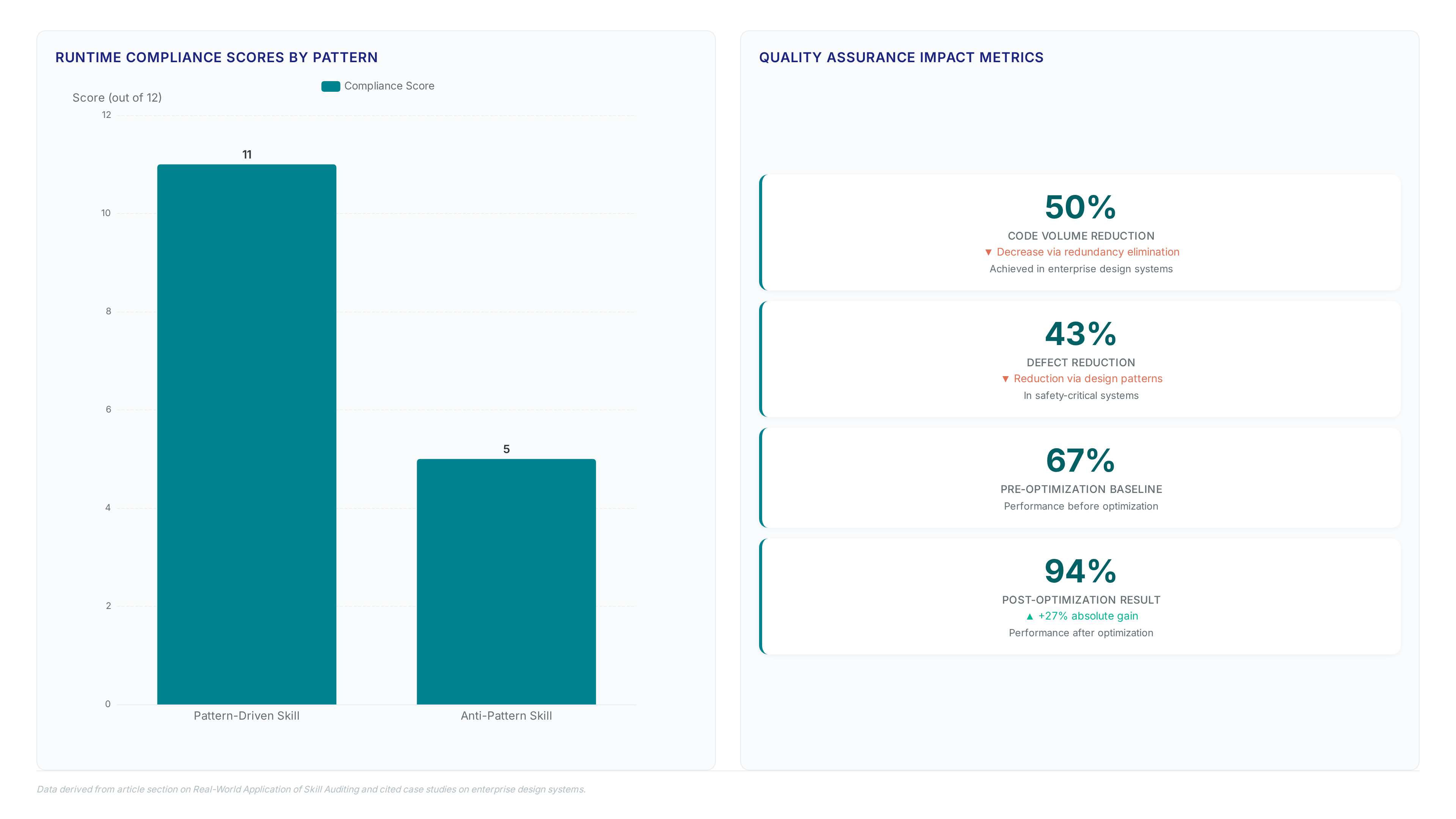
Four distinct test scenarios (S1 through S4) audit skill performance by targeting specific failure modes in the competitor-analyzer demo. S1 provides full input to verify contract-driven structure, while S2 feeds only a company name like "Analyze Figma" to trigger progressive enhancement defaults. S3 attempts out-of-scope requests, such as demanding a marketing plan alongside analysis, to enforce single-responsibility boundaries. Finally, S4 probes for exact current-quarter revenue to validate defensive output labeling against unverifiable real-time data.
| Scenario | Input Condition | Target Pattern |
|---|---|---|
| S1 | Full parameters | Contract-Driven |
| S2 | Company name only | Progressive Enhancement |
| S3 | Out-of-scope task | Single Responsibility |
| S4 | Real-time financial query | Defensive Output |
Implementing these rigorous checks mirrors enterprise design systems that achieved a 50% decrease in code volume by eliminating redundant logic paths. Flexibility clashes with safety because broad interpretation in S2 risks hallucination, yet rigid rejection frustrates users. Balance these by ensuring degradation strategies explicitly log inferred defaults rather than guessing silently. Downstream workflows consume poisoned data without such observable design, compounding errors across the automation stack.
Audit Results: Pattern-Driven vs Anti-Pattern Scores
Runtime compliance scores show the pattern-driven skill achieving 11/12 against the anti-pattern's 5/12. This quantitative gap highlights how safety-critical defect reduction methodologies translate directly to prompt engineering reliability. The comparison table below details the specific failure modes observed across four test scenarios.
| Scenario | Target Pattern | Anti-Pattern Score | Pattern Score |
|---|---|---|---|
| S1 Full Input | Contract-Driven | 2/4 | 4/4 |
| S2 Partial Input | Progressive Enhancement | 0/2 | 2/2 |
| S3 Out of Scope | Single Responsibility | 1/2 | 2/2 |
| S4 Uncertain Data | Defensive Output | 2/4 | 3/4 |
A deeper Design Quality Audit reveals the pattern version scored 24 out of 25 points, while the unstructured version managed only 14. The most significant divergence occurs in Defensive Output, where the structured approach gained three additional points by correctly labeling uncertainty rather than fabricating data. Tailored patterns reduce defects notably in complex systems according to industry findings. Increased token consumption for assumption logging is the cost of this precision. Balance the need for explicit assumptions against context window limits in long-running sessions. The pattern-driven model successfully declared defaults for partial inputs, yet it still occasionally leaked formatting symbols when handling financial data queries. Negative constraints in prompts require iterative tightening to fully prevent schema violations. Agents fail to maintain boundaries when faced with ambiguous triggers without these rigid structures.
Finding 1: Handling Partial Input in Figma Analysis
Finding 1 identifies S2 as the sharpest gap, with scores of 0/2 versus 2/2. The anti-pattern skill received "Analyze Figma" and produced a free-form structure with no declared assumptions. In contrast, the pattern-driven response included a Competitor Analysis: Figma header and an Assumptions block listing Product, Technology, and Market Position dimensions. This explicit declaration allows users to correct defaults before the model executes the full task.
Splitting multi-task skills remains necessary because a significant majority of AI job postings now seek focused experts rather than generalists. A unified agent attempting both analysis and planning often fails to enforce boundaries, whereas specialized skills maintain strict single responsibility. Maintaining multiple skills increases orchestration complexity for the operator.
Formalizing these capabilities into distinct Task skills ensures predictable output even when input data is sparse. Partial inputs trigger hallucinated parameters rather than safe defaults without this separation. The industry shift toward standardized skill formats supports this modular architecture. Choose between fragile all-in-one prompts or strong, segmented workflows that handle ambiguity through declared degradation strategies.
About
Priya Nair serves as AI Industry Editor at AI Agents News, where she tracks the rapid evolution of autonomous systems and coding agents. Her daily coverage of platform shifts involving Devin, Claude Code, and Cursor provides a unique vantage point on why standardized skill design patterns are critical for enterprise scaling. As the industry moves from experimental prototypes to professional deployment, Nair observes that unpredictable agent behavior often stems from poorly set triggers and output contracts. This article distills her reporting on how leading engineering teams are adopting structured frameworks to ensure reliability. By auditing skills across five specific dimensions, developers can change volatile AI interactions into predictable workflows. Her analysis connects real-world product launches to the urgent need for rigorous design standards, offering practical guidance for engineers building the next-generation of task-specific agents.
Conclusion
Scaling skill patterns reveals a critical friction point: orchestration overhead grows quicker than capability when operators rely on fragile, all-in-one agents. While modular skills prevent the ambiguity that derails complex tasks, managing dozens of hyper-specialized nodes introduces latency and versioning chaos that simple prompt engineering cannot solve. The operational cost shifts from writing prompts to maintaining the routing logic that connects them. Without rigid interface contracts, your agent network will fracture under the weight of its own complexity.
Adopt a segmented workflow architecture immediately if your current agents fail more than a small fraction of the time on ambiguous inputs. Do not attempt to refactor legacy monolithic prompts; instead, isolate high-failure domains into distinct, single-responsibility skills with explicit assumption blocks. This transition must happen within the next two quarters before the market fully penalizes generalist approaches with unmanageable error rates. Specialization is no longer just a hiring trend but a structural requirement for reliable automation.
Start by auditing your most frequent failure mode this week and extracting it into a standalone skill with set degradation strategies. Measure the reduction in hallucinated parameters after forcing this separation. This concrete step validates the ROI of modularity before you commit to a full system redesign.
Frequently Asked Questions
When (trigger), Who (role), What (task), How (steps), and Output (contract). Omit any one of them and behavior turns unpredictable, because the missing dimension gets filled in by the model rather than by the definition.
Implementing defensive output rules and structured templates reduces defects in safety-critical systems by 43%. This significant improvement ensures downstream tools receive reliable data rather than hallucinated or unverified prose.
Gartner forecasts that 40% of enterprise applications will host task-specific agents by late 2026. This shift demands reliable skill definitions to prevent the ambiguity that causes many unstructured agents to fail.
Runtime compliance scored the pattern-driven skill 11/12 against the anti-pattern's 5/12, and the deeper Design Quality Audit gave it 24 out of 25 points versus 14. The widest gap appeared in Defensive Output, where labeling uncertainty beat fabricating data.
All-in-one skills create untestable quality where one change breaks multiple functions simultaneously. Splitting these into distinct units ensures each agent maintains a strict boundary and prevents total workflow breakage.