Parallel ensemble routing stops agent hallucinations
Running queries across 47+ providers in parallel allows the A3M Router to deliver 60%+ cost savings while simultaneously reducing hallucinations. This efficiency proves that parallel ensemble routing has evolved from an experimental tactic into the definitive standard for enterprise AI reliability. The era of relying on single-model outputs for critical agentic reasoning is effectively over, as larger parameter counts no longer guarantee superior performance across all task types.
Voting-based consensus filters noise to produce higher confidence results than any single model reaches alone, which is why routing logic often beats raw model size on narrow orchestration jobs. ReasoningBank integration supplies the semantic memory that holds context during complex, multi-step agent loops.
Arranging agents into functional planes is what stops error propagation before it reaches the whole workflow, and that is the part of enterprise implementation strategies that survives contact with production. These multi-model orchestration patterns let organizations bypass the diminishing returns of raw model size and spend on architectural durability instead.
Where Sequential Chains Break and Voting Holds
Parallel Ensemble Routing vs Sequential Processing in Agentic Loops
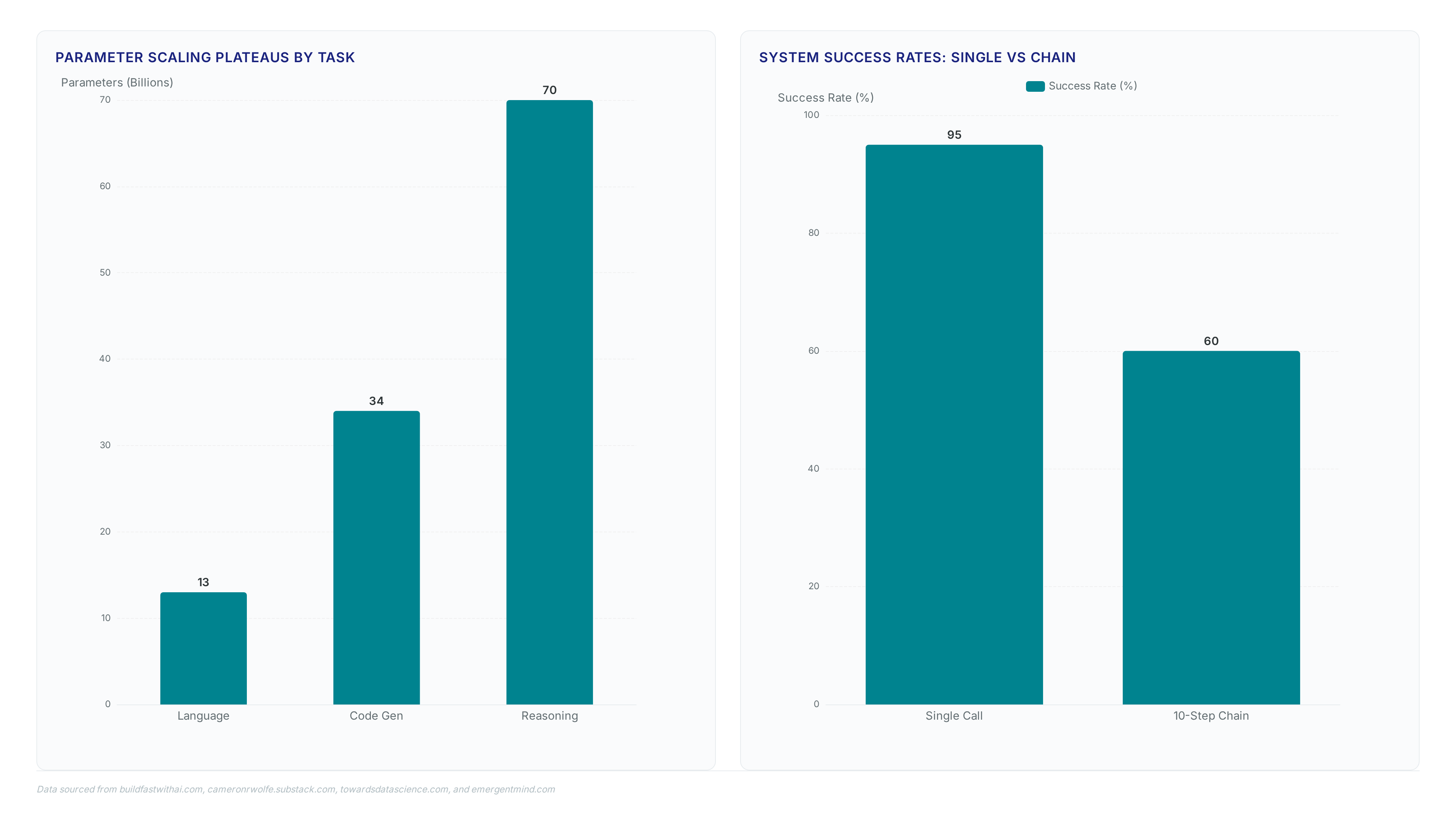
Stop chaining models linearly. Every dependency in a sequential agentic reasoning loop stacks latency and compounds error probability. Consider the math: a system with a 95% single-call success rate collapses to roughly 60% over a ten-step sequence. This multiplicative risk kills production reliability.
Parallel ensemble routing breaks this cycle. By dispatching multiple model queries at once and gathering outputs through voting, we replace brittle chains with strong consensus. Voting in AI cuts failures by selecting the majority answer across parallel runs, stopping hallucinations before they propagate. The mechanism works, but it demands fiscal discipline. Large-scale parallel loops can generate seven-figure monthly token bills if left unchecked.
Here lies the economic pivot. Routing logic often beats raw model size for specific jobs, yet operators frequently overspend on massive models for simple orchestration tasks. Cross-validated scaling laws predict the optimal agentic architecture with 87% accuracy, but the tradeoff remains the immediate cash flow required for concurrent compute. You must weigh the topology of coordination against budget limits. Uncoordinated parallelism burns tokens on redundant queries without boosting consensus quality. Moving to parallel systems requires strict fan-out limits to stop cost spikes while keeping enterprise reliability.
Applying Topology of Coordination to Mitigate System Fragility
Chaos is expensive. Systems lacking structural discipline suffer a 17x error increase compared to coordinated alternatives. Organizing agents into functional planes stops the error multiplication found in uncoordinated "bag of agents" setups. This Topology of Coordination turns chaotic node interactions into stable reasoning chains by isolating failure domains before they spread.
Model selection must match specific task thresholds. Assuming bigger scales give linear gains is a fallacy that adds unnecessary latency without improving output quality. Matching model size to the task also ensures that semantic memory integration via tools like ReasoningBank adds value without compounding token costs. Infrastructure spending should focus on task-specific architecture rather than scaling model size.
Enterprise Implementation Strategies for Voting-Based Consensus and Semantic Memory
What Semantic Memory Adds to Parallel Workstreams
ReasoningBank integration maintains context across these parallel workstreams without requiring redundant token generation. The A3M Router orchestrates this shift by dispatching concurrent queries and aggregating results through voting, a mechanism that suppresses hallucinations before they compromise downstream logic. Coordination layers must manage agent interactions precisely to avoid synchronization bottlenecks. Semantic memory preserves state across divergent paths, eliminating the need to re-encode context for each branch.
The open question in such a deployment is not whether voting works but what it costs: the router has to balance load distribution and hold output consistency while the fan-out stays inside its limit. That is the line between parallel infrastructure as a structural choice and parallel infrastructure as an expensive habit.
About
Sofia Berg serves as Research Editor at AI Agents News, where she specializes in translating complex multi-agent research into actionable insights for engineers. Her deep expertise in evaluating agentic reasoning loops and benchmarking orchestration frameworks makes her uniquely qualified to analyze the A3M Router. In her daily work, Berg dissects arXiv papers on parameter scaling and ensemble methods to determine their practical utility for building reliable systems. As the voice behind AI Agents News, a hub dedicated to technical founders and ML engineers, Berg ensures that coverage of emerging tools like the A3M Router remains grounded in concrete benchmark data rather than speculation. Her analysis connects theoretical scaling laws to the real-world challenges of deploying autonomous agents, providing the clarity builders need to make informed architectural decisions.
Conclusion
Scaling sequential reasoning chains exposes a critical fragility where minor individual error rates compound into systemic failure. The operational cost of cleaning up corrupted downstream logic far exceeds the compute expense of running concurrent checks. Enterprises must shift from reactive error handling to proactive isolation, treating parallel execution as a fundamental requirement for any agent handling complex tasks. Relying on linear chains for high-stakes operations is an unsustainable risk that invites catastrophic breakdowns as task complexity grows.
Organizations should mandate parallel voting architectures for all critical reasoning paths within the next two quarters. This transition is not merely about speed but about establishing a verifiable trust boundary around automated decisions. Do not attempt to patch sequential workflows with post-hoc validation; the architecture itself must prevent error propagation. Piloting a parallel router on a single non-critical workflow this week benchmarks confidence scoring against your current serial baseline. This immediate test reveals the latency versus reliability trade-off specific to your domain without committing to a full infrastructure overhaul. True durability comes from designing systems where faults are contained instantly rather than managed after they spread.
Frequently Asked Questions
Single models drop to roughly 60% success over ten steps due to multiplicative risk. Parallel ensemble routing prevents this collapse by voting on concurrent outputs, ensuring reliable agentic reasoning without the severe degradation seen in linear chains.
Cross-validated scaling laws predict the optimal agentic architecture with 87% accuracy. However, operators must still manage immediate cash flow for concurrent compute, as uncoordinated parallelism can burn tokens on redundant queries without boosting consensus quality.
Uncoordinated topologies suffer a 17x error increase compared to structured systems. Organizing agents into functional planes isolates failure domains, preventing local errors from multiplying across the network and compromising the entire enterprise workflow unexpectedly.
The A3M Router reports 60%+ cost savings against traditional approaches. The saving comes from routing each step to a model sized for that step instead of paying for maximum scale on every call, which frees budget for architectural durability rather than redundant token generation.
It supplies the semantic memory that preserves state across divergent paths, so each branch skips re-encoding the same context. That keeps multi-step agent loops coherent without the redundant token generation concurrent dispatch would otherwise force.
References