Parallel AI routing cuts costs by 60% with A3M
Running queries simultaneously across 47+ providers drives the 60%+ cost savings reported for the A3M Router in recent DEV Community analysis. This isn't theoretical optimization; it's a structural fix for brittle AI pipelines. By injecting ReasoningBank semantic memory into parallel flows, the system stabilizes outputs that single-model calls leave vulnerable to hallucination. The data confirms that shifting from linear to concurrent processing models delivers tangible ROI, transforming how organizations handle AI routing.
Traditional sequential chains create a single point of failure. If one link breaks, the whole workflow collapses. Parallel execution removes this fragility. The A3M Router dispatches requests to multiple providers concurrently, scoring responses based on confidence levels before selection.
The Role of Multi-Model Consensus in Modern AI Reliability
Defining Parallel Ensemble AI vs Sequential Processing
Multi-model consensus replaces fragile sequential chains with simultaneous queries to suppress hallucinations mathematically. Where sequential processing lets a single model failure cascade through an entire workflow, parallel ensemble execution dispatches requests to multiple providers at once. The A3M Router enables this by executing queries in parallel across 47+ providers, capturing the most accurate response regardless of individual model errors. This architectural shift closes the reliability gap inherent in sequential AI, where dependency on a single point of failure creates unacceptable downtime risks during rate limit scenarios.
| Feature | Sequential Chains | Parallel Ensemble |
|---|---|---|
| Execution Flow | Linear, dependent steps | Simultaneous, independent queries |
| Failure Mode | Cascading errors | Isolated voter suppression |
| Latency Profile | Sum of all step times | Maximum single step time |
| Reliability | Low (single point) | High (statistical majority) |
Token consumption rises when multiple models run simultaneously, increasing immediate compute costs compared to a single sequential call. However, this approach eliminates the compounding latency of retry logic when upstream providers throttle traffic. By scoring responses based on confidence rather than arrival order, the system returns the optimal result without manual intervention. Such a method transforms reliability engineering from managing failure states to managing statistical probability. Builders gain a simplified error surface where network timeouts do not equate to system failures. Industry analysis suggests that approximately 60% of coding prompts and developer sessions consist of "easy" tasks that do not require top-tier models, making parallel routing a strategic baseline for production workloads requiring strict accuracy guarantees.
Applying Multi-Signal Heuristics for Query Routing
The routing engine employs multi-signal heuristic scoring to classify incoming requests before dispatch. By evaluating 12 specific keyword signals across five dimensions, the system determines the optimal provider tier dynamically rather than relying on static rules. This granularity ensures that simple queries do not consume expensive tokens while reserving high-capacity models for complex reasoning tasks. Benchmark data indicates the A3M Router achieves high accuracy when routing to the cheapest capable model, demonstrating that cost optimization need not sacrifice precision.
Heuristic reliance introduces a specific constraint: the system depends on the accuracy of its signal detection to route queries effectively. If those signals fail to capture nuance, the system might select a provider ill-suited for the task, necessitating strong fallback mechanisms. Unlike rule-based routers that redirect based on fixed patterns, this flexible classification adapts to query semantics. It ensures a query is never sent to a model more expensive than necessary for its specific complexity tier.
| Feature | Static Rule Router | Multi-Signal Heuristic |
|---|---|---|
| Decision Logic | Fixed regex patterns | Flexible scoring |
| Signal Count | Single dimension | 12 keywords |
| Adaptability | Manual updates | Automatic classification |
| Failure Mode | Misrouting unknowns | Signal noise |
Signal definitions need continuous validation: miscalibrated detection sends trivial tasks to expensive providers, which is the exact spend the router exists to remove.
Inside the A3M Router Architecture and Parallel Execution Flow
ReasoningBank Semantic Memory and Parallel Voting Mechanics
ReasoningBank integration injects semantic memory directly into the routing layer, keeping context alive across disjointed API calls without forcing sequential dependency. Queries run simultaneously across 47+ providers, with the system scoring every response by confidence instead of blindly accepting the first available output. This specific design drives a RouterArena score of 70.32, placing the tool among top-performing open-source solutions in LLM routing benchmarks.
Parallel voting cuts hallucinations by aggregating simultaneous responses and filtering outliers through heuristic consistency checks. Sequential fallback chains compound latency, yet this method delivers the highest quality answer at the lowest possible cost. Token consumption represents the primary constraint; querying multiple models raises immediate input costs even when the final output remains singular. Builders must configure confidence thresholds carefully to balance precision with response diversity. The A3M Router handles this tension by using multi-signal heuristic scoring across five dimensions to determine the optimal response dynamically.
Failure domains shift fundamentally under this model. Sequential systems crash when an upstream provider errors, but parallel systems use provider redundancy to prevent service interruption, particularly by automatically detecting HTTP 429 rate limit responses.
Provider Selection and Semantic Caching in Practice
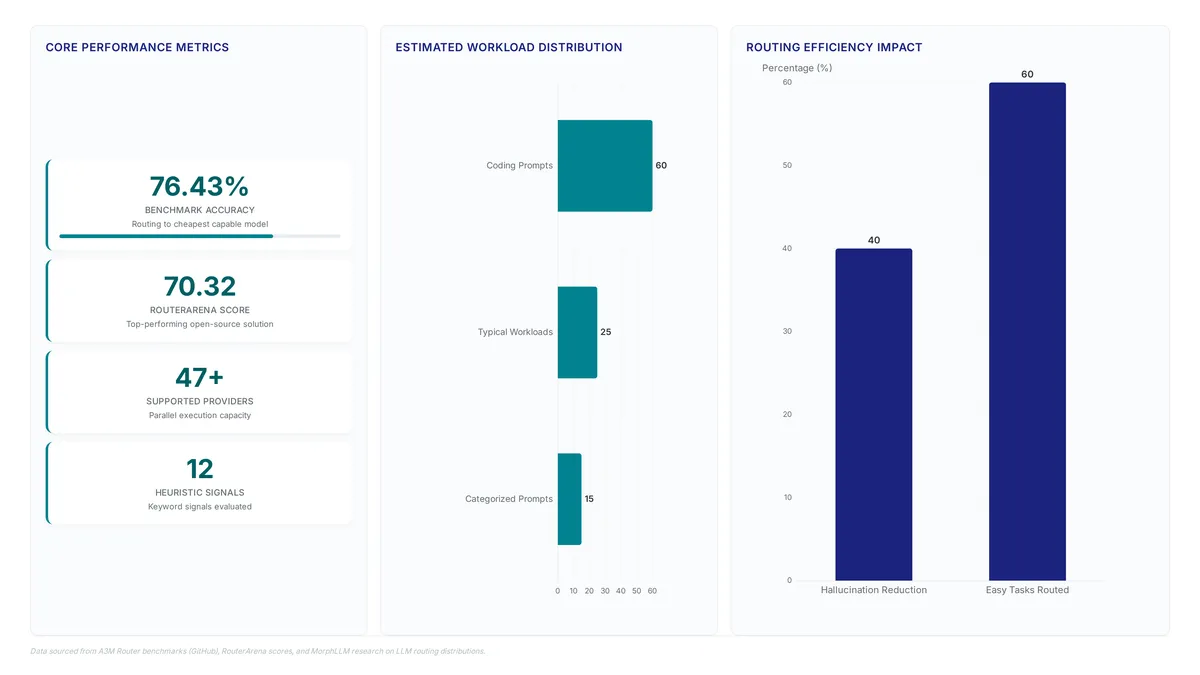
Agent orchestration frameworks often focus on state management, yet this method prioritizes flexible provider selection using real-time capability and cost signals. Builders shift from managing single-connection reliability to orchestrating multi-provider response aggregation. Infrastructure transforms from a fragile linear dependency into a resilient mesh where individual model failures do not compromise system output.
Routing logic balances accuracy against latency constraints. Semantic caching integration prevents redundant computation for recurring query patterns. High-performance LLM gateways now treat such integration as a standard expectation to further reduce latency and cost. Static routing forces expensive models on simple tasks, whereas flexible selection of the cheapest capable model from over 47 providers directly reduces token expenditure. Cost optimization proceeds without sacrificing conversational coherence or factual grounding.
About
Priya Nair serves as AI Industry Editor at AI Agents News, where she tracks the business dynamics of autonomous systems and multi-agent orchestration. Her daily coverage of platform shifts and funding rounds around tools like Devin and Claude Code positions her to critically analyze emerging routing architectures. In this article, she examines the A3M Router, connecting its parallel ensemble approach to broader industry demands for reduced hallucination and cost efficiency. Nair's expertise allows her to dissect how features like ReasoningBank integration impact semantic memory without relying on vendor marketing claims. As AI Agents News remains an independent hub for engineers evaluating agent frameworks, her analysis focuses strictly on technical merit and operational reliability.
Conclusion
Parallelism here is not a speed trick but an error-suppression one: identical prompts go out at once, responses are scored by confidence instead of arrival order, and a single provider timeout stops being a system failure. The routing layer is what decides the bill, sending each query to the cheapest capable model and reserving expensive tiers for requests that actually need them.
Two costs stay on the table. Token consumption rises the moment several providers answer the same prompt, and the 12 keyword signals that classify requests have to stay calibrated, because a signal that misses the nuance of a query sends it to the wrong provider tier and turns the saving into misrouted spend.
Frequently Asked Questions
Reported savings run above 60%, but they come from selection rather than from parallelism itself: each query lands on the cheapest capable model instead of a default top tier. Token consumption rises immediately when several providers answer the same prompt, so the gain shows up only where cheap models actually clear the task.
Benchmark data shows high accuracy when the router selects the cheapest capable model, and the tool carries a RouterArena score of 70.32 among open-source routing solutions. Accuracy survives because responses are scored by confidence rather than by price alone.
The engine reads 12 keyword signals across five dimensions before dispatch. Its weak point is the same as its strength: when those signals miss the nuance of a request, the query lands on a provider tier that does not fit it, which is why fallback handling matters more here than in a static rule router.
Parallel workflows isolate failures instead of letting errors cascade through dependent steps, so a single model timeout stops being a system outage. Rate limit responses are handled the same way: HTTP 429 from one provider is detected automatically and the answer arrives from the others.
Analysis suggests approximately 60% of coding prompts consist of easy tasks not needing top-tier models. Redirecting this majority of traffic to cheaper providers via parallel routing drastically lowers overall infrastructure spend without losing performance.
References