Parallel coding systems: What actually ships
Seven contenders now define the AI coding agent market as of July 2026. We are past the era of simple autocomplete. The industry has pivoted to autonomous orchestrators that manage complex, multi-step workflows independently. These systems execute commands and modify code without hand-holding. Windsurf has rebranded to Devin Desktop, while Cursor now charges a monthly fee for parallel agent capabilities. The math is specific: Windsurf IDE-native features cost $15 monthly, whereas GitHub Copilot relies on usage-based flex billing.
What separates these tools now is orchestration, not model quality: Cursor 3 runs coding tasks in parallel inside isolated virtual machines, Kiro executes specs in parallel, and Claude Code splits heavy jobs across subagents through Flexible Workflows. Availability is the second variable, because Claude Fable 5 came back only after the export control order was lifted, which is why a single-vendor pipeline carries regulatory risk on top of its bill.
The Evolution of AI Coding Agents from Assistants to Autonomous Orchestrators
Defining AI Coding Agents vs Agentic IDEs and Flexible Workflows
An AI coding agent plans, executes, and verifies features by running terminal commands without step-by-step guidance. True agents manage their own context windows and error states. This stands in sharp contrast to Assistants like GitHub Copilot, which demand user prompts for every single action. Agentic IDEs represent a third category: full integrated development environments with deep project context across multiple files. These platforms embed the agent directly into the user interface to slash context switching, a distinct advantage over terminal-native tools. Flexible Workflows emerge when systems coordinate parallel sub-agents to handle independent slices of work simultaneously.
Parallel Orchestration in Cursor 3, Antigravity 2.0, and Kiro
Q2 2026 marked the pivot to parallel orchestration. Coordinators now delegate subtasks to isolated execution threads rather than processing requests sequentially. This architectural shift allows multi-agent systems to solve complex dependency chains faster than single-threaded assistants. Cursor 3 introduced Build in Parallel, enabling simultaneous execution of distinct coding tasks within isolated virtual machines. This capability separates modern Agentic IDEs from earlier single-threaded coding assistants by managing concurrent state without manual intervention. Similarly, Antigravity 2.0 expanded its agent suite with flexible subagents and a Go-based CLI to handle background coordination. Kiro adopted a spec-driven approach, adding parallel task execution that can cut multi-task workflows by up to 4x. These implementations prove flexible workflows function by breaking large specifications into independent, verifiable units of work.
| Feature | Cursor 3 | Antigravity 2.0 | Kiro |
|---|---|---|---|
| Mechanism | Build in Parallel | Flexible Subagents | Parallel Spec Execution |
| Concurrency | High | High | Medium-High |
| Primary Benefit | Isolated VMs | Go-based CLI | 4x Workflow Speedup |
The operational tax on this shift is increased backend complexity. Coordinating multiple agents requires strong state isolation to prevent race conditions during file writes. Concurrency accelerates output, yet it demands that builders define clearer initial specifications to avoid divergent agent behaviors. Teams must now evaluate tools based on their orchestration logic, not model intelligence. The ability to manage parallel threads determines throughput in large-scale refactoring projects.
Comparing Pricing and Capabilities: Claude Code, Cursor, and GitHub Copilot
The July 2026 landscape divides into seven distinct contenders: Claude Code, Google Antigravity, OpenAI Codex, Cursor, Kiro, GitHub Copilot, and Windsurf. Pricing stratification now signals intended workflow depth rather than just feature access. Entry-level access remains at $10 per month via GitHub Copilot, targeting teams needing basic assistance. Mid-tier operators often select $15 plans from IDE-native options like Windsurf and Cursor. These platforms embed deep project context understanding directly into the editor, allowing the agent to edit across files and run tests within the local environment. The premium tier sits at $20 for Claude Code, a terminal-native agent. Builders must decide whether their bottleneck is speed of iteration or cost of compute cycles. Match the tool category to the specific autonomy level required by your deployment pipeline.
Comparative Analysis of Leading AI Coding Platforms and Pricing Models
Defining Agentic Mode and Terminal Integration in AI Coding Tools
Agentic mode denotes autonomous task execution where the AI plans and verifies code without step-by-step human prompting. All seven substantial platforms now support this capability, with Antigravity featuring multi-agent architectures and Codex using a cloud sandbox. Terminal integration separates tools into native CLI agents like Claude Code versus IDE-embedded workflows found in Cursor or Windsurf. This IDE-first versus terminal-first divergence dictates whether the agent operates within your shell environment or a restricted GUI pane. Native terminal access offers direct system control yet requires careful configuration to prevent unintended filesystem changes. IDE-integrated agents provide safer, sandboxed contexts but often lack low-level system visibility. Selection depends on whether the workflow prioritizes rapid iteration speed or strict environmental containment. Builders must weigh the efficiency of direct command access against the stability of managed interfaces. Choosing the wrong interface type creates friction that no amount of model intelligence can resolve.
Applying Model Tiers: When to Use Opus 4.8 vs Sonnet 5 for Code Tasks
Complex refactoring demands Claude Opus 4.8. Its 88.6% SWE-Bench Verified score justifies the $5/M input and $25/M output costs. Released on May 28, 2026, just 41 days after Opus 4.7, this model excels at multi-file editing tasks requiring deep reasoning across disjointed codebases. Routine maintenance or documentation updates instead suit Claude Sonnet 5 using its massive 1M token context window. Replacing Sonnet 4.6 on June 30, 2026, the newer tier is economically positioned for high-volume token consumption. Routing simple query tasks to Opus inflates bills without measurable quality gains. Engineering teams should establish a routing layer that directs prompts based on estimated complexity rather than defaulting to the most capable model. Enterprises engaging with upper tiers of AI lab pricing must enforce these boundaries to prevent budget overruns.
Cursor Composer 2.5 vs Windsurf Devin Desktop: Pricing and Protocol Differences
Windsurf rebranded to Devin Desktop on June 2, 2026, bundling the Devin Cloud agent directly inside the editor interface. Individual developers choosing between flat seat licensing and usage-based billing face distinct cost structures depending on volume. Team pricing remains stratified with distinct tiers for budget-conscious versus performance-focused users. Protocol support drives the technical divergence. Windsurf explicitly supports the open Agent Client Protocol (ACP), enabling interoperability with external agent ecosystems that adhere to the standard. Cursor differentiates itself by offering parallel agents, targeting users who need simultaneous task execution. Select Windsurf if your workflow requires strict adherence to open inter-agent protocols for multi-vendor orchestration. Teams prioritizing tight model integration with specific LLM tiers may prefer Cursor's direct benchmark matching. Evaluate actual token throughput before locking into flat-rate seats; high-volume users may exceed value thresholds on fixed plans.
Implementing Spec-Driven Development and Multi-Agent Orchestration
Claude Code Terminal-Native Architecture and Flexible Workflows
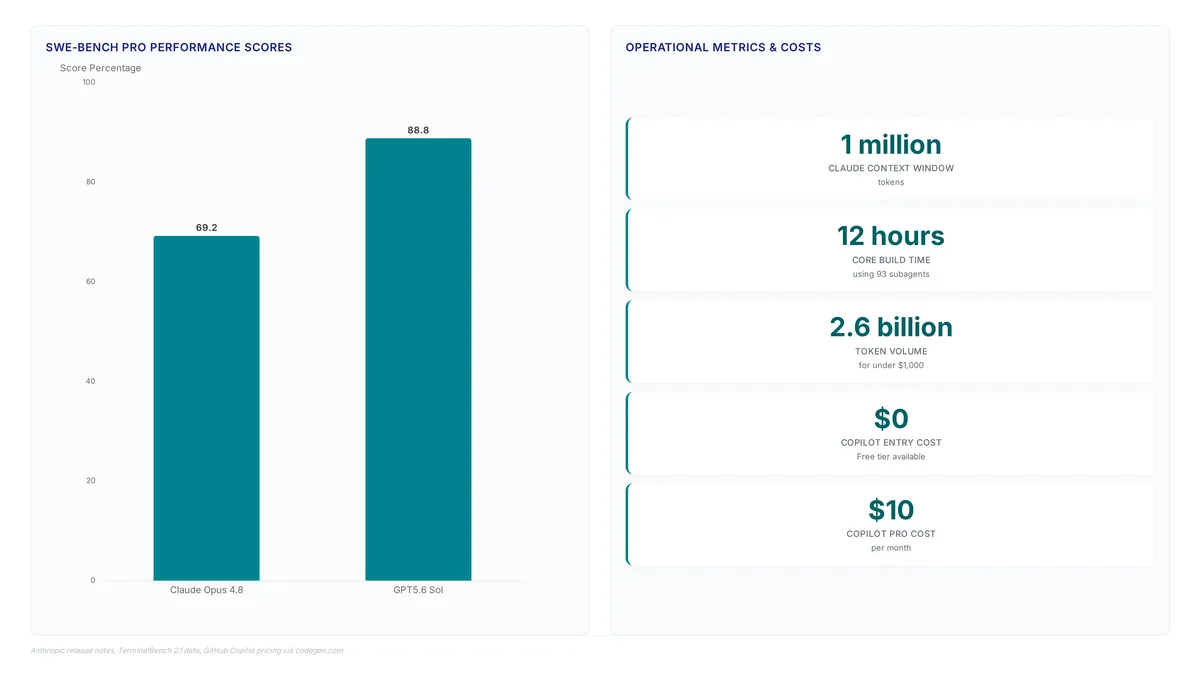
Claude Code works terminal-native: it digests entire codebases using a 1 million token context window, skipping the truncation errors that plague smaller models, and it runs on Claude Opus 4.8, which scored 69.2% on SWE-Bench Pro after its May 28 release. Developers invoke the tool directly from the command line or embed it into IDE workflows through standard commands. Flexible Workflows split heavy jobs across parallel subagents to handle multi-file refactoring efficiently. The primary agent delegates discrete logic branches to specialized workers, slashing execution time for expansive tasks. Coordination overhead exists, requiring precise prompt engineering to stop redundant file edits. Builders must define clear boundaries for sub-agent responsibilities to avoid race conditions during simultaneous writes. Power users keep the terminal interface because scriptability beats graphical menus for repetitive operations.
Deploying Google Antigravity 2.0 Multi-Agent Suites via CLI
Google relaunched Antigravity 2.0 on May 19, 2026, centering operations on a Go-based CLI that replaces the legacy Gemini interface. Engineers start orchestration by installing the binary and authenticating via the agv auth command, establishing a persistent session for flexible subagents. This architecture delegates discrete build steps to isolated workers, a parallel execution model necessary for managing concurrent threads and state isolation in complex tasks. One demonstration constructed an operating system core in 12 hours using 93 subagents and approximately 2.6 billion tokens. Operators configure scheduled background tasks by defining triggers in a local agents.yaml manifest.
The Gemini 3.5 Flash model processes output at roughly 289 tokens per second, enabling rapid iteration cycles without blocking the primary thread. Builders trade manual file navigation for high-level spec definition, letting the Antigravity CLI handle granular implementation details autonomously.
Configuring OpenAI Codex Cloud Agents and API Token Billing
OpenAI Codex operates as a cloud-based autonomous agent powered by GPT-5.6 Sol, announced June 26, 2026. The platform uses a tiered pricing structure based on the Sol, Terra, and Luna model families, offering granular cost controls through usage-based billing.
- Install the standalone desktop application available for macOS and Windows environments.
- Authenticate using existing credentials to access the Sol/Terra/Luna model family.
- Navigate to billing settings to manage usage-based flex billing, which went live on June 1.
- Configure integrations for centralized governance, noting that availability varies by partner platform.
The shift to token-based pricing allows precise budget allocation per project rather than flat user fees. GPT-5.6 Sol achieves an 88.8% score on TerminalBench 2.1, indicating high reliability for terminal automation tasks. Teams should verify that their cloud policies permit the specific model family before attempting orchestration. Validating token limits during the pilot phase prevents unexpected expenditure spikes. Latency and context management change fundamentally when moving from local IDE agents to cloud-native executors.
Optimizing Costs and Resolving Coordination Challenges in Enterprise Deployments
Defining Enterprise AI Coding Cost Structures and Agent Coordination
Annual liabilities shift dramatically based on the chosen orchestration platform. GitHub Copilot Business costs $190/mo, totaling $2,280 annually, while Cursor Teams (Standard, annual) requires $320/mo, totaling $3,840 annually. Windsurf / Devin Desktop Teams commands $400/mo, totaling $4,800 annually. Cost optimization requires aligning agent autonomy with billing tiers. Teams must resolve coordination challenges where parallel execution multiplies token consumption without proportional output gains. Usage-based models risk unpredictable overruns if function calling loops remain unchecked. Establish hard caps on agent iteration depth to prevent budget leakage. Operators choose between predictable seat costs or flexible but volatile consumption billing.
Resolving AI Model Access After Export Control Directives
Teams blocked from Claude Fable 5 must verify the June 30 Commerce Department directive before reconfiguring access policies. Anthropic restored global availability on July 1, 2026, ending the suspension triggered by the initial June 12 export control order. Operators should immediately update allow-lists for the Anthropic API, AWS Bedrock, Google Cloud Vertex AI, and Microsoft Foundry to resume multi-agent coordination. A mandatory 30-day data retention requirement persists for all generated content, requiring storage architecture validation. Restoring access demands a specific four-step workflow to bypass cached denial errors:
- Invalidate existing API keys and generate new credentials to clear suspension flags.
- Update infrastructure-as-code templates to remove geography-based orchestration blocks.
- Re-enable function calling profiles that were disabled during the outage window.
- Audit logs for failed requests stemming from the June 12 to July 1 blackout.
Claude Mythos 5 remains restricted to vetted organizations and is unavailable for general enterprise deployment. Builders optimizing AI coding costs must weigh these subscription layers against token consumption rates. The limitation of this restoration is temporal; future directives could re-impose suspension without automated fallback mechanisms. Enterprises relying on spec-driven development should architect switchover logic to alternative providers like OpenAI Codex or GitHub Copilot to mitigate single-vendor regulatory risk.
Validating ROI and Data Retention Compliance for Team Deployments
Verify the mandatory 30-day data retention requirement before finalizing storage architecture for any team deployment. This compliance rule persists regardless of model availability or pricing tier selection. Logging pipelines must retain conversation history and generated code artifacts for this exact duration to satisfy audit trails. Failure to configure retention policies correctly risks regulatory penalties even if token usage remains within budget. Resolve cost overruns by mapping actual usage patterns against tiered subscription limits rather than assuming flat-rate efficiency. Teams ignoring these coordination challenges frequently observe diminishing returns as agent concurrency scales. Implement automated weekly cost reports alongside retention policy checks. This dual-verification process ensures financial predictability while maintaining strict adherence to data governance mandates.
About
Marcus Chen serves as Lead Agent Engineer at AI Agents News, where he daily architects and evaluates production-grade multi-agent systems. His direct experience shipping complex orchestration workflows using frameworks like LangGraph and AutoGen uniquely qualifies him to dissect the nuances of modern AI coding agents. In this comparison of Cursor, Windsurf, Claude, Copilot, and Kiro, Marcus uses his hands-on work with tool use and function calling mechanics to move beyond marketing hype. He rigorously tests how these agents handle real-world development constraints, providing engineers with factual data on reliability and capability. As the leader of AI Agents News, an independent hub dedicated to technical founders and engineering leaders, Marcus ensures every analysis connects theoretical agent research to practical implementation. His assessment grounds the latest availability updates, such as the restoration of Claude Fable 5, in the reality of building scalable software, helping readers make informed decisions based on concrete performance metrics rather than vendor claims.
Conclusion
The seven contenders differ less in what the model writes than in how many tasks the tool runs at once, and concurrency is exactly where the bill appears: parallel execution multiplies token consumption without delivering proportional productivity gains. The operational cost of running multiple autonomous units simultaneously can quickly erode the efficiency benefits promised by lower entry-level subscriptions. Teams must recognize that multi-agent coordination requires strict budget gating to prevent financial leakage during complex refactoring tasks. Relying on a single vendor for critical development workflows introduces unnecessary regulatory and availability risks that simple subscription management cannot address.
Organizations should mandate a switchover architecture that integrates alternative providers before deploying agents at scale. This approach ensures continuity if primary services face restrictions or if specific models like Claude Mythos 5 remain inaccessible to general teams. Do not assume flat-rate efficiency when agent concurrency increases; instead, map actual usage patterns against tiered limits immediately.
Start by configuring your shell tools to support multiple AI providers, allowing smooth transitions between services like OpenCode and established cloud options. This specific technical adjustment creates the necessary flexibility to manage costs while maintaining development velocity. By establishing this fundamental adaptability now, teams can navigate the shift toward agent-first architectures without being locked into rigid or expensive single-vendor dependencies.
Frequently Asked Questions
GitHub Copilot offers entry-level access for just $10 per month. This low cost allows new teams to adopt AI assistance without significant budget approval hurdles or complex financial planning.
Windsurf charges $15 per month for individual developers needing IDE-native features. This price point balances advanced code authoring capabilities with affordability for solo practitioners seeking integrated tools.
The premium tier for Claude Code sits at $20 per month. This investment provides terminal-native agency necessary for deep reasoning tasks and complex problem-solving workflows in development.
Cursor 3 runs Build in Parallel inside isolated virtual machines, and Kiro executes spec tasks in parallel, cutting multi-task workflows by up to 4x. Antigravity 2.0 delegates build steps to flexible subagents through a Go-based CLI.
Claude Fable 5 lost availability on the June 12 export control order and returned only on July 1, 2026, and a mandatory 30-day data retention requirement applies to generated content. Architect switchover logic to a second provider before that decision is forced on you.
References