Agent evaluation: Score 50+ metrics for LLMs
Agent evaluation in 2026 relies on over 50 research-backed metrics to score discrete execution steps like tool calls and planning. Because LLMs are non-deterministic, agents frequently follow illogical paths yet still produce correct answers, rendering output-only assessment useless for identifying root causes.
This guide details how to architect granular test cases that validate specific routers and skills rather than just final responses. We outline methods for diagnosing execution path loops and incorrect function calls by breaking agents into individual evaluatable steps. The focus shifts to integrating production monitoring data back into your development loop to catch regressions early.
Building reliable systems demands assessing what an agent knows and how it plans, not merely if it succeeded. By applying structured evaluation templates for tool use and reflection, developers can systematically maximize eval scores. This approach turns the chaotic nature of generative models into a measurable engineering discipline.
The Role of Structured Evaluation in Non-Deterministic Agent Systems
Defining Agent Evaluation for Non-Deterministic LLMs
Agent evaluation isolates router logic and execution paths to mitigate risks where non-deterministic models follow strange paths to correct answers. LLMs generate variable reasoning traces, so checking only the final output leaves production systems vulnerable. A correct conclusion reached via a strange path masks brittle planning that fails under edge cases. Effective assessment analyzes what an agent knows, which actions it executes, and how it plans across multi-step workflows.
Modern frameworks apply over 50 research-backed metrics to score distinct execution steps including tool calls, retrieval accuracy, and planning coherence. This granular approach surfaces the reasoning failures that a single pass/fail verdict hides. Trace-based methods now track these divergent paths to ensure the agent selects the correct skill and extracts accurate parameters before function calling occurs.
Relying solely on final success rates creates a false sense of security. Lucky convergence hides brittle planning logic that fails under edge cases. Builders must implement evaluators for individual components like routers and skills rather than treating the agent as a black box. This shift enables precise debugging when agents deviate from expected operational patterns during complex orchestration tasks.
Applying the Cyclical Development Loop for Strong Agents
The cyclical development loop iterates through testing, evaluation, and revision to address non-deterministic model outputs. Building any LLM application requires this repetition because developers cannot anticipate every query or potential output path. The typical cycle of iteration involves creating an initial set of representative test cases and breaking down the agent into individual steps like router and skills.
Evaluation harnesses must mirror production dynamics rather than relying on static questions to ensure realistic assessment through flexible interaction. Teams create specific evaluators for each step, checking if the router selects the correct function and extracts accurate parameters. This granular isolation allows engineers to identify whether failures stem from planning errors or execution faults.
Industry experience building agentic systems highlights the necessity of assessing these three distinct layers simultaneously: the final output, individual agent components, and the performance of the underlying model. Maintaining thorough test suites creates operational overhead as agents evolve. The constraint of rigorous evaluation is increased development time, yet skipping this step risks deploying unstable agents.
Operators must revise test cases and evaluators continuously based on production data to catch emerging failure modes. This feedback loop transforms a basic prototype into a reliable system capable of handling complex, multi-step tasks. Integrating these checks directly into the development process helps avoid silent regressions that waste resources in production.
Checklist for Validating Agent Planning and Tool Use
Validate agent planning by isolating reasoning layers from action layers to detect logic drift before execution failures occur. Templates have been created for every stage of the process, from tool use to planning and reflection, combining traditional LLM evaluation methods with agent-specific diagnostics. This separation allows developers to pinpoint whether a failure originated in the decision path or the tool invocation parameters.
In game-playing benchmark environments such as Digital Card Game, where an agent plays out full matches, the primary metric for task completion is the win rate, yet this single number often masks intermediate planning errors. Relying solely on task success ignores the computational waste of inefficient reasoning paths.
Transforming a basic agent into a strong, production-ready tool is difficult, with evaluation identified as a main tool to simplify this process. Developers must verify that the reasoning layer correctly identifies the need for a tool before checking if the tool call itself was syntactically valid. Ignoring the distinction between a correct final answer and a flawed execution path creates fragile systems that fail under novel query distributions. Evaluating the action layer independently ensures parameter extraction does not degrade as context windows expand.
Architecting Granular Test Cases for Router and Skill Validation
Granular Agent Steps: Routers, Skills, and Execution Branches
Breaking agents into granular steps separates router selection logic from the specific parameters a skill needs to execute. This division lets engineers benchmark discrete operations, like the retrieval phase of a RAG skill or payload validation for an API call, instead of trusting opaque end-to-end success rates. Amazon's work building agentic systems showed that checking only final outputs hides specific failure modes happening inside intermediate reasoning layers.
Routers need different evaluation axes than downstream skills since they control the whole execution path. The system must first verify it picks the right function for a given user input. Next, it has to extract parameters accurately to fill that function call without making things up.
| Component | Evaluation Focus | Failure Consequence |
|---|---|---|
| Router | Skill selection accuracy | Cascading errors in all downstream turns |
| Skill Execution | Parameter precision | Tool rejection or incorrect data retrieval |
| Planning | Step sequence coherence | Infinite loops or resource exhaustion |
Mistakes in early turns of a multi-step agent path can snowball, causing wasted compute resources and useless tool executions later in the chain. Prompt complexity fights against routing reliability; descriptions that are too long often hurt the router's ability to match intent, while sparse descriptions increase parameter extraction errors. Teams need to iterate on router prompts separately from skill logic to see real gains. Production setups usually start by over-evaluating steps before cutting the suite down to focus on high-impact branching points where non-determinism creates the most operational risk.
Building Test Cases for Router Skill Selection and Parameter Extraction
Build a test suite that covers every supported query type, including the off-topic inputs the system must reject. Good coverage helps the router tell the difference between valid function calls and general chatter without needing thousands of rephrased variations. Engineers should deliberately add curveballs, like a user asking for order status but providing a shipping tracking number instead of an order ID. This specific mismatch checks if parameter extraction logic spots conflicting data types before trying a tool call. Edge cases like this show whether the agent invents a solution or handles the discrepancy gracefully.
Evaluation frameworks like DeepEval allow testing of reasoning and tool selection at separate layers to find these failures. The test corpus has to change as new input patterns appear in production, even if adding cases makes historical runs harder to compare. Keeping benchmarks static often hides regressions in novel scenarios where the agent sees phrasing it has never encountered.
| Test Category | Purpose | Expected Outcome |
|---|---|---|
| Standard Query | Validate basic skill routing | Correct function selected |
| Parameter Mismatch | Stress test extraction logic | Error handling or clarification request |
| Off-Topic Input | Verify rejection boundaries | No tool invocation |
Balancing a stable regression baseline with adaptation to live traffic patterns creates friction. Choosing adaptability means accepting that evaluation scores might move around as the test set grows to cover real-world complexity. AI Agents News suggests focusing on path coverage rather than volume to get the most diagnostic value.
Deterministic String Matching Versus LLM-as-a-Judge for Skill Evaluation
Comparing outputs to expected strings works as a deterministic check, but only when exact ground truth exists for the skill being tested. This method falls apart for qualitative assessments where semantic correctness matters more than character-for-character matching. Teams deploy an LLM-as-a-judge in these scenarios to grade responses based on alignment with expert consensus rather than rigid syntax rules. String matching guarantees consistency for parameter extraction, yet it cannot assess retrieval relevance or spot subtle hallucinations in generated text.
| Feature | Deterministic Matching | LLM-as-a-Judge |
|---|---|---|
| Ground Truth | Required | Optional |
| Evaluation Type | Exact match | Qualitative alignment |
| Best For | API outputs, JSON schemas | RAG faithfulness, tone |
| Cost Profile | Negligible compute | High token usage |
Common evaluations for RAG skills include checking retrieval relevance, QA correctness, hallucination rates, and citation accuracy against source documents. Platforms like Arize offer built-in evaluators to measure tool call accuracy using an LLM as a judge, which automates scoring for complex trajectories. Relying only on automated judges brings arbitrariness if the grading prompt lacks strong grounding in specific criteria. Infrastructure costs for flexible, multi-turn evaluations jump notably compared to static checks, requiring a hybrid strategy to avoid silent regressions in production systems. Engineers must balance the precision of code-based integration tests with the flexibility of semantic grading. Too much reliance on deterministic checks for open-ended queries yields false negatives, while exclusive use of judges obscures specific regression points. The best configuration pairs strict schema validation for function calls with semantic scoring for natural language responses.
Diagnosing Execution Path Loops and Incorrect Function Calls
Defining Path Errors and Convergence Scores
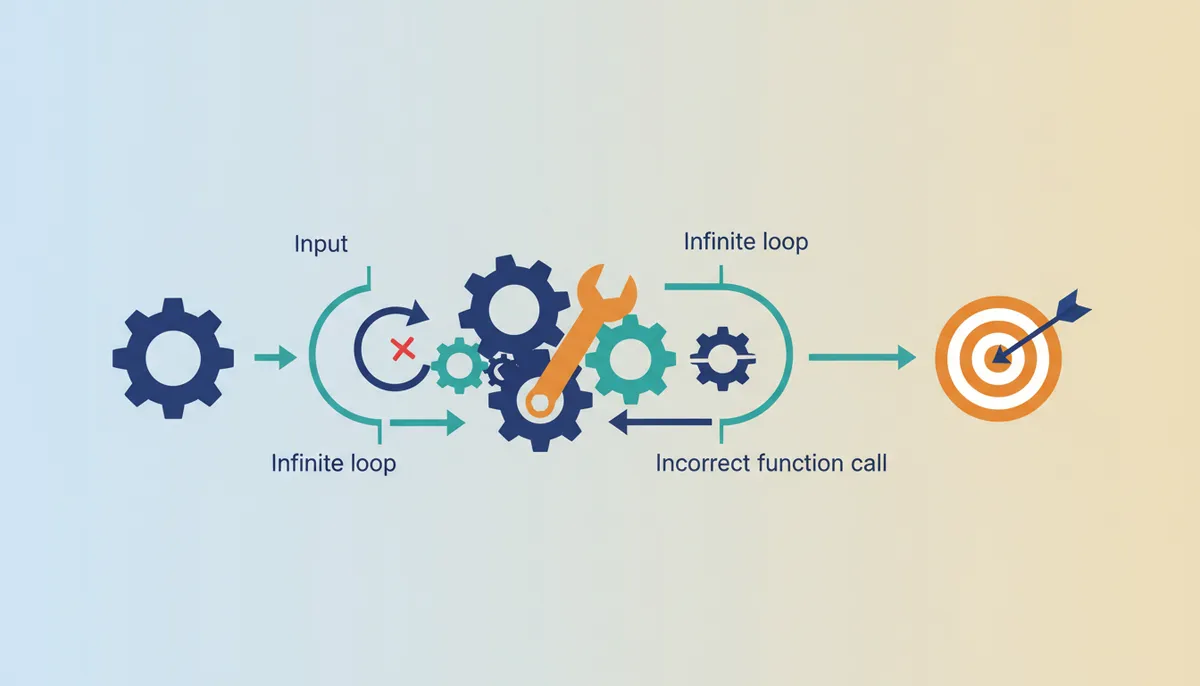
Repeated steps, execution loops, or unnecessary returns to the router define path errors that drain system efficiency. Non-deterministic model behaviors often drive these deviations, complicating debugging efforts in production environments. Trace-based evaluation methods let engineers follow an agent's path through an environment, a necessity for spotting inefficiencies when standard output checks pass.
Builders quantify efficiency by calculating a convergence score using a specific formula applied across similar queries. The process requires running the agent on a test set, recording the step count for each execution, and identifying the overall minimum steps taken for that query type. This final metric averages the ratio of the minimum steps to the actual steps taken per run, yielding a value between zero and one. Such a score indicates how frequently the agent selects the optimal path versus diverging into suboptimal sequences.
| Metric Component | Data Requirement | Calculation Logic |
|---|---|---|
| Minimum Steps | Overall run minimum | Baseline denominator |
| Actual Steps | Per-run step count | Variable numerator |
| Convergence Score | Ratio per run | Average of (minimum steps / actual steps) across runs |
The baseline minimum derives from the shortest observed run, so the metric cannot detect cases where every single execution takes a suboptimal path. A high convergence score guarantees consistency relative to the best observed attempt rather than the existence of an optimal path. Engineers combine this quantitative score with qualitative trace analysis to verify the reference path itself is truly efficient.
Applying LLM-as-a-Judge Templates to Isolate Bad-Args
Phoenix templates isolate bad-args failures by separating tool selection logic from parameter extraction validation. The Agent Tool Selection evaluator answers whether the router chose the correct skill for a specific input, deliberately ignoring arguments to diagnose mis-routes. Distinctly, the Agent Parameter Extraction template verifies that function calls extract exactly the parameters present in the user query. These diagnostics run via Phoenix, an open-source library enabling integration into CI pipelines or notebooks for automated regression testing.
Engineers deploy these evaluators to fix agent loop issues where incorrect arguments force repeated router returns. Stress-tested prompts achieve high precision, providing a quantifiable baseline for debugging incorrect function calls without manual trace inspection. This separation allows teams to pinpoint whether a failure stems from the routing decision or the argument population step.
| Template Focus | Diagnostic Target | Ignores |
|---|---|---|
| Agent Tool Selection | Router mis-routes | Parameters |
| Agent Parameter Extraction | Bad-args issues | Tool choice |
Optimizing solely for selection accuracy creates a scenario where a perfectly routed query with corrupted parameters still fails execution. High tool selection scores can mask persistent extraction errors if evaluators are not decoupled, a detail teams often overlook. Builders must tune router prompts and parameter schemas independently rather than treating the agent as a monolithic black box. Industry analysis recommends iterating on these specific failure modes to prevent non-deterministic paths from degrading production reliability.
Reading Traces Where the Score Cannot See
Where the convergence ratio stops being informative, the recorded path still is: it shows the redundant reasoning steps that an averaged ratio smooths over.
Manually inspecting traces via an observability platform remains the most effective method to debug agent paths, particularly during early development stages before patterns stabilize. Operators must prioritize visual verification of execution flows alongside aggregate scores to catch compounding errors where early mistakes trigger unnecessary tool executions later in the chain.
| Evaluation Focus | Metric Limitation | Required Action |
|---|---|---|
| Step Count | Ignores logical redundancy | Inspect full trace |
| Success Rate | Masks inefficient paths | Analyze step sequence |
| Parameter Accuracy | Misses routing loops | Visualize decision tree |
Quantitative thresholds alone create a false sense of security regarding router stability. Teams address agent loop issues by analyzing trace segments to identify where token usage spikes indicate redundant reasoning or tool calls. Automated regression gating competes with the need for human intuition to spot novel failure modes in complex reasoning chains.
Iterative Refinement Strategies for Production-Ready Agents
The Refinement Loop: Test, Evaluate, Compare Against Baseline
Run test cases after every substantial modification, then apply evaluators to outputs or traces immediately. This workflow isolates logic failures before they cascade into downstream skill errors. Evaluation functions as a cyclical process rather than a linear checkpoint.
- Execute a representative set of test cases covering all known agent branches.
- Run specific evaluators on execution traces to detect loops or redundant steps.
- Compare results against baselines to confirm changes do not break existing functionality.
Over-reliance on final output correctness creates significant risk. An agent might satisfy a query while executing unnecessary tool calls that inflate latency and cost. Effective harnesses test agents dynamically by mirroring production interaction patterns instead of static question-answer pairs. Automated scoring provides speed yet often misses semantic drift where parameter extraction remains syntactically valid but contextually wrong. Teams track these experiments to visualize how specific prompt tweaks alter execution paths. A "fix" for one failure mode frequently introduces subtle regressions in unrelated agent capabilities without this visibility.
Where the Loop Goes Blind: Tracking Experiments and Reading Traces
Blind spots appear when a suite scores destinations and never inspects the route taken. Relying solely on final state verification hides inefficient path convergence: a system can appear healthy while wasting compute on suboptimal reasoning chains. Engineers record specific metrics for each run, manually or through evaluation frameworks like Arize, to detect regressions in logic or skill execution.
Manual inspection of execution traces remains necessary when automated scores miss logical inefficiencies hidden by correct final outputs. Rapid iteration speed conflicts with the depth of trace analysis required to catch subtle planning errors, and automated tracking cannot fully replace human review of complex multi-step trajectories where context shifts unexpectedly. Monitoring production systems and integrating that data back into development is what keeps this loop honest against performance drift.
About
Priya Nair serves as AI Industry Editor at AI Agents News, where she tracks product launches and platform shifts across the autonomous agent environment. Her daily work analyzing the trajectory of tools like Devin, Claude Code, and Cursor provides a unique vantage point on agent evaluation. Because she constantly assesses how new frameworks handle orchestration and tool use, Nair understands that debugging non-deterministic LLM behavior requires more than checking final outputs. She recognizes that transforming a basic prototype into a production-ready system demands rigorous diagnostics of an agent's internal planning and reflection capabilities. At AI Agents News, her mission is to provide engineers with factual, verified insights rather than marketing hype. This article connects her market-level observations with practical engineering challenges, offering a clear path for builders to evaluate agent robustness effectively. Her experience ensures the discussion remains grounded in the real-world complexities of deploying reliable multi-agent systems.
Conclusion
Static benchmarks fail when agents operate over extended horizons because they cannot capture the compounding cost of inefficient reasoning chains. As systems shift toward flexible environmental interaction, pass/fail metrics become dangerous disguises for logical waste. A correct final output often masks redundant loops that drain resources and obscure planning flaws. Teams must prioritize execution trace analysis over simple success rates to identify where non-deterministic paths converge on answers through broken logic. This operational shift requires accepting that historical comparability matters less than surfacing new edge cases as input types evolve.
Organizations should mandate manual trace inspection for any agent deployment where compute costs or latency matter, starting immediately before the next release cycle. Do not wait for a specific failure event to justify this depth of review. Begin this week by selecting three recent successful test runs and manually auditing their step-by-step trajectories for unnecessary returns or context shifts. This specific action reveals the hidden inefficiency that automated evaluators miss. True system health depends on understanding the path, not just the destination. Engineers who ignore path quality in favor of output accuracy will find their production environments bloated with subtle, compounding errors that static checks never flag.
Frequently Asked Questions
Output-only checks miss brittle planning that fails on edge cases. Frameworks now use over 50 metrics to score steps like tool calls and planning, ensuring the path is reliable, not just the result.
No fixed count applies; the suite must cover every supported query type, off-topic inputs, and each branch the router can take. Path coverage rather than volume gives the most diagnostic value, so add an environment only when it exercises a branch nothing else reaches.
In Digital Card Game benchmarks, where an agent plays out full matches, the main metric is the win rate. That single number masks intermediate planning errors, so pair it with trace analysis of the steps the agent took to get there.
You must revise test cases continuously using production data to catch new failure modes. This cyclical loop involves creating evaluators for each step, such as routers, to isolate whether errors stem from planning or execution faults.
Start by breaking your agent into individual steps like specific skills or router logic. You do not need thousands of cases, but your set must cover all supported query types and off-topic inputs thoroughly.
References