LangGraph leads stateful agent frameworks today
LangGraph holds 33,900 GitHub stars and leads the open-source AI agent framework space for stateful, long-running workflows. The market has shifted decisively toward stateful workflows and multi-agent orchestration as the primary requirements for production-grade systems, moving beyond simple chat interfaces. Frameworks now separate along one axis: whether the runtime keeps a shared state object between steps. LangGraph persists that state in a graph, AutoGen keeps it inside a conversation, and CrewAI hides it behind role abstractions, which is why the three break in different places once workflows run long.
Gartner predicts that 40% of enterprise applications will feature task-specific AI agents by the end of 2026, a massive jump from less than 5% in 2025. The practical question at that scale is not which framework is most popular but how much state a workflow has to carry, and what it costs to see that state when a run fails.
Defining the Modern AI Agent Framework Architecture
Stateful vs Stateless Agent Architectures in LangGraph
Conversation history and variables persist across execution cycles in a stateful agent, while stateless designs discard context after each response. LangGraph arrived in 2024 as a specialized framework within the LangChain system, engineered specifically for these long-running, stateful workflows. Unlike stateless chains that treat every query as an isolated event, this architecture maintains a shared state graph to enable complex loops and human-in-the-loop interventions. The system builds controllable agents that hold context and connects with LangSmith for performance monitoring. Simple retrieval tasks often suit stateless agents, but production environments increasingly demand the persistence found in frameworks like LangGraph to handle branching logic without losing user intent. Added complexity introduces a failure mode where corrupted state can poison entire session histories, requiring rigorous schema validation. Teams must weigh architectural overhead against the necessity for long-term memory in their specific use case. The distinction between ephemeral scripts and durable agents becomes the primary architectural decision for engineers deploying autonomous systems as the market expands at 46.3% annually toward a projected $52.62 billion by 2030.
Real-World Deployment of Multi-Agent Systems at Cisco and Uber
Distinct LLM instances coordinate within a multi-agent system to execute hierarchical and sequential control flows for complex enterprise tasks. Many companies currently deploy agent platforms in production, including Cisco and Uber, prioritizing stateful orchestration over simple chaining. These frameworks enable agent orchestration where specific nodes handle retrieval-augmented generation (RAG) to ground responses in verified data rather than parametric memory. Linear chains suffice for basic queries, yet production environments require the cyclic graphs that LangGraph provides to manage long-term context and human-in-the-loop interruptions. Rapid scaling exposes a tension where the need for auditability often conflicts with development speed. LangGraph and AutoGen possess enterprise certifications such as SOC 2 and GDPR compliance features required for enterprise deployments, whereas vendor SDKs may lack these specific orchestration-level compliances out of the box. Builders must architect for state management from day one because retrofitting memory into stateless pipelines introduces unacceptable latency and complexity later.
Operational Risks of Immature Framework Abstractions in CrewAI
Rigid role-based abstractions in CrewAI often obscure underlying prompt mechanics, causing developers to lose visibility into LLM inputs. CrewAI orchestrates role-playing AI agents and launched in early 2024. The framework offers a low barrier to entry with its domain-specific language, yet production deployments frequently encounter opaque debugging challenges. Developers report that once high-level abstractions activate, tracing the exact prompts passed to the model becomes difficult, effectively hiding the reasoning chain. One developer in r/AI_Agents commented on the trade-offs, noting that CrewAI currently feels like an immature framework with no proper out-of-the-box observability. Streaming tool call events arrived in January 2026 to improve visibility, yet the high-level DSL still masks the specific tool calls and intermediate reasoning steps that troubleshooting needs.
Comparative Analysis of Leading open-source Agent Frameworks
Architectural Definitions: LangGraph Statefulness vs AutoGen Event-Driven Design
LangGraph implements a directed graph orchestration model with conditional edges, whereas AutoGen relies on an event-driven GroupChat pattern for autonomous multi-agent conversations. This structural divergence dictates how each framework manages context and tool execution. LangGraph maintains a centralized state object that persists across nodes, enabling precise human-in-the-loop interruptions and deterministic replay capabilities. Conversely, AutoGen agents operate as independent participants exchanging messages in a shared chat session, prioritizing flexible, emergent collaboration over rigid workflow control.
| Feature | LangGraph | AutoGen | Semantic Kernel |
|---|---|---|---|
| Core Model | Directed Graph | Event-Driven Chat | Skill-Based |
| State Management | Centralized Graph State | Conversation History | Context Variables |
| Primary Language | Python | Python | C#, Python, Java |
| Best For | Controllable Workflows | Autonomous Research | Enterprise Integration |
Implementation of LangGraph state management has been reported to shave 40% off latency in advanced chains that apply LangChain Expression Language (LCEL) for composability. In contrast, AutoGen uses an event-driven architecture that integrates with various LLMs to enable flexible role switching without explicit state definition. Semantic Kernel distinguishes itself as the only listed framework with first-class support for C#, Python, and Java, appealing to legacy enterprise environments. The cost for LangGraph's precision is the boilerplate required to define graph edges, while AutoGen sacrifices deterministic control for conversational fluidity. Builders requiring auditable, step-by-step execution should select LangGraph, whereas teams needing open-ended research agents benefit from AutoGen's conversational GroupChat mechanics.
Production Deployment Scenarios: Klarna Support Bots and Novo Nordisk Data Workflows
Klarna's support automation manages two-thirds of all customer inquiries, absorbing a volume that would otherwise require a large human support desk. This scale requires stateful orchestration to maintain context across complex, multi-turn interactions without losing conversational history. Operators prioritize frameworks that offer strict audit trails and human-in-the-loop capabilities over raw speed. LangGraph excels here, yet its graph-based state management introduces latency overhead that simpler chains avoid. Developers must weigh the cost of context retention against the need for sub-100ms response times in high-volume channels.
Novo Nordisk uses AutoGen for data science workflows, using its event-driven architecture to coordinate specialized agents for statistical analysis. This approach supports multi-agent coordination where distinct models exchange messages to refine hypotheses iteratively. Unlike rigid sequential pipelines, this pattern allows emergent collaboration but sacrifices deterministic replay. Teams adopting this style often face challenges in tracing exact decision paths during failure analysis. The limitation favors flexibility in research settings where exploration outweighs the need for strict reproducibility.
| Feature | LangGraph | AutoGen | Vendor SDKs |
|---|---|---|---|
| Workflow Type | Stateful Graphs | Event-Driven Chat | Linear Chains |
| Best For | Auditability | Research Collaboration | Rapid Prototyping |
| Compliance | SOC 2, GDPR | SOC 2, GDPR | Provider Dependent |
Enterprise adoption increasingly favors frameworks with verified SOC 2 and GDPR compliance for sensitive workloads. Vendor SDKs simplify initial setup yet often lack the granular control required for regulated industries. Builders should select tools based on specific governance needs rather than general capability claims. AI Agents News recommends reserving heavy orchestration layers for tasks demanding strict state management.
System Maturity Metrics: GitHub Stars and Download Volume Across Frameworks
GitHub star counts and PyPI download volumes provide immediate signals regarding developer traction and production reliance. AutoGen leads in repository attention with 58,700 stars, reflecting its strong research origins, yet the OpenAI Agents SDK dominates installation frequency with 10.3 million monthly downloads. CrewAI follows with 5.2 million, serving as a frequent entry point for rapid prototyping, whereas AutoGen retains a dedicated base for complex, event-driven research tasks. That download volume indicates rapid adoption for lightweight, provider-agnostic workflows. LangGraph maintains a specialized position; while its star count is lower, its integration within the broader LangChain system ensures steady enterprise usage for stateful applications. Teams often migrate away from rigid role-playing models once operational visibility becomes critical. Conversely, AutoGen's lower download volume relative to its star count implies a steeper learning curve that filters casual users but retains power users needing event-driven architectures. Selecting a framework requires balancing initial velocity against the eventual need for granular control over agent state. Builders prioritizing speed may favor CrewAI, while those requiring audit trails should evaluate the overhead of more complex orchestration layers.
Implementing Stateful Workflows and Multi-Agent Orchestration
Setting Up a LangGraph State Graph and a CrewAI Crew
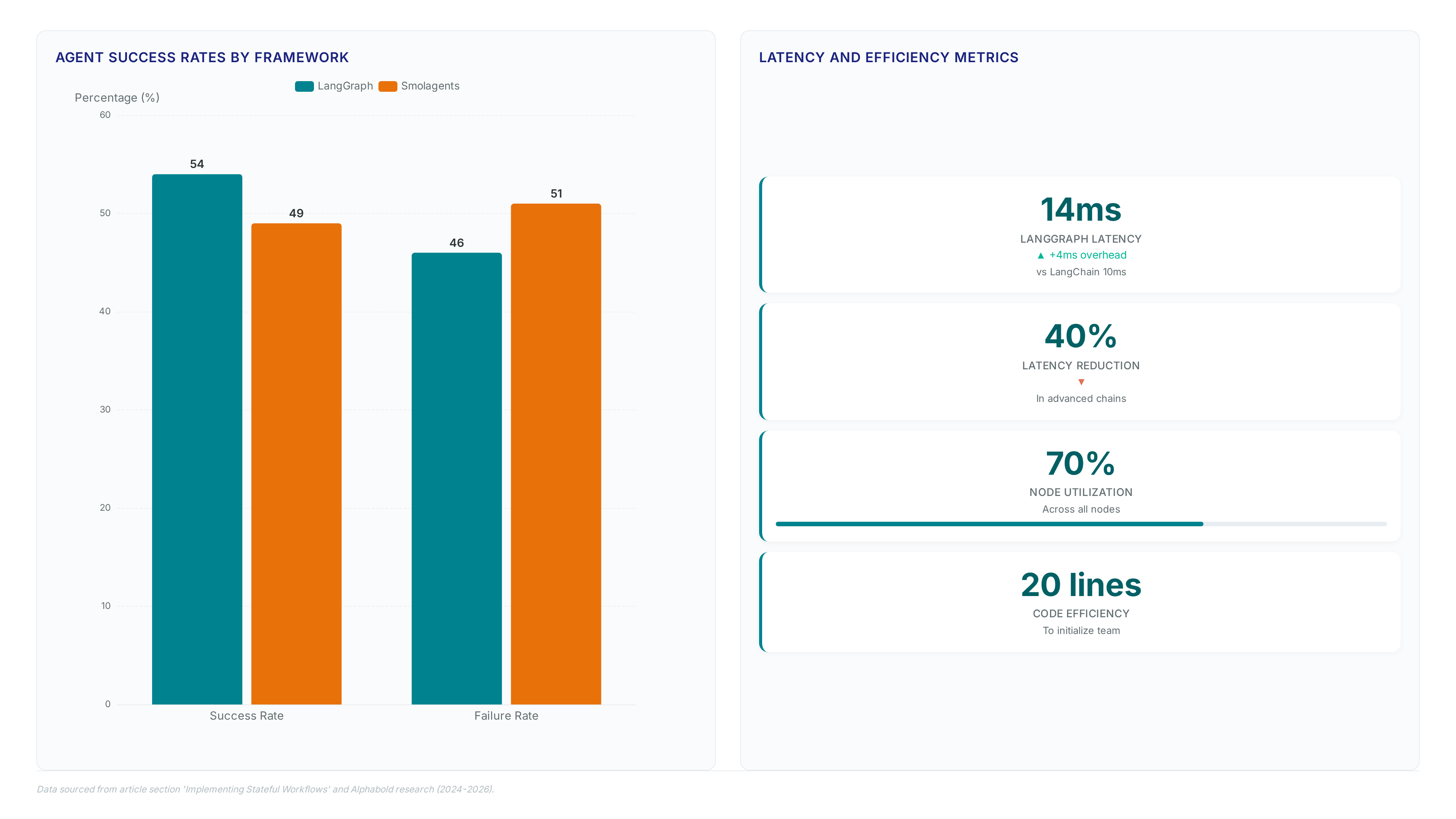
LangGraph is a specialized agent framework within the LangChain system, released in 2024, that constructs state graphs where nodes represent logic steps and edges define conditional transitions for persistent context. This architecture enables hierarchical workflows that maintain long-term memory across complex, multi-turn interactions without losing conversational history. Unlike event-driven alternatives, the framework enforces a centralized state object, allowing operators to pause execution for human-in-the-loop approval before proceeding to sensitive tool calls. Implementing this control flow requires defining a schema that persists across the entire graph lifecycle.
Deploying CrewAI for customer service requires defining distinct agent roles like 'Support Lead' and 'Billing Specialist' to handle specific inquiry types. This framework uses role-based crews with process types to orchestrate interactions, distinguishing it from the directed graph models found in other ecosystems. It is independent from LangChain and offers minimal code requirements for agent setup. Operators favor this approach for its low barrier to entry, often requiring only twenty lines of code to initialize a functional multi-agent team. The setup involves importing the base classes, assigning tools, and specifying the sequential or hierarchical process flow.
Operationalizing Agent Systems for Enterprise Production
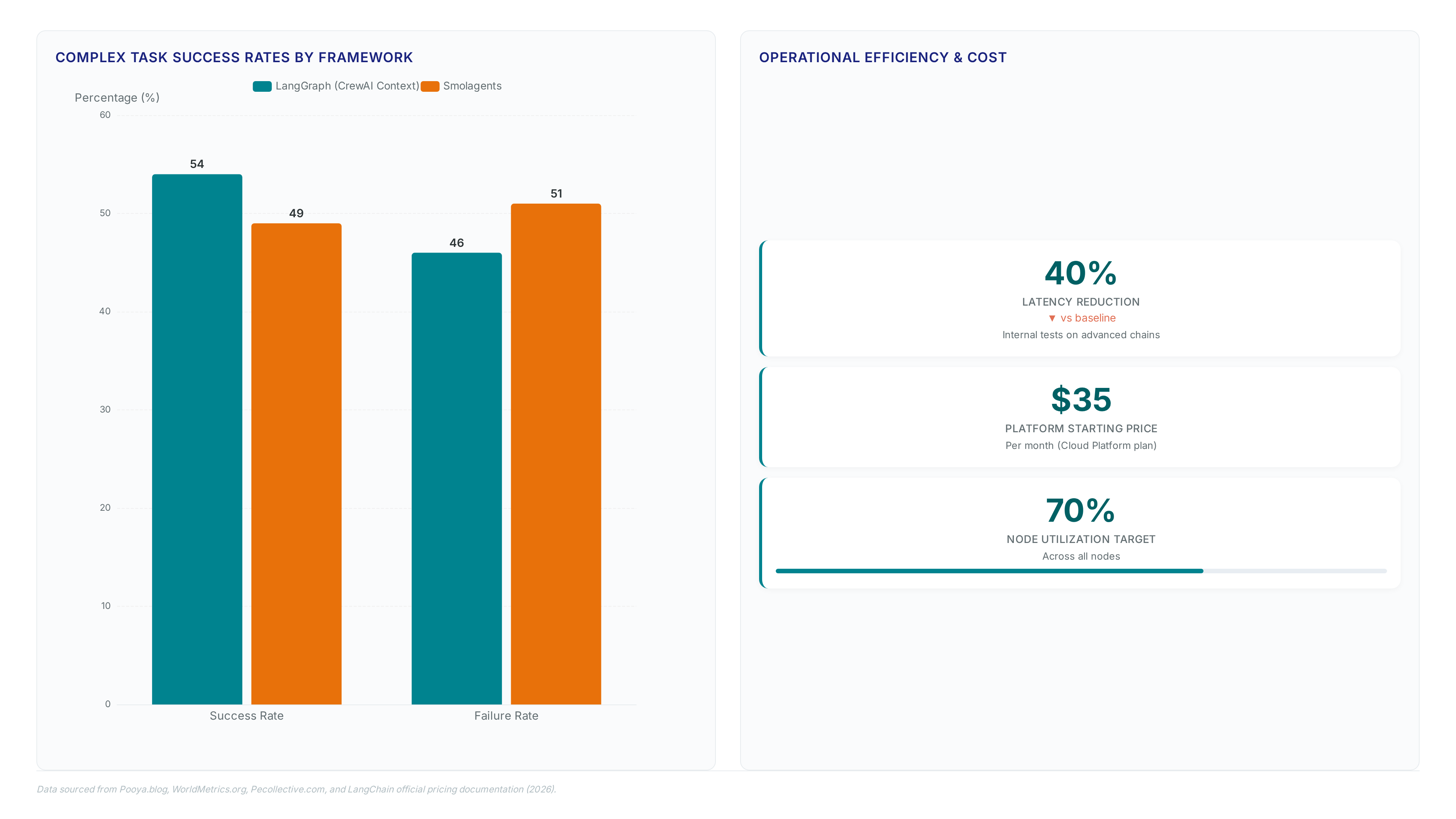
Builders targeting enterprise scale should prioritize frameworks that persist state rather than merely chaining function calls, and that keep human-in-the-loop checkpoints available at critical decision points. Production success then depends on whether operators can still see what the agent did, which is where the low-code path starts charging interest.
What Opaque Debugging Costs in CrewAI Deployments
Debugging collaboration failures in CrewAI requires intrusive logging patches rather than native inspection tools. The cost is measurable: teams report spending disproportionate cycles reconstructing prompt history from fragmented logs instead of fixing logic errors. Unlike LangGraph, which integrates directly with LangSmith for trace visibility, CrewAI forces operators to choose between rapid prototyping and production-grade transparency. This constraint creates a maintenance bottleneck where fixing maintainability issues becomes harder as agent teams scale. Enterprises requiring audit trails face a critical blocker due to the lack of granular prompt visibility. AI Agents News recommends validating observability features during proof-of-concept phases before committing to long-term deployment.
About
Priya Nair serves as AI Industry Editor at AI Agents News, where she tracks the business dynamics and product evolution of the autonomous agent system. Her daily work involves rigorous analysis of platform launches, funding rounds, and strategic shifts among key players like Devin, Claude Code, and Cursor. This constant exposure to market-moving data uniquely qualifies her to evaluate open-source frameworks against real-world industry demands. By monitoring how enterprises actually deploy multi-agent systems, Priya identifies which technical features, such as reasoning capabilities or orchestration efficiency, translate into tangible business value. Her role requires distinguishing genuine innovation from marketing hype, ensuring that her assessments of frameworks like LangGraph or AutoGen are grounded in verified performance metrics rather than speculation. At AI Agents News, an independent hub dedicated to technical builders, she uses this deep market intelligence to provide engineers with neutral, fact-based comparisons. This article synthesizes her ongoing coverage of the sector's rapid expansion, offering a curated guide for professionals navigating the exploding environment of agent development tools.
Conclusion
Scaling agent frameworks reveals that observability debt compounds quicker than latency gains. The ranking that matters is therefore not the star count but the shape of the workload: LangGraph for workflows that must persist state and replay it under audit, AutoGen for open-ended research where emergent collaboration outweighs deterministic replay, CrewAI for teams that need a functional crew in twenty lines and can absorb blind spots while prototyping.
Klarna's support automation and Novo Nordisk's data science workflows sit at opposite ends of that axis, and compliance posture, latency budget and trace visibility all follow from where a workload lands on it. Start by auditing your current proof-of-concept deployments this week to verify if you can retrieve exact prompt histories without applying intrusive logging patches. A team that cannot reconstruct a failed run has already made the architectural choice, whether or not it meant to.
Frequently Asked Questions
Stateful orchestration adds latency per query compared to a simple chain, because the graph persists a shared state object between nodes. The same state management has been reported to shave 40% off latency in advanced chains that apply LangChain Expression Language, so the overhead depends on how much composition the chain already does.
No. AutoGen leads repository attention with 58,700 stars, while the OpenAI Agents SDK dominates installation frequency with 10.3 million monthly downloads and CrewAI follows with 5.2 million. Stars track research interest, downloads track how often a framework reaches a working environment.
Enterprise applications featuring task-specific agents are growing rapidly across all sectors. The market expands at 46.3% annually, requiring teams to select scalable frameworks now to handle the upcoming surge in deployment demands.
The global agent market value is increasing dramatically due to widespread enterprise integration needs. Projections indicate the market will reach $52.62 billion by 2030, validating heavy investment in robust agent infrastructure today.
Task-specific AI agents will soon become a standard component in most software. By late 2026, 40% of enterprise applications will include these agents, necessitating immediate upgrades to support stateful workflows and orchestration.
References