Agent framework choices: LangGraph leads production
LangGraph ranks number one for production readiness based on data from over 18 deployments between 2024 and 2026. What separates the frameworks at that level is not model quality but bookkeeping: a planner that fixes the order of operations, a worker that executes one step without re-litigating the goal, and a session state that survives the context window.
Foundation labs like OpenAI and Google now offer in-house SDKs, yet established players like CrewAI remain necessary for complex workflows. The thesis is clear: without a framework enforcing strict rules on tool invocation and state changes, agents lack the predictability required for enterprise use.
The comparison runs across the OpenAI Agents SDK, Google ADK and LangGraph, and the deciding evidence is the same in each case: whether the framework records action traces through evaluation hooks, so a failure can be read instead of guessed at.
The Role of AI Agent Frameworks in Controlling Autonomous Behavior
AI Agent Framework as Control Layer for Order of Operations
An AI agent framework functions as the control layer that enforces a strict order of operations around the model. This infrastructure determines exactly when to invoke a tool and how to manage state changes rather than allowing the LLM to drift into ad-hoc reasoning. Defining these rules prevents context rot and ensures the agent follows a predictable execution path instead of wiring separate logic by hand. LangGraph currently leads in production readiness for these stateful workflows due to its strong handling of graph-based transitions.
Reduced flexibility for open-ended exploration is the cost of this structured approach. Operators gain reliability and a clean surface for debugging, yet the rigid order of operations can constrain agents that require spontaneous branching. Developers must decide if their use case demands the strict governance of a framework or the loose coupling of custom scripts. Understanding this distinction is vital before integrating evaluation hooks that measure correctness and latency in production environments.
Planner-Worker Model Execution and Session State Storage
Deterministic orchestration emerges when task decomposition separates from tool execution via the planner-worker pattern. In this architecture, the planner selects the next logical step and sets the execution order, keeping the agent on a steady track rather than allowing drift. The worker carries out the specific step the planner selects, triggering the required tool or model operation without re-evaluating the overall goal. This division enables complex hierarchical delegation where a lead agent divides tasks among sub-agents to maximize parallelism.
Session state acts as the shared memory layer, storing values and actions produced along the way so the system maintains context across multiple turns. Without this distinct storage, agents frequently suffer from context rot, losing critical information as the conversation lengthens. Distinguishing short-term session state from persistent long-term memory remains a challenge, as most frameworks conflate context windows with true memory. This architectural choice limits an agent's ability to learn across sessions. Relying on implicit context windows leads to unstable production systems, whereas explicit state management provides the clean surface needed for debugging and observability.
Single-Agent vs Multi-Agent Architecture Readiness Rankings
Production readiness rankings distinguish single-threaded loops from graph-based multi-agent orchestration requiring explicit state management. LangGraph leads current deployments by using graph architectures where nodes represent actions and edges define transitions for conditional branching. This structure supports complex workflows better than linear chains, though it demands rigorous schema enforcement to prevent context rot. The Claude Agent SDK, released in May 2025, is identified as the second most production-ready framework specifically for Anthropic-native agents. Some tools offer the fastest path to role-based prototypes, yet they may provide reduced visibility into inter-agent communication boundaries during failure analysis compared to established graph systems. Microsoft recently unified its system, with Microsoft Agent Framework reaching version 1.0 GA by mid-2026 to merge AutoGen and Semantic Kernel capabilities. This consolidation simplifies .NET stack integration but introduces a migration burden for teams currently relying on legacy Semantic Kernel patterns. Operators must weigh the benefit of a unified toolset against the effort of refactoring existing agent definitions.
| Feature | Single-Agent | Multi-Agent |
|---|---|---|
| Orchestration | Linear chain | Graph-based |
| State Scope | Local context | Distributed session |
| Failure Mode | Total halt | Partial degradation |
| Best Fit | Simple Q&A | Complex workflows |
Architecture selection depends on whether the use case requires strict sequential logic or parallel task delegation. Builders prioritizing type safety often prefer unified frameworks, while those needing rapid iteration favor modular setups. The correct choice balances immediate development speed against long-term operational stability requirements.
Architectural Mechanics of State Management and Context Preservation
Session State Storage as the Root of Context Rot
Neglecting session state storage invites context rot by blurring the line between fleeting conversation turns and the durable memory needed for long-term autonomy. Confusing the ephemeral context window with permanent history causes the agent to forget completed steps, forcing it to re-execute prior logic endlessly. Isolating short-term session data from the persistent memory that accumulates across interactions stops the system from discarding execution markers whenever the window resets.
| Failure Mode | Mechanical Cause | Operational Impact |
|---|---|---|
| Value Overwrite | Shared mutable state in worker threads | Agent loses tool output before planning next step |
| Context Truncation | Fixed window size exceeds token limit | Historical constraints vanish from prompt |
| Schema Drift | Unvalidated state updates | Downstream tools receive malformed arguments |
Centralized state stores often choke on serialization bottlenecks when high-concurrency handoffs occur between the planner and worker. The entire orchestration loop halts if state lock latency drags past the model generation time. Maintaining throughput demands granular locking mechanisms or append-only logs. Tracing state mutations provides the necessary visibility to debug these stalls, whereas inspecting final outputs alone leaves root causes hidden. Identifying the precise moment context degrades becomes impossible without explicit versioning on state objects. AI Agents News suggests isolating state schemas per workflow type to stop cross-contamination.
Debugging Looping Behavior via Planner and Worker Traces
Excessive latency frequently originates from the planner re-selecting steps the agent already finished because session state missed the termination signal. Operators fix this by activating evaluation or testing hooks that log every action as distinct traces, enabling direct inspection of the decision loop connecting the planner and worker. These traces expose whether session state dropped the previous output or if the tool response lacked a definitive success marker when the planner picks a step the worker already executed. Rebuilding logic to repair broken state machines consumes weeks of engineering time, a cost far exceeding mere compute expenses.
Effective debugging requires teams to isolate session state updates immediately following each worker execution. The planner inevitably re-issues the same instruction if the state fails to reflect the completed tool call, creating a visible loop in the trace data.
| Symptom | Likely Root Cause | Trace Signal |
|---|---|---|
| Repeated tool calls | Missing state update | Worker executes, no state write |
| High latency | Parallel task contention | Planner waits on locked resource |
| Context rot | Overwritten history | Session state truncates early turns |
Observability platforms now sit apart from core logic to manage this tracing load without dragging down runtime performance. Distinguishing planning decisions from worker outputs via separate traces removes the guesswork of locating errors in orchestration logic versus tool integration. AI Agents News advises validating state writes before pushing complex multi-step workflows into production environments.
Hidden Maintenance Costs of Custom Framework Architectures
Bespoke agent stacks often accumulate unsustainable maintenance debt due to unexpected breaking API changes in minor versions. While open-source licenses often cost $0, total cost of ownership analyses confirm that infrastructure upkeep and refactoring for breaking API changes drive actual expenditure. Teams increasingly skip building from scratch because established tools like LangGraph cover orchestration needs adequately without the custom maintenance burden.
Operational stability suffers directly from architectural fragility. Minor updates can alter session state serialization if a custom planner lacks rigorous version pinning, causing immediate context rot across running agents. Fixing high latency in tool calls then demands deep forensic analysis of the custom worker logic instead of simple configuration tuning. Real-world cost scenarios show that picking a framework prone to breaking changes leads to significant rebuilding costs, occasionally resulting in lost contracts due to architectural failure.
| Risk Factor | Custom Stack Impact | Established Framework Mitigation |
|---|---|---|
| API Stability | High risk of minor version breaks | Managed deprecation cycles |
| Debugging | Manual trace reconstruction | Built-in evaluation hooks |
| Context Integrity | Fragile serialization logic | Standardized session state |
Initial flexibility conflicts with long-term survivability. A bespoke architecture fits perfectly today but demands continuous engineering resources to match the reliability of mature ecosystems. Production teams now use shared infrastructure to keep tool success rates measurable without custom instrumentation overhead.
Comparative Analysis of Leading Frameworks for Production Readiness
Orchestrator and Worker Behavior in LangGraph and CrewAI
LangGraph embeds control logic directly within the graph structure. CrewAI delegates orchestration to set agent roles. The planner and worker functions merge into nodes inside LangGraph that fire based on conditional edges, granting developers explicit authority over state transitions. This architecture supports complex, non-linear workflows but requires manual definition of every possible path. CrewAI abstracts the execution loop instead. It assigns tasks to agents based on their assigned capabilities and lets the framework manage handoffs. Role-based delegation accelerates prototyping for multi-agent teams. Precise order of operations can become obscure during failure analysis though.
The deployment data puts LangGraph ahead wherever strict state management decides the outcome, while CrewAI remains the fastest path to role-based multi-agent prototypes. Embedding control in the graph increases initial setup time compared to the declarative style of CrewAI. Teams selecting a framework must weigh the need for custom transition logic against the speed of role-based abstraction. Over-reliance on automated delegation leads to ambiguous failure modes where isolating the specific agent causing a loop requires deep trace inspection. Production deployments confirm that while CrewAI speeds development, LangGraph provides superior long-term stability for complex business processes. Operational visibility differs sharply between the two models. Maintenance overhead follows suit.
Deploying CrewAI Flows for Role-Based Multi-Agent Research Pipelines
CrewAI version 0.86+ takes third place in the rankings, and the reason is speed to a working team of agents. The system uses Flows to explicitly define work order. Agents with narrow roles coordinate without manual handoff logic. Single-loop runtimes cannot match this architecture in research pipelines where multiple independent decision-makers require strict coordination. Structured logs provide step-level traces for agent messages, tool calls, and task outcomes. Precise debugging of delegation failures becomes possible.
Operators should choose CrewAI when speed-to-prototype for team-based agents outweighs the need for granular graph control. Abstraction of the execution loop obscures the precise order of operations during failure analysis compared to explicit graph definitions. Builders requiring complex conditional branching or persistent state management across non-linear paths may find LangGraph superior for those specific complex workflows. Visibility is the constraint. Flows accelerate development yet reduce direct oversight of intermediate state transitions. AI Agents News recommends this stack for content systems where set roles simplify the coordination overhead inherent in multi-agent research tasks.
Production Readiness Rankings: LangGraph Stability vs Mastra Typed Workflows
LangGraph version 0.2+ leads complex stateful workflows based on data from over 18 production deployments conducted between 2024 and the first half of 2026. This graph-based runtime manages branching logic and long-running flows through explicit node definitions and conditional edges. Mastra offers a distinct alternative as a TypeScript framework for typed, workflow-driven development where steps fail fast if arguments mismatch the schema. Stability advantages for LangGraph arise from its persistence layer, which prevents context rot across asynchronous human-in-the-loop pauses. Mastra enforces strict input-output contracts at every transition. Hidden errors decrease in linear automations where open-ended planning is unnecessary. Teams selecting between these options face a trade-off. LangGraph provides superior control for non-linear business processes. Mastra minimizes maintenance for structured pipelines requiring compile-time safety.
Production teams increasingly rely on LangGraph to avoid the fragility of custom orchestration layers. Developers prioritizing TypeScript ecosystems benefit from Mastra's ability to make behavior clear and reduce debugging time during initial setup. Higher configuration overhead remains the limitation for LangGraph compared to lightweight SDKs. Mastra struggles when agents require flexible replanning outside predefined sequences. Selecting the correct tool depends on whether the workflow demands adaptive branching or rigid repeatability. AI Agents News recommends LangGraph for systems where state consistency outweighs setup speed.
Implementing Observability and Correctness Metrics in Agent Workflows
Defining Correctness and Tool Success Rates for AI Agents
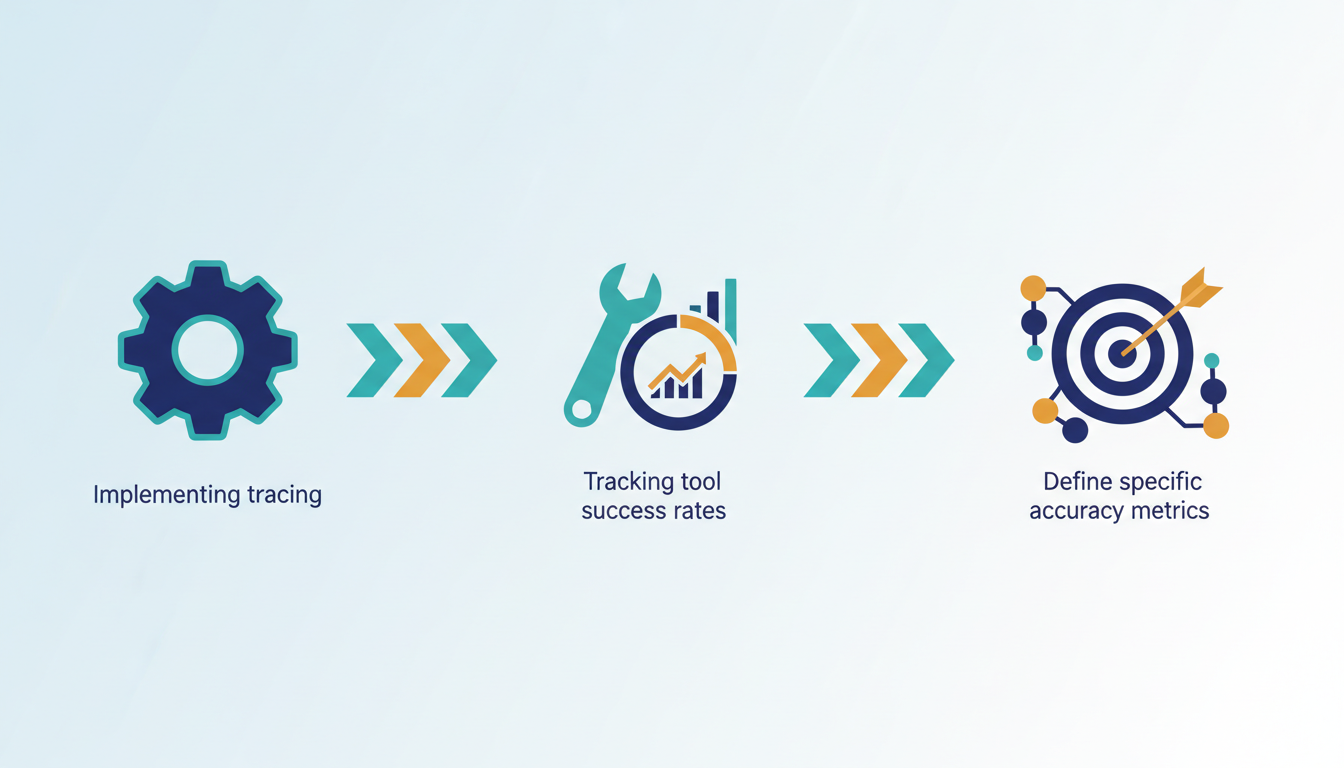
Output quality determines whether an agent reaches the intended state or merely generates plausible text. Builders verify that workflows function instead of shipping a system that answers confidently but incorrectly. This distinction separates functional automation from hallucinated noise. Integration logs reveal how often tools return usable results versus errors, exposing unstable APIs before they trigger inconsistent behavior.
| Metric Focus | Measurement Target | Operational Risk |
|---|---|---|
| Correctness | Expected result frequency | Confidently wrong outputs |
| Tool Reliability | Usable result ratio | Integration fragility |
Cost reporting tools correlate execution quality with spend when deployed alongside these checks. Tracking such signals early provides a clear picture of agent performance before scaling efforts begin. Evaluation hooks record every action as traces, offering operators specific points to inspect behavior and measure output quality. Measuring these metrics detects when memory or state breaks the workflow, preventing runaway runs and wasted cycles.
Configuring Mastra Workflows and CrewAI Tracing
Mastra serves as a framework for TypeScript-native development, while CrewAI runs agent teams rather than a single loop. Users define agents with clear roles and tools in CrewAI, organizing them into a "Crew" that moves through a workflow where the framework coordinates handoffs, delegation, retries, memory sharing, and state transitions. Structured logs expose agent messages, tool calls, decisions, and task outcomes, providing step-level traces to evaluate the multi-agent setup without modifying the workflow.
| Framework | Tracing Mechanism | Primary Signal |
|---|---|---|
| Mastra | TypeScript Native Support | Workflow Execution |
| CrewAI | Structured Logs | Role Handoff and Task Outcomes |
These frameworks help manage the cost per successful task, indicating if a workflow is sustainable. Detailed logging provides visibility, yet teams must balance correctness verification against operational overhead. Comparative analyses in 2026 explicitly include "long-term cost of ownership" as a primary ranking parameter alongside production readiness. Choosing a framework with breaking changes can lead to significant rebuilding costs, making the selection of stable, well-supported tools vital for production environments.
Preventing Looping Behavior and Latency Bottlenecks in Agent Steps
Uncontrolled recursion in the planner component creates infinite execution loops that exhaust compute budgets without completing tasks. This looping or stuck behaviour often stems from ambiguous termination conditions where the agent repeats reasoning steps instead of invoking tools. Excessive latency accumulates when the session state grows too large, slowing down token generation for every subsequent decision. Measuring latency across each step isolates whether delays originate from external API calls or internal reasoning overhead.
| Failure Mode | Root Cause | Mitigation Strategy |
|---|---|---|
| Infinite Loops | Missing exit criteria | Enforce maximum step counts |
| High Latency | Context bloat | Prune session state aggressively |
| State Corruption | Unchecked tool errors | Validate outputs before storage |
Operators must tune timeout thresholds based on specific task complexity rather than applying global defaults. Ignoring these signals allows minor state drift to compound into total workflow collapse. Implementing hard stops on iteration depth guarantees liveness and prevents wasted cycles.
About
Marcus Chen serves as Lead Agent Engineer at AI Agents News, where he daily evaluates the operational mechanics of AI agent frameworks like LangGraph, CrewAI, and AutoGen. His direct experience shipping production multi-agent systems provides the technical foundation necessary to dissect the nuances of agent orchestration and tool-use patterns discussed in this article. Unlike theoretical overviews, this analysis stems from Chen's routine work testing function calling reliability and memory persistence across varying framework versions. At AI Agents News, an independent hub for engineering leaders, Chen focuses on separating marketing claims from actual observability capabilities. This specific expertise allows him to critically assess how foundation models from OpenAI and Google integrate with established libraries, ensuring readers understand the trade-offs required to build reliable, fast MVPs. His insights connect immediate development challenges with long-term ROI through rigorous tracing methods.
Conclusion
Scaling agentic frameworks reveals that operational fragility often outweighs initial licensing savings. As the industry shifts toward governance by 2027, the true cost emerges not from acquisition but from the labor required to fix breaking changes and debug infinite loops. Teams that ignore session state bloat or lack strict termination criteria will face compounding latency that renders their workflows economically unviable. The window for treating these tools as experimental prototypes is closing; production demands stable infrastructure with predictable behavior.
Adopt a framework only if it offers native observability and enforces hard stops on iteration depth without custom patching. Do not migrate legacy workflows until you have validated that the tool handles context pruning automatically. This discipline prevents the scenario where minor state drift causes total system failure. Your immediate priority is to audit your current agent configurations for missing exit criteria. Set explicit maximum step counts on your most complex workflows today to guarantee liveness. That single configuration change secures the system against runaway costs. The ranking in this analysis holds for one reason: LangGraph keeps the order of operations and the session state explicit enough to audit, and every number a production team lives by, from loop detection to long-term cost of ownership, depends on that being visible.
Frequently Asked Questions
Nothing decides when a tool fires or when state changes, so the model drifts into ad-hoc reasoning. The agent then loses track of prior actions during long orchestration and re-executes steps it has already completed.
The planner sets the execution order and the worker carries out the selected step without re-evaluating the goal, while session state stores the values and actions produced along the way. Context survives because those markers live outside the context window instead of inside it.
CrewAI version 0.86+, ranked third overall in the deployment data, because Flows define the work order explicitly and narrow-role agents coordinate without manual handoff logic. The trade is visibility: the abstracted execution loop obscures the precise order of operations during failure analysis.
A worker execution with no matching state write. The planner then re-issues the same instruction, which surfaces in the trace as repeated tool calls, so the evaluation hooks that log every action are what expose the loop.
It separates a workflow that completes work from one that burns compute on retries. Runs that loop without exit criteria still consume tokens, so cost per completed task is the figure that shows whether the workflow scales or merely spends.
References