LangGraph CLI Release: Secure Your Supply Chain
The langgraph-cli release 0.4.28 ships with commit f0e8147 and a verified GPG signature from key B5690EEEBB952194. This update prioritizes supply chain security and tooling efficiency over raw feature expansion for the langgraph platform.
Meanwhile, the repository, boasting 36.2k stars, relies on rigorous verification processes to maintain trust across its 6.1k forks. The latest release notes explicitly confirm the commit was created on GitHub.com and signed with GitHub's verified signature, a critical step given the cli tool's role in deploying applications. Ignoring these GPG verification steps exposes deployment pipelines to potential tampering, a risk no production environment should accept.
Beyond security, the update addresses internal mechanics that impact developer velocity. The changelog details a specific migration of Python type checking to ty, signaling a shift away from established tools like MyPy for performance gains. The release manages complex dependency bumping workflows, updating packages like starlette and typescript across multiple directories. Understanding these automated processes reveals how large-scale projects maintain stability while iterating rapidly on core infrastructure.
Verifying the cli==0.4.28 Signature Before Installation
Confirm the cli==0.4.28 artifact carries a signature from key ID B5690EEEBB952194 matching commit hash f0e8147.
Engineers inspect release metadata on GitHub.com for the "Verified" badge next to the commit message. This indicator shows the signature matches the maintainer's public key, proving the binary remains untampered since publication. The release package holds 2 distinct assets, and both need this cryptographic attestation to guarantee supply chain integrity before local installation. A compromised dependency update could run arbitrary code during builds and bypass standard perimeter defenses without manual verification.
The "Verified" status depends entirely on the initial safety of the maintainer's private key, offering zero defense if that credential was previously stolen. Operators cross-reference the key ID against official documentation channels instead of trusting the interface alone. This step confirms dependency updates in the bundle, such as the uv version bump, come from the trusted source. Skipping this check leaves development environments open to repo-jacking attacks where adversaries mimic legitimate release tags. Secure workflows demand explicit GPG signature confirmation before integrating any new CLI version into production pipelines.
Popularity metrics do not equal cryptographic integrity: the langgraph repository carries 36.2k stars and 6.1k forks, and attackers frequently create unverified forks or compromise transient credentials to publish altered artifacts mimicking legitimate release tags.
A download that fails or truncates looks identical whether the cause is network latency or tampering during retrieval. Engineers cannot distinguish between a transient connectivity glitch and a compromised binary without validating the GPG key ID. Only cryptographic verification of the commit signature guarantees the artifact matches the maintainer's intent. Builders treat unsigned packages as untrusted regardless of apparent origin or version number.
Mechanics of Automated Dependency Bumping in GitHub Monorepos
Starlette Minor Bumps and Dependency Grouping Mechanics
The cli==0.4.28 release includes the Starlette update from 1.0.0 to 1.0.1 within the /libs/cli path, with changes listed relative to the previous version, cli==0.4.27. The changelog lists a specific entry for "chore(deps): bump the minor-and-patch group in /libs/cli with 4 updates," indicating that multiple dependencies were updated together. This grouping appears in the release history alongside other distinct updates, such as the migration of Python type checking to ty.
| Update Type | Scope | Impact |
|---|---|---|
| Starlette | 1.0.0 → 1.0.1 |
Runtime patch |
| Grouped Deps | 4 updates | Dependency maintenance |
| Tooling | uv bump |
Build performance |
The release notes also document other grouped updates, including 7 updates for the js-monorepo-example and 8 updates for js-examples within minor-and-patch groups. Substantial version bumps occurred for typescript (5.9.3 to 6.0.3) and mypy (1.20.2 to 2.1.0) in their respective groups. These entries demonstrate that the repository uses grouped dependency management across various directories and update types.
Validating Automated Release Signatures and Commit Hashes
The hash under scrutiny, f0e8147, corresponds to the release published by github-actions on 10 Jun at 18:20. The release notes explicitly state that the commit is signed with GitHub's verified signature, associated with GPG key ID B5690EEEBB952194.
Validate that the listed changes, such as the starlette patch from 1.0.0 to 1.0.1, align with the signed commit content.
The release itself is tagged release(cli): 0.4.28 (#8041) in the changelog, the identifier to match when a lockfile and a release page disagree about what shipped.
The MyPy to Ty Switch in cli==0.4.28
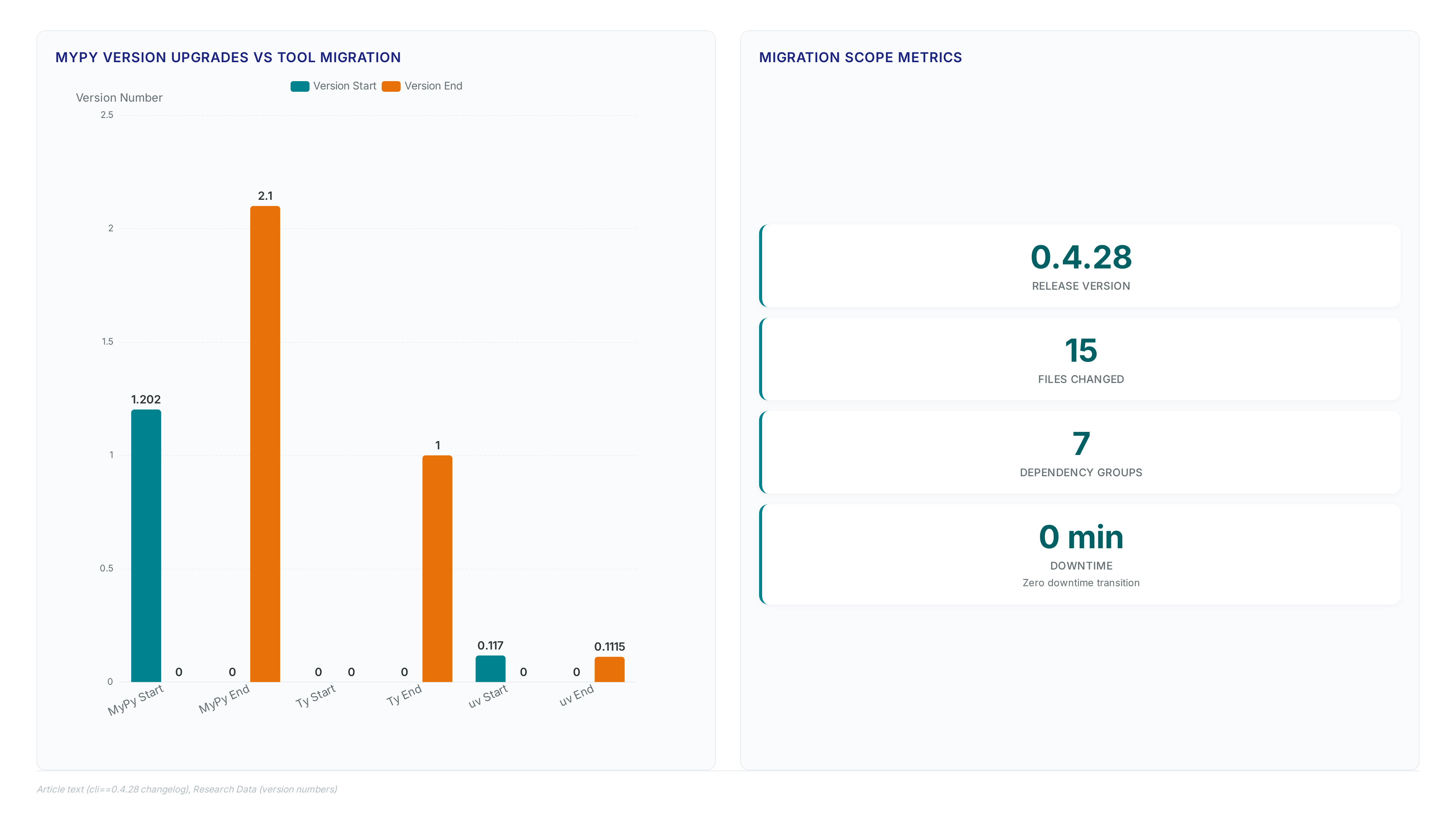
Ty now serves as the assigned tool for Python type checking in this release. The changelog entry chore: migrate Python type checking to ty (#8002) is the directive, and it lands in the same cycle as chore(deps-dev): bump mypy from 1.20.2 to 2.1.0 (#7968) in the substantial group. Seeing MyPy 2.1.0 arrive right after the switch creates momentary confusion about the primary linter; the dependency is still in the tree, but the project moves forward with Ty. Engineers should review pyproject.toml configurations to align with the new ty invocation.
Executing Dependency Updates and Verification in LangGraph CLI
LangGraph CLI 0.4.28 Dependency Scope and TypeScript Substantial Version Shifts
cli==0.4.28 confines TypeScript substantial version shifts to specific monorepo examples while applying minor patches broadly. This scoped approach prevents breaking changes in core logic from destabilizing the entire toolchain during the 5.9.3 to 6.0.3 transition. Developers must distinguish between the minor-and-patch group, which updates four dependencies automatically, and the substantial group requiring manual intervention across directories.
- Identify directories flagged for substantial group updates, such as
/libs/cli/js-examples. - Apply the TypeScript 6.0.3 bump only where explicit compatibility testing exists.
- Allow the minor-and-patch group to resolve lower-risk updates like starlette increments automatically.
This separation acknowledges that TypeScript substantial releases often introduce strict type inference changes that break existing agent definitions if applied globally. Ignoring the substantial group entirely leaves projects vulnerable to security gaps found in older runtimes. Teams managing large monorepos face a tension between immediate stability and long-term maintainability when 1 directory requires a breaking change while others remain static. Recent discussions on the LangChain Forum highlight user urgency regarding support lifecycles, making selective updating critical for avoiding "Critical support" warnings.
The langgraph-api 0.5.42 Lifecycle Trap
Pinning Starlette 1.0.1 in the /libs/cli manifest only helps if the local environment matches the committed lockfile; drift during agent orchestration reintroduces what the patch removed. The primary risk involves transitive dependencies where older langgraph-api versions might reintroduce vulnerabilities fixed in the patch. Users still on langgraph-api 0.5.42 see the [support] langgraph-api 0.5.42 is in Critical support warning during development, the lifecycle tier where only security fixes land. Ignoring this hierarchy creates a fragile state where the CLI functions but lacks the backbone for production multi-agent coordination.
Pre-Update Validation Checklist for MyPy 2.1.0 and Ty Migration Coexistence
The checklist below closes out both the artifact check and the type-checking stack that ships in cli==0.4.28.
- Confirm the commit f0e8147 matches the local checkout to ensure artifact integrity.
- Inspect
pyproject.tomlfor conflicting MyPy 2.1.0 directives now that Ty is the default. - Validate that uv resolves to 0.11.15 to maintain dependency stability during the transition.
The simultaneous presence of substantial MyPy upgrades and Ty migration creates a fragile state where legacy type hints may trigger false positives in the new binary checker. Most teams overlook that Ty enforces stricter path resolution than its predecessor, requiring manual cleanup of stub files before CI passes.
| Checkpoint | Legacy Requirement | Current Standard |
|---|---|---|
| Verifier | Manual Hash | GPG Key ID |
| Checker | MyPy 1.20.2 | Ty Native |
| Resolver | Pip/Setuptools | uv 0.11.15 |
Operators must choose between maintaining dual type-checking pipelines or fully committing to the Ty system to avoid configuration drift. The cost of retaining MyPy alongside Ty is measurable in increased build times and ambiguous error reporting.
About
Marcus Chen is the Lead Agent Engineer at AI Agents News, where he specializes in evaluating agent orchestration frameworks and multi-agent coordination patterns. His daily work involves deploying production systems using tools like LangGraph, giving him direct insight into the practical challenges of managing complex agent workflows. This hands-on experience makes him uniquely qualified to analyze the latest langgraph-cli release (v0.4.28), as he routinely navigates the same deployment pipelines and versioning constraints in his own stack. At AI Agents News, an independent hub for technical builders, Marcus focuses on translating raw framework updates into actionable intelligence for engineers. By testing these tools against real-world scenarios, he ensures that coverage of langchain-ai's public repository goes beyond surface-level announcements. His analysis connects specific commit changes and error handling improvements directly to the needs of developers building reliable, autonomous systems, prioritizing technical accuracy over marketing hype.
Conclusion
The center of cli==0.4.28 is not the feature list; it is attribution. Commit f0e8147 carries a GPG signature, and every other item in this changelog, the grouped dependency bumps, the Starlette patch, the switch to Ty, is worth exactly as much as that signature. A release you cannot attribute is a release you cannot audit.
Frequently Asked Questions
Skipping verification allows malicious code injection into your build pipeline. The release contains 2 distinct assets that both require signature validation to prevent repo-jacking attacks.
You must match commit f0e8147 with the GPG key ID B5690EEEBB952194. This cryptographic link ensures the binary remains untampered since its publication on GitHub.
The changelog records chore: migrate Python type checking to ty (#8002) as the directive, trading established tooling for performance gains. MyPy has not left the tree: the same release bumps it from 1.20.2 to 2.1.0.
The minor-and-patch group in /libs/cli carries 4 updates, including the Starlette patch and the uv bump to 0.11.15. Separate groups cover 7 updates for js-monorepo-example and 8 for js-examples.
The web badge offers zero defense if the maintainer's private key was previously stolen. Operators must cross-reference key IDs locally to enforce true supply chain security.
References