LangGraph 1.2.4 Release: Stable Overrides Defined
LangGraph 1.2.4 arrived on 02 Jun via a GitHub commit signed with key ID B5690EEEBB952194, cementing a stable release cycle for agent orchestration. This update defines the current standard for backward compatible overrides, ensuring that legacy workflows involving _on_started remain functional despite internal architectural shifts. The release mechanics rely entirely on GPG signed commits and strict tag comparisons to maintain integrity within the langchain-ai system.
Operationalizing this version demands rigorous signature verification before deployment. The release notes highlight critical fixes, including PR #7987, which preserves compatibility for overrides predating the current cause structure. The addition of factory-graph integration tests in the SDK Python path demonstrates a shift toward validating the server factory execution model under real-world conditions.
While LangGraph introduces latency overhead compared to standard pipelines, version 1.2.4 prioritizes stability over raw speed. The repository, boasting 37.6k stars, continues to evolve through automated workflows managed by github-actions. The practical read on 1.2.4: existing _on_started overrides keep working, the release is signed and checkable offline, and the new factory-graph test is what proves the server factory path still holds before a build gets promoted.
LangGraph 1.2.4 Defines Stable Agent Orchestration with Backward Compatible Overrides
LangGraph 1.2.4 Release Signature and Commit 054a6f3
Commit 054a6f3 defines the langgraph 1.2.4 release. github-actions executed this build on 02 Jun at 17:07. A verified GPG key ID B5690EEEBB952194 signs the artifact, creating a cryptographic chain of trust for binaries entering production. The langchain-ai organization hosts this Public repository, which holds 37.6k stars while developers scrutinize its StateGraph implementation. Fixes within this update preserve backward-compatible behavior for _on_started overrides so existing agent definitions survive upgrades intact. Security patches land without forcing teams to refactor legacy workflow logic.
Automated github-actions releases create a dependency on CI/CD pipeline integrity. A compromised build environment yields a valid signature despite malicious code injection, a risk inherent to all automated supply chains. Validating the GPG key ID locally before package managers resolve dependencies prevents man-in-the-middle attacks where an attacker serves a modified wheel file with a matching version number but altered behavior.
Executing factory-graph Integration Tests in SDK-Py
A new factory-graph integration test exercises the server factory path (#7978) inside the test(sdk-py) update. This suite matters when validating custom StateGraph deployments relying on flexible server instantiation rather than static definitions.
Depth of integration testing must balance against the speed of iterative development cycles. Builders adopt a tiered testing strategy where unit tests cover logic while factory-graph tests validate structural integrity. Adding this new test suite to continuous integration pipelines prevents regression in complex orchestration topologies.
Backward-Compatible _on_started Overrides Pre-1.2.4
Maintaining backward-compatible execution paths allows agents depending on earlier override structures to function without code modifications. Industry focus has shifted from simple pipelines to complex, stateful workflows requiring reliable agent orchestration. Operators managing established deployments upgrade to version 1.2.4 without refactoring existing event handlers, avoiding downtime associated with breaking changes.
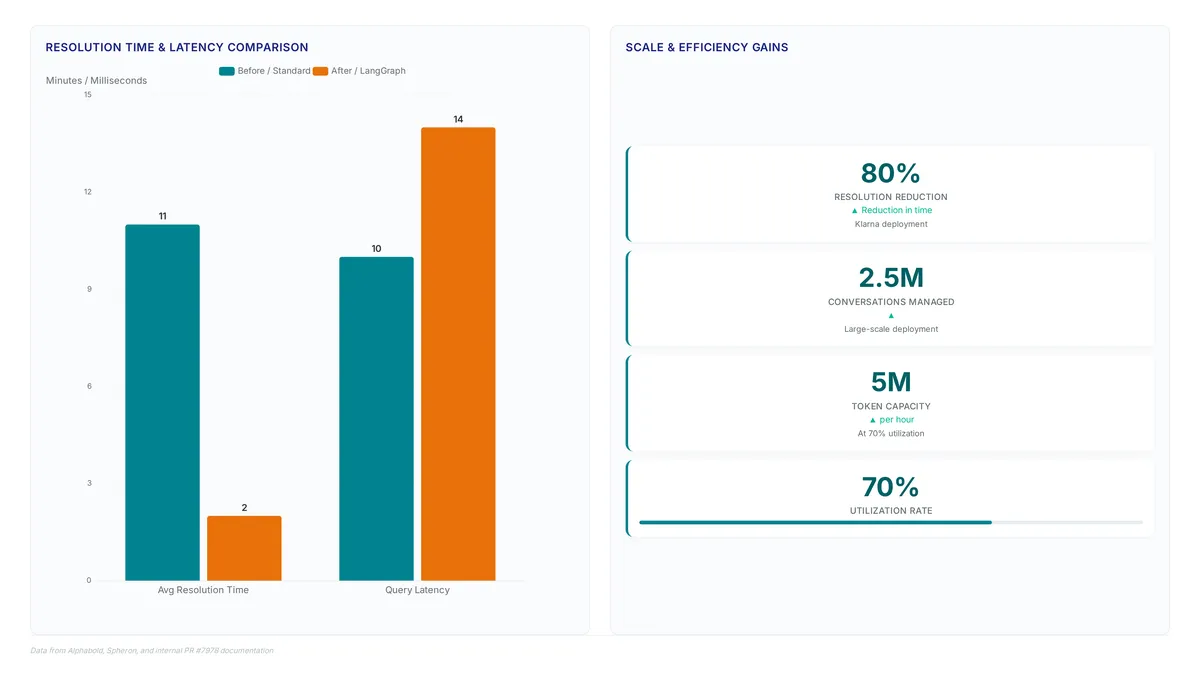
Legacy override patterns introduce measurable performance constraints. LangGraph introduces an average latency overhead of approximately 14ms per query compared to standard LangChain pipelines which average around 10ms. Teams must weigh the safety of unchanged code against the potential for optimized latency in newer implementations. Retaining pre-1.2.4 override styles depends on whether strict latency budgets outweigh the risks of modifying stable production logic.
GitHub Release Mechanics Rely on GPG Signed Commits and Tag Comparisons
GitHub Verified Signatures and GPG Key B5690EEEBB952194
GitHub cryptographically signs commits created on its interface using the GPG key ID B5690EEEBB952194 to guarantee artifact authenticity. This mechanism ensures that the 1.2.4 release tagged 054a6f3 originates directly from the repository maintainers rather than an impersonator. The verification process relies on matching the commit signature against this specific public key, confirming the github-actions bot executed the deployment at 17:07 on 02 Jun.
The release includes specific updates such as fix(langgraph): keep _on_started backward-compatible with overrides predating cause (#7987) and new integration tests for the server factory path (#7978). Release notes reference a comparison with previous versions, though the interface may display error messages when attempting to filter or choose a tag. Managing GPG trust stores across distributed build environments creates operational overhead. Teams risk deploying unverified code that could compromise stateful agent memory or expose sensitive context data without strict enforcement.
Resolving Tag Comparison Failures in Release Interfaces
Interface errors displaying "Sorry, something went wrong" can block tag filtering during release verification. When the GitHub UI fails to load the comparison list for 1.2.4, operators cannot visually confirm the 054a6f3 commit hash against previous versions. This behavior necessitates a shift from interactive selection to command-line validation using git diff between local tags. Relying on the browser interface introduces a potential single point of failure if the UI does not render correctly. Developers can fetch refs directly to bypass UI rendering issues.
- Clone the repository and fetch all tags manually.
- Run
git verify-commitusing GPG key B5690EEEBB952194. - Compare commit messages locally to identify the factory-graph test additions.
| Failure Mode | UI Symptom | CLI Workaround |
|---|---|---|
| Asset Loading | "Uh oh! There was an error" | gh release view |
| Tag Filter | "Sorry, something went wrong" | git tag --list |
| Commit Link | Broken anchor links | git show |
The fixes in this patch, such as maintaining backward compatibility for _on_started, alter how callbacks propagate, making verification necessary before deployment. If the web interface cannot render the asset list, the integrity of the downloaded binary requires local hash matching. Treating UI loading states as non-authoritative when cryptographic proofs exist locally is a recommended practice. Developer convenience conflicts with the absolute requirement for artifact integrity in production systems. Ignoring the interface error and validating the GPG signed commits offline ensures the update remains secure despite front-end instabilities.
Operationalizing LangGraph 1.2.4 Requires Validated Integration Tests
What the factory-graph Integration Test Covers in SDK-Py
Pull request #7978 introduces a specific factory-graph integration test designed to exercise the server factory path within the SDK-Py environment. Unit tests isolate individual functions, yet this integration test validates the complete interaction between graph definitions and runtime server instantiation. Stateful agent orchestration frequently fails during the handoff between the graph factory and the execution engine rather than within logic branches themselves. The scope excludes simple model invocation to focus entirely on checkpoint persistence and multi-actor coordination paths that only appear when the full server stack engages.
Skipping this integration layer invites undetected production failures where transient network issues or race conditions expose weaknesses invisible to unit-level checks. Consistent graph instantiation across distributed nodes relies on the factory pattern, making this test vital for any deployment depending on stateful execution. Teams cannot guarantee that agent definitions will survive the transition from local development to scaled infrastructure without verifying the server factory path.
The Latency Cost of Running Stateful Graphs
LangGraph 14ms Latency Overhead vs Stateless Pipeline Baselines
LangGraph introduces a measurable latency overhead of approximately 14ms per query compared to the 10ms baseline of standard LangChain pipelines. This 4ms delta represents the architectural cost of maintaining persistent state and enabling complex graph traversals that stateless systems cannot support.
| Dimension | LangGraph Stateful Agents | Stateless LangChain Pipelines |
|---|---|---|
| Average Latency | 14ms per query | 10ms per query |
| Primary Use Case | Multi-step conditional logic | Linear RAG retrieval |
| Memory Model | Persistent checkpointer | Ephemeral context window |
| Complexity Cost | Higher orchestration load | Minimal runtime overhead |
Developers should adopt this architecture when workflow requirements demand human-in-the-loop interrupts or long-term session memory. Production teams must weigh this fixed time cost against the functional necessity of state management. This architecture is best reserved for applications where the ability to resume execution or handle branching logic outweighs the raw throughput of linear chains. The trade-off is explicit: builders exchange minimal latency for maximum orchestration capability.
About
Priya Nair, AI Industry Editor at AI Agents News, brings rigorous market analysis to the examination of langgraph==1.2.4. While her daily coverage focuses on the business dynamics of autonomous agents and platform funding, this specific technical update requires a precise understanding of how framework evolution impacts the broader agent system. As the editor responsible for verifying claims across substantial vendors like LangChain, Nair contextualizes this release within the rapid iteration cycles that define current infrastructure development. Her role involves dissecting how updates to core orchestration tools influence engineering decisions for builders evaluating multi-agent systems. By connecting repository statistics and release metadata to tangible industry trends, she ensures readers at AI Agents News receive factual, noise-free intelligence. This approach aligns with the company's mission to provide engineers with trustworthy data on the frameworks powering their applications, avoiding hype while highlighting significant shifts in the open-source environment.
Conclusion
LangGraph 1.2.4 earns its place by asking nothing of you: _on_started overrides written before the current cause structure keep working (#7987), so the upgrade costs no refactor. What it adds is evidence. The factory-graph integration test from #7978 exercises the server factory path, and commit 054a6f3 is signed, so the artifact stays checkable offline when the web interface refuses to render its own asset list.
The standing trade-off has not moved: roughly 14ms per query against a 10ms baseline for standard pipelines, paid for persistent state and branching logic. Take 1.2.4 as the version where staying on old override code stops being the risky option.
Start on the command line, not in the browser. Fetch the tags, run git verify-commit with key B5690EEEBB952194, and compare your local checkout against 054a6f3 before any package manager resolves the upgrade for you.
Frequently Asked Questions
Keeping them costs no refactor and no downtime; the latency you pay is the framework's own, about 14ms per query against roughly 10ms for standard pipelines. That 4ms delta buys persistent state, not backward compatibility.
Verifying signatures ensures the code originates from maintainers and prevents malicious injection.
You must include the factory-graph integration test added in #7978; it exercises the server factory path end to end, which unit-level checks never touch.
Yes, the update preserves backward compatibility for overrides predating the current cause structure.
It relies on GPG signed commits to guarantee artifact authenticity against impersonation.
References