Gaia skills: Verifying 235 AI capabilities via code
Gaia's registry verifies 235 total skills through code-execution runs rather than marketing claims. You will learn how skill fusion mechanics combine basic primitives into ultimate capabilities, why trust ledger validation is required for permanent attribution, and how to deploy the Gaia CLI to scan and publish your own verified assets.
Current market noise often relies on unverified assertions found in repositories like the "awesome-agent-skills" collection by VoltAgent, which aggregates over 1,000 entries without rigorous proof. In contrast, the Gaia project enforces a strict hierarchy where Basic capabilities fuse into Extra workflows and eventually Ultimate platform capstones. This structure ensures that every claimed ability maps to a specific, auditable commit history rather than a vague promise.
The system uses a tiered ranking from 0★ to 6★ to categorize agent maturity objectively. By examining the Gaia Skill Tree, developers can see exactly how component skills evolve into complex workflow skills through transparent validation.
The Role of Evidence-Backed Skill Graphs in Verifying AI Capabilities
Gaia Skill Tree Architecture and the G7 Trust Taxonomy
Mutable assertions die hard in our industry, but the Gaia skill tree forces a different standard: an open-source registry confirming AI capabilities through a public ledger of code-execution runs. Here, executable proof replaces hope, guaranteeing skills stay attributed to their provers permanently. The system bundles reusable capabilities as plain Markdown files, demanding a SKILL.md manifest for metadata and instructions. Trust derivation depends on the G7 Trust Taxonomy RFC, which outlines 10 canonical evidence types such as arxiv, repo-own, and benchmark-result. These inputs produce a Trust Magnitude score, grading each skill from S to ungraded based on verification depth. The public trust ledger ranks every named skill by this computed magnitude, establishing a transparent hierarchy of reliability. Contributor @balukosuri submitted proof for community reproduction of Karpathy's autoresearch and the ledger ingested that artifact at the matching tier, while @kriptoburak's x-twitter-automation skills drew a B on partial evidence rather than a rejection. A C grade signals presence, not reliability, so downstream systems filter on a minimum trust threshold before production use. High barriers emerge when specific evidence types like verifier-attestation are mandatory, slowing down emerging skills without established provenance. Operators balance the security of high-magnitude skills against the innovation speed of ungraded contributions. This tension forces a choice between immediate utility and long-term auditability in agent deployments.
Validating AI Skills Against G7 Canonical Evidence Types
Mapping components to the 10 canonical evidence types set by the G7 Trust Taxonomy RFC validates an AI skill. The SkillsBench research initiative structurally defines a skill as a package containing instructions, code templates, resources, and verification logic. Rigorous agent capabilities differ from simple prompts lacking executable verification. Submissions must include all four components to achieve a Trust Magnitude grade above ungraded status. Basic skills typically rely on single-source attestation, whereas extra skills demonstrate composite workflow validation through fusion recipes. The registry currently hosts 235 total skills, each attributed permanently to the prover. Omitting resource definitions creates a critical limitation; without external data pointers, the verification logic cannot execute independently, rendering the evidence invalid. Consequently, the Public Trust Ledger rejects incomplete packages regardless of the claimed capability. Builders should consult the Gaia skill tree to verify their package structure before submission. Strict adherence prevents the degradation of the graph into a collection of unverified claims.
Inside the Mechanics of Skill Fusion and Trust Ledger Validation
Gaia Skill Fusion Tiers and Star Ranking Logic
The Gaia Skill Tree enforces a strict hierarchy where Basic capabilities fuse into Extra composites, which subsequently merge into Ultimate capstones. This structural graph prevents unverified claims by requiring every node to pass through a set fusion recipe.
| Symbol | Tier Type | Star Range | Definition |
|---|---|---|---|
| ○ | Basic | 0★ to 4★ | Primitive capability |
| ◉ | Unique | 4★ to 6★ | Mastery without fusion |
| ◇ | Extra | 2★ to 4★ | Composite workflow |
| ◆ | Ultimate | 5★ to 6★ | Platform capstone |
Operators generate skill badges by executing a local scan that validates code against the gaia-skill-tree registry standards. The system computes a Trust Magnitude for each entry, ranking it from S to ungraded based on proven evidence types like benchmark results or verifier attestations. Unlike simple instruction lists, a valid skill package must structurally include verification logic to confirm performance at inference time.
However, the requirement for explicit verification logic creates a friction point for rapid prototyping, as community-curated collections often lack the rigorous testing needed for higher trust tiers. This constraint means that while Basic skills may propagate quickly, ascending to the Unique or Ultimate tiers demands significant engineering overhead to satisfy the verification logic mandates. Consequently, the registry favors stable, well-documented workflows over experimental prompts, ensuring that high-star skills represent reproducible engineering assets rather than transient configurations. Builders should treat the star rating as a signal of maintenance burden; a 5★ skill implies a verified, stable dependency, whereas a 1★ skill requires local validation before production use.
Executing Fusion Recipes for Composite Workflows
Developers execute fusion-recipe evidence types to bind primitive capabilities into validated composite workflows. This mechanism requires explicit definition rather than implicit assumption, ensuring that an Extra tier skill functions only when its constituent Basic inputs satisfy strict dependency constraints. High-volume curators like @ruvnet demonstrate this utility by fusing distinct modules such as agentdb and flow-nexus into 48 coordinated skills, while @garrytan applies similar logic across 47 gstack system entries. These examples illustrate how operators convert isolated functions into reliable, multi-step automations without manual re-verification of every sub-component.
Builders integrate this process with the Model Context Protocol by using automated acquisition tools. The Nous Research /learn command exemplifies this by capturing directories, documentation URLs, and conversation logs to generate reusable SKILL.md files instantly. This approach eliminates manual authoring errors and ensures that the resulting fusion-recipe accurately reflects the executed logic.
| Input Source | Automated Action | Output Artifact |
|---|---|---|
| Local Directory | Context Extraction | SKILL.md |
| Doc URL | Knowledge Parsing | Reusable Skill |
| Conversation Log | Workflow Capture | Slash Command |
The cost of this rigor is increased initial configuration overhead compared to ad-hoc scripting. Operators must define explicit interfaces for each fusion point, which slows initial prototyping but prevents downstream trust failures. Relying on unverified composites risks propagating errors through the entire skill graph, making the upfront investment in fusion-recipe validation necessary for production stability.
Privacy Boundaries in Gaia Scan and Data Curation
Gaia isolates capability metadata by recording only type, level, and evidence class while strictly excluding file contents, prompt text, or conversation history. This architectural constraint ensures the public ledger functions as a trust verification mechanism without becoming a repository for sensitive user data. Unlike static analysis tools that failed to detect mutable link vulnerabilities in recent security incidents, Gaia's model prioritizes structural evidence over content storage, mitigating risks associated with flexible content verification. The system collects zero analytics or usage data, meaning operators do not leak proprietary workflow details during the scanning process.
When integrating via the Model Context Protocol, builders connect local agents to this read-only registry to validate executable proof before loading skills. This approach prevents the injection of unverified code paths that have historically bypassed standard vetting processes. The trade-off is that developers must manually curate evidence pointers rather than relying on automated content scraping. Consequently, the registry maintains high fidelity for attribution data while leaving private intellectual property entirely on the user's local machine. This separation allows organizations to adopt shared capability graphs without exposing internal logic to the public network.
Deploying the Gaia CLI to Scan and Publish Verified Skills
Gaia CLI 6.3.14 Installation Methods and Core Commands
Release 6.3.14 of the Gaia CLI delivers the executable interface required to populate the public trust ledger with verified agent capabilities. Operators must choose an installation path that fits their specific environment constraints to guarantee proper dependency resolution.
- Shell environments: Execute the automated script via
curl -fsSL gaiaskilltree.com/install.sh | sh. - Python ecosystems: Install directly using
pip install gaia-cliwithin an isolated virtual environment. - Windows systems: Run the PowerShell command
iex (irm gaiaskilltree.com/install.ps1)to configure the binary.
Local verification happens before any data leaves the machine once the toolset is active. The gaia init command builds the directory structure and configuration files needed for a new skill tree. Running gaia scan next analyzes the local repository to find code templates and resources matching the structural definition of a verifiable skill. This local-first strategy guarantees that only capabilities carrying attached verification logic enter consideration for the registry.
The gaia push operation opens a GitHub issue for review, adhering to the rule that programmatic management handles all metadata shifts. Hand-editing JSON nodes is deprecated because the system enforces integrity by forcing all graph modifications through these CLI commands. Such design stops the divergence between claimed and actual capabilities that plagues unverified registries, forcing a strict coupling between code execution and published metadata.
Executing Gaia Scan and Push Workflows for Skill Verification
Start the verification sequence by running gaia scan to detect local capabilities before any registry submission attempt. This command inspects the current directory structure to identify executable scripts and configuration files matching known agent patterns without altering source code. Developers working in mixed-language environments should note that Python constitutes 47.3% of the existing code base for building agent capabilities, suggesting a strong bias toward Python-based skill definitions during the initial scan phase. The tool generates a local manifest of candidate skills so operators can review inferred dependencies and entry points.
Validation of the local inventory allows the gaia push command to open a GitHub issue for review within the registry-for-review directory. This workflow enforces a strict separation between the pending registry-for-review/ intake zone and the immutable skill-trees/ where final per-user skill-tree.json files reside.
Failure often occurs when operators push skills lacking dynamic verification evidence, as static analysis alone failed to detect mutable external link vulnerabilities in recent security audits. Every submitted capability must include proof of execution rather than just a static definition. A skill push remains blocked in the review queue until the associated GitHub issue contains links to reproducible test runs or benchmark results. This design prevents pollution of the graph with unverified claims, ensuring the public ledger reflects only demonstrated behaviors. Builders must treat the push operation as a request for evidence validation, not merely a file transfer mechanism.
Pre-Flight Checklist for Gaia Graph Generation and Fusion
Validate local directory structures before executing graph generation to prevent malformed node attribution during fusion. Developers managing capabilities across multiple environments should verify that symlinks resolve correctly, as real-world implementations like Skill Desktop demonstrate the operational necessity of a single source of truth. The skills explorer TUI displays disconnected fragments rather than a cohesive capability map without this alignment.
- Confirm the repository root contains valid
skill-tree.jsonfiles within theskill-trees/directory. - Ensure the
gaia graphcommand can render output in html, svg, or json formats without parsing errors. - Verify that basic skills intended for combination are present before running the gaia fuse command.
| Command | Primary Function | Output Target |
|---|---|---|
gaia scan |
Detects local capabilities | Local manifest |
gaia graph |
Renders dependency maps | html, svg, json |
gaia fuse |
Merges skill nodes | Updated tree |
gaia skills |
Launches interface | Terminal TUI |
Rapid iteration conflicts with graph integrity; fusing skills prematurely locks intermediate states into the public trust ledger before evidence aggregation completes. Operators must treat the fusion step as a commit boundary rather than a draft operation. The resulting skill graph accurately reflects executable proof rather than mutable claims when this validation sequence runs completely.
Strategic Value of Contributing to an open-source Agent Registry
Permanence of Attribution in the Gaia Public Trust Ledger
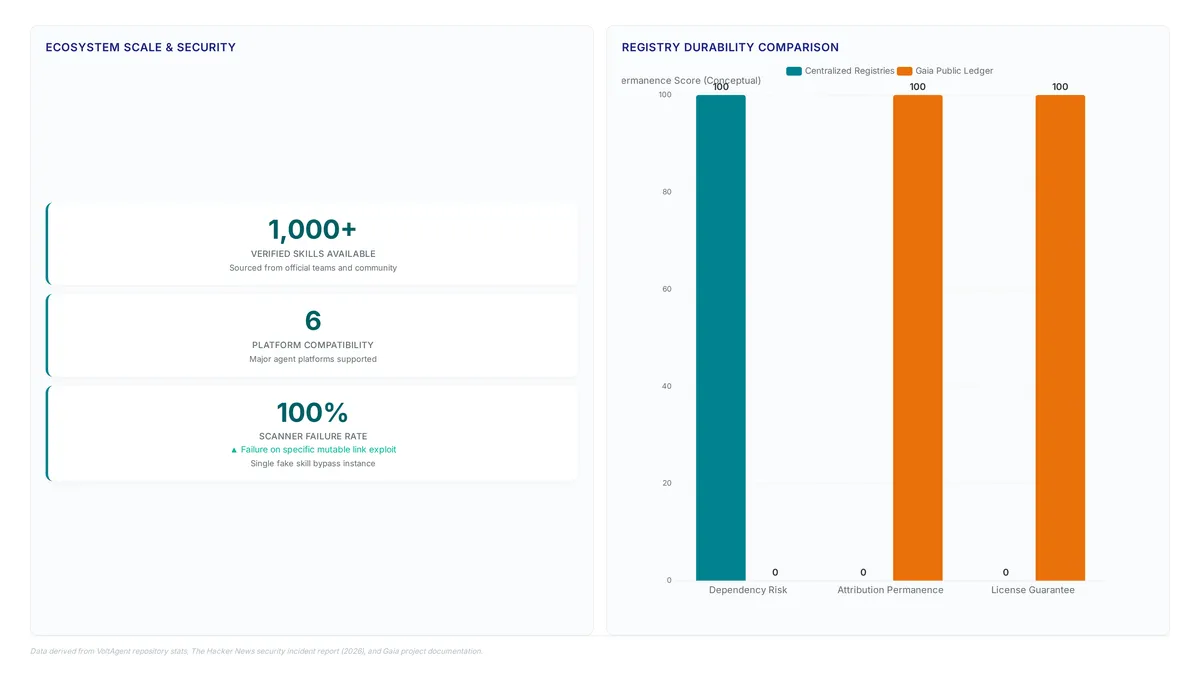
Private repositories vanish, taking claimed capabilities with them when owners delete accounts or switch to paid tiers. The ai agent skill registry secures capability attribution permanently against such losses. A persistent record of verified capabilities survives within the Gaia ledger regardless of individual hosting decisions. This public trust ledger attributes skills to the developers who proved them, creating a durable history independent of specific repository states. Centralized registries reduce search and discovery costs yet depend entirely on continuous host availability. Gaia decouples skill existence from these fragile states so the registry persists through community maintenance as long as developers create skills. The Apache 2.0 license guarantees these verified capabilities remain accessible even if original authors disengage. Permanent attribution demands active community curation to validate new entries against the G7 Trust Taxonomy. The ledger risks stagnation without ongoing peer review despite its structural permanence. Publishing to Gaia transforms transient code snippets into enduring, attributable assets for builders. This shifts the risk model from host-dependent fragility to community-sustained durability. AI Agents News recommends this path for maintainers seeking long-term credibility over temporary convenience.
Using Apache 2.0 Licensing for Open Agent Capability Maps
Engineers publish a shared map of agent capabilities without exposing proprietary logic by applying the Apache 2.0 license. This permissive framework allows curation of community skills while legally guaranteeing that the registry collects zero analytics or usage data. Encoding permissions directly into skill metadata prevents the silent data harvesting common in centralized agent marketplaces. The model mirrors successful decentralized efforts like the awesome-agent-skills repository, which curates over 1,000 compatible skills through similar open standards. Developers define these capabilities using plain Markdown files, specifically requiring a SKILL.md container to function as the metadata and instruction layer.
Gaia's Verified Skill Ledger Versus Unverified Marketplaces
Mutable capability claims give way to a permanent ledger of executable code runs when contributors prioritize Gaia. Unverified marketplaces host agent skills that lack cryptographic proof of function, creating significant integration risk for production systems. The Gaia project requires successful local execution tests before an entry enters its ledger.
| Feature | Gaia Verified Ledger | Unverified Marketplaces |
|---|---|---|
| Verification Method | Code-execution runs | Self-reported claims |
| Permanence | Permanent attribution | Volatile repository hosting |
| Discovery Cost | Low (standardized API) | High (manual curation) |
| Data Privacy | Zero analytics collected | Often tracks usage |
Trusting math replaces trusting documentation as the strategic return on investment. Repositories like the awesome-agent-skills collection provide valuable breadth yet cannot guarantee that a listed skill functions as described without manual testing. Gaia enforces a higher standard where the trust magnitude of a skill depends on reproducible evidence rather than community upvotes. This approach eliminates the "link rot" failure mode common in decentralized ecosystems where skills vanish when maintainers delete private repos. Engineers gain a stable dependency graph where capability attribution persists independently of the original host's availability. A stricter contribution process yields a shared map where every node represents a proven, executable asset rather than a hopeful promise. This distinction determines whether an agent framework serves as a reliable tool or an experimental liability for teams building critical infrastructure.
About
Priya Nair serves as AI Industry Editor at AI Agents News, where she tracks the business dynamics and product evolution of autonomous systems. Her daily work involves rigorously verifying claims around emerging platforms like Devin and Claude Code, making her uniquely qualified to analyze Gaia's evidence-based approach to skill verification. While much of the industry relies on marketing assertions, Nair's reporting prioritizes concrete data and source verification, directly aligning with Gaia's mission to permanently attribute capabilities through code-execution proofs. At AI Agents News, she evaluates how frameworks and registries impact engineering decisions, providing a critical lens on why a public ledger for agent skills matters for builders. This article connects her expertise in market analysis with the technical necessity of trusted benchmarks, offering readers a clear understanding of how Gaia's verified skill ledger influences the broader system of autonomous agent development.
Conclusion
Scaling agent architectures reveals that integration risk escalates when systems depend on volatile, unverified code sources. While broad repositories offer volume, they impose a hidden operational tax where engineers must manually validate every dependency to prevent runtime failures. This manual curation becomes unsustainable as the repository composition grows, particularly when nearly half of available tools rely on languages like Python that demand strict version compatibility. Teams cannot afford to treat capability claims as facts without cryptographic proof of function.
Organizations building production-grade infrastructure must immediately shift from trusting documentation to trusting reproducible evidence. Do not adopt unverified skills for critical paths until your team establishes a validation pipeline that mimics the Gaia verified ledger approach. This transition requires prioritizing skill versioning standards that ensure permanent attribution and zero analytics collection. The goal is a stable dependency graph where capability attribution survives the disappearance of original host repositories.
Start this week by auditing your current agent dependencies to identify any skills lacking local execution tests or cryptographic proof. Replace any unverified components with entries from a verified registry to secure your system against link rot and functional drift. This immediate action isolates your core logic from the volatility of decentralized marketplaces.
Frequently Asked Questions
Static analysis alone has failed to catch mutable external link vulnerabilities, so a skill can clear a scanner and still misbehave at runtime. Gaia blocks a push until the review issue links reproducible test runs or benchmark results.
Python dominates the existing code base for building agent capabilities today. Developers should note that Python constitutes 47.3% of the existing repository composition, guiding language selection for new contributions.
A valid skill requires four distinct parts including instructions and verification logic. The SkillsBench research initiative defines this structure to ensure every package contains necessary resources for proper execution and testing.
Any platform that reads plain Markdown can load them: a skill is a Markdown bundle whose SKILL.md manifest carries the metadata and instructions. Gaia connects local agents to the read-only registry through the Model Context Protocol, and the VoltAgent collection curates skills in the same format.
The registry currently confirms capabilities through rigorous code-execution runs rather than claims. Gaia's registry verifies 235 total skills, ensuring each entry maps to an auditable commit history for trust.
References