Coordinated agent teams replace single scripts now
With 2,448 agents currently searchable on Agent.ai, the industry pivot is undeniable: we are moving from isolated scripts to coordinated AI agent teams. This isn't just about better prompts; it's about replacing linear execution with coordinated workflows where discovery, usage, and building merge into a single operational loop. The marketplace architecture underneath makes those units discoverable, and pre-built teams like the Sales Prospecting Team qualify leads and draft outreach in one sequence.
The concept of the agent team abandons simple chatbot interactions for complex, multi-step execution where distinct specialized units collaborate. While CrewAI reports having over 100,000 developers certified through its community courses, the real value now lies in pre-built collaborative units handling entire business functions. These are structured groups where one agent's output becomes another's input without human intervention.
The Role of Coordinated AI Agent Teams in Modern Workflows
Defining Coordinated AI Agent Teams vs Single-Agent Tools
Agent Teams are orchestrated networks where specialized units execute interdependent tasks within a single workflow, surpassing the linear constraints of isolated single-agent tools. Standalone models process one prompt at a time. This architecture organizes multiple AI agents into collaborative structures with set roles to solve complex problems. The framework functions as a coordination layer sitting above individual agents, managing handoffs and state rather than merely generating text. This structural shift enables systems to plan detailed steps, self-correct errors through iterative loops, and maintain context across long-running operations. These coordinated AI agents work together on your biggest workflows to distribute cognitive load effectively where single agents often fail.
Managing these interactions requires strong tool use patterns and precise function calling definitions so agents do not conflict. Market adoption reflects this nuance, presenting a steep learning curve compared to simple prompt engineering. Success depends less on the underlying model's raw intelligence and more on the rigor of the agent network topology. The industry is shifting towards standardized interfaces that allow AI agents to dynamically discover one another's capabilities, reducing the need for custom integration code.
The Overhead That Comes With Coordination
Single-agent tools stop where a workflow needs an orchestration layer: they process linear prompts effectively, yet cannot maintain state across multi-step sequences like prospecting or market analysis.
Advanced frameworks provide sophisticated CLI or APIs for granular control over these collaborative teams, unlike basic natural language interfaces. This architecture allows organizations to start small with proven tools before scaling to full workflow automation.
| Feature | Single-Agent Tool | Multi-Agent System |
|---|---|---|
| Task Scope | Linear, single-turn execution | Interdependent, multi-step workflows |
| Coordination | Manual human handoff required | Automated coordination layer |
| Context | Lost between sessions | Persisted across agent handoffs |
| Control | Limited to prompt engineering | Sophisticated CLI or APIs |
The market for AI agent tools is evolving rapidly, with advice to start small and then scale, suggesting a timeline of iterative adoption rather than immediate large-scale deployment. The core framework often carries a $0 license cost, yet the operational complexity of managing stateful conversations introduces new infrastructure demands. Builders must weigh the benefit of automated coordination against the engineering overhead of maintaining persistent context stores. The transition from isolated tools to coordinated AI agents fundamentally changes the failure mode from simple hallucination to systemic coordination errors.
Inside the Agent Marketplace Architecture and Coordination Mechanics
Agent Marketplace Discovery and Rating Mechanics
The platform indexes 2448 agents through a searchable database operated by AgentAI Platform, Inc. Users filter this inventory to locate free vs premium agents, distinguishing between open access tools and those requiring subscription tiers. The system supports flexible discovery, allowing agents to identify and apply each other's capabilities without static, hard-coded connections. Creator attribution remains explicit, linking tools like the Buyer Persona Builder to authors such as Shaalin Parekh alongside user ratings.
A structural limitation exists where high-volume discovery relies on manual tagging rather than automated capability verification. This creates friction for engineers seeking verified function-calling compatibility across the network. Consequently, builders must manually validate agent outputs before integrating them into production coordination layers. Reliance on community ratings alone introduces variance in reliability for critical sales workflows.
Executing Premium Workflows: Cold Email and Web Copy Analysis
Premium agents change raw URLs into specific buyer persona gut reactions and actionable copy rewrites. Users initiate the Web Copy Analyzer by submitting a target page URL alongside set buyer parameters. The system evaluates retention factors against the provided persona, identifying sections that trigger bounce behavior. It then rewrites underperforming segments to match the buyer's linguistic patterns rather than generic marketing speak. This process moves beyond simple grammar checks to address semantic resonance.
The Cold Email Analyzer operates on a similar coordination layer, ingesting draft text and prospect details to simulate a recipient's cognitive load. It highlights exactly where a reader stops engaging and provides reasoned rewrites to improve flow. Unlike single-agent tools that offer static feedback, these premium modules function as part of a larger multi-agent architecture where specialized roles handle distinct analysis tasks.
| Feature | Input Requirement | Output Focus |
|---|---|---|
| Web Copy Analyzer | Page URL, Buyer Details | Retention fixes, Tone alignment |
| Cold Email Analyzer | Draft Text, Persona Data | Engagement breakpoints, Reasoned rewrites |
Precise input definitions are non-negotiable; vague persona data yields generic adjustments. Builders must recognize that coordinating these specialized agents requires structured data handoffs to avoid context loss between analysis and generation steps.
Choosing Between Free and Premium Agent Tiers
Free tools like the Domain Idea Generator cover high-volume brainstorming tasks without cost. These agents suit teams needing rapid iteration on naming or basic content structures where deep contextual accuracy is secondary to speed. Premium offerings diverge by constructing a Pre-Meeting Profile built around verbatim quotes from podcasts, articles, talks, and press. This depth enables sales engineers to align technical proofs-of-concept with a prospect's stated strategic priorities rather than generic pain points. The trade-off is latency; gathering verbatim evidence requires more processing time than generating synthetic ideas.
| Feature | Free Tier Utility | Premium Capability |
|---|---|---|
| Data Source | Synthetic patterns | Verbatim quotes |
| Primary Use | Brainstorming | Meeting preparation |
| Output Depth | Surface level | Strategic alignment |
| Coordination | Standalone | Team integrated |
Deploy free agents for initial discovery phases where volume outweighs precision. Conversely, paid research tiers earn their cost only when a multi-agent workflow needs high-fidelity context to avoid hallucinated outreach. The platform offers free options alongside paid tiers, catering to both beginners and technical teams requiring advanced control free. Relying solely on synthetic data for final outreach risks misalignment with actual buyer sentiment. AI Agents News recommends reserving premium capabilities for the final validation step in any coordinated sales workflow.
Building High-Performance Sales Prospecting Teams with AI
Sales Prospecting Team Workflow Components
This coordinated automation replaces isolated tool usage: finding, research, qualification, and drafting run as one connected sequence. The team maintains state across research and writing phases, so generated outreach references verified account data rather than hallucinated premises. The process initiates when a Buyer Persona Builder analyzes LinkedIn profiles to construct detailed personas and pressure-test messaging strategies against specific buyer constraints. Subsequent agents use this context to automate manual research tasks, pulling insights from internal engagement sources or external web data to build account intelligence.
| Component | Function | Output |
|---|---|---|
| Persona Builder | Analyzes profiles | Validated buyer constraints |
| Research Agent | Aggregates signals | Account intel |
| Outreach Drafter | Synthesizes data | Personalized message drafts |
The limitation of this multi-agent approach is the dependency on high-fidelity input signals; without accurate initial persona definitions, downstream orchestration propagates errors rather than correcting them. Builders must prioritize strict validation at the persona generation step, as the Research Agent uses these parameters to focus on the account activity. Unlike single-agent tools that offer broad but shallow assistance, this team structure enables deep, context-aware execution where every agent contributes to a unified sales narrative.
Executing Buyer Persona Analysis with DISC Profiles
Generating a buyer persona starts by chaining the Buyer Persona Builder with the Executive DISC Profile agent to layer psychological attributes onto firmographic data. This two-step process transforms static job titles into flexible behavioral models. First, the persona builder analyzes LinkedIn activity to extract professional constraints and communication patterns. Second, the DISC agent maps these signals against Dominance, Influence, Steadiness, and Conscientiousness axes to predict decision-making styles.
This coordination addresses a specific failure mode in single-agent workflows: the inability to distinguish between a high-Dominance executive who requires direct, metric-heavy brevity and a high-Influence leader who prioritizes social proof. Standard research agents often surface identical company news for both, resulting in generic outreach that fails to convert. By integrating psychological profiling, sellers can tailor the steps for generating a buyer persona to emphasize specific communication preferences for different buyer types.
Layering DISC signals onto firmographic data moves the Sales Prospecting Team from data aggregation to executable strategy without manual synthesis bottlenecks.
Validating Outreach Quality Using Marketplace Graders
Sales teams fix low cold email response rates by validating drafts against benchmark data before launch. Generic outreach messages fail because they lack specific resonance with target buyer constraints. Operators route generated content back through the Cold Email Analyzer before it leaves the pipeline. This validation step acts as a critical filter, catching vague language that human reviewers often miss during rapid iteration.
| Validation Target | Tool Mechanism | Operational Outcome |
|---|---|---|
| Message Resonance | Persona reaction simulation | Identifies generic phrasing |
| Domain Strategy | Data scoring | Prevents low-engagement sends |
| Persona Fit | Profile analysis | Aligns tone with buyer type |
The HubSpot App Marketplace Listing Grader specifically uses benchmark data from AppMarketplace.com to establish these performance standards. Relying solely on aggregate benchmarks may optimize for broad appeal while missing niche technical triggers specific to a prospect. Integrating this check into the Sales Prospecting Team workflow ensures only vetted content reaches the inbox.
Deploying Content Creation and Meeting Intelligence Agents
Coordination Pattern for Content and Meeting Teams
Content and meeting workflows run end to end only when each phase hands its output to the next without a person in between. Frameworks serving this pattern offer both "sophisticated CLI or APIs" for complex orchestrations and "simple visual build tools" for simplified entry.
Implementation follows a strict coordination pattern:
- Define specialized roles to manage task delegation and final output assembly.
- Configure specialized agents for distinct phases like research, drafting, and validation.
- Establish shared context variables to maintain data integrity across steps.
- Deploy the team to execute the full pipeline, such as generating a week's social content in under 30 minutes.
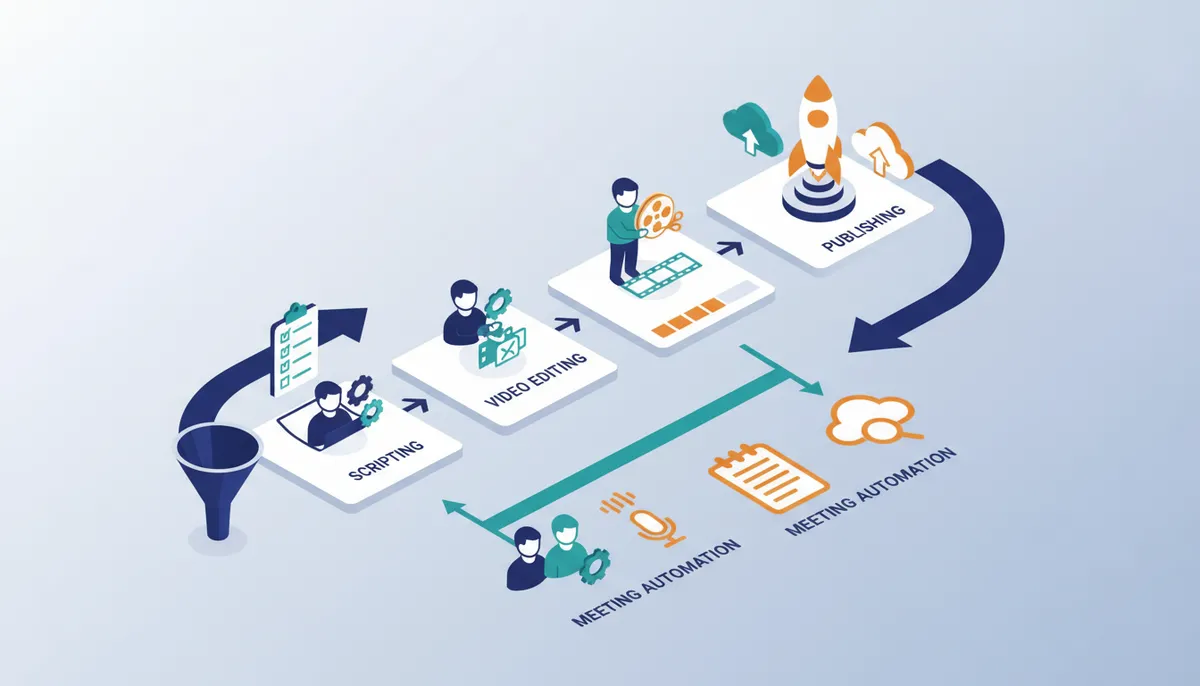
The emergence of these teams shifts the engineering burden from prompt tuning to system design. Builders must now architect for failure modes where one agent's incorrect output corrupts downstream steps. This necessitates building explicit validation gates between agents rather than assuming linear success.
Executing YouTube Creator and Meeting Intelligence Workflows
Operators initiate the YouTube Creator Team by defining a niche to generate scripted video packages in less than 30 minutes. This workflow chains a research agent to identify trending topics, followed by a script writer that structures content for specific formats before a packaging agent generates thumbnails and metadata.
Simultaneously, the Meeting Intelligence Team executes a sequential prep-and-follow protocol. The process begins with deep-dive research into a contact's organization, synthesizing verbatim quotes from recent press to build a pre-meeting profile. Following the call, a summary agent ingests the transcript to produce action items and draft follow-up correspondence that matches the user's established tone. While this reduces manual administrative overhead, the complexity of multi-step orchestration requires strong coordination layers to manage state across distinct phases of a business operation. For detailed implementation guides on constructing these workflows, developers can refer to community resources and documentation detailing "Crews" set as teams of autonomous agents.
Deployment Checklist: Validating Premium Agents and Team Readiness
Verify agent ratings before integrating any component into a production workflow. High-scoring tools like Prospect Research by SellBetter, which holds a 5.00 rating, demonstrate reliable verbatim quote extraction necessary for accurate meeting profiles.
| Agent Type | Validation Focus | Critical Capability |
|---|---|---|
| Premium Research | Rating Verification | Verbatim quote extraction |
| Content Creation | Output Timing | End-to-end run without manual handoff |
| Meeting Intelligence | Data Continuity | Automated follow-up dispatch |
- Confirm the agent retrieves external data sources to build profiles based on podcasts, articles, talks, and press.
- Test the connected workflow to ensure outputs from research agents correctly trigger downstream drafting tasks.
- Validate that the Market Research Team maintains persona consistency across industry deep dives and competitor tracking.
The operational risk lies in unverified handoffs between specialized roles. Industry guides advise organizations to "start small with proven tools" before attempting to scale operations to prevent cascade failures in complex sales or content pipelines.
About
Marcus Chen, Lead Agent Engineer at AI Agents News, brings deep practical expertise to the analysis of emerging agent team architectures. Having shipped production multi-agent systems, Chen daily evaluates orchestration mechanics across frameworks like CrewAI, AutoGen, and LangGraph. This hands-on experience allows him to dissect platform claims, such as Agent.ai's upcoming "Agent Teams" feature, with a focus on actual coordination protocols rather than marketing hype. His work involves rigorously testing tool use and function calling patterns to determine how effectively distinct agents share context and divide labor. At AI Agents News, an independent hub for technical founders and engineers, Chen translates these complex engineering challenges into actionable insights. By grounding his analysis in real-world build constraints, he helps the community distinguish between superficial aggregators and reliable autonomous workflows capable of handling complex, multi-step tasks without constant human intervention.
Conclusion
Scaling an AI agent team reveals that the true bottleneck is not the cost of the framework, but the fragility of state management between distinct operational phases. When research, drafting, and dispatch tasks chain together, a single unverified handoff causes the entire workflow to collapse, negating the promised end-to-end speed. Organizations must recognize that deploying these systems requires a shift from simple tool adoption to rigorous orchestration engineering. The immediate operational cost is the time spent validating that data continuity holds firm across every automated transition.
The validation therefore belongs between the agents, not after them: persona consistency and verbatim accuracy have to survive each handoff, because a coordination layer that needs a human to carry state is still the manual workflow it replaced.
Frequently Asked Questions
Single agents fail because they lack the orchestration layer needed for complex tasks. This limitation forces humans to manage handoffs, whereas coordinated teams automate these interdependent sequences without intervention.
A coordinated social content team can rate and plan a full week of posts in under 30 minutes. That figure holds only while every handoff survives: one unverified pass between research and drafting returns the saved time as manual repair.
Downstream orchestration propagates the error instead of correcting it, so every later agent works from a flawed premise. Builders must validate the persona step before the research and drafting agents consume it.
It carries state across the call boundary: research builds the pre-meeting profile from verbatim quotes, and after the meeting a summary agent ingests the transcript to produce action items and draft follow-ups in the user's established tone. A single-agent tool drops that context at every step.
On Agent.ai, which indexes 2,448 of them. Discovery there relies on manual tagging rather than automated capability verification, so builders validate an agent output before wiring it into a production coordination layer.