Coding agents handle complex refactors alone
Coding agents in 2026 now execute tasks from initial descriptions to final pull requests with little human intervention. This shift marks the moment autonomous agents transitioned from novelty chatbots into reliable engineering teammates that handle end-to-end workflows. The Cognition Team notes that while previous tools like copilots only wrote the next couple of lines, today's systems manage entire files and complex refactors independently.
You will learn how autonomous agents differ fundamentally from the generative chatbots of two years ago by running continuously without constant prompting. Delegating strategic tasks to these tools turns every engineer into an effective engineering manager.
Senior-to-staff engineers are adopting these tools fastest because they understand how to direct junior coding partners rather than just requesting code snippets. Whether integrated into Slack, GitHub, or running locally via Cursor, these agents require clear architectural guidance to succeed. Mastering this delegation is no longer optional for teams seeking measurable ROI in modern software development.
The Role of Autonomous Agents in Modern Software Development
From Chatbots to Engineered Agent Workflows in 2026
Modern coding agents execute end-to-end pull requests from initial descriptions with minimal human intervention, a stark departure from the generative chatbots of two years ago that stalled after generating a single file. Current autonomous agents operate on a "Model + Autonomous Layer" architecture. This structure sustains runtime for minutes or hours, allowing developers to manage autonomous AI teams rather than simply prompting for code snippets. The industry has moved from chat-based assistance to engineered workflows where agents handle planning and execution independently.
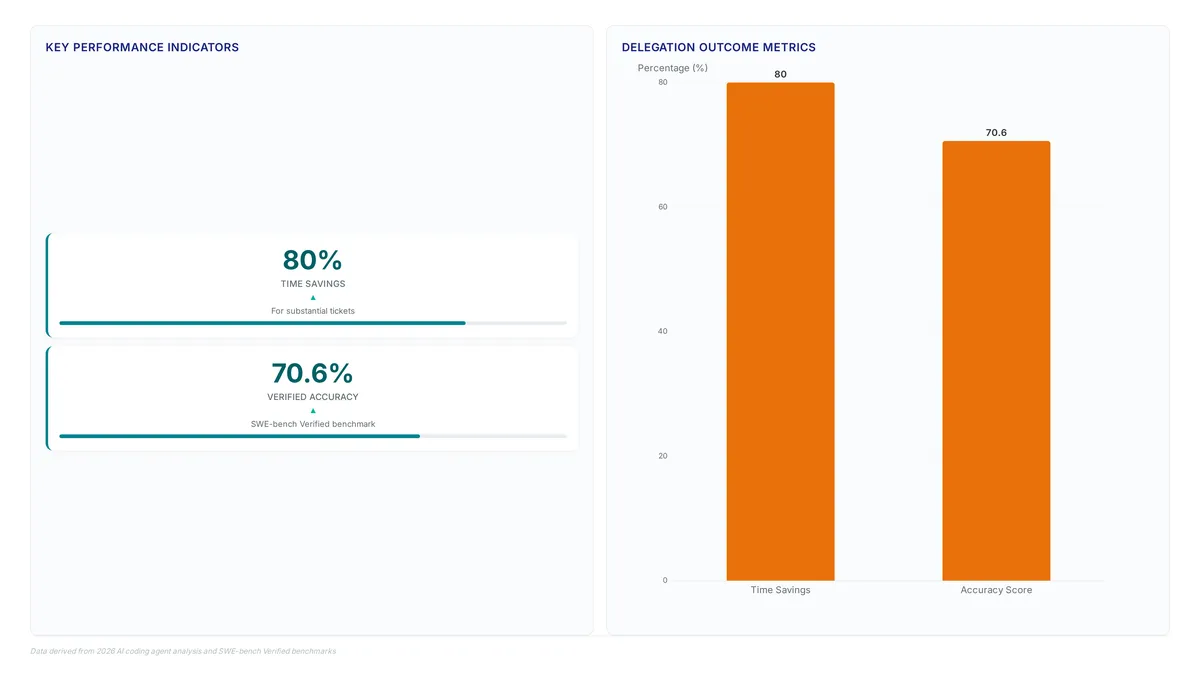
Context capacity is what makes that runtime usable. Augment Code runs a 200K-token Context Engine, allowing the system to ingest and navigate massive enterprise codebases without losing track of dependencies. By maintaining this expansive context window, the agent achieves a reported 70.6% accuracy on the SWE-bench Verified benchmark, a critical threshold for production readiness.
Copilot Tab Complete Versus Agentic Coding Performance
Four years ago, Copilots and tab complete wrote the next couple of lines of code. Modern agentic coding extends beyond this limited scope to execute end-to-end engineering tasks. The performance gap between simple generation and autonomous execution is quantifiable via the SWE-bench Verified benchmark. This metric validates the shift from line-level assistance to workflow-level reliability. The limitation of this architecture is computational cost; sustaining long-horizon reasoning requires notably more tokens than static completion. Developers must weigh the higher accuracy of autonomous agents against the latency of extended runtime cycles. Simple tab completion remains efficient for routine edits, but complex refactoring demands the depth of an agent. AI Agents News identifies this divergence as the primary factor in 2026 tool selection. Engineers now orchestrate these distinct modes based on task complexity rather than relying on a single interface for all work.
Inside the Architecture of AI-Driven Code Execution
Model Plus Autonomous Layer Architecture Set
Separating intelligence from planning defines the modern executor. The formula "Agent = Model + Autonomous Capability" distinguishes these systems from simple chat interfaces. Earlier tools offered inline autocomplete, yet they lacked the sustained runtime required for managing entire development lifecycles without step-by-step human guidance. Specific implementation of the autonomous layer drives the competitive difference in 2026. This factor determines whether a tool functions as a passive helper or an independent operator. Reviews in 2026 separate tools based on their ability to handle entire workflows versus those that only provide inline suggestions. Systems like GitHub Copilot remain assistants, while agents with full planning capabilities earn the label of autonomous systems.
Operational success depends on configuring the autonomous layer with strict guardrails. Raw intelligence from the model cannot compensate for poor workflow definitions.
Custom CLI Tools and MCPs for Workflow Reliability
Constructing custom CLI tools forces the engineer to define precise failure boundaries. This process effectively narrows the search space for the autonomous system. Developers must verify protocol stability before integrating complex external dependencies into critical paths. The cost is increased upfront configuration time. The long-term benefit involves reduced hallucination during extended execution windows. Implementing this reliability pattern requires a disciplined approach to tool definition:
- Identify repetitive failure modes where the agent struggles to prioritize errors.
- Encapsulate the logic for filtering these errors into a standalone script.
- Expose the script via MCP to standardize how the agent consumes diagnostic data.
This architecture shifts the developer role from writing code to orchestrating typed SDKs and enforcing constraints through interface design. The system presents pre-validated signals rather than relying on the model to parse raw logs. This method ensures that autonomous AI teams operate within strictly set feedback loops. The result is a more predictable execution environment where the agent acts on confirmed state changes rather than probabilistic guesses.
Environment Setup Checklist: .envrc and Pre-Authenticated Logins
Pre-authenticated logins and a committed .envrc let the system access internal documentation or CI dashboards without human intervention. Such access serves as a prerequisite for true agentic coding performance.
| Configuration Target | Manual Setup Risk | Agent-Ready State |
|---|---|---|
| Language Versions | Version mismatch errors | .envrc enforced pinning |
| Auth Tokens | Expired session loops | Persistent cookie store |
| Path Resolution | Hardcoded absolute paths | Flexible $PWD references |
Relying on implicit shell state fails when the autonomous layer spawns isolated processes. A distinct limitation emerges here. Strict environment locking improves stability but reduces the agent's ability to experiment with novel library versions outside the whitelist. Builders should prioritize reproducibility over flexibility to maintain reliable workflow integration. Validating these setups before delegating critical path tasks is necessary for operational stability.
Measurable ROI from Strategic Task Delegation in Engineering Teams
Defining the Junior Coding Partner Prompting Strategy
Engineers treat the agent as a junior coding partner whose decision-making can be unreliable. This mental model dictates that teams must specify how to execute tasks, not what to achieve. Outlining the preferred approach, architecture, and logic upfront for complex assignments boosts success chances while reducing review time. The shift from chat-based assistance to autonomous AI teams means agents now run for minutes or hours without step-by-step guidance. Developers should define functionality, edge cases, and mocking requirements explicitly instead of simply requesting "add unit tests." This practice, known as defensive prompting, anticipates where an intern might misunderstand instructions. Balancing detailed direction with the agent's ability to self-correct using typed SDKs and linters remains necessary. Vague instructions incur a measurable cost in extended review periods and logic errors that slip through initial checks. Operators should mandate typed Python or TypeScript to provide the feedback loops necessary for autonomous error correction. The agent cannot validate its own output against type definitions without these guardrails. This constraint forces the human engineer to remain the primary verifier of logic and result correctness. Defining clear start points by referencing repositories and documentation links minimizes wasted effort on irrelevant file modifications.
Delegating 1-6 Hour Tickets for Maximum ROI
Delegating medium-to-large tasks yields high ROI from autonomous agents. A realistic goal for these substantial tickets is around 80% time savings, rather than expecting complete automation without oversight. This approach mirrors a newsroom workflow where the AI generates the initial draft while the engineer acts as the editor, refining logic and verifying edge cases. Teams should assign refactoring chores, documentation updates, and feature investigations to these systems immediately.
| Task Type | Delegation Strategy | Human Role |
|---|---|---|
| Refactoring | Provide target architecture | Verify type safety |
| Documentation | Point to source code | Check technical accuracy |
| Investigation | Define success metrics | Interpret final data |
The hidden cost of this delegation model is the increased cognitive load required to verify outputs rather than generate them. If the human operator fails to maintain rigorous defensive prompting standards, the agent may confidently produce plausible but incorrect code that passes superficial checks. Teams must establish clear handoff protocols where the AI handles execution volume while humans retain ownership of system correctness. This division of labor allows senior engineers to use their expertise on high-value problems while the agent manages repetitive execution. Success depends on the engineer's ability to specify exactly how things should be done, not what needs achieving.
Workflow Integration Checklist: Slack Handoffs and Mobile Code
Tagging agents on Slack for bug fixes or minor feature updates enables engineers to delegate investigations without breaking flow. This handoff mechanism shifts the developer role from writer to orchestrator, allowing teams to manage self-governing AI teams rather than just prompting for code. Mobile access options via dedicated apps or Slack allow engineers to remain much more productive on car rides and flights.
- Assign repetitive chores like documentation updates post-shipment to agents immediately after code merge.
- Use typed SDKs to provide agents with strong feedback loops for self-correction during execution.
- Configure preview deployments to generate live URLs for every pull request automatically.
- Delegate architecture comparisons by asking agents to implement multiple options for evaluation.
Skipping typed interfaces carries a measurable cost: agents struggle to self-correct without compiler errors or linter feedback. Integrating these tools creates a hybrid architecture supporting both interactive coding and independent task execution. Success depends on defining clear boundaries for autonomous features while maintaining human oversight for final verification.
Implementing Reliable CI/CD Pipelines with Preview Deployments
Defining Preview Deployment Triggers for Agent Workflows
Preview deployments must activate only after successful type-checking and unit test execution to prevent broken environments from consuming compute resources. Unlike standard CI checks that report pass-fail status, these triggers provision isolated live environments for visual validation before code merges. The primary differentiator in 2026 is the capacity to handle entire workflows rather than providing mere inline suggestions, requiring deeper pipeline integration. Operators should configure triggers using the following sequence:
- Detect pull request updates from authorized agent service accounts.
- Verify the architectural constraints defined for the branch.
- Build container images with pinned dependencies to ensure reproducibility.
- Deploy to ephemeral namespaces with restricted network egress policies.
Agents respond to events quicker than humans and willingly perform repetitive work, yet they lack fine-grained visual reasoning for complex UI changes. Human review of the rendered preview remains mandatory despite automated passing statuses. The shift from autocomplete to engineered agent workflows suggests pricing models will evolve toward per-workflow valuation rather than seat-based licensing. Limiting trigger frequency based on change magnitude optimizes cost while maintaining safety gates for production readiness.
Executing Automated Test Creation on New Feature PRs
Triggering test generation requires binding playbooks to repository events that detect new pull requests. In Devin, reusable prompt templates known as playbooks standardize how agents approach repetitive coding tasks like unit test creation. One customer configuration automatically triggers three distinct agents to write unit tests whenever a new feature branch is pushed, ensuring consistent coverage without manual intervention. This approach shifts the operator role from writing individual test cases to defining the architectural constraints within the playbook itself.
- Define a playbook that specifies the target testing framework and required mock objects.
- Configure the CI pipeline to invoke the agent only after the code passes static type checking.
- Route the generated tests to an isolated preview environment for execution before merging.
Developers prioritizing strict data sovereignty often prefer CLI-based agents that execute these playbooks locally rather than in the cloud. This local control model illustrates a real-world use case where teams sacrifice some cloud convenience to maintain local code control over sensitive logic during test generation. Local execution demands the host machine possesses sufficient compute resources to run the model and the test suite simultaneously. Relying solely on automated test creation risks generating false positives if the agent lacks access to updated documentation or database schemas. AI Agents News recommends verifying that agents interact with typed SDKs to reduce ambiguity during the test synthesis phase.
Automated test creation has a ceiling. A fully autonomous run attempts end-to-end resolution but lacks the contextual grounding to judge whether a failing assertion reflects a real defect or an outdated schema. Engineers must act as orchestrators who validate the agent's proposed root causes against actual system behavior before approving merges. AI Agents News recommends treating agent output as a high-probability hypothesis rather than a verified solution.
About
Marcus Chen, Lead Agent Engineer at AI Agents News, brings direct engineering rigor to the complex environment of coding agents. Having shipped production multi-agent systems, Chen understands that effective agent deployment relies less on hype and more on precise orchestration and reliable tool use. His daily work involves evaluating frameworks like CrewAI, LangGraph, and AutoGen release-by-release, distinguishing genuine capability improvements from marketing noise. This hands-on experience allows him to dissect the evolution from simple autocomplete to autonomous execution with technical accuracy. At AI Agents News, an independent hub for engineers building with autonomous systems, Chen applies this comparative lens to ensure content remains product-agnostic and tactical. By grounding analysis in concrete version numbers and actual function-calling mechanics, he helps technical leaders navigate the shift toward agentic workflows without falling for unverified claims, ensuring the guide serves those actually building the future of software development.
Conclusion
Scaling autonomous agents reveals that accuracy metrics like 70.6% on verified benchmarks mask a critical operational reality: the remaining failure rate demands rigorous human orchestration rather than passive observation. As the industry shifts toward independent AI teams, the primary bottleneck becomes the engineer's ability to validate hypotheses against live system states that agents cannot inherently perceive. Relying on agents for end-to-end resolution without structured feedback loops invites infinite debugging cycles on visual or database discrepancies.
Organizations must mandate a governance model where agents operate strictly as hypothesis generators within isolated preview environments. This approach preserves the reported 80% time savings on substantial tickets while preventing data corruption from unverified migrations. Treat every agent output as a high-probability suggestion requiring explicit human confirmation against actual rendered behavior.
Start by restricting your deployment pipeline this week to ensure all agent-generated code targets read-only staging environments with no direct production database access. This single constraint forces the necessary separation between automated suggestion and human validation, securing your workflow against the inherent limitations of current visual reasoning models.
Frequently Asked Questions
Leading agents reach a 70.6% accuracy rate on verified benchmarks. This specific performance level indicates they are ready for production tasks but still require human review to catch the remaining errors before merging code.
Teams report around 80% time savings when delegating substantial tickets. This massive efficiency gain allows senior engineers to focus on high-level architecture while the agent handles the repetitive implementation details of complex workflows.
Senior engineers succeed quicker because they treat agents as junior partners needing clear direction. They understand how to provide the specific architectural guidance required to prevent the agent from compounding errors during long execution windows.
Omitting constraints causes agents to confidently generate plausible but incorrect implementations. Without explicit instructions on testing protocols, the lack of continuous human oversight during long runs allows these errors to compound significantly before detection.
Modern agents run continuously for minutes or hours instead of short bursts. This extended runtime requires developers to define strict boundaries upfront so the system can self-correct over longer horizons without stalling or drifting off task.
References