AI coding agent explained: beyond autocomplete
An AI coding agent plans multi-step tasks, executes code, and iterates without hand-holding, moving far beyond simple autocomplete.
True agency demands autonomous scaffolding. The system must operate in a continuous loop, not a single input-output trip. As the MindStudio Team notes, these tools do not just generate text; they write, run, evaluate, and revise code to reach a described goal. This shift moves the tool from passive suggestion to active problem solving. Unlike basic assistants, these systems break objectives like "Add user authentication" into subtasks, install libraries, and diagnose failures automatically.
The execution loop drives this behavior by planning subtasks, observing test results, and adjusting strategies when errors occur. We are moving toward spec-driven development, where the agent scopes trade-offs and handles architecture before writing a single line of code. This evolution marks a definitive break from tools that merely complete your sentences.
Defining the AI Coding Agent as Autonomous Scaffolding
AI Coding Agent as Autonomous Scaffolding Around LLMs
An AI coding agent operates as autonomous scaffolding wrapped around a base large language model, executing multi-step planning loops that reactive autocomplete tools cannot match. This architecture enables the system to plan a task, write code, execute it, observe results, and decide subsequent actions without manual intervention for every step. Operational duration has expanded from short prompt-response interactions to running autonomously for minutes or hours at a time. Such a shift allows the scaffolding to manage persistent workflows rather than stateless exchanges.
The core mechanism relies on a feedback loop where the agent uses specific tools like terminal execution and file system access to validate its own output. If a build fails, the execution loop captures the error and iterates on the code until the goal is met. Autonomy introduces a dependency on effective context management; as interaction history grows, the agent risks context rot, causing it to lose track of earlier decisions when the context window fills. Consequently, the value proposition shifts from mere code generation to the reliability of the surrounding orchestration layer that handles tool use and error recovery. Builders must evaluate agents based on their ability to maintain state over long durations rather than just the quality of single-turn code suggestions.
Executing Multi-Step Loops with File System and Terminal Tools
True differentiation occurs when agents access file systems and terminal execution to resolve errors autonomously. Unlike AI assistants that suggest single lines, these systems interact with real-world tools like browsers and shells to close the feedback loop. The operational sequence requires the agent to write code, run commands, parse output, and decide whether to retry or stop. This cycle often repeats for dozens of iterations on complex tasks without human prompting.
These systems prove particularly effective for complex, multi-file tasks where simpler tools break down. Unrestricted tool use increases the risk of cascading failures if the planning logic misinterprets a compiler error. Autocomplete accelerates typing, yet only an autonomous loop can diagnose a failed test suite and patch the source accordingly. This capability shifts the operator role from writer to reviewer, demanding strong sandboxing rather than just fast token generation. Market differentiation in 2026 relies heavily on these trade-offs, with cost structures varying notably between agents based on their autonomy levels and context window sizes.
Autonomous Agents Versus GitHub Copilot and Cursor Assistants
The 2026 industry definition restricts "coding agent" status to systems executing autonomous multi-step loops, excluding single-turn assistants. GitHub Copilot and Cursor function as reactive autocomplete tools that suggest code based on immediate context without independent execution capabilities. True agents differ by planning tasks, writing code, running tests, and iterating on failures without human prompting between steps. This structural divergence means builders should select agents for complex, multi-file refactoring where independent error resolution is required, reserving assistants for routine line-by-line completion.
| Feature | Autonomous Agents | GitHub Copilot / Cursor |
|---|---|---|
| Execution Model | Multi-step planning loop | Single round-trip suggestion |
| Tool Interaction | Direct terminal and file access | Text completion only |
| Error Handling | Self-correcting via output observation | Relies on user to fix |
| Workflow Scope | Entire task delegation | Line or block completion |
Augment Code reports a self-reported accuracy of 70.6% on the SWE-bench Verified benchmark, demonstrating measurable performance on complex software engineering tasks. This autonomy introduces a distinct failure mode where agents actively modify the repository state, requiring stricter guardrails on file system permissions.
Inside the Agent Execution Loop and Planning Layer
The Scaffolding Architecture Enabling LLM Tool Use
A large language model provides the reasoning engine; the agent itself is the scaffolding architecture that manages external interfaces like file systems, terminals, and web browsers to create a closed action-observation cycle. That layer, not the model, is what companies mean when they separate assistants for quick help from agents like Cline or Claude Code that complete end-to-end workflows.
Decomposing Express App Authentication into Subtasks
Executing a plain language goal like "Add user authentication" triggers an autonomous loop mechanism that breaks the task into distinct subtasks. An example goal provided is 'Add user authentication to this Express app,' which the agent breaks down into installing libraries, scaffolding routes, connecting to the database, and writing tests. Next, the agent writes code for database connections, executes the server, and observes startup logs for configuration errors. If the process fails, the system reads the error output and revises the implementation without human intervention. This multi-step reasoning allows capable agents to manage complex workflows that extend far beyond single-shot generation. An agent that can reason across a long chain of steps is notably more capable than one that just predicts the next action. The distinction lies in the ability to maintain state across file modifications and terminal outputs.
| Phase | Agent Action | Tool Utilized |
|---|---|---|
| Plan | Sequence dependencies | Internal Reasoning |
| Execute | Install packages | Terminal |
| Observe | Read test results | File System |
| Iterate | Fix syntax errors | Code Editor |
Risk emerges if the initial plan misinterprets the security requirements of the target framework. A flawed decomposition strategy can lead to infinite correction loops where the agent repeatedly fixes one error while introducing another in a dependency. Builders must therefore define clear success criteria in the initial prompt to constrain the search space. Operational reality dictates that context rot remains a hard limit on how many iterations an agent can sustain before losing track of earlier architectural decisions.
Remy's Design-First Questioning Versus Immediate Coding
Remy, a spec-driven coding agent, initiates workflows by querying architectural constraints before generating any code. This design-first approach contrasts sharply with standard agents that begin autonomous task execution immediately upon receiving a prompt. Reactive tools type instantly. Remy interrogates user experience goals, asking whether an interface should mimic Linear or Salesforce. This preliminary scoping phase defines the planning layer depth required for complex applications. Standard agents often skip this step, leading to context rot as they attempt to retrofit logic later.
| Feature | Immediate Coding Agents | Remy (Design-First) |
|---|---|---|
| Initial Action | Writes code | Asks questions |
| Focus | Syntax completion | Architecture definition |
| Risk Profile | High rework probability | Low rework probability |
| Context Use | Reactive window filling | Strategic scope locking |
Some platforms apply massive 200K-token engines to manage large codebases, yet raw capacity cannot replace explicit requirement gathering. Remy inherits over 200+ AI models and 1,000+ integrations, allowing it to validate feasibility against existing infrastructure before committing to a path. The constraint is time; users wait for answers before seeing output. This delay prevents the compounding errors seen when agents execute multi-step reasoning on undefined premises. Focusing on scoping, trade-offs, and edge cases before a line of code is written addresses the real work of product definition.
Deploying Agents for Spec-Driven Development Workflows
Remy's Spec-Driven Development Model
Remy operates at a higher level of abstraction than code-level agents by treating annotated markdown as the single source of truth. This spec-driven development model shifts the developer role from writing implementation details to defining system behavior and constraints in plain text. Unlike reactive assistants that suggest single-line completions, Remy compiles these specifications into complete, real TypeScript applications encompassing backend logic, database schemas, authentication flows, and test suites. The mechanism relies on a compilation step where the agent translates declarative requirements into executable code artifacts.
Enterprise Agent Harnesses at Stripe and Shopify
Raw large language models require structured environments called harnesses to prevent task drifting during extended execution loops. At Stripe, an internal system named Minions manages this orchestration, generating approximately 1,300 pull requests weekly within guarded pipelines. Shopify deploys a similar architecture known as Roast to coordinate high-volume agent workflows across distributed repositories. These platforms function by constraining the agent loop to specific toolsets and verifying intermediate states before allowing further code modifications.
Autonomous systems often succumb to context rot or execute unintended commands when facing ambiguous success criteria without such containment. This data-driven approach ensures that deployed agents possess the reasoning depth required for multi-file refactoring rather than simple completion. High-scoring models fail without rigorous boundary enforcement on terminal access and file system permissions. The operational cost involves maintaining these validation layers, which adds complexity to the deployment pipeline compared to standalone IDE plugins.
| Feature | Raw Agent | Enterprise Use |
|---|---|---|
| Scope | Single session | Repository-wide |
| Verification | Manual review | Automated gating |
| Tool Access | Unrestricted | Policy-limited |
| Context | Volatile | Managed state |
Builders must recognize that tool use capabilities alone do not constitute a reliable engineering workforce without the surrounding governance infrastructure. Successful implementation demands treating the agent as a distinct service requiring its own monitoring, logging, and rollback mechanisms. This architectural shift moves the focus from prompt engineering to system design and safety protocol definition.
Verifiable Tasks Versus Business Judgment
Whether an agent finishes or stalls turns on one property of the task: whether success can be checked. Intermediate checkpoints that reset the working memory hold the line on long runs, but they cannot supply a pass condition that was never defined.
| Feature | Boilerplate & Scaffolding | Business Logic Decisions |
|---|---|---|
| Success Criteria | Explicit and syntactic | Ambiguous and contextual |
| Context Depth | Shallow, local scope | Deep, global state |
| Agent Performance | High reliability | Frequent failure |
Tools like Cursor and Claude Code excel at refactoring across multiple files, such as renaming an interface touching thirty files, because the success condition is binary and verifiable. Conversely, agents fail when success criteria require subjective business judgment or when the desired behavior is undefined. The underlying tension exists between autonomy and correctness; the biggest change in 2026 is the ability for agents to run autonomously for minutes or hours, yet this requires careful management. Teams implementing agent-based testing should restrict agents to well-scoped loops rather than open-ended exploration. Validating agent output against static analysis tools helps catch logic errors that statistical models miss.
Mitigating Context Rot and Agent Failure Modes
Context Rot Is Not the Same as Running Out of Tokens
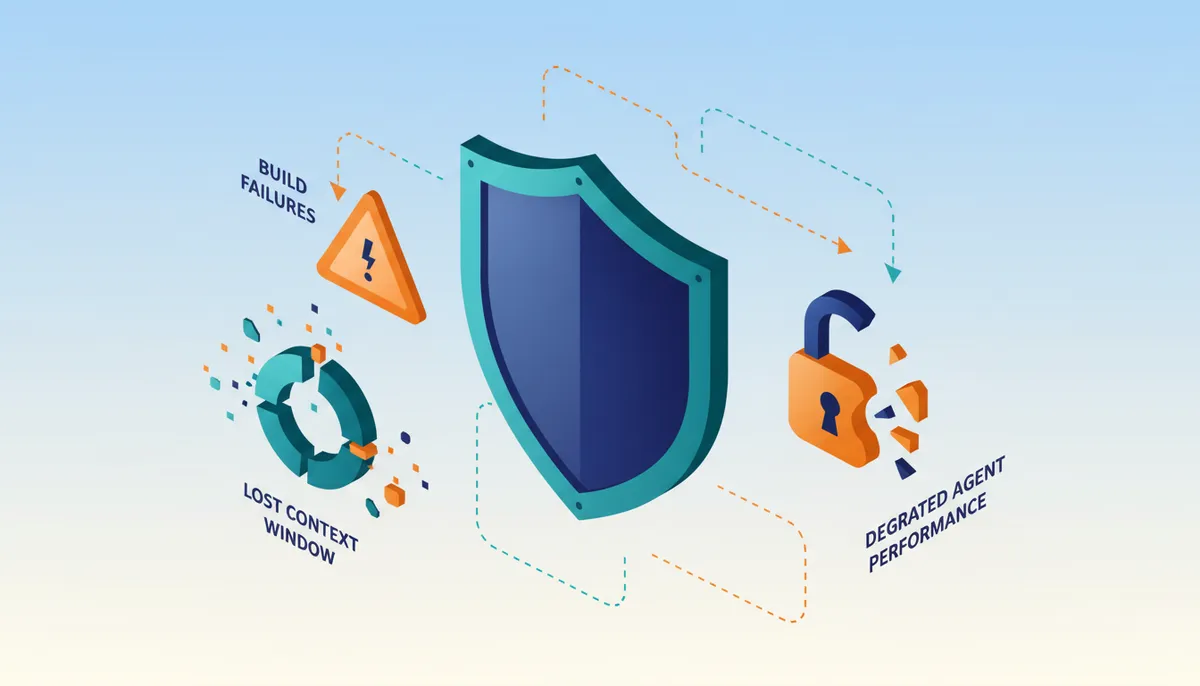
Context rot happens when an autonomous agent forgets its starting goal during long execution loops, a problem distinct from simply hitting token limits. This failure mode appears as the model ignores early constraints or previous decisions because the context window fills with intermediate tool outputs and file reads. Reactive autocomplete tools process single prompts, yet agents operating in a planning loop accumulate heavy history from file system access and terminal execution results. Logical drift or circular debugging attempts occur once this history exceeds the model's capacity, causing the system to stop referencing original specifications.
Harnesses as the Reliability Boundary, and What They Cost
The evaluation loop that Minions and Roast enforce on every iteration is what keeps a raw agent from diverging as the context window fills with transient tool outputs. That verification is not free. Security and memory metrics now weigh equally with raw coding speed in production assessments, and drift at runtime requires continuous verification against a fixed state, even if some solutions boast high accuracy on static benchmarks.
- Hidden costs include the engineering overhead of building custom evaluation scaffolds.
- Linting errors or validation failures can interrupt the execution loop, requiring manual intervention to resolve.
- Strict context pruning may discard necessary historical constraints prematurely.
- Unchecked execution allows an agent to refactor thirty files based on a misinterpreted early instruction.
Tools like Augment Code address this with a 200K-token Context Engine, yet even large windows eventually succumb to rot without external state checks. The implication for builders is clear: deploy agents only within environments that mandate human-in-the-loop checkpoints for ambiguous logic. AI Agents News recommends treating the harness, not the model, as the primary reliability boundary. Autonomous systems remain prone to circular debugging and spec divergence without these guardrails.
Failure Modes: Ambiguous Criteria and Business Logic Gaps
Agents stall when success metrics lack binary verification, forcing reliance on subjective judgment calls. Unlike deterministic scripts, autonomous loops require explicit pass/fail states to terminate the planning loop effectively. An agent may iterate indefinitely without these guards, modifying code until it hallucinates a solution that satisfies syntax but violates intent. Production-ready code from agents requires human review due to potential subtle bugs that evade automated testing suites. These failures often stem from missing business logic context, where the model optimizes for local code correctness rather than global system constraints. The qualitative risk of context rot remains high during multi-hour execution runs that span complex architectural boundaries, regardless of large context windows offered by some tools.
- Hidden costs include engineer time spent debugging logically sound but functionally wrong implementations.
- Unchecked agents may introduce security vulnerabilities while attempting to satisfy vague requirements.
- Higher independence increases the probability of drifting from original specifications when criteria are ill-set.
- Operators must implement strict human-in-the-loop checkpoints for tasks involving financial transactions or user data permissions.
Meanwhile, agents cannot independently query domain experts or access updated policy documents to resolve undefined behavioral requirements, so they require explicit, pre-set constraints to function safely. Developers should consult pricing analysis to understand how different models balance token limits against the depth of reasoning required for complex validation. The tension between autonomy and accuracy demands careful architectural planning.
About
Sofia Berg serves as Research Editor at AI Agents News, where she specializes in translating complex multi-agent research into actionable insights for engineers. Her deep literacy in agentic frameworks and evaluation benchmarks like SWE-bench uniquely qualifies her to dissect the operational realities of AI coding agents. Unlike basic autocomplete tools, these agents function through iterative planning and execution loops, a nuance Berg analyzes daily when reviewing new frameworks and autonomous systems. At AI Agents News, an independent hub dedicated to covering autonomous agents and their underlying architectures, she rigorously separates verified capabilities from marketing hype. This article reflects her commitment to grounding technical discussions in concrete evidence, helping builders understand exactly how modern agents plan multi-step tasks and adapt to failures. By focusing on precise mechanics rather than exaggerated claims, Berg provides the clarity engineering leaders need to evaluate these evolving tools effectively.
Conclusion
Scaling autonomous operations reveals that the 70.6% accuracy rate on SWE-bench Verified represents a ceiling for blind trust, not a baseline for deployment. As the industry shifts toward autonomous AI teams, the operational cost of failure moves from minor syntax errors to systemic logic drift. You cannot rely on the model to infer missing business constraints or resolve ambiguous success metrics without explicit guardrails. The real risk lies in context rot during extended execution runs, where an agent optimizes for local code correctness while violating global system intent.
Organizations must mandate strict human-in-the-loop checkpoints for any task involving financial data or user permissions. Treat the current generation of tools as high-velocity drafters that require deterministic pass/fail states to terminate their planning loops effectively. Do not deploy these systems where success criteria rely on subjective judgment calls. Start by auditing your most critical integration points this week to identify which workflows lack binary verification states. Implementing these hard stops prevents the agent from entering infinite iteration cycles that consume resources while producing logically sound but functionally broken code.
Frequently Asked Questions
Augment Code reports a self-reported accuracy of 70.6% on the SWE-bench Verified benchmark. This metric indicates that roughly seven out of ten complex software engineering tasks are resolved without human intervention during testing.
Operational duration has expanded from short interactions to running autonomously for minutes or hours at a time. This shift allows the system to manage persistent workflows rather than limiting users to stateless, single-turn exchanges.
Agents risk context rot when the context window fills, causing them to lose track of earlier decisions. This failure mode forces builders to evaluate agents based on their ability to maintain state over long durations.
True agents plan tasks and iterate on failures without human prompting between steps. This structural divergence means builders should select agents for complex, multi-file refactoring where independent error resolution is required.
Agents apply specific tools like terminal execution and file system access to validate their own output. If a build fails, the execution loop captures the error and iterates on the code until the goal is met.
References