Agentic testing: Stop false Shopify failures now
By 2030, 80% of enterprise software will be multimodal. Traditional QA cannot validate the reasoning of autonomous agents. We need agentic AI testing: a shift from checking outputs to analyzing decision trajectories and enforcing strict component isolation. You must construct component tests that stub external APIs like GA4 and Shopify to prevent false failures. You need a tagged prompt repository to catch memory leaks and prompt injections.
This framework replaces basic pass/fail metrics with trajectory analysis. It ensures agents select the correct tools in the proper order without unnecessary detours. Single-run evaluations fail because of model stochasticity. Instead, track pass rates and variance across multiple executions. This captures cost, tokens, and latency data to inform upgrade decisions rather than guessing at trade-offs.
Operationalize quality through versioned ground truths requiring explicit domain expert approval. Stamp every run with a specific version identifier. Teams can then pinpoint exactly when regressions occur instead of debating historical behavior. This structured approach addresses the unique challenges of agents that plan and act, ensuring systems remain reliable as they evolve beyond simple chat interfaces into complex workflow orchestrators.
The Role of Component Testing and Prompt Repositories in AI Validation
Defining Agentic AI Testing Stages and Prompt Repositories
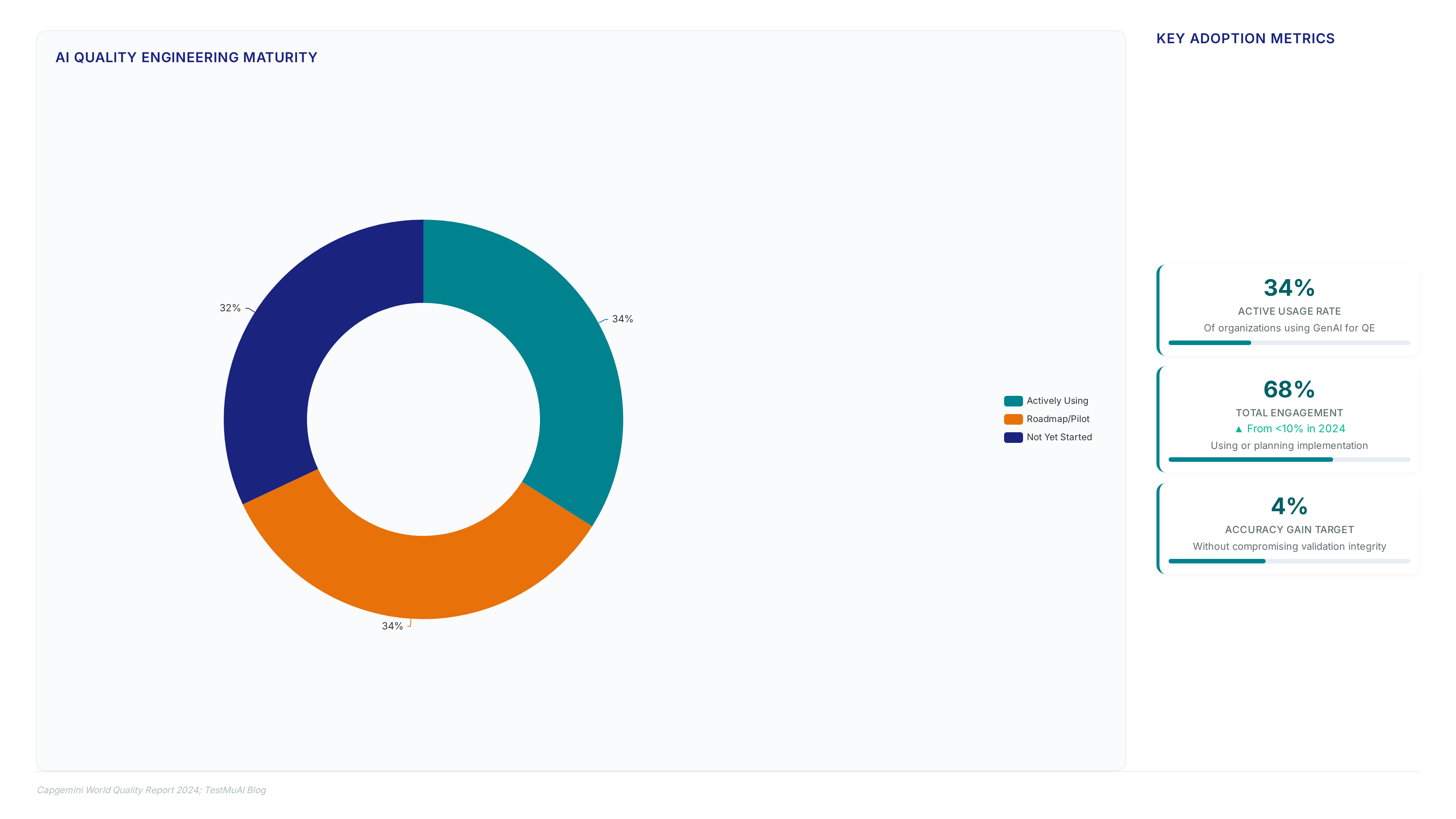
Agentic AI testing validates autonomous tool use through deterministic component checks and versioned trajectory analysis. The industry standard is shifting toward a staged maturity progression: starting with manual grading, moving to LLM-based graders with set criteria, and finally achieving fully continuous automated suites. This evolution addresses the unique complexity of agent evaluation, which tests end-to-end system behavior rather than isolated model knowledge. Currently, 68% of organizations are either actively using generative AI for quality engineering or have built roadmaps following successful pilots. A prompt repository functions as a curated collection of expert-approved inputs tagged by business area to isolate changes.
Preventing False Positives by Stubbing GA4, OpenSearch and Shopify
When an integration test fails because a vendor service is unreachable, the result is a false positive that obscures actual regression signals. Engineers must configure mocks for GA4, OpenSearch, and e-commerce platforms to ensure red indicators reflect broken agent reasoning rather than network volatility. With 80% of IT leaders currently tasked with evaluating AI solutions, those cycles are better spent on agent behavior than on debugging infrastructure noise. Unlike full trajectory analysis, which assesses end-to-end planning across multiple tool calls, component checks verify only that specific functions fire with correct arguments in a controlled environment.
The constraint is that stubbed tests cannot validate real-time data freshness or schema drift in upstream systems. A mock response remains static even if the production API changes its payload structure, creating a risk of undetected incompatibility until deployment. Teams mitigate this by running deterministic unit scripts such as test_research_agent.py and test_web_search_tool.py on every commit, against mock data approved by domain experts and without paying for LLM inference, while reserving live API calls for nightly integration suites. This separation ensures that immediate feedback loops remain fast and cost-free, whereas broader system validation occurs less frequently against actual vendor endpoints.
Mechanics of Trajectory Analysis and LLM-Judged Evaluations
LLM Judge Mechanics: Scoring Against Versioned Ground Truth
Ragas combined with an LLM judge measures precision, recall, completeness, and correctness by scoring candidate runs against versioned ground truth. This evaluator compares agent outputs to domain-expert-verified references, such as a dated ground-truth snapshot, to assign quantitative performance metrics. Complex reasoning paths that deterministic unit tests miss get validated through this automated mechanism.
Biases toward longer answers, whatever comes first, and specific stylistic preferences exist within the LLM judge itself. Metrics become wrong yet confident if the system lacks human calibration data to counter these inherent tendencies. Engineers maintain a small set of human-labelled examples so they can verify judge agreement and detect drift in scoring logic. The evaluation suite might validate incorrect behaviors simply because they match the judge's bias without this check.
| Metric | Definition | Bias Risk |
|---|---|---|
| Precision | Relevance of retrieved content | Favors verbosity |
| Recall | Completeness of information | Misses concise accuracy |
| Correctness | Factual alignment with truth | Style over substance |
Automated evaluators need continuous human-in-the-loop feedback to function as reliable validation tools. Low-scoring cases surface for manual review, and teams use the resulting labels to recalibrate the judge before full deployment. Erroneous quality gates do not automate into production pipelines when this cycle runs correctly. Industry analysis recommends investing early in trajectory capture and structured feedback loops for building reliable systems.
Validating Agent Trajectories for Correct Tool Ordering
The right tool must fire with correct arguments in the proper sequence without detours, which is exactly what validating agent trajectories confirms. Coverage and trajectory validation requires running the full repository to verify every agent and tool executes while analyzing the specific path taken. Firing a tool is insufficient. The system must validate argument correctness, ordering, and error recovery logic. Agentic testing differs from plain LLM application validation because it analyzes the path, not the final output quality.
Does an agent take three pointless detours before reaching a solution? Can it recover gracefully when a tool returns an error? Teams must examine these behaviors closely. The Bolt AI team illustrates this pivot, building a thorough evaluation system in just 3 months to grade outputs using static analysis and LLM graders.
| Check Type | Focus Area | Agent Specificity |
|---|---|---|
| Component Test | Single layer logic | Low |
| Trajectory Analysis | Tool order and args | High |
| Output Eval | Final response quality | Medium |
Trajectory capture serves as a substantial cost center for enterprises building agentic systems to ensure trust and safety. Breadth of coverage conflicts with depth of path analysis; verifying every tool fires does not guarantee the agent chose the optimal route. False confidence arises when engineers measure only completion rates while ignoring inefficient or hazardous intermediate steps taken during execution.
Mitigating False Failures from Stale Ground Truth and Model Stochasticity
Static ground truths become obsolete as products evolve, causing valid agent behaviors to register as test failures. Old ground truths go stale when a product feature changes, and without an update process the suite slowly starts failing things that are actually correct. Technical debt accumulates without a set approval workflow for changing ground truth, forcing the test suite to fight reality rather than validate logic.
Model stochasticity complicates validation because a single execution acts more like a coin flip than a reliable metric. Running each prompt several times rather than once captures the probabilistic nature of LLM inference where identical inputs yield divergent output paths. Tracking both pass rate and variance accounts for this randomness.
| Factor | Single Run Risk | Multi-Run Mitigation |
|---|---|---|
| Stochastic Variance | High false failure rate | Quantified via pass rate |
| Ground Truth Drift | Silent acceptance of errors | Flags divergence from version |
| Regression Signal | Indistinguishable from noise | Clear trend identification |
Storage requirements and evaluation latency increase notably when maintaining versioned runs like gpt-5.5-upgrade-20260623. Capturing cost, tokens, latency, and tool-call count on every run is necessary because upgrade decisions are trade-offs; for instance, a system might be "four percent more accurate at three times the tokens and twice the latency." Depth of trajectory analysis must balance against the compute budget available for continuous integration pipelines. Brittle test suites block deployments on anomalous but functionally correct outputs when variance metrics get ignored. High variance should trigger human review rather than an automatic build failure. This distinction prevents the validation framework from becoming a bottleneck while still catching systematic reasoning errors in autonomous systems.
Operationalizing AI Quality Assurance Through Versioned Ground Truths
Defining Versioned Ground Truths and Approval Workflows
A ground truth store mandates preserving domain-expert-verified references for every prompt, tagged with immutable identifiers like ...-20250510. This structure prevents stale assertions from flagging correct agent behaviors as regressions when product logic evolves. Without strict versioning, the test suite increasingly rejects valid outputs, creating noise that obscures actual failures. Governance protocols must explicitly define which roles possess write access to these truths and how approval chains are recorded.
The primary tension lies between maintaining rapid iteration cycles and enforcing rigorous change control on evaluation data. If any engineer can modify a ground truth, the system loses its ability to detect drift; conversely, excessive bureaucracy slows down necessary updates when business rules shift. Unlike static unit tests, agentic systems require flexible reference data that adapts to new capabilities while preserving historical baselines for comparison.
| Governance Element | Requirement |
|---|---|
| Identity | Named domain expert only |
| Trigger | Product feature change |
| Record | Commit hash + timestamp |
Operationalizing this store reduces the human capital cost associated with Expert Trace Review by ensuring humans inspect only genuine ambiguities rather than configuration errors. Teams should implement a dual-signoff mechanism where one party proposes the truth update and a second verifies the semantic intent. This approach ensures that 4% accuracy gains do not come at the expense of validation integrity. The limitation remains that manual review bottlenecks scale linearly with prompt count, requiring selective application to high-impact trajectories.
Executing Multi-Run Evaluations to Track Pass Rate and Variance
Run each prompt multiple times per versioned run tag, such as gpt-5.5-upgrade-20260623, to capture distributional behavior rather than a single outcome. A solitary execution acts as a coin flip due to inherent model stochasticity, masking true system reliability. Engineers must track both pass rate and variance to distinguish random token sampling noise from genuine logic regressions. This approach reveals whether an agent consistently solves a task or merely succeeds by chance on specific iterations.
The operational cost of this rigor requires balancing frequency against compute expense. While nightly full evaluations provide thorough coverage, teams often restrict multi-run deep dives to pre-release gates to manage token consumption.
Checklist for Validating LLM Judge Agreement and Bias Mitigation
Prevent metrics that are wrong and confident by maintaining a small set of human-labelled examples to verify judge agreement continuously. Without this calibration step, evaluators drift toward favoring longer answers or repeating their own stylistic preferences rather than assessing factual correctness. Teams must define explicit approval workflows for changing ground truth to prevent stale assertions from flagging valid agent behaviors as regressions.
Running each prompt several times reveals variance that single executions mask, distinguishing stochastic noise from logic failures. Engineers should inspect detailed failure traces from high-impact tasks to identify systemic weaknesses in reasoning rather than reviewing every output manually. This approach shifts the human role from author to orchestrator who defines quality objectives while agents generate execution paths. A critical tension exists between rapid iteration cycles and rigorous change control on evaluation data; relaxing governance allows quicker updates but risks corrupting the ground truth store with unverified claims. Regular human review of low-scoring cases provides the labeled data necessary to recalibrate the judge against emerging failure modes.
Integrating Agentic Testing Pipelines into CI/CD Workflows
Defining CI/CD Gates and Thresholds for Agentic Tests
Component tests execute on every pull request to validate deterministic logic before code review. This stage uses mock data and stubs external dependencies like Shopify to isolate agent failures from third-party outages. The full evaluation suite runs nightly and before release, assessing complex trajectories rather than simple function calls.
Deployment gates block promotion when scores fall below set thresholds, preventing stochastic regressions from reaching production.
- Configure the pipeline to trigger unit tests on commit and deep evaluations on a schedule.
- Set score thresholds that reject deployments failing precision or recall metrics.
- Maintain a small set of human-labelled examples to regularly check how often the LLM judge agrees with human assessors.
The shift in QA roles now demands defining quality objectives rather than writing static scripts. Gate strictness fights iteration velocity. Rigid thresholds halt development on minor variances. Loose gates allow subtle logical drift. Teams must balance immediate feedback loops with the computational cost of running multi-turn scenario checks frequently. Without automated gating, suites decay into unused artifacts that fail to catch autonomous planning errors.
Why an Unwired Suite Decays
A suite that nothing in the pipeline calls won't get run, and won't get maintained. Wiring the gate into the pipeline is what keeps evaluation data honest month after month.
Organizations must ensure their deployment gates account for model variance by requiring consistent pass rates across multiple runs rather than single-shot success. Without this rigor, teams risk deploying agents that appear functional during isolated checks but fail under load. As the industry evolves toward continuous, automated suites, the ability to programmatically halt releases based on empirical data becomes the primary mechanism for maintaining trust in autonomous systems. Treating these gates as non-negotiable infrastructure components is necessary for reliability.
About
Diego Alvarez, Developer Advocate at AI Agents News, brings direct, hands-on expertise to the complex challenge of agentic AI testing. His daily work involves building end-to-end agents using frameworks like CrewAI, AutoGen, and LangGraph, where he constantly navigates the fragility of non-deterministic systems. This practical experience makes him uniquely qualified to outline a testing strategy that prevents autonomous systems from failing unpredictably. Unlike theoretical discussions, Diego's guide stems from real-world scenarios where external API outages or prompt failures can derail an entire workflow. At AI Agents News, an independent hub for engineers evaluating autonomous systems, Diego focuses on reliability and evaluation rather than hype. By connecting component-level unit tests with reliable prompt repositories, he bridges the gap between experimental demos and production-ready agents. His approach ensures builders can distinguish between genuine agent logic errors and external noise, providing the concrete, actionable guidance necessary for engineering teams deploying multi-agent systems today.
Conclusion
Scaling agentic AI exposes a critical fragility: static validation cannot contain flexible reasoning errors. As organizations move from pilot to production, the operational cost shifts from writing tests to managing the volatility of autonomous decision-making. Without rigorous, multi-run verification, minor model updates introduce compounding logic failures that traditional linear scripts miss entirely. Teams must treat evaluation not as a final checkpoint but as a continuous, embedded constraint within the development lifecycle.
Implement multi-run deployment gates immediately to halt releases when agent consistency drops below your set threshold. Do not rely on single-pass success metrics, which mask stochastic failures inherent in large language models. By enforcing these gates now, you prevent the accumulation of undetected regressions that erode system trust over time. This structural discipline ensures that speed does not compromise the reliability required for enterprise-grade autonomy.
Start this week by configuring your CI/CD pipeline to execute every critical agent prompt several times per build. Analyze the variance in outputs rather than just the pass rate to distinguish genuine logic errors from token sampling noise. This single change transforms your testing strategy from a reactive filter into a proactive shield against agent drift.
Frequently Asked Questions
Mocking prevents false failures from transient vendor outages, so a red signal means a code defect rather than an upstream timeout. The cost is that a static mock hides schema drift until deployment.
Repositories must include injection attempts and ambiguous inputs to verify memory isolation. This coverage protects production systems by ensuring agents correctly refuse invalid requests rather than leaking user data across sessions.
It tracks the path an agent takes: the right tool, the right arguments, the right order, and recovery when a call returns an error. A run can end on the correct answer after three pointless detours, and only the path shows it.
Multiple runs expose variance caused by model stochasticity rather than logic errors. Tracking pass rate together with variance is what keeps a build from failing on output that was functionally correct.
Explicit domain expert approval is mandatory, recorded with a commit hash and timestamp. Dual signoff, where one party proposes the update and a second verifies the semantic intent, keeps the store from drifting.
References