Agentic engineering: Spot silent code failures
The "Soul Badge" in agentic engineering exposes 211 million lines of code that look correct but fail silently. Async loops that ignore await commands are the clearest case: the code clears a small demo, then drops work under load. Structured logging exposes those gaps, and a human reading that output is what catches them, because Claude Code and Copilot cannot verify their own work.
The DEV Community highlights a brutal reality: a three-user demo might pass, yet the underlying forEach pattern causes console logs to print before notifications actually send. This failure mode illustrates the core thesis. The hardest skill in the age of autonomy is tasting poison that looks delicious. Asking an LLM to verify its own output often yields more slop, making human oversight the only reliable filter.
Agents invent APIs with total confidence. They hallucinate cache invalidation strategies. Instead of relying on telepathy, you must build mental models of agent failure modes. By mastering these debugging workflows, engineers ensure they remain the human in charge rather than a passenger asleep in the seat.
The Role of Agentic Engineering in Modern Software Development
Defining Agentic Engineering as Goal-Directed Autonomy
Agentic engineering constructs systems exhibiting goal-directed autonomy. This distinction separates active agents from passive code completion tools that only suggest syntax. Autonomous units perceive context, reason through constraints, and execute multi-step actions without human approval at every intermediate step. Architecture shifts from deterministic scripts to flexible agents adapting to runtime conditions.
The recognition arrived with dedicated workshops at substantial conferences, signaling movement beyond experimental phases into production environments across finance and healthcare. Bridging the knowledge gap requires significant upskilling. Learners must build competence in necessary architectures and frameworks to effectively apply these new tools.
Relying on autonomous operation introduces a palpable tension. Agents handle entire workflows rather than providing inline suggestions. Developers must implement rigorous review workflows to detect subtle logic errors that pass initial tests but fail under load. The cost is measurable in system instability, as agents may confidently execute flawed reasoning chains. Builders treat these systems as collaborative partners requiring constant validation rather than black-box solutions.
Applying the Soul Badge to Detect Asynchronous Poison
The Soul Badge validates a developer's ability to spot code that appears correct but fails silently under load. This concept identifies the specific failure mode where a forEach loop ignores await commands. Syntax looks valid. Runtime executes the console log before notifications finish sending. The narrative posits that once the basic skills are in place, the challenge shifts from doing the work to not getting fooled by it. Such patterns often pass initial three-user demos yet cause data loss in production.
The error evaporates because the loop does not wait for promises to resolve, leaving the main thread free to proceed prematurely. This asynchronous poison represents a gap in current agentic engineering practices where human oversight remains necessary.
| Pattern | Behavior | Risk Level |
|---|---|---|
forEach + async |
Fire-and-forget execution | High |
for...of + await |
Sequential blocking wait | Safe |
Operators cannot outsource this validation to the very agents generating the code. Asking an LLM to verify its own output can produce confident but incorrect assurances, compounding the original error. The limitation is structural. Models are trained on vast datasets but may not always account for specific runtime temporal correctness. Trust must be replaced by verified observation of runtime behavior. Mastery of this detection separates functional automation from fragile scripts that collapse at scale.
Prompting strategies must explicitly request sequential iteration patterns, and manual verification of loop constructs prevents the hidden instability that standard linters miss. AI Agents News recommends replacing all forEach async patterns with for...of or Promise.all to enforce explicit concurrency control.
Tracing Request Deaths with Structured Logs and Request IDs
Finding where a request died demands structured logs containing unique request IDs rather than unparseable text streams. Vague console.log("here 2") statements must yield to JSON payloads capturing context at every async boundary. This shift transforms debugging from a "vibe" into a precise queryable process within any standard tracing tool. An agent generating code with a missing await inside a loop causes the parent function to exit before child promises resolve. Silent failures appear only under load. Structured logging exposes these gaps by linking the initial trigger to the final database write or external API call.
High-volume async loops generate massive log files if verbosity is not carefully tuned. Storage costs become a real constraint. Operators should sample traces in production to avoid disk exhaustion while retaining enough data to reconstruct error paths. The badge metaphor makes the point plainly: reading logs on normal days builds the mental model needed for crisis debugging. Mastery of one tracing tool ensures that finding a failure point relies on syntax, not intuition.
Agent Hallucinations: Inventing APIs and Agreeing with Wrong Premises
Agents invent non-existent APIs with total confidence. Runtime failures occur when code executes against undefined interfaces. Probabilistic token generation drives this behavior rather than verified schema lookups. The hallucinated method appears syntactically correct but remains functionally void. These systems lack inherent knowledge of specific dependency versions unless explicitly constrained by context.
An agent will agree with a wrong premise if stated with conviction. Errors compound rather than correct themselves. A user asserting a bug exists in the cache layer prompts the model to generate a fix for cache invalidation even when the root cause lies elsewhere. This sycophantic tendency creates a dangerous feedback loop where incorrect assumptions solidify into broken logic. Benchmarks like Terminal-Bench v2 show even advanced combinations scoring 83.4%, leaving a significant margin for such logical drift.
Every generated function call remains unverified until cross-referenced with official documentation. Troubleshooting requires isolating the agent's output from the user's initial bias to prevent validating false premises. AI Agents News recommends validating all external calls against a known good schema before deployment.
Implementing Strong Debugging and Code Review Workflows
Defining the Volcano Badge Workflow for Live Code Combustion
The Volcano Badge represents the critical phase where code is live and gently combusting at 2 AM, a stark reminder that the fire doesn't care who wrote the code.
- Make logs readable before they are needed by using structured formats with request IDs.
- Treat the AI coding agent as a coworker by sharing full-stack traces.
- Trace one request end-to-end daily to verify visibility while systems are stable.
If you cannot follow a transaction when the system is healthy, you will fail to locate the rupture when the Volcano Badge phase arrives. Ownership of the commit means maintaining the mental model of the system even when using autonomous helpers.
Earth Badge Checklist: Verifying Commits Against Shortcut Philosophy
Developers who ship unread agent output take exactly the shortcut the Earth Badge is meant to close. Preventing that regression requires a rigid verification workflow before any commit bears your name.
- Execute the agent's code locally to ensure it functions as intended.
- Compare generated logic against known async pitfalls like
forEachwithawait. - Ensure logs exist for new function paths before merging.
Relying solely on AI coding agents without oversight invites the instability seen when delivery stability dropped during rapid AI adoption. Engineers must treat these tools as coworkers requiring supervision, not magic wands. Your name remains on the commit long after the agent session ends.
Strategic Lessons from the Earth Badge Commit Responsibility
What the Numbers Show When Nobody Reads the Diff
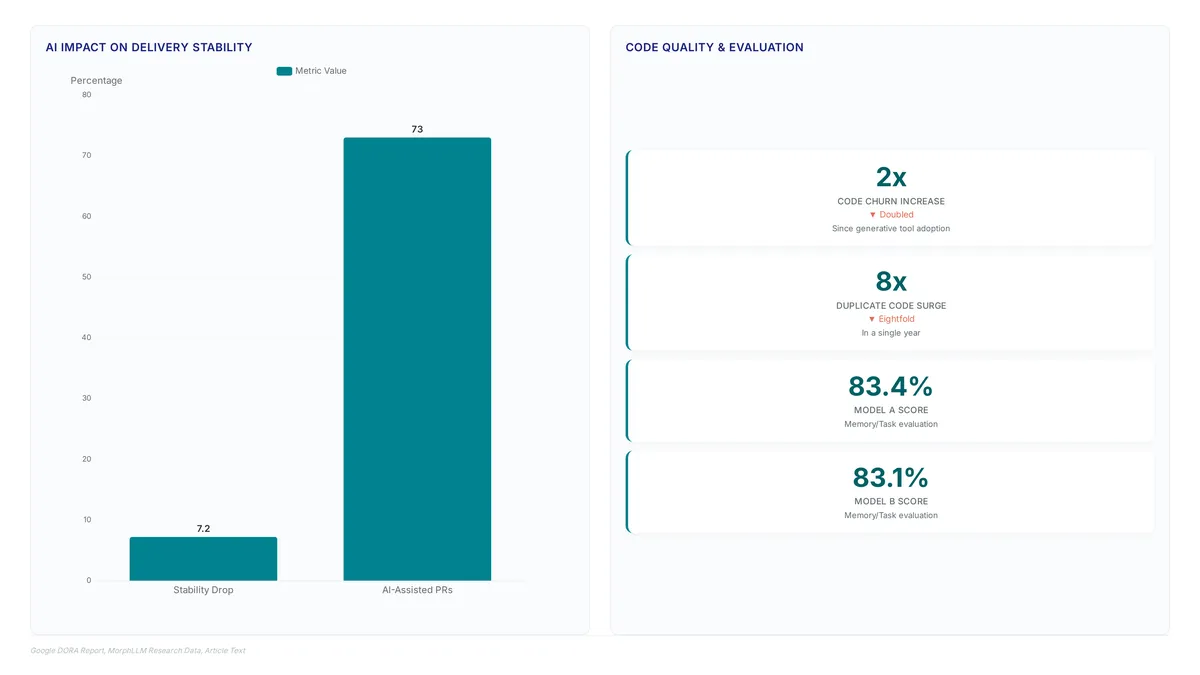
The Earth Badge declares the human name on the commit line serves as the ultimate accountability mechanism. AI agents execute workflows yet lack the contextual grasp to guarantee system stability without oversight. Code churn has roughly doubled as groups adopt generative tools without rigorous review. Google's DORA report indicates delivery stability dropped 7.2% alongside increased AI adoption, proving speed often compromises reliability. 73% of pull requests are now AI-assisted, yet duplicated code blocks have surged eightfold in a single year.
Developers who merge unverified code treat the AI agent as a source of finished products instead of a tool requiring strict oversight. Such shortcuts bypass the critical evaluation phase where logic errors and security flaws typically surface. Modern evaluation criteria now score systems on memory retention and task handling rather than simple completion accuracy. Ignoring these dimensions leaves production environments vulnerable to subtle failures that pass initial syntax checks.
The duplication happens because agents prioritize immediate task completion over global context awareness, reinventing existing logic rather than refactoring, and copy/pasted lines finally exceeded refactored lines for the first time in historical datasets.
| Metric Trend | Consequence | Root Cause |
|---|---|---|
| Duplicated Blocks | 8x Increase | Lack of global context |
| Code Churn | Roughly Doubled | Unverified agent commits |
| Refactoring Rate | Declining | Preference for generation |
High benchmark scores do not guarantee clean repositories. The limitation lies in the agent's inability to perceive long-term degradation while optimizing for short-term feature delivery. Automation without rigorous human oversight accelerates technical decay quicker than manual development ever could. Builders must verify every commit because their name remains on the final build.
About
Priya Nair serves as AI Industry Editor at AI Agents News, where she tracks the business dynamics behind autonomous coding tools. Her daily work involves rigorously verifying product claims and analyzing market shifts for platforms like Claude Code and Devin, making her uniquely qualified to dissect the nuances of "agentic engineering." This article's focus on distinguishing genuine software creation from AI-generated noise directly mirrors her professional mandate to separate fact from vendor hype. By evaluating the "Soul Badge" concept, Nair applies her expertise in source verification to help engineers navigate the risks of trusting AI outputs blindly. Through her lens at AI Agents News, readers gain a trustworthy, neutral perspective on evolving agent capabilities, grounded in the same factual accuracy she demands for all industry reporting.
Conclusion
Scaling AI agents reveals a breaking point where speed erodes structural integrity: the forEach loop that skipped its awaits passes review, and so does the duplicated block nobody read. Both defects share one property. They look correct at the moment of merge and surface later as work that never ran or code nobody can maintain, which is why neither a passing demo nor a benchmark score reports them.
That is what the badges actually name: reading structured logs on a normal day, checking a generated loop against the known async pitfalls, and putting your name on a diff you traced yourself. The agent will not run those checks for you, because asking it to verify its own output returns the same confident text that produced the defect. Human oversight is not the stage of the workflow that autonomy removes; it is the part autonomy makes load-bearing.
Frequently Asked Questions
The Soul Badge exposes 211 million lines of code that look correct but fail silently. The volume matters because the defect is invisible at review time: a three-user demo passes, and the skipped await only shows up as dropped work once real load arrives.
The loop never waits for the promises it starts, so the main thread proceeds and the console log prints before the notifications finish sending. Replacing the pattern with for...of or Promise.all restores the sequencing that a syntax check cannot enforce.
73% of pull requests are now AI-assisted, and duplicated code blocks surged eightfold in a single year. The pairing is the finding: generated code enters the repository faster than anyone reads it, so the review step rather than the generation step is where capacity ran out.
Delivery stability dropped 7.2% alongside increased AI adoption, and code churn roughly doubled over the same adoption curve. Stability is measured after the merge, so the drop counts precisely the failures that passed review, which is why tracing one request end-to-end while the system is healthy is the countermeasure.
No. Asking an LLM to verify its output often yields more slop instead of corrections, and the model will agree with a wrong premise stated with conviction, producing a cache invalidation fix for a bug that lives elsewhere. Verification has to come from outside the session: run the code, and cross-reference every generated call against official documentation.
References