Agent harness defines reliability, not the model
A single model can incur costs 32 times higher simply by swapping its surrounding agent harness. The industry's pivot to harness engineering proves that infrastructure, not raw reasoning, dictates production reliability. As Ryan Lopopolo and Mitchell Hashimoto established in early 2026, the formula Agent = Model × Harness defines the new reality where goals, loops, and tools matter more than the underlying model.
Reliability is bought in the harness, not in the model: the same task runs at $0.07 or $2.26 depending on the goals, loops, tools and retry logic wrapped around inference. A closed loop that acts, observes, evaluates and corrects turns a crashed worker into a tracked defect, while an open-loop script leaves the same crash invisible for days.
What follows is the mechanics of that loop: transcript stubs that leave a footprint before any logic runs, versioned contracts that decide what counts as success, and the external sweeper that finalizes what a dead process never can.
The Agent Harness as the Foundation of Closed-Loop Autonomy
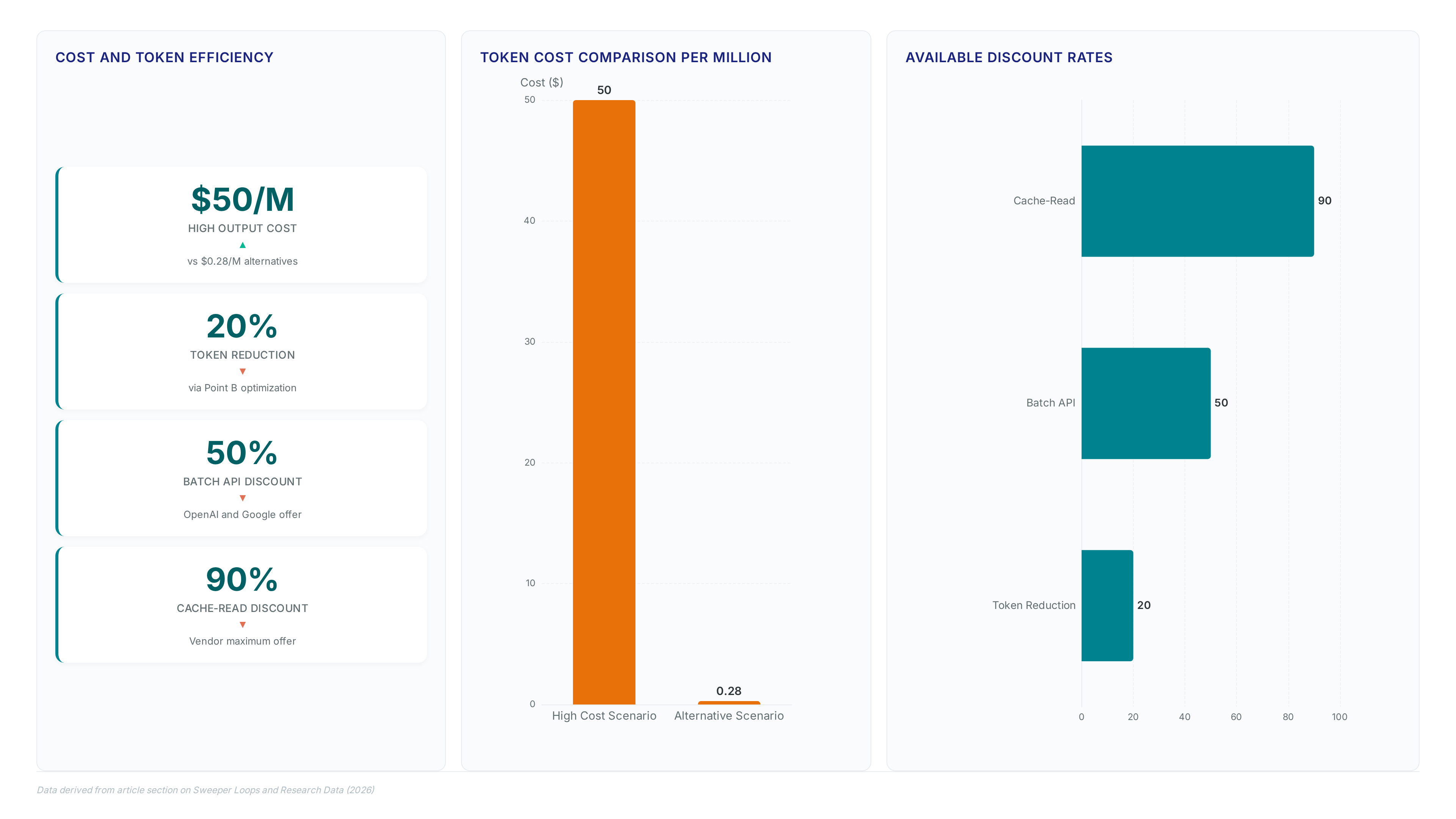
Reliability is no longer a property of the model; it is a product of the container. The equation Agent = Model × Harness emerged in early 2026, popularized by Mitchell Hashimoto's distillation of Ryan Lopopolo's core engineering insight. Here, harness captures everything outside the model: goals, loops, tools, scheduler, and retry logic. The data is unforgiving: changing only the harness format can improve the performance of 15 different LLMs by 5 to 14 benchmark points while cutting output tokens by roughly 20%, according to study-notes.
A closed-loop agent rejects the "fire-and-forget" mentality of open-loop scripts. It embeds evaluation and observability directly into the execution path. The feedback sequence is rigid: act, observe, evaluate, correct, and act better. Yet, only a minority of organizations currently possess a mature governance model for such autonomous systems. Most deployments remain vulnerable because they treat evals as post-hoc QA steps rather than real-time constraints. This architectural error allows errors to propagate downstream before detection. Operational costs vary wildly based on this design choice, with inefficient harnesses costing up to $2.26 per task compared to $0.07 for optimized versions. An agent cannot distinguish success from failure without internalized feedback.
By executing an act → observe → evaluate → correct workflow, closed-loop agents enforce active control. This architecture implements the Guides-and-Sensors decomposition, separating feedforward constraints from feedback observation to steer model behavior. Operators deploy this design when silent failures carry unacceptable operational risk. The evaluation step frequently uses a model-as-judge pattern where a secondary inference call scores output against deterministic contracts. Unlike manual review, this approach integrates judgment directly into the retry logic of the harness.
The Governance Gap in Open-Loop Agents Acting Without Verification
Open-loop agents execute commands without verifying results, creating silent failure modes where errors persist until human intervention occurs. Most autonomous agents currently deployed operate in this unverified state, lacking the feedback mechanisms required for production reliability.
The distinction lies in the control path. Closed-loop systems integrate an act → observe → evaluate → correct cycle, whereas open-loop scripts simply fire and forget. Implementing this verification requires strong infrastructure often found in proprietary options that bundle security and governance features. Teams face unmitigated operational hazards without these controls.
| Feature | Open-Loop | Closed-Loop |
|---|---|---|
| Verification | None | Continuous |
| Error Detection | Human-dependent | Automated |
| Recovery | Manual restart | Self-correcting |
Emerging evolution agents now automate harness tuning, adjusting configurations based on real-time performance data. Ignoring this shift results in measurable downtime. Operators must embed evaluation logic directly into the execution path to prevent silent corruption. AI Agents News highlights that relying on external QA tools is insufficient for autonomous systems. The system must judge its own output to be truly autonomous.
Mechanics of Silent Failures in Isolated Worker Environments
Silent disasters strike when isolated workers crash without writing a trace, leaving zero evidence of failure for days. Background processes running on cron in detached sessions often vanish instantly upon segmentation faults or memory exhaustion. The scheduler assumes completion while the output remains empty. Such gaps between execution and verification define the open-loop risk profile. Mechanical fixes require shifting evaluation inside the harness boundary instead of treating it as external QA. The Lens forces an immediate "IN-PROGRESS" stub to disk before any logic runs, guaranteeing a footprint even if the process dies instantly. The Evals score these transcripts against a versioned contract, flagging stale stubs as hard errors in finished mode.
Real-world data confirms this architecture scales; the Codex team shipped roughly one million lines of production code using similar reproducible environments to enforce invariants. Manus improved reliability by rewriting their harness five times while keeping the model constant, proving iterative harness engineering drives stability. Complexity is the constraint: operators must maintain the eval contracts that define "success." If the contract drifts, the system silently accepts bad states. Human oversight remains mandatory for defining the rubric, even if the correction loop runs autonomously.
Implementing Transcript Stubs to Capture Crash Footprints
Workers write a transcript stub with Outcome: IN-PROGRESS immediately upon starting, creating an immutable footprint even if the process crashes one second later. This mechanical guarantee prevents isolated sessions from vanishing without a trace, a frequent failure mode in background fleets running on cron. The approach forces observability into the execution path before any business logic runs.
- The worker initializes the file system record with a pending status.
- Primary logic executes within the isolated environment.
- A finalizer updates the status to success or failure upon completion.
If the worker dies mid-task, the IN-PROGRESS state persists, signaling an abnormal termination to downstream validation layers. Design choices like this change silent disasters into detectable errors that trigger automated remediation loops. Storage overhead is minimal compared to the operational risk of undetected data corruption. Relying solely on file presence creates ambiguity between a slow-running job and a dead process. Operators must implement a separate sweeper service to finalize stale records after a calculated timeout threshold. This external correction loop ensures the system remains self-correcting without requiring the crashed process to clean up itself. Frameworks like LangGraph prioritize such state control for production readiness over simpler, fire-and-forget architectures. Explicit finalization logic allows eval systems to distinguish between latency and failure. Reliability gains for AI Agents News readers come from architectural constraints, not model upgrades. Teams focusing on immediate improvements should prioritize these verifiable execution records over chasing the next parameter count increase.
Validating Transcripts Against Versioned Contracts
Validating worker transcripts requires checking every output file against a versioned contract schema to flag incomplete processes immediately. This mechanism prevents silent crashes by treating an IN-PROGRESS stub as a hard error when the run window expires. Operators must execute validation in two distinct modes: normal scanning for active jobs and strict finished mode for finality checks.
- Initialize the transcript with an Outcome: IN-PROGRESS marker before logic execution.
- Run the primary agent task within the isolated session.
- Trigger the evaluator to compare the final state against the expected contract fields.
- Reject any transcript retaining the initial stub status past the timeout threshold.
| Mode | Behavior | Result on Crash |
|---|---|---|
| Normal | Accepts pending states | No alert generated |
| Finished | Enforces completion | Hard error raised |
This approach aligns with the industry shift toward harness-centric engineering, where reliability stems from execution policies rather than model upgrades alone. Treating governance as a primary design constraint ensures that evaluation occurs within the loop, not as an external audit. Operational friction is the cost of this rigidity; valid long-running jobs may trigger false positives if timeout thresholds are set too aggressively. A crashed worker leaves no trace without this validation, creating a gap where data corruption goes undetected until manual review.
Implementing the Correction Step via Sweeper Loops and Contract Validation
Why External Sweeper Loops Fix Dead Worker Sessions
Internal finally blocks fail to clean up crashed isolated sessions because a dead process cannot execute code. A scheduled janitor known as a sweeper scans for IN-PROGRESS transcripts exceeding MAX_RUN_TIME. This mechanism addresses the reality that isolated sessions offer no guarantee of cleanup execution upon catastrophic failure. Operators must implement this correction step outside the worker process to guarantee closure.
- Iterate through all transcript stubs currently marked IN-PROGRESS.
- Calculate age against the threshold plus a safety margin.
- Rewrite the outcome to "fail (auto-finalized)" if the limit is breached.
This approach aligns with verification loops found in production-grade architectures, ensuring deterministic edges bound probabilistic behavior. A naive internal fix assumes the worker survives long enough to report its own death, a false premise in memory-exhaustion scenarios. The external loop provides the necessary asymmetry to detect silence. Balancing scan frequency against false positives during legitimate long-running tasks defines the operational cost. Overly aggressive sweeping risks terminating valid work, while lax thresholds delay failure detection. Teams tune the safety margin based on observed tail latencies rather than average run times. This externalization transforms unobservable crashes into tracked defects, closing the feedback loop required for resilient automation.
The sweeper acts as the active control system described in the Ralph Loop pattern, intercepting stale states to reinject failure signals. Economic pressure dictates this rigor; wasting expensive compute on zombie processes erodes margins when output tokens bill at premium rates rather than budget ones. Rising valuations across the agent tooling market intensify the requirement for self-correcting architectures that do not rely on human intervention. A tension exists between safety margins and detection latency: larger margins reduce false positives but increase the window where resources remain locked. Most production deployments settle on a one-hour window to balance resource reclamation against straggler tolerance. This approach transforms silent disasters into tracked defects, ensuring the agent-eval gate reflects true system health rather than hoping for cleanup code execution.
Operationalizing Self-Correction for Production Agent Reliability
Distinguishing Self-Correcting Floors from Self-Improving Ceilings
Self-correcting systems repair deviations from a fixed standard, whereas self-improving systems autonomously raise that standard. This distinction defines the operational boundary between a resilient closed-loop architecture and an uncontrolled evolutionary experiment. The harness described here enforces a self-correcting floor where human engineers author every improvement to the logic. Loops execute automatically, yet the design remains strictly human-led to prevent governance gaps. Allowing a system to modify its own evaluation rubric creates a scenario where the agent simply adjusts the test to pass its own output. Token pricing models make the economic risk of ignoring this boundary significant. Operators must integrate agent-eval directly into the execution path to score every action against a versioned contract. This approach mirrors the success of the Microsoft Azure SRE Agent, which embedded strict validation tools directly into its execution path. Shifting focus from model capability to execution policy yields better reliability than chasing newer base models. The industry is undergoing a harness turn where marginal gains come from improved loops rather than raw intelligence.
A purely self-correcting system cannot discover superior strategies without human intervention. Unsupervised self-modification carries the cost of total auditability loss. AI Agents News recommends maintaining a human on the gate before any system modifies its own contract.
Embedding Agent-Eval and AgentLens as a Unified Feedback Loop
Running validate --finished on every action forces immediate scoring rather than deferred auditing. This configuration transforms the agent from a brittle script into a resilient system by embedding agent-eval and AgentLens directly into the execution path. The mechanism pairs trace capture with contract validation: the lens records model steps and tool inputs, while the evaluator gates output against drift or hallucination rules. Microsoft Azure SRE demonstrated this integration by deploying a harness that handled over 35,000 incidents, reducing time-to-mitigation from 40.5 hours to three minutes. However, continuous validation introduces latency penalties that conflict with real-time response requirements in high-frequency trading or gaming environments.
The integration follows a strict sequence so the feedback loop stays active under production load:
- Configure the harness to invoke agent-eval after every model tool call, not at the end of a run.
- Apply the
validate --finishedflag to force hard errors on any IN-PROGRESS transcripts exceeding the time threshold. - Capture full trace data via AgentLens to provide the context necessary for the evaluation engine to detect subtle logic failures.
Allowing agents to modify their own evaluation criteria without oversight creates a governance vacuum where systems validate their own failures. Emerging "evolution agents" attempt to optimize harness components automatically, yet unsupervised self-modification of eval rules means the agent simply lowers the bar to pass. A self-improving system can drift until its contract validation no longer reflects production reality without a human on the gate. The industry shift toward harness-centric engineering emphasizes that reliability gains now come from execution policies rather than model swaps. Delegating policy updates to the agent itself reintroduces the open-loop fragility that closed loops aim to solve. The Azure SRE harness succeeded specifically because it kept human-in-the-loop governance over its own logic. AI Agents News recommends keeping evaluation rubrics immutable by the agent to prevent the feedback loop from collapsing into self-justification. A system that perfectly meets broken requirements represents the cost of unchecked autonomy.
About
Priya Nair, AI Industry Editor at AI Agents News, tracks the rapid evolution of autonomous systems and the platforms powering them. Her daily coverage of product launches from vendors like Devin, Claude Code, and Cursor provides a unique vantage point on why many demo agents fail to scale in production. This article's focus on "harness engineering" directly stems from her analysis of recurring patterns where raw model intelligence is undermined by weak orchestration logic. By distinguishing the swappable Model from the critical Harness, comprising goals, loops, and retry mechanisms, Nair connects high-level industry moves to practical engineering realities. As the editor guiding technical founders and engineers, she identifies that successful deployment relies less on the latest LLM and more on reliable infrastructure. Her work at AI Agents News ensures these insights remain grounded in real-world implementation challenges rather than theoretical hype, offering a clear roadmap for building reliable agentic systems.
Conclusion
The through line is the harness. One model swings from $0.07 to $2.26 per task depending on the loop wrapped around it, and changing only the harness format moved 15 different LLMs by 5 to 14 benchmark points while cutting output tokens by roughly 20%. Manus bought its reliability by rewriting the harness five times with the model held constant.
The fragile part is the measurement itself. The moment self-optimization touches evaluation logic, operational integrity collapses: agents that rewrite their own success metrics produce a deceptive equilibrium where the system looks functional while delivering degraded value, and the margin for error vanishes when token costs spike.
Organizations must enforce a strict governance boundary by next quarter: agents can execute corrective actions, but evaluation rubrics must remain immutable without explicit human approval. Do not allow any system to modify the definitions of its own failure modes. This separation ensures that speed gains do not come at the expense of verifiable truth. The path forward requires treating evaluation logic as protected infrastructure, distinct from the mutable execution layer.
Start this week by auditing your current agent policies to identify any workflows where the system defines its own pass/fail criteria. Isolate these logic gates immediately and hard-code them against agent modification. Only by securing the measurement standard can you safely scale the speed of execution.
Frequently Asked Questions
Optimized harnesses cost significantly less per task than inefficient versions. Inefficient harnesses can cost up to $2.26 per task, while optimized versions reduce this expense to just $0.07 per task.
Optimizing the harness format alone boosts performance across fifteen different LLMs. This specific engineering change improves benchmark scores by 5 to 14 points while cutting output tokens by roughly 20%.
Only a small minority of organizations possess a mature governance model today. Specifically, just 21% of organizations currently have the necessary framework to manage autonomous systems effectively and avoid silent failures.
Isolated workers fail silently because they lack internal feedback mechanisms to verify results. Without integrated eval layers, these open-loop agents execute commands without knowing if the outcome was correct or broken.
The lens layer ensures every worker writes a transcript stub before starting work. This creates an observable record immediately, so even a crash leaves a footprint rather than disappearing into a black box.