Token efficiency: Cut prompts to 250 tokens
Short prompts of ~250 tokens keep models in peak form, while longer inputs cause measurable degradation. By adhering to strict brevity, users can extract premium-tier productivity from budget models like GPT-4.1-mini, DeepSeek-V3, and Phi-4 without sacrificing output quality.
Accuracy loss increases by 5% per 500 extra tokens. That is the metric that matters. High-density prompt framing removes fluff to achieve a 70% word reduction in technical queries and up to ~85% in creative scenarios. Strategic model selection handles diverse workloads, ranging from Meta-Llama-3.* to Mistral Small. Explicit output constraints, such as requesting JSON formats or limiting responses to one paragraph, prevent the token bloat that plagues 800+ token prompts. Gartner forecasts that 70% of enterprises will deploy AI-driven prompt automation by 2027, making these efficiency skills mandatory rather than optional for modern development teams.
The Role of Token Efficiency in Cost-Effective AI Operations
Defining Token Efficiency and Information Density in Prompts
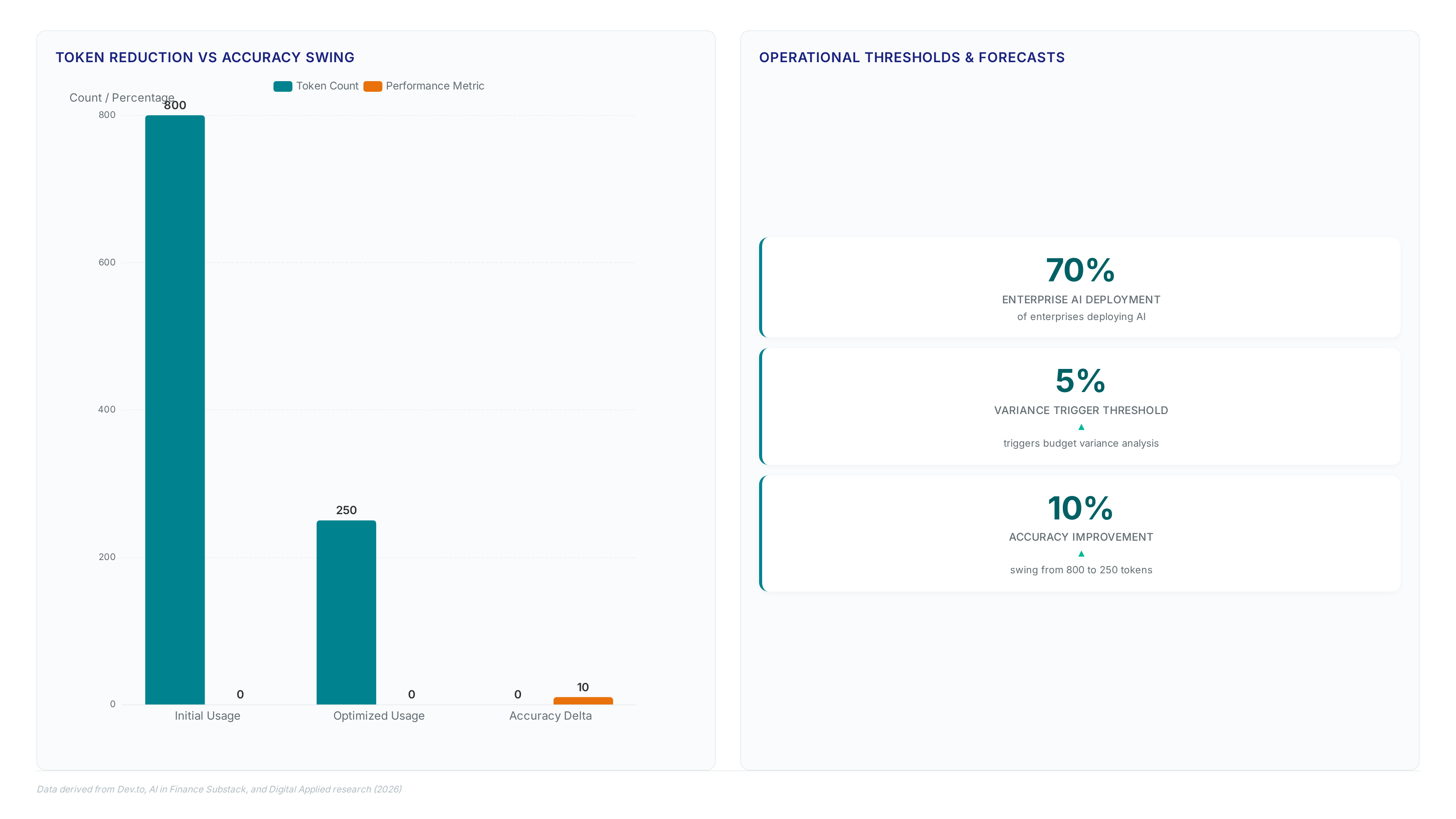
Token efficiency maximizes information density while minimizing token count to cut costs and latency. Brevity in prompt engineering means packing maximum meaning into minimum space, a practice that directly lowers the primary cost driver in budget prompt engineering. A specific optimization case demonstrated that reducing token usage from 800 to 250 resulted in a 10% accuracy swing, effectively turning a "B- student" into an "A+ nerd" level of output quality. This shift demands strict input pruning where every word counts toward the total token limit and cost, a mechanism known as token budgeting.
We are moving past simple prompt engineering into Context Engineering, a discipline expected to mature by 2027. This evolution moves beyond single-query crafting to designing systems that manage retrieval pipelines and memory. However, aggressive token reduction risks omitting necessary constraints, potentially increasing iteration cycles if the model misinterprets the condensed intent. Prompt engineers must balance density with clarity to avoid ambiguous instructions that degrade output reliability. Complex reasoning sometimes requires expanded context windows, creating a friction point between cost savings and computational depth.
Applying the Burger Prompt Framework for Budget Models
The Burger Prompt framework structures inputs into Top Bun context, Meat task, and Bottom Bun output to maximize model efficiency. Operators apply this tri-layer syntax to maintain high information density while avoiding performance degradation associated with verbose instructions. Isolating role definition, specific action, and format constraints prevents the model from diluting attention across irrelevant tokens. This approach directly addresses how short prompts improve accuracy, as excessive verbiage often obscures the primary directive.
| Component | Function | Example Constraint |
|---|---|---|
| Top Bun | Sets Role & Context | "You are a Python expert..." |
| Meat | Defines Action | "...fix the loop error..." |
| Bottom Bun | Specifies Format | "...output JSON only." |
Providing sufficient context often clashes with the brevity required for budget models like GPT-4.1-mini, DeepSeek-V3, Phi-4, Meta-Llama-3.*, and Mistral Small/Medium. Complex reasoning tasks might tempt users to add explanatory fluff, yet such additions increase token counts and risk accuracy loss. Clear output specifications are necessary, as vague requests force the model to guess formats, wasting tokens on correction rather than computation.
Prompt templates must enforce strict delimiters to separate instruction from data. Without rigid structural boundaries, even budget-friendly models may hallucinate constraints or ignore format requirements. Engineers should optimize all sections of the prompt structure, as every token contributes to the overall cost and potential latency of the operation.
Risks of Token Bloat and Manual Prompt Obsolescence
Verbose prompts trigger measurable accuracy decay, whereas concise inputs maintain peak model performance. This token bloat forces the language model to distribute attention across irrelevant context, directly degrading output quality. Financial exposure compounds as manual prompt crafting becomes viewed as obsolete low-level assembly language, creating unsustainable labor overhead for production systems.
Emerging frameworks like DSPy 3.0 now compile prompts automatically from input-output signatures, bypassing the fragility of human-written instructions. This shift to automated compilation reduces the risk of human error while optimizing for specific model constraints dynamically. Relying on static manual prompts introduces a hidden maintenance debt; as underlying model weights update, hand-tuned phrasing often breaks silently, requiring constant re-validation. Teams sticking to manual methods face compounding costs where labor exceeds inference spend. The strategic imperative is clear: treat prompts as compilable assets rather than static text to mitigate obsolescence risk.
Deploying Zero-shot and Few-shot Framing for Coding Tasks
Zero-shot execution handles trivial trivia lookups by demanding strict output constraints like "[year only]" to suppress verbose reasoning. This direct instruction method eliminates example overhead, making it ideal for simple fact retrieval where the model's training data is sufficient. Complex coding tasks often require explicit context about environment and version since models have less training data on older technologies.
Few-shot framing addresses this complexity by supplying 2-5 input-output pairs that guide the model toward the desired syntax and logic pattern. For "Glorified Stack Overflow" scenarios, providing a minimal code snippet alongside expected versus actual behavior notably improves fix accuracy compared to vague descriptions. Legacy stacks like WinForms require this explicit contextual grounding since training data density drops for older technologies.
| Technique | Example Count | Best Application |
|---|---|---|
| Zero-shot | 0 | Trivia, simple extraction |
| Few-shot | 2-5 | Complex code refactoring |
Operators must balance the token cost of examples against the risk of hallucination in high-stakes debugging workflows. Adding examples increases input tokens, yet skipping them on complex tasks invites logical errors that require costly re-prompts. Strategic free tier stacking allows engineers to absorb these extra tokens without breaching budget limits, effectively trading cheap input tokens for expensive output corrections. Reserve few-shot patterns for complex tasks where the model requires guidance, and rely on zero-shot directives for deterministic data extraction.
Validation Checklist for Removing Filler Words and Rhetorical Questions
Audit prompt inputs by stripping politeness markers like "please" and "really" to reclaim roughly 30% of token capacity. Eliminating rhetorical inquiries such as "Can you explain?" preserves an additional 20% of the context window for substantive data. This linguistic compression directly supports high-density framing required for efficient prompt execution.
- Scan input for hedge words and remove them.
- Replace questions with direct Zero-shot commands.
- Verify the model receives only necessary constraints.
Teams must balance token savings against the potential need for explicit disambiguation in edge cases.
Strategic Model Selection for Budget and Multilingual Workloads
GPT-4.1 Mini vs DeepSeek-V3 Pricing and Capability Definitions
GPT-4.1 Mini operates at $0.40 input and $1.60 output per million tokens, prioritizing latency for general tasks. Such pricing forces teams to rewrite model routing logic where complex code generation once defaulted to expensive tiers. The cost is architectural. Routing queries to the cheapest capable model becomes a core strategy instead of defaulting to the most expensive option. This distinction matters when scaling from prototype to production because unchecked token accumulation in high-volume APIs erodes margins quicker than infrastructure overhead. Builders must implement strict routing rules based on prompt complexity rather than relying on a single provider.
Mapping Multilingual Code Tasks to Mistral and Llama-3.3
European codebases favor Mistral Small due to native multilingual tokenization efficiency. This advantage reduces preprocessing overhead when handling mixed-language repositories common in regional enterprises. The Meta-Llama-3.3 70B model addresses latency constraints by delivering inference speeds exceeding 300+ tok/sec via Groq infrastructure, making it the definitive choice for voice agents and live chat interfaces. Llama excels in throughput. Mistral remains noted for strengths in multilingual and code tasks.
| Feature | Mistral Small/Medium | Meta-Llama-3.3 70B |
|---|---|---|
| Primary Strength | Multilingual code | Real-time latency |
| Best Use Case | European projects | Voice agents |
| Throughput | Standard | 300+ tok/sec |
| Cost Model | Budget tier | Free via Groq |
Routing logic should direct batch translation and complex refactoring to Mistral, while interactive sessions require the low-latency path of Llama. Flexible task routing prevents costly token waste on models ill-suited for specific workload types. A tension exists between linguistic accuracy and response time. Maximizing one often degrades the other. This constraint dictates that production architectures implement a dual-model strategy rather than seeking a universal solution.
Escalation Triggers: When to Upgrade from Budget to Mid-Tier APIs
Free tiers often impose strict rate limits that halt batch processing or high-frequency polling before daily quotas reset. Operators must monitor request velocity against provider caps to prevent service degradation during peak usage windows. Stacking free tiers of various AI services strategically allows organizations to achieve premium-tier productivity at near-zero cost, though this requires careful management of limits and contexts. Google AI Studio offers Gemini 2.5 Flash with 1M context, best for prototyping long-context needs.
| Provider | Constraint Type | Escalation Trigger |
|---|---|---|
| Groq | Throughput cap | Real-time chat demands exceed capacity |
| OpenRouter | Rate limit | Multi-agent coordination requires parallel calls |
| Mistral | Frequency cap | Sustained production traffic outpaces the free quota |
| Cerebras | Volume cap (~1M tokens/day) | Batch jobs process over 1M tokens daily |
OpenRouter restricts access, which can stall complex workflows requiring parallel model calls. The hidden cost of free tiers is latency variability; as shared resources saturate, response times spike unpredictably compared to reserved capacity. Stacking free tiers mimics premium productivity initially. The operational overhead of managing multiple API keys and fallback logic often outweighs the savings.
Implementation Steps for Iterative Refinement and Output Troubleshooting
Defining Iterative Refinement Cycles for Prompt Optimization
Iterative refinement functions as a diagnostic loop where operators adjust prompt constraints to arrest output degradation. Unlike one-shot strategies that accept initial model variance, this process isolates failure modes by systematically reducing token density. As the industry transitions from simple prompt engineering to Context Engineering, focusing on the structural integrity of input data becomes paramount for maintaining performance.
- Execute an initial query using the Burger Prompt framework to establish baseline context and task boundaries.
- Analyze the response for logical drift or hallucinated details rather than mere formatting errors.
- Condense rules and remove unnecessary phrasing to maximize information density, as the primary cost driver is token count.
- Re-run the prompt, comparing the new output against the previous iteration to verify constraint adherence.
Reasoning models generate internal reasoning tokens that incur significant costs if not explicitly managed. Builders must distinguish between prompts requiring deep logical derivation versus those needing only concise data extraction. This rigor transforms prompt creation from manual assembly into a repeatable operational process.
Applying Hybrid Model Workflows for Technical Documentation
Routing tasks to optimal models is a core strategy, where queries are directed to the most capable system for the specific task rather than defaulting to a single provider. For technical documentation, this involves using specific model strengths: using reasoning-capable models for complex argumentation and standard models for strict template adherence.
- Generate core technical explanations using a model suited for complex reasoning to maintain argument depth across documentation sets.
- Pass the resulting text to a cost-effective production model with strict instructions to format headers, code blocks, and API parameter tables.
- Validate the final output against source code to ensure no hallucinated endpoints remain in the documentation.
Ignoring this hybrid workflow produces verbose, circular documentation that fails to guide developers through implementation steps effectively. Single-model approaches simplify the stack yet often require extensive manual editing to fix degraded output from long prompts. Semantic caching prevents redundant API calls during this multi-stage process, storing previous query results to reduce overall token consumption. This configuration is recommended for teams producing high-volume API references where accuracy and format consistency are non-negotiable requirements.
Validation Checklist for Token Budget and Context Limits
Reducing prompt length prevents the accuracy degradation observed in verbose contexts. Operators must verify input size against model limits before execution to maintain output quality and control costs.
- Calculate total token count and trim verbose phrasing to eliminate hidden overhead.
- Isolate reasoning tokens that incur billing costs without appearing in standard output logs.
| Constraint Type | Failure Mode | Mitigation Strategy |
|---|---|---|
| Input Length | Logic drift | Enforce token soft caps |
| Hidden Costs | Budget overrun | Allocate separate token pool |
| Variance | Noise generation | Set trigger threshold |
Shrinking context yields measurable accuracy improvements, effectively upgrading model performance by removing noise. Advanced reasoning models introduce invisible costs because reasoning tokens are billed separately, requiring distinct budget allocation strategies. Monitoring these hidden counts is necessary to prevent unexpected expenditure spikes during iterative refinement cycles.
About
Marcus Chen, Lead Agent Engineer at AI Agents News, brings rigorous engineering discipline to the economics of prompt design. His daily work involves orchestrating complex multi-agent systems using frameworks like LangGraph and AutoGen, where inefficient token usage directly inflates operational costs and degrades model performance. This article distills his practical experience managing production workflows into actionable strategies for maximizing information density while minimizing expense. By focusing on budget-friendly models such as GPT-4.1-mini and DeepSeek-V3, Chen addresses a critical pain point for developers building scalable agent architectures. At AI Agents News, an independent hub dedicated to technical founders and engineers, the mission is to provide factual, comparative analysis free from vendor hype. Chen's "Burger Prompt" framework reflects this commitment, offering a structured approach to maintain accuracy without unnecessary token bloat. For engineers evaluating the financial viability of autonomous agents, his insights bridge the gap between theoretical efficiency and real-world deployment constraints.
Conclusion
Scaling prompt operations reveals that logic drift becomes the primary failure mode when context windows swell with conversational filler. While shrinking inputs from 800 to 250 tokens can swing accuracy by 10%, the operational reality is that hidden reasoning costs often outpace visible output charges. Teams relying on single-model workflows for high-volume documentation face a compounding debt where manual editing to fix degraded outputs erodes the initial savings from cheaper token pricing. The budget advantage of models like GPT-4.1 Mini disappears if you do not isolate reasoning tokens that incur billing costs without appearing in standard logs.
Adopt a hybrid workflow immediately if your team produces more than fifty API references weekly. Use expensive reasoning models strictly for drafting logic, then pass results to cost-effective production models for final formatting. This separation prevents the noise generation that triggers variance failures in long contexts. Do not attempt to force one model to handle both deep reasoning and strict formatting simultaneously, as this invites the very hallucinations you aim to avoid.
Start by auditing your current token logs this week to identify hidden reasoning charges before your next billing cycle closes. Calculate the ratio of reasoning tokens to output tokens to see if your budget allocation matches your actual usage patterns.
Frequently Asked Questions
Accuracy drops 5% for every 500 extra tokens used. You must prune prompts to roughly 250 tokens to maintain peak model performance and avoid this measurable degradation in output quality.
Technical queries can achieve 70% word reduction by stripping conversational filler. This aggressive pruning maximizes information density while ensuring budget models process your intent without confusion or wasted compute resources.
Reducing usage from 800 to 250 tokens creates a 10% accuracy swing. This optimization transforms average results into high-quality outputs by forcing the model to focus on dense, relevant data.
GPT-4.1 Mini charges $0.40 per million input tokens for processing. This low entry price allows users to run high-volume workflows on budget models while maintaining strict control over operational spending.
Creative prompts can see word count reductions up to 85% when optimized. Applying strict delimiters and removing fluff ensures these models deliver premium productivity without the bloat of verbose instructions.
References