Microsoft AutoGen 1.0: Multiagent Orchestration Ready
Microsoft Research shipped the production-ready unification of AutoGen and Semantic Kernel as Microsoft Agent Framework 1.0 on April 3, 2026. This release marks the definitive shift from rigid, single-agent workflows to flexible multi-agent orchestration where specialized AI teams collaborate through dialogue rather than sequential instructions. Traditional deployment strategies fail because they impose deterministic structures on generative models that require iterative exploration and real-time error correction.
The new framework's layered architecture, spanning Core, AgentChat, and Extensions, enables progressive flexibility from rapid prototyping to advanced customization. Integrating these systems within Azure and Microsoft 365 creates the synergies required for secure, scalable enterprise adoption. Forcing linear workflows on generative AI leads to mechanical outputs, while event-driven architectures solve critical interoperability challenges.
By moving beyond the hype of isolated chatbots, organizations can deploy collaborative agent teams that handle complex financial analysis and reporting with genuine feedback loops. This approach ensures that scalability does not come at the expense of security or operational control.
The Role of Multi-Agent Orchestration in Modern Enterprise AI
AutoGen Core vs AgentChat Layered Architecture
Microsoft AutoGen functions as a structured platform rather than a monolithic tool, dividing execution mechanics from developer interaction into three distinct layers. The Core layer serves as an immutable foundation built on an actor model and asynchronous, event-driven messaging where every agent maintains independent state. This design guarantees reliable message passing without forcing developers to manage thread synchronization manually. Direct interaction with this layer remains rare since its primary purpose involves ensuring system stability and traceability.
Developers spend the vast majority of their time working within the AgentChat layer, the high-level interface where 68% of development work occurs. This tier supplies predefined agents like AssistantAgent, UserProxyAgent, and WebSurferAgent to structure interactions efficiently. Engineers define roles and orchestrate conversations in Python here, remaining completely abstracted from the underlying message bus. The framework supports specific design patterns, such as the Mixture of Agents, to organize these exchanges effectively.
Structural separation creates a distinct operational trade-off. AgentChat accelerates prototyping by simplifying multi-agent orchestration yet limits direct control over low-level message routing logic. Most enterprise deployments stay within AgentChat to use this speed, accepting the constraint of predefined interaction motifs. Such a layered approach enables organizations to evolve from simple conversational flows to complex distributed systems without rewriting the fundamental communication engine.
Orchestrating Specialized AI Teams with UserProxyAgent
Coordination replaces monolithic tasking as AutoGen allows specialized AI teams to handle specific roles without rigid sequential flows. Developers orchestrate these interactions by defining entities like AssistantAgent and UserProxyAgent in Python, avoiding direct manipulation of the underlying Core layer. This separation helps teams overcome single-model limitations by assigning distinct functions, such as fact-checking or research, to dedicated actors. One documented implementation successfully coordinated exactly seven specialized agents, including Architect and Editor roles, to produce technical content through collaborative dialogue. Static pipelines pale in comparison since a single model attempting all tasks linearly often lacks error-correction loops.
| Feature | Single-Agent Model | Multi-Agent Orchestration |
|---|---|---|
| Execution Flow | Linear, sequential steps | Flexible, event-driven conversation |
| Error Handling | Limited self-correction | Peer review via UserProxyAgent |
| Scalability | Constrained by context window | Scales by adding specialized roles |
Introducing multiple conversational entities does increase token consumption and requires careful management of termination conditions to prevent infinite loops. Reliance on asynchronous messaging means latency can accumulate if agents wait excessively for human feedback via the proxy interface. Operators must balance collaborative reasoning depth against the operational cost of prolonged inference times. Effective deployment demands rigorous monitoring of message counts rather than focusing solely on output quality.
Single-Agent Logic vs Microsoft Agent Framework Evolution
Linear execution frequently lacks the feedback loops necessary for self-correction and error handling in complex scenarios. The Microsoft Agent Framework addresses this gap by replacing rigid sequential pipelines with graph-based flows that enable flexible, event-driven coordination among specialized actors. By March 2026, the original AutoGen project had effectively split into three distinct evolutionary paths, clarifying the roadmap toward this unified production environment. This divergence allows builders to prioritize stability over experimental features when deploying on Azure or hybrid cloud infrastructures. Unlike earlier iterations relying on turn-taking speech, the new framework introduces explicit state management to handle multi-step business logic reliably.
| Feature | Single-Agent Logic | Microsoft Agent Framework |
|---|---|---|
| Execution Model | Linear, sequential steps | Event-driven graph flows |
| Error Handling | Hard failure or retry loop | Collaborative peer correction |
| State Management | Context window limited | Persistent session state |
| Scalability | Vertical (model size) | Horizontal (agent count) |
Reducing orchestration logic to configuration tasks lowers initial setup time but increases debugging complexity for silent coordination failures. The unified Microsoft Agent Framework inherits session-based state management from Semantic Kernel, offering advantages for long-running enterprise scenarios, yet the shift to asynchronous messaging requires rethinking how applications handle latency. Developers can consult multi-agent model standardization efforts to understand how abstractions like GroupChat are now formalized. Strategic implications remain clear: organizations must treat agent teams as distributed systems rather than simple function callers. This architectural shift demands rigorous governance protocols to prevent emergent behaviors from violating security policies during autonomous execution.
Inside AutoGen: Asynchronous Messaging and the Actor Model
Event-Driven Actor Model in AutoGen Core
AutoGen Core isolates state management within autonomous actors to prevent synchronization bottlenecks. Each agent is an autonomous actor managing its own state, communicating exclusively through asynchronous message passing rather than shared memory. Slow tasks run without blocking the entire system, enabling non-linear execution paths. Direct manipulation of this layer is rare because reliability takes priority over ease of access. This layer guarantees the reliability and traceability of interactions but is not meant to be manipulated directly by most developers. Rigorous overhead suits distributed deployments across regions yet complicates simple, single-process scripts. Builders accept that direct state intervention is impossible, forcing all coordination through set message protocols.
| Feature | Synchronous Model | Event-Driven Actor Model |
|---|---|---|
| State Management | Shared or Global | Encapsulated per Actor |
| Communication | Direct Function Calls | Asynchronous Messages |
| Failure Domain | System-wide Blocking | Isolated to Single Agent |
Debugging shifts from inspecting variables to tracing message flows. Teams gain durability against network partitions but lose the ability to instantly query an agent's current thought process without explicit message requests. Monitoring must shift from checking individual server health to tracing message flow across the entire actor graph.
Cross-Region Agent Deployment on Azure
A message published in Amsterdam may be processed by an agent instance in Singapore, demonstrating the geographic decoupling inherent in the architecture. This cross-region capability relies on the asynchronous, event-driven architecture where the Core layer handles state isolation without blocking global execution. AutoGen works well with orchestrators such as Kubernetes, allowing agent pods to scale dynamically based on regional load spikes rather than provisioning static infrastructure. Connecting AutoGen to existing APIs occurs through the Extensions layer, which wraps external endpoints like payment gateways or databases into standardized tool calls.
Distributed flexibility introduces complexity in maintaining data consistency across regions when network partitions occur. Security and interoperability remain high-priority concerns, necessitating careful planning to ensure governance across these distributed boundaries.
Navigating API Throttling and Data Consistency
OpenAI and Azure OpenAI Service enforce strict throttling limits that interrupt asynchronous agent loops when token consumption spikes unexpectedly. The event-driven architecture mitigates some latency by decoupling message production from consumption, yet upstream rate limits remain a hard constraint on throughput. The framework is designed to be model-agnostic, allowing developers to swap between different Large Language Models (LLMs), which directly impacts variable costs and throughput depending on the chosen provider.
Distributed state management introduces a second failure mode where concurrent writes corrupt the shared context window. For state management and data consistency in a distributed environment, modern architectures use patterns such as CQRS or event sourcing to separate read-optimized views from write-heavy command processing. This separation ensures that an agent in one region does not act on stale data generated by a peer in another geography.
| Constraint | Impact | Mitigation Strategy |
|---|---|---|
| API Rate Limits | Interrupts multi-turn reasoning | Token bucket algorithms in Extensions |
| Distributed State | Context incoherence across regions | Event sourcing for immutable logs |
| Network Latency | Delayed handoffs between actors | Asynchronous message queuing |
Local optimization cannot entirely bypass upstream congestion because external LLM providers control the pipeline. Asynchronous models improve scalability yet increase the window where data inconsistency can occur if event ordering is not strictly enforced. Enforcing strict consistency increases latency, forcing a choice between immediate data accuracy and system responsiveness. Scalability is possible, but it requires thinking in terms of distributed, event-driven architecture.
Deploying Secure and Scalable AI Workflows in Azure
Progressive Deployment Phases for AutoGen Enterprise Rollout
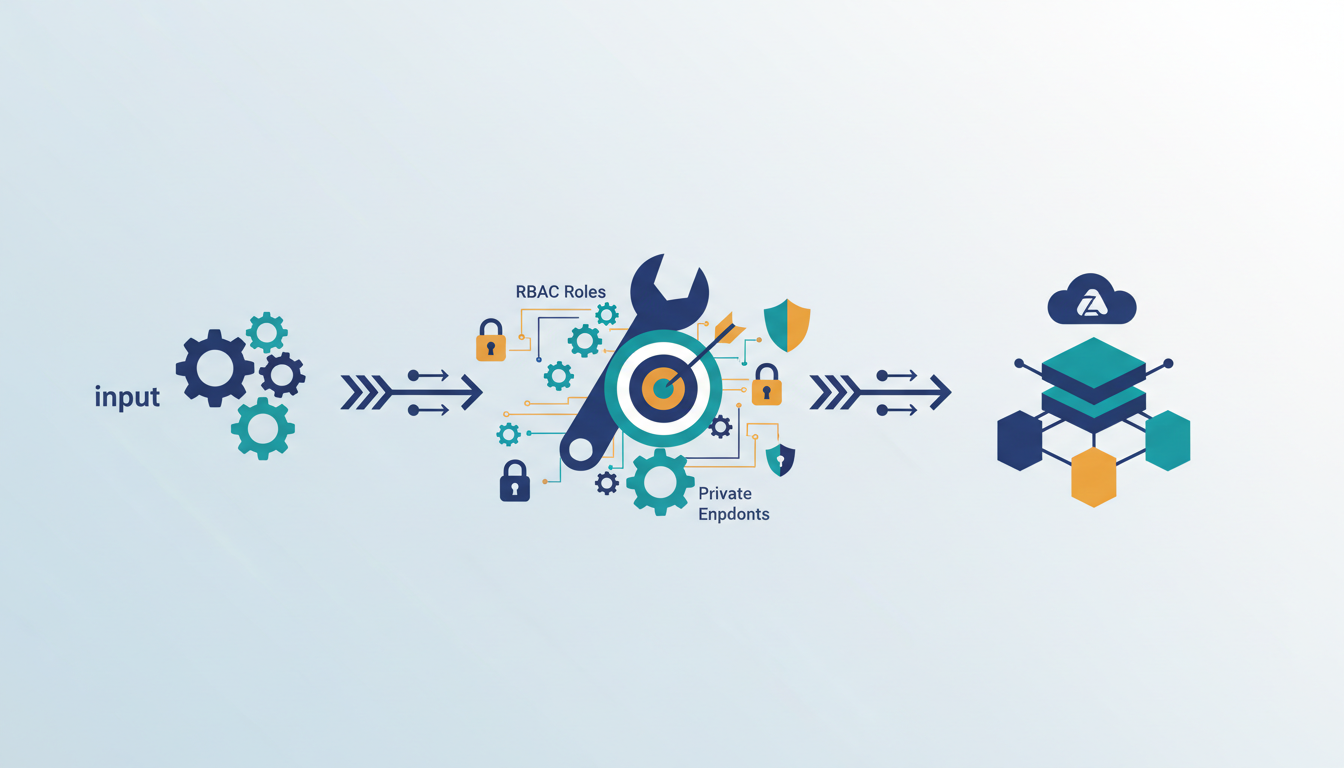
Enterprises validate business value during Phase 1 (weeks 1-4) by prototyping concrete problems with two or three agents using AgentChat. This initial window restricts scope to prove utility without complex infrastructure dependencies. Teams that attempt direct system integration here often encounter avoidable friction in prompt engineering.
Phase 2 (weeks 5-12) shifts focus to connecting existing CRMs and data warehouses through Extensions AutoGen. Authentication flows and API throttling policies become visible only when bridging these external systems. Organizations targeting the Q1 2026 maturity milestone apply this period to stabilize tool use patterns. The limitation is that legacy endpoint latency frequently degrades multi-agent dialogue coherence.
| Phase | Timeline | Primary Objective |
|---|---|---|
| Phase 1 | Weeks 1-4 | Rapid prototyping with AgentChat |
| Phase 2 | Weeks 5-12 | Integration with existing systems |
| Phase 3 | Weeks 13+ | Hardening and production rollout |
Phase 3 (weeks 13+) consolidates security posture and prepares infrastructure for scalability before full production release. Operators implement strict RBAC policies and audit trails to satisfy governance requirements. Many deployments stall prior to this stage, leaving systems vulnerable to unmonitored agent actions. The strategic risk involves halting at integration, where functional completeness masks underlying operational fragility.
Using Azure RBAC and Managed Identities for Agent Governance
Assigning each autonomous agent a dedicated Azure AD identity enables granular audit trails for every action performed within the enterprise boundary. This architectural choice transforms abstract AI processes into traceable security principals compatible with existing governance frameworks. By binding specific permissions to these identities, organizations enforce the principle of least privilege, ensuring agents access only the data warehouses or CRM systems strictly required for their set roles.
AutoGen natively supports structured logging, recording every message exchange and decision vector to satisfy compliance mandates in regulated sectors like finance. Operators can correlate these logs with Azure Monitor to detect anomalies, such as an agent attempting to access unauthorized endpoints or exceeding token thresholds. This visibility is critical because autonomous loops can escalate errors quicker than human operators can intervene manually.
| Security Control | Implementation Mechanism | Operational Benefit |
|---|---|---|
| Identity Management | Managed Identities for Azure Resources | Eliminates credential rotation and secret storage |
| Access Control | Role-Based Access Control (RBAC) | Restricts agents to minimum necessary permissions |
| Auditability | Structured Logging Integration | Provides immutable records for forensic analysis |
However, rigid permission sets can stifle legitimate agent adaptation when novel task requirements emerge during execution. If an agent lacks flexible permission elevation capabilities, it may fail silently rather than requesting human oversight, creating invisible bottlenecks in complex workflows. Teams must balance strict isolation with flexible escalation paths to maintain both security and utility.
Billing for these hosted agents within the Azure AI Foundry Agent Service commenced April 22, 2026, linking consumption costs directly to the volume of authenticated transactions. This consumption model incentivizes efficient prompt engineering and tight access controls to prevent budget overruns from runaway agent loops. Builders should implement circuit breakers that halt operations if spending velocity exceeds predefined limits.
AI Agents News recommends defining explicit RBAC roles for agent personas before deploying them into production environments. This proactive governance strategy prevents the accumulation of excessive permissions that often occurs during rapid prototyping phases.
Validating Microsoft System Integration and Anomaly Detection Thresholds
Connecting AutoGen to Microsoft 365 APIs requires explicit validation of token consumption limits against Azure OpenAI Service quotas. Operators must configure anomaly detection rules that trigger circuit breakers when an agent accesses sensitive data outside normal behavioral patterns. Without these thresholds, a runaway loop monitoring Outlook for commands could exhaust budget allocations before human intervention occurs.
| Integration Target | Validation Check | Governance Control |
|---|---|---|
| Microsoft 365 | OAuth Scope Verification | Least Privilege Access |
| Azure OpenAI | Token Rate Limits | Budget Caps |
| Data Stores | Sensitivity Labeling | RBAC Policies |
Language models may originate from OpenAI via Azure OpenAI Service or apply Microsoft Phi models to maintain strict data residency within the tenant boundary. This architectural choice determines whether inference traffic traverses the public internet or remains on the Azure backbone. Billing for hosted agents in the Foundry Agent Service commenced April 22, 2026, making consumption tracking a financial imperative alongside security.
Teams often overlook that enabling deep telemetry for anomaly detection can itself become a source of throttling if the logging infrastructure cannot ingest events as fast as agents generate them. AI Agents News recommends defining qualitative thresholds for "unusual access" based on baseline business hours rather than static volume counts.
Strategic Decision Framework for AutoGen Adoption
AutoGen vs CrewAI vs LangGraph: Framework Selection by Workflow Type
Select AutoGen when business logic demands emergent, dialogic collaboration rather than rigid execution paths. This framework excels where conversable AI agents dynamically adapt interaction patterns to solve complex problems, making it excellent for dialogic orchestration and fluid collaboration where dialogues emerge and adapt for creativity, debugging, and brainstorming. Open-ended dialogue can lead to infinite loops without strict termination conditions set in the GroupChat manager. Operators must implement explicit stop sequences to prevent resource exhaustion during these adaptive exchanges.
Choose CrewAI for structured automation pipelines requiring sequential task completion with set roles. This approach fits automating sequential processes with clear steps and precise roles, such as data pipelines and AI-boosted RPA, where step-by-step progression outweighs the need for creative deviation. LangGraph provides low-level control over state transitions, suiting highly customized workflows with complex conditional branching. The cost of this granularity is increased verbosity and higher maintenance overhead for graph definition.
| Feature | AutoGen | CrewAI | LangGraph |
|---|---|---|---|
| Primary Pattern | Dialogic Orchestration | Sequential Pipeline | State Graph |
| Abstraction Level | High | Medium | Low |
| Best Fit | Creative/Adaptive Tasks | Linear Automation | Custom Control Flow |
| Language Support | Python,.NET | Python | Python |
Flexibility conflicts with predictability. AutoGen enables fluid problem-solving through natural language communication, so teams should prioritize workflow type over feature lists. A banking compliance check may demand the rigidity of CrewAI or LangGraph. A research assistant benefits from AutoGen's adaptability. Builders must match the orchestration model to the variance inherent in their specific domain tasks.
Real-World Multi-Agent Scenarios: Banking Onboarding and Data Analysis
Specialized agents resolve distinct verification steps concurrently in complex enterprise environments, potentially accelerating processes like onboarding. KYC, compliance, and configuration agents collaborate asynchronously, each clearing its own verification step instead of queueing behind a single reviewer. Speed introduces a constraint: resource consumption for multi-agent dialogues can exceed single-agent workflows, demanding strict budget caps to prevent cost overruns.
Distributed data analysis benefits from dividing labor among specialized agents for cleaning, analysis, visualization, and reporting that are capable of dialoguing to correct anomalies dynamically. Implementations in utility sectors demonstrate that replacing thousands of lines of legacy orchestration code with just a few hundred lines of AutoGen logic notably simplifies engineering maintenance. Emergent dialogue patterns require strong termination conditions to avoid infinite loops during error correction cycles.
Task complexity exceeding one model's capabilities or distinct security domains requiring isolation signals a need to scale beyond single agents. Organizations can adopt AgentChat for rapid prototyping using its high-level abstractions. Production deployment requires implementing monitoring thresholds before launch to govern resource usage effectively.
Operational Pitfalls: Token Cost Explosions and Infinite Dialogue Loops
Multi-agent permutations increase notably once orchestration exceeds two distinct participants, creating diverse dialogue paths. Underestimating orchestration complexity leads to an explosion of dialogue permutations with more than two agents. A single multi-agent conversation can consume substantially more tokens than a solitary agent, driving unexpected operational expenses. Ignoring token costs is risky since a multi-agent conversation can cost 500 tokens where a simple agent would cost 100. This cost variance stems directly from the recursive nature of conversational feedback loops inherent in the framework. Agents may enter infinite dialogue cycles without explicit termination conditions, continuously generating new context until hitting hard API limits or budget caps. The underlying open-source SDK provides the mechanism for collaboration but relies on developers to implement guards against runaway execution in complex topologies.
| Risk Factor | Trigger Condition | Operational Consequence |
|---|---|---|
| Dialogue Explosion | >2 Active Agents | Increased token growth |
| Infinite Loop | Missing Stop Sequence | Budget exhaustion |
| Governance Gap | Unmonitored Deployment | Compliance violation |
Allowing sufficient agent autonomy for problem-solving conflicts with enforcing rigid constraints to prevent resource exhaustion. Operators must define strict stop sequences and implement real-time cost monitoring before deploying to production environments. Security and interoperability remain pressing issues requiring careful planning, as autonomous agents may access or process sensitive data. The model-agnostic design allows swapping LLM providers to manage variable costs, yet this flexibility demands rigorous configuration management. Establishing hard token budgets per conversation thread is a recommended practice to mitigate financial exposure. Failure to implement these controls transforms the orchestration layer from a productivity multiplier into a financial liability.
About
Marcus Chen, Lead Agent Engineer at AI Agents News, brings direct production experience in deploying multi-agent orchestration systems to his analysis of Microsoft AutoGen. Having shipped complex workflows where single-agent limitations became bottlenecks, Chen understands the critical shift toward collaborative agent teams that AutoGen enables. His daily work involves rigorously evaluating frameworks like CrewAI and LangGraph, giving him the technical depth to assess AutoGen's interoperability and scalability claims without vendor hype. At AI Agents News, an independent hub for engineers building autonomous systems, Chen focuses on concrete mechanics rather than marketing narratives. This article reflects his commitment to helping technical leaders navigate the 2026 environment of agent frameworks. By connecting real-world implementation challenges with AutoGen's architecture, he provides actionable insights for teams aiming to integrate collaborative AI into enterprise infrastructure while maintaining strict security and evaluation.
Conclusion
Scaling multi-agent orchestration reveals a critical breaking point where dialogue permutations outpace static configuration limits. The operational cost is not merely higher token usage but the compounding expense of recursive feedback loops that drain budgets before human intervention occurs. Without flexible termination logic, the system shifts from an efficiency engine to a financial liability as agent count exceeds two. Teams must prioritize implementing hard stop sequences and real-time budget guards over adding new agent capabilities. This shift requires treating conversation topology as a first-class infrastructure concern rather than an afterthought in code logic.
Organizations should mandate token budget enforcement per thread before any production rollout, regardless of the perceived simplicity of the agent tasks. This control layer prevents runaway execution while preserving the autonomy needed for complex problem-solving. Start this week by auditing your current orchestration definitions to identify missing stop conditions in any workflow involving more than one agent. Explicitly defining these boundaries ensures the orchestration layer remains a productivity multiplier rather than a source of uncontrolled expenditure.
Frequently Asked Questions
Linear workflows cause mechanical outputs because models need iterative exploration. Traditional strategies fail since they impose rigid structures on adaptive systems requiring real-time error correction loops.
Developers complete 68% of their work within the high-level AgentChat interface. This layer abstracts complex messaging, allowing teams to focus on defining roles rather than managing thread synchronization manually.
Single models lack peer review loops found in multi-agent teams. They often produce imprecise reports because they cannot dynamically correct errors through dialogue like specialized agent groups can.
The immutable Core layer uses an actor model for message passing. This design ensures system stability and traceability without forcing developers to handle low-level thread synchronization or state management directly.
Scalability improves by adding specialized roles instead of stretching one context window. This distributed approach handles complex analysis better than isolated chatbots constrained by linear processing limits and fixed capacity.
References