Loadout Pattern: Stop Hardcoding Your Agent Tools
Most automation code still forces rigid, fixed sequences that cannot react when context shifts. The Loadout Pattern reverses this by shifting decision authority from static scripts to autonomous models that select their own tools at runtime.
This approach distinguishes a toolbox, which contains every available function, from a loadout, a curated subset assigned to a specific mission. By separating mission logic from mechanical implementation, engineers can stop hardcoding URLs and queries into every prompt. You will learn how to architect self-describing tools that allow an LLM to act as the driver while code simply executes the mechanics.
The article details implementing a Loadout Assembler to manage these flexible sets for cron-triggered routines like news digesters or ledger reconcilers. Agent orchestration often relies on composition patterns where specialized agents handle planning and execution. Instead of repeating the same curl commands across five different files, this structure hands the model a purpose and the latitude to pursue it. The result is a system where the brain decides the path, not a pre-written script.
Defining the Loadout Pattern as a Shift from Fixed Automation to Autonomous Decision Making
Defining the Loadout Pattern: The Model as Driver and System as Suit
Standard automation scripts run fixed procedures where identical inputs always produce identical paths, offering zero adaptability when context shifts. The Loadout Pattern flips this script by making the LLM the driver while the surrounding system becomes the suit it wears. An autonomous LLM serves as the reasoning engine, judging what matters and selecting specific tools from a curated catalog instead of following hardcoded logic. Tactical shooters force players to pre-select a limited gear set for a mission, preventing context flooding while ensuring the capabilities are available at wake.
Toolbox vs Loadout: Why Per-Mission Pre-Curation Prevents Drowning the Model
A toolbox represents the entire armory of available functions, whereas a loadout is a curated, self-describing subset equipped for a single mission. The pattern involves the model equipping itself with a curated, self-describing set drawn from a shared toolbox. Conventional integrations often expose the full catalog to the model, creating excessive token overhead and increasing selection errors. The Loadout Pattern solves this "drowning the model" problem through per-mission pre-curation, ensuring the autonomous brain suits up with only the capabilities at wake rather than discovering tools at runtime.
| Feature | Toolbox | Loadout |
|---|---|---|
| Scope | Global inventory of all tools | Mission-specific subset |
| Selection | Static or runtime discovery | Pre-curated at wake |
| Context Cost | High (all tools) | Low (focused tokens) |
| Failure Mode | Analysis paralysis | Missing capability |
Precise definition of mission boundaries becomes mandatory because an ill-set scope yields a loadout lacking necessary functions. If the curated set omits a necessary tool, the agent cannot dynamically request it without breaking the pattern's safety guarantees. System designers must balance the safety of restriction against the flexibility of dynamic expansion. Defining the mission intent becomes the primary engineering constraint, dictating exactly which sensors and actuators the LLM can access.
Applying the Tony Stark Metaphor: Delegating Intent to an Autonomous JARVIS
Tony Stark delegates high-level intent while JARVIS operates the suit autonomously. Engineers apply this by delegating intent instead of procedure. Conventional automation executes fixed code paths, whereas this pattern shifts engineering effort to building what the brain senses. Intelligence improves by swapping models rather than rewriting logic, a shift visible in how autonomous AI teams now emerge from agentic architectures. The model decides when to call Python interpreters or SQL engines based on mission context.
| Feature | Fixed Automation | Loadout Pattern |
|---|---|---|
| Decision Logic | Hardcoded in source | Flexible model selection |
| Adaptability | Zero | High (context-aware) |
| Upgrade Path | Code rewrite | Model swap |
Builders must curate loadouts carefully to maintain focus. This structure ensures the system remains a flexible vessel for evolving intelligence. You define the mission; the autonomous JARVIS handles the mechanics.
Architecting Self-Describing Tools That Separate Mission Logic From Mechanical Implementation
Mission-Only Skills: Separating Judgment From Plumbing Code
Early automation scripts frequently tangle high-level judgment with low-level plumbing like raw curl commands. This mixture breeds fragility. Changing a single notification URL forces edits across five distinct skills when mechanics fuse with mission logic. Mission-only skills express intent while stripping away transport layer specifics.
| Conventional Skill | Mission-Only Skill |
|---|---|
Embeds curl syntax |
Calls notify tool |
| Hardcodes resource IDs | Accepts flexible context |
| Fails on URL change | Adapts via tool update |
| Mixes judgment with plumbing | Isolates decision logic |
Decoupling policy from mechanism stops the LLM brain from inventing infrastructure paths. Maintaining a synchronized catalog of self-describing tools becomes mandatory. Tool definitions drifting from actual implementation leads the agent to execute invalid operations. Engineers treat tool descriptions as the single source of truth, updating them atomically alongside code changes. This boundary ensures a database schema update modifies one tool definition instead of fracturing every downstream workflow.
Implementing Self-Describing Tools via the --describe Flag
A --describe flag allows tools to output capability metadata instead of running logic. This mechanism lets the loadout assembler fetch current tool definitions at wake time. The skill stays focused on mission intent without hardcoded plumbing. Fresh interface contracts fill the context window while implementation details stay encapsulated. Changing a notification URL now requires editing one tool script rather than rewriting five distinct skills.
| Conventional Approach | Loadout Pattern |
|---|---|
| Mechanics embedded in prompt | Mechanics hidden in tools |
| Static descriptions | Flexible --describe output |
| High maintenance overhead | Centralized updates |
| Brittle to change | Resilient interface |
This architecture creates a hard dependency on the description routine during boot. The model receives only what the assembler retrieves, limiting fallback options if a tool description is malformed. Engineers must guarantee high-availability for the description endpoint because the agent can only apply tools successfully retrieved at wake.
Static prompt engineering gives way to flexible selection based on current descriptions. The burden of accuracy shifts from the prompt writer to the tool maintainer. The model sees clean verbs like notify or query_db without exposure to underlying curl syntax or database IDs. Excessive context no longer clutters the decision space. The brain reasons about whether to act rather than how to format the request. Builders implement this by ensuring executables in the toolbox support the --describe flag. These commands return valid JSON that the assembler parses and injects into the system prompt dynamically. A --describe line serves as the single source of truth for tool capabilities.
Validating Interface Logs for Shadow Mode Execution
Shadow mode lets the notify tool log events without sending external traffic. Model behavior remains intact while side effects vanish. Engineers validate this boundary by deploying a script that records discrete state transitions: INVOKED, OK, DRY, or ERR. This approach isolates mechanical failures from logical errors. A tool dependency issue in the underlying curl command appears as an ERR state rather than a silent mission failure.
| Log State | Meaning | Execution Result |
|---|---|---|
| INVOKED | Model selected tool | Pending |
| OK | Success | Side effect occurred |
| DRY | Success | No side effect (Shadow) |
| ERR | Failure | No side effect |
Capturing these states helps operators fix tool dependency issues by observing where the chain breaks. Production data stays safe. Logging must occur at the interface boundary, not within the implementation. The verification layer stays independent of the tool's internal complexity. When the loadout assembler downloads tool definitions, the verification layer remains untouched by internal tool mechanics. The resulting trail provides a definitive record of what the brain intended versus what the suit physically performed.
Implementing the Loadout Assembler to Curate Flexible Tool Sets for Cron-Triggered Routines
Defining the Loadout Assembler as a Self-Description Aggregator
Accepting a static list of tool names, the loadout assembler prints their self-descriptions to create a runtime single source of truth. This mechanism mirrors the Builder pattern found in gaming, where agents dynamically assemble capabilities instead of relying on fixed inventories. Rather than embedding mechanical logic, the system curates a specific subset from the broader toolbox for each mission context.
- Define Tools as executable scripts with a
--describeflag outputting interface metadata. - Configure the skill to list only permitted tool names, omitting implementation details.
- Execute the loadout assembler at wake to inject fresh descriptions into the model context.
Isolating judgment from plumbing keeps transport details out of the mission text entirely. Strict adherence relies on developer discipline since no framework enforces the separation. A limitation of this flexibility is the potential for runtime errors if a listed tool lacks a valid description flag. Operators must treat the loadout assembler as a trust boundary where interface contracts are verified before execution.
Implementing Wake-Time Loadout Downloading for Cron-Triggered Routines
Executing the loadout assembler immediately upon cron trigger fetches current tool definitions before processing mission logic. This sequence ensures the model receives an updated capability list rather than relying on stale, hardcoded prompt instructions.
- Configure the scheduler to invoke a wrapper script containing the mission intent and a static list of allowed tool names.
- Call the loadout assembler with this list to aggregate self-descriptions from the shared toolbox.
- Inject the aggregated descriptions into the system prompt, allowing the brain to equip itself dynamically.
- Execute the primary judgment loop where the model selects tools based on fresh interface contracts.
Separating mission logic from mechanical implementation prevents the need to edit multiple skills when backend URLs change. Unlike static configurations where removing a core mechanic forces rigid code rewrites, this approach allows the loadout to adapt as tool interfaces shift in external APIs. Latency creates tension; fetching descriptions adds startup time, which may exceed timeout thresholds for sub-minute cron jobs. Engineers must balance the flexibility of dynamic discovery against the strict timing requirements of high-frequency routines. If the assembler fails to retrieve a description, the routine should abort rather than guess, preventing the model from hallucinating tool signatures.
Enforcing Discipline Without Frameworks: The Risk of Ignored Loadouts
Nothing technically prevents a routine from bypassing the loadout entirely since the pattern provides no base class or inversion of control. Adherence relies strictly on developer discipline or explicit CI checks to enforce architectural boundaries. Unlike gaming systems where the Builder pattern dynamically assembles valid rounds, this software architecture lacks a runtime enforcer to reject unauthorized tool calls. The risk manifests when engineers revert to embedding raw curl commands directly in skills to save time, quietly eroding the separation of concerns. Mechanics leak back into mission logic without automated guards, making the toolbox a suggestion rather than a constraint.
Teams must implement structural validations to mitigate this drift:
- Configure CI pipelines to fail builds where skills import networking libraries instead of calling tools.
- Audit prompt templates regularly to ensure no hardcoded URLs or IDs remain embedded in the mission text.
- Treat the loadout assembler output as the single source of truth for all capability definitions.
Ignoring these checks causes a gradual return to tightly coupled code, where transport details creep back into the mission text. The loadout list must remain the definitive set of tools handed to the routine at wake.
Strategic Advantages of Model-Centric Architecture Over Hardcoded Workflow Systems
Model-Agnostic Suits: Swapping Brains Without Rewriting Code
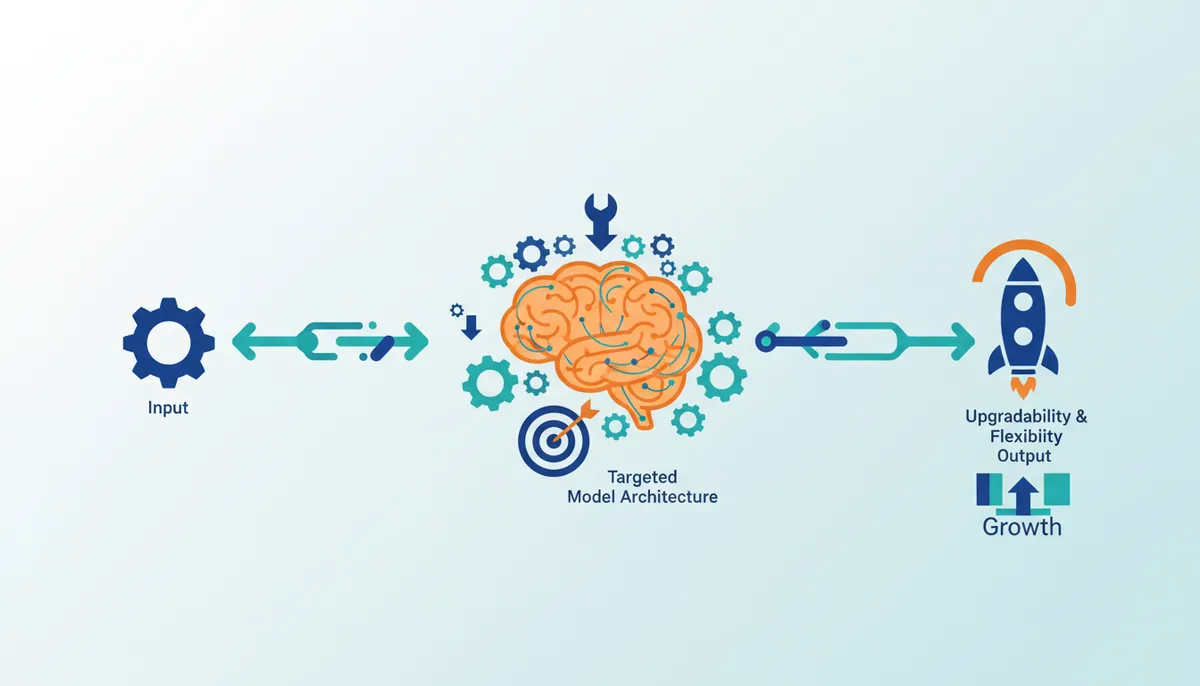
Swapping the brain means adopting a better model, which is not code you write but a component you exchange. This model-centric architecture separates mission intent from mechanical execution, so the interfaces stay fixed while the reasoning component changes. Because the brain depends on these standardized interfaces, the suit remains model-agnostic, allowing engineers to upgrade intelligence without refactoring underlying logic. The Loadout Pattern resolves rigid workflow update requirements by curating a specific subset of self-describing tools at wake time, functioning similarly to how tactical loadouts allow players to swap equipment without changing the game engine.
Deterministic tracing disappears when brains swap, even if the toolset stays constant. Engineers must rely on strong evaluation suites rather than unit tests to verify behavior after a swap. This approach shifts the engineering burden from writing integration code to defining precise interface contracts. Such separation enables rapid iteration on model capabilities while preserving stable mechanical foundations. Intelligence scales independently of infrastructure provided the interface definitions remain stable across versions.
From Human-Triggered Scripts to Autonomous Cron-Waking Agents
A headless Claude Code session waking hourly illustrates the shift from reactive scripts to scheduled autonomous agents that decide without human input. Conventional automation executes fixed steps where nothing happens until a user triggers the process, creating a dependency on manual presence. The Loadout Pattern inverts this by having routines wake on a cron, fetch their own tool definitions, and execute mission logic independently. This architecture transforms the LLM from a passive component into an active AI decision engine that evaluates context at each step rather than following a rigid path.
Execution differs from decision because a script runs while the brain chooses. Autonomy introduces a verification gap where the system must trust the model's tool selection without real-time human oversight. Operators must implement rigorous logging of invocation events to audit why specific tools were chosen during unsupervised runs. Freedom costs deterministic tracing, requiring new observability strategies for non-linear execution paths.
About
Diego Alvarez, Developer Advocate at AI Agents News, brings direct, hands-on expertise to the discussion of the Loadout Pattern. His daily work involves building end-to-end autonomous systems and rigorously comparing frameworks like CrewAI and LangGraph, where distinguishing between a global toolbox and a routine-specific loadout is critical for reliability. This pattern emerged from his practical experience constructing cron-driven agents, addressing the precise engineering challenge of separating mission logic from mechanical tool selection. At AI Agents News, Diego focuses on translating complex agentic concepts into actionable build guides for engineers. His role requires identifying failure modes and optimizing tool usage, making him uniquely qualified to articulate this structure. By documenting this pattern, he provides the technical community with a validated approach to orchestration, ensuring developers can build more efficient and maintainable autonomous routines without reinventing the wheel.
Conclusion
Scaling model-centric decision engines exposes a critical fragility: the invocation events log becomes the single source of truth for auditing non-linear reasoning paths. As systems shift from static scripts to flexible LLM automation, the operational cost moves from writing conditional logic to curating the loadout of available tools. When the "brain" selects actions dynamically, engineers lose deterministic tracing unless they implement rigorous, real-time observability specifically designed for adaptive execution flows. This transition demands that teams treat tool availability as a strategic configuration layer rather than a hardcoded dependency.
The test is narrow: can you change a notification endpoint by editing one tool script, and can you upgrade intelligence by swapping the model instead of rewriting logic? If both hold, the loadout list is doing its job. If either fails, transport details have leaked back into the mission text and the routine has drifted into the hardcoded workflow it was meant to replace. Audit your invocation events for tool calls that carry no selection rationale, since that log is the only record of what an unsupervised run actually decided.
Frequently Asked Questions
The agent cannot dynamically request missing tools without breaking safety guarantees. This rigid structure means a single omitted function causes total mission failure, forcing engineers to verify every item in the curated set before deployment.
It limits the model to a focused subset of tools rather than the entire global inventory. This pre-curation prevents analysis paralysis and ensures the autonomous brain operates efficiently without drowning in excessive token overhead.
Separation allows engineers to swap underlying models to upgrade intelligence without rewriting execution code. This modularity means changing the decision driver requires zero updates to the mechanical sensors or actuators set in the system suit.
A toolbox holds every available function while a loadout contains only the mission-specific subset. This distinction ensures the system provides exactly what is needed for the task, avoiding the confusion of exposing all options.
The system wakes the agent with a pre-curated set of tools for that specific routine. This approach lets the model judge what matters and select tools autonomously instead of following a fixed script path.
References