Governed AI platforms fix context loss

Blog 17 min read

Brunelly is currently in Beta as a governed AI software development platform designed to fix fragmented engineering pipelines. You will learn how to define a governed AI platform that replaces generic outputs with architecture-aware planning backlogs. Finally, the text details how to implement end-to-end orchestration where testing suites reflect actual system behavior and code reviews consider security requirements beyond simple diffs. Engineering teams scaling without losing context require this level of auditable delivery to finally prove their ROI.

Defining the Governed AI Software Development Platform

Defining the Governed AI Platform by Single Source of Context

Architectural drift disappears when business goals and technical depth merge into a single source of context.

Generic coding assistants crumble under system complexity. Evolving teams and intricate architectures cause severe context loss, leaving these tools to spit out code blind to accumulated decisions. The result is a rift between product intent and actual implementation. Brunelly solves this by holding a persistent understanding of the project so every agent works from an identical, complete picture. The platform adjusts to greenfield & brownfield environments alike, learning specific codebase constraints instead of forcing generic templates onto unique systems.

Transient chat interfaces cannot guarantee architectural integrity because they lack historical grounding. This system grows sharper as it accumulates patterns over time, making it suitable for SMEs and enterprise organizations aiming to scale output without chaos. Fragmented toolchains force engineers to manually rebuild context with every switch, a friction point that multiplies rework and delays delivery. A unified context engine lets new team members onboard quickly while keeping institutional knowledge intact.

Adopting such a platform means sacrificing the flexibility of disjointed point solutions for a rigid, integrated lifecycle. The cost is reduced tool choice in exchange for eliminated context switching and consistent policy enforcement. Teams building software that must scale gain from this constraint because it forces alignment across planning, coding, and review stages.

Applying Governed AI to SME Scaling and Brownfield Legacy Systems

Engineering groups building scalable software need more than transient code generation; they require a system stopping context loss across the entire development lifecycle.

Generic tools often fail in brownfield scenarios since they ignore years of accumulated technical debt and undocumented decisions. By maintaining a single source of context, the platform ensures AI agents understand specific system constraints rather than applying generic patterns. This approach allows SMEs to onboard new engineers quicker while maintaining architectural consistency without scaling confusion. Brunelly applies governed AI to preserve architectural integrity within scaling SMEs and complex legacy environments.

Standard AI-generated code frequently misaligns with existing system logic, forcing developers to manually reconcile conflicts. Brunelly mitigates this by generating pull requests that respect established patterns and business goals. For organizations managing greenfield & brownfield systems simultaneously, this persistence means the AI gets smarter over time as it ingests project history. The platform unifies planning, coding, and security reviews into one auditable workflow, reducing the cognitive load on developers.

Efficacy depends entirely on the quality of initial context provided; poor definition of business goals limits the AI's ability to enforce the policies. Teams must invest effort in priming the system with accurate architectural constraints to avoid propagating errors. Unlike fragmented toolchains where decisions in sprint three contradict sprint one, this unified approach ensures every agent operates from the same complete picture. The result is a delivery pipeline where institutional knowledge is preserved rather than lost during team transitions.

Generic Coding Assistants vs Context-Aware AI for Enterprise Scale

Generic coding assistants lack the persistent context required to maintain architectural integrity in complex, long-lived systems.

Most tools function as transient responders, generating code without awareness of prior decisions or system-wide constraints. This approach causes fragmentation where business goals decided in one tool disconnect from code written in another. The result is measurable rework when AI-generated logic contradicts established patterns from previous sprints. Enterprises suffer compounding misalignment between product, engineering, and QA as context switches accumulate across fragmented delivery pipelines.

Context-aware platforms resolve this by unifying technical depth and business objectives into a single source of context. Unlike generic models, these systems adapt to both greenfield & brownfield environments by learning existing codebase constraints rather than applying uniform templates.

Feature Generic Assistant Context-Aware Platform
Knowledge Scope Transient session data Persistent project history
Architecture Fit Generic patterns only Learns specific constraints
Team Alignment Siloed by tool switch Unified across lifecycle
Evolution Static knowledge cutoff Gets smarter over time

The operational cost of lost context manifests as decisions in sprint three that invalidate architectural choices from sprint one. Preserving institutional knowledge requires a system where every agent, workflow, and review accesses the same complete picture. Without this unity, scaling output inevitably scales confusion. Teams must choose between quick, isolated code generation and governed delivery that respects system complexity.

Mechanics of Persistent Context and Agent Collaboration

How Persistent Context Unifies Business Goals and Code Architecture
Brunelly stops context loss by making sure agents share one persistent understanding of the project from day one. Users link their repository and set goals, letting the platform soak up architecture, past decisions, and business context into a shared AI layer. This setup stops the usual mess where business goals live in one tool while code gets written in another, totally disconnected.

The workflow moves through four clear stages:

  1. Prime it with your project: The system ingests repo history and goals to build initial context.
  2. Plan with precision: The Planner Agent generates backlogs grounded in actual system constraints.
  3. Build with full awareness: The Code Agent writes code respecting established patterns without re-briefing.
  4. Test, review, and evolve: The QA Agent and security checks validate against real behaviors and risks.
Capability Generic AI Assistants Governed Persistent Context
Context Scope Fragmented across tools Entire project history
Architecture Unknown or guessed Explicitly modeled
Goal Alignment Manual re-briefing required Unified by default

Keeping this continuity means architectural integrity holds up across every sprint, feature, and team. Fast prototyping often clashes with long-term maintainability; generic tools speed up early output but build technical debt through lost context. Persistent context fixes this by making institutional knowledge portable, so new hires onboard quicker because Brunelly carries that history. This shift turns AI from a fleeting coding helper into a stable part of the software delivery lifecycle. Teams tackling complex systems need this unified view to stop product, engineering, and QA functions from drifting apart.

Executing Precision Planning and Context-Aware Code Generation

Turning vague goals into structured backlogs demands plans grounded in real architecture, not disconnected templates. Brunelly handles this by having the Planner Agent digest repository history to create epics and tasks that respect existing system constraints. This method fixes context loss in development by mapping business objectives directly to technical implementation details without manual translation layers.

When generating code, the Code Agent works with full knowledge of upstream decisions, avoiding the drift common in generic tools. Standard assistants treat every prompt as isolated, yet this system retains pattern memory across sprints. The difference matters most for AI tools in greenfield versus brownfield projects; new builds might accept generic scaffolding, but extending legacy systems requires strict adherence to established conventions. The platform removes re-briefing by keeping a persistent state where the system gets smarter the more it learns about the project, accumulating decisions and patterns so the platform evolves alongside the team.

How does AI reduce context loss effectively? It unifies the silent knowledge usually trapped in senior engineers' heads into a shared, accessible layer.

Speed often fights fidelity; accelerating output usually sacrifices architectural alignment, yet this system enforces both by design. The value relies on a single source of context where business goals and technical depth merge, ensuring every agent and workflow draws from the same complete picture. Teams must define goals clearly during the priming phase to maximize the persistent understanding shared across agents.

The Hidden Costs of Fragmented Tools and Disconnected Delivery

Decisions made in sprint three often contradict architectural choices from sprint one when business goals and code remain unconnected. This fragmentation forces new engineers to spend weeks rebuilding context that should never have been lost, as legacy tools isolate product intent from technical execution. Generic AI assistants make this worse by generating code with no knowledge of architecture or history, creating compounding misalignment at scale.

Failure Mode Consequence
Isolated Goal Setting Requirements drift from technical reality
Stateless Code Gen Patterns violate established constraints
Manual Context Transfer Onboarding delays compound over time

Restoring alignment needs a unified layer where the Planner Agent and Code Agent share a single source of truth. Without this, organizations face rework cycles where every tool switch is a context loss. Rapid, disjointed iteration clashes with governed, cohesive delivery; lost context leads to misalignment, rework, and decisions that contradict what came before. Teams must eliminate these silos to prevent the erosion of system coherence.

Implementing End-to-End AI Orchestration for Engineering Teams

Implementation: Defining the Single Persistent Context Principle

Conceptual illustration for Implementing End-to-End AI Orchestration for Engineering Teams

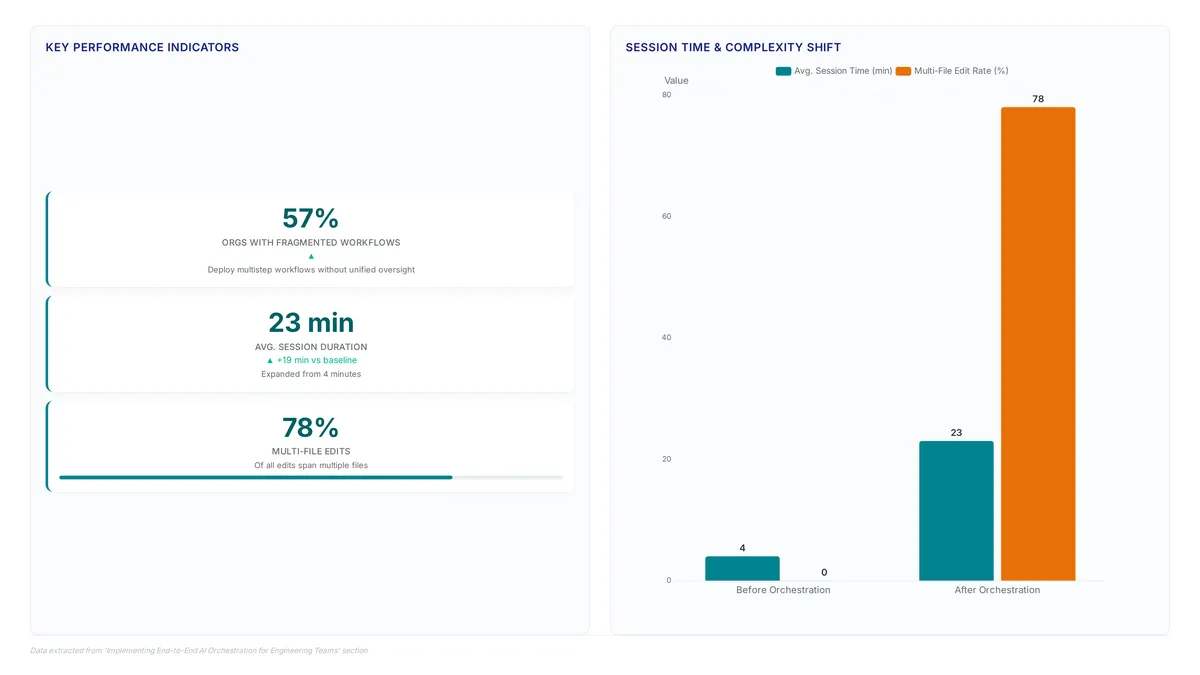
Connecting the repository starts the process by letting the system absorb existing architecture and business goals immediately. This initial configuration creates a single persistent context shared by every agent from day one, eliminating the fragmentation where 57% of organizations now deploy multistep workflows without unified oversight. Coding sessions drift as complexity grows without this foundation. Average session times expand from four minutes to 23 minutes while 78% of edits span multiple files.

The onboarding process follows four distinct phases to maintain architectural integrity:

  1. Prime it with your project: Define goals to build the shared understanding required for complex tasks.
  2. Plan with precision: Generate backlogs grounded in actual system constraints rather than generic templates.
  3. Build with full awareness: Execute code generation that respects upstream decisions without requiring re-briefing.
  4. Test, review, and evolve: Run security and quality checks using the full historical context of the software lifecycle.

Context loss compounds silently for builders. Decisions made in later sprints often contradict architectural choices from earlier ones when agents lack shared memory. Fragmented toolchains force engineers to manually reconcile disjointed outputs. This approach ensures that the Planner Agent and Code Agent operate against identical constraints. The cost is an upfront investment in defining precise business goals. Such preparation prevents the cumulative rework caused by misalignment between product and engineering teams.

Implementation: Executing Precision Planning and Context-Aware Code Generation

Connecting repositories initiates 02 Plan with precision by converting high-level goals into structured backlogs grounded in actual system architecture. This process eliminates disconnected templates. Every epic reflects real technical constraints rather than generic best practices. By absorbing the existing codebase during the 01 Prime it with your project phase, the system prevents the context loss that typically fragments delivery across complex tools.

  1. Configure repository access: Link the target repository so the Planner Agent ingests current patterns and business logic immediately.
  2. Define architectural guardrails: Establish constraints that the Code Agent must respect when generating pull requests for brownfield or greenfield environments.
  3. Execute context-aware generation: Deploy agents that produce code respecting upstream decisions without requiring repeated briefings or manual drift correction.

This workflow ensures that 03 Build with full awareness generates artifacts fitting the established architecture. Rework caused by misalignment between product and engineering disappears. Unlike generic assistants, this approach maintains architectural integrity across sprints by retaining institutional knowledge within the platform. Maximizing agent autonomy requires strict initial context definition. The system may otherwise propagate existing inefficiencies found in the legacy code. Teams must balance rapid generation with the governance needed to prevent compounding technical debt. The result is a delivery pipeline where Security Agent reviews and QA Agent tests align with how the software actually behaves. More engineering insights appear at AI Agents News.

Validating Lifecycle Quality and Security Checks

Validating governed AI in enterprise requires running quality and security checks with full context across the entire software lifecycle management. This approach ensures the Security Agent evaluates code against specific architectural history rather than generic rules.

  1. Ingest system constraints: The QA Agent generates tests aligned to actual system behavior, not textbook ideals.
  2. Enforce policy-as-code: Teams can offer context-aware recommendations on which security rules apply to specific domains.
  3. Verify architectural fit: Reviews inform every decision using accumulated project knowledge to prevent drift.
Check Type Generic AI Tool Governed Platform
Context Scope Single file diff Full lifecycle history
Test Alignment Standard patterns Actual system behavior
Security Rules Generic best practices Domain-specific constraints

Rapid iteration conflicts with deep contextual analysis. Extensive history checks may initially slow feedback loops for simple fixes. Skipping these checks risks compounding errors in brownfield codebases. Setup is stated to take under 5 minutes and requires no credit card, allowing teams to validate these controls immediately without procurement delays. AI Agents News recommends this configuration for teams managing complex legacy systems where context loss drives rework.

Strategic Application of Full Lifecycle AI Delivery

Defining Full Lifecycle AI Delivery for Complex Systems

A unified delivery model merges planning, coding, and security into a single source of context that survives every sprint cycle. Business objectives stay locked to technical depth under this regime, stopping the architectural drift that plagues complex systems. Generic assistants spit out code blind to upstream constraints, creating gaps between product intent and the final implementation. A governed platform adjusts to greenfield and brownfield settings alike, digesting existing patterns to keep consistency intact.

Context management defines the difference; the system does not reset with each query but instead accumulates decisions so it gets smarter over time. Engineers scale output through this persistence without driving up rework rates or onboarding friction. Fragmented workflows force developers to manually rebuild project history, while integrated delivery bakes institutional knowledge directly into the process.

Feature Fragmented Tools Full Lifecycle Platform
Context Scope Session-limited Persistent across sprints
Architecture Awareness Generic templates System-specific constraints
Knowledge Retention Lost after session Accumulates over time

Lost context in software development breeds misalignment, rework, and choices that clash with previous work, such as sprint three decisions overturning sprint one architecture. Organizations building scalable software need a built for scale base where every agent sees the full picture. Teams risk compounding errors without this unity as misalignment between product, engineering, and QA expands. The software development trends show semantic layers giving AI real business context are vital for cutting cognitive load. Platform value rises as more context enters the system, letting decisions, patterns, and learnings pile up so the tool evolves with the team.

Application: Applying Governed AI to SME Scaling and Brownfield Legacy Systems

Rapidly scaling SMEs and enterprises face real engineering complexity where fragmented tools cause context loss. A governed platform fixes this by creating a single source of context that speeds up familiarity with system constraints. Generic assistants treat every query as isolated, whereas this approach keeps business goals synced with technical execution. Expanding teams maintain output velocity while preserving decision history across sprints, helping new members onboard quicker because the platform holds the institutional knowledge.

Teams managing brownfield legacy systems face a shift from creation to safe modernization of undocumented code. Generic AI tools often hallucinate patterns clashing with established, opaque architectural rules in older codebases. A persistent context engine studies existing structures to generate pull requests honoring historical constraints instead of forcing generic templates. Engineers refactor technical debt without breaking critical legacy paths since the system learns the codebase and understands constraints to work with what exists.

Scenario Fragmented Tool Risk Governed Platform Outcome
SME Scaling Knowledge silos cause rework Unified onboarding and consistent patterns
Legacy Modernization Context loss breaks hidden dependencies Architecture-aware refactoring and safe updates
Multi-team Alignment Contradictory sprint decisions Shared institutional memory and goals

The cost of lost context includes weeks spent rebuilding context that should never have been lost when onboarding new engineers. Builders need platforms designed for teams building software that matters, capable of adapting to both new projects and existing systems. Organizations must prioritize tools unifying business and technical context from goal to merged PR to avoid compounding technical debt during rapid expansion.

Application: Generic Coding Assistants vs Context-Aware AI for Enterprise Scale

Disconnected coding assistants generate code with no knowledge of architecture or history, forcing senior engineers to spend cycles correcting context-free output. Generic tools operate on isolated queries, ignoring the cumulative weight of prior technical decisions and business constraints. This fragmentation creates a cycle where misalignment between product intent and code implementation compounds as teams scale.

Brunelly resolves this by maintaining a single source of context that unifies business goals with technical depth across every workflow. Unlike generic agents, the platform adapts to greenfield & brownfield environments, ensuring new code respects legacy constraints without manual re-briefing. The result is a reduction in rework caused by decisions in later sprints invalidating earlier architectural choices, maintaining architectural integrity across every sprint, feature, and team.

Disconnected tools suffer a sharp limitation: every tool switch represents a context loss, leading to misalignment and rework. New hires using generic assistants must manually reconstruct system understanding, whereas a governed platform carries this history explicitly, acting as the connective tissue your engineering organization has been missing. Organizations managing complex systems should adopt full lifecycle AI so product, engineering, and QA align by default rather than by meeting, as the platform gets smarter with every sprint.

About

Sofia Berg serves as Research Editor at AI Agents News, where she specializes in translating complex multi-agent research and benchmarking data into actionable insights for engineering teams. Her deep expertise in evaluation frameworks like SWE-bench and agentic planning makes her uniquely qualified to analyze Brunelly, an AI software advancement platform currently in Beta. Unlike generalist coverage, Berg's daily work involves rigorously dissecting how autonomous systems handle tool use and orchestration, allowing her to critically assess Brunelly's claim of providing a governed, auditable lifecycle for code generation and testing. By connecting her background in validating agent capabilities to the platform's focus on provable ROI, she offers a technical perspective on whether Brunelly truly solves the fragmentation plaguing modern engineering pipelines. This analysis reflects AI Agents News' commitment to grounding vendor claims in concrete technical merit rather than hype, ensuring builders understand the actual utility of integrating such systems into their workflows.

Conclusion

Scaling engineering teams exposes a critical breaking point where fragmented tooling converts velocity into technical debt. When developers rely on isolated agents, the operational cost manifests as compounding misalignment between product intent and code implementation. This friction grows linearly with team size, forcing senior engineers to waste cycles correcting context-free output rather than building features. The solution requires shifting from query-based assistance to a governed platform that enforces architectural constraints automatically.

Organizations managing complex systems must adopt full lifecycle AI immediately to stop this drift. Do not wait for a specific crisis threshold; implement a context-aware system before your next substantial feature expansion to ensure new code respects legacy decisions by default. This approach eliminates the manual re-briefing that currently slows down onboarding and edit cycles.

Start this week by mapping your current workflow to identify exactly where context switches occur between product goals and code commits. Replace any standalone coding assistant that lacks persistent project history with a unified solution like the AI software evolution platform to ensure every sprint accumulates institutional knowledge rather than erasing it. This single change aligns engineering output with business strategy without requiring constant oversight meetings.

Frequently Asked Questions

Generic tools fail because they lack persistent context for your specific architecture. This context loss causes misalignment where 78% of edits span multiple files, forcing manual reconciliation.

Teams can complete setup in under 5 minutes without needing a credit card. This speed prevents the delay where onboarding times typically expand from four minutes to 23 minutes.

Standard assistants act as transient responders that ignore prior system decisions. This fragmentation means 57% of organizations now deploy multistep workflows that contradict earlier architectural choices.

You sacrifice the flexibility of disjointed point solutions for a rigid, integrated lifecycle. This constraint eliminates context switching and ensures every agent works from an identical picture.

The system adapts to greenfield and brownfield environments by learning specific constraints. It avoids forcing generic templates onto unique systems, ensuring code respects your actual architecture.

References