CrewAI agents: standalone Python orchestration
Over 100,000 developers certified by CrewAI confirm that collaborative intelligence has replaced single-agent experiments as the enterprise standard. You will learn how this lean, lightning-fast Python framework operates independently of LangChain to provide precise low-level control.
The analysis dissects the dual-engine approach where CrewAI Crews optimize for autonomy while CrewAI Flows enable granular task orchestration via single LLM calls. We examine the specific mechanics of YAML configuration that allow organizations to deploy these multi-agent systems without writing complex boilerplate code. This separation of concerns allows teams to balance high-level simplicity with the rigorous demands of production environments.
Tracking over 14,800 monthly searches, the framework has become the fastest-expanding multi-agent AI solution in 2026 according to tech-insider.org. The discussion highlights how the Crew Control Plane provides necessary tracing and observability for monitoring agent metrics in real-time. Readers will understand why this shift toward autonomous AI agents working in smooth teams is redefining automation strategies for modern software architecture.
The Role of Collaborative Intelligence in Modern Agent Orchestration
CrewAI Definition: Standalone Framework for Collaborative Intelligence
Version 1.15.1 of crewai, published on Jun 27, 2026, operates as a standalone Python framework built specifically for role-playing and autonomous AI agents without relying on LangChain. This design isolates orchestration logic to cut down on boilerplate code, letting agents tackle complex jobs through collaborative intelligence instead of rigid sequential scripts.
Developers retain low-level customization for internal prompts and execution logic while keeping a clear view of high-level workflows. The framework allows mixing model tiers, so non-critical agents can run on smaller, cheaper models. This modularity demands that engineers explicitly map out process flows since the system lacks the implicit chaining seen in older libraries.
Separating autonomous decision-making from deterministic state management fixes a frequent failure point in multi-agent setups: unbounded recursion during error handling. Enforcing secure state management between tasks inside Flows stops context pollution from ruining long sessions. This approach favors production stability over experimental freedom, fitting enterprise needs where audit trails and consistent outputs matter more than exploratory generation. Engineers must set specific personas and goals ahead of time, swapping flexible role emergence for predictable behavioral limits.
CrewAI Crews vs Flows: Autonomy versus Event-Driven Control
CrewAI Crews focus on agent autonomy while CrewAI Flows enforce strict event-driven state control. Teams choose Crews for flexible role-playing situations where agents need collaborative intelligence to negotiate tasks without rigid ordering. Flows offer granular control over execution paths, locking in consistent state management between tasks via single LLM calls instead of chained autonomous choices. A typical three-agent crew using GPT-4o burns through 15,000 to 25,000 tokens per single execution run, making token budgeting vital for high-volume setups. Adding Flows in version 1.x sets the platform apart from basic orchestration tools missing native state management for complex workflows.
Relying only on Crews for deterministic business logic brings unpredictability to output formatting and execution order. Autonomy gives up strict reproducibility to gain adaptive problem-solving flexibility. Operators should use Flows when conditional branching and precise execution logic are required, saving Crews for open-ended exploration phases.
WorkOS shows this difference by using Flows to generate and validate Python code, ensuring iterative creative tasks keep structural integrity. This case study highlights how structured workflows stop hallucination drift during multi-step generation. AI Agents News suggests pairing both modes to balance adaptive reasoning with production-grade reliability.
Operational Cost Risks in CrewAI Multi-Agent Automation
Token consumption in complex CrewAI Crews drives variable operational expenses that grow linearly with execution frequency. A standard three-agent sequence using GPT-4o incurs costs between a few cents and a quarter per run due to high context window usage. Strategic model selection lowers this financial risk without losing orchestration fidelity. Switching non-critical agents to GPT-4o-mini within a workflow can reduce operational costs significantly while maintaining task completion rates. Builders must tell apart reasoning-heavy roles needing large models from routine functions suited for smaller, quicker alternatives.
Engineers can track exact token usage programmatically via the result.token_usage attribute returned after every crew execution. This visibility allows flexible budget enforcement before runaway sequences drain allocated funds. Managing multiple model endpoints and context limits adds architectural complexity. Ignoring these variables leads to unpredictable billing spikes in production environments. Effective cost governance means treating model selection as a primary configuration parameter rather than an afterthought. AI Agents News recommends auditing agent roles quarterly to align model capabilities with actual task difficulty.
Inside the Architecture of Event-Driven Agent Workflows
Standalone Framework Independence from LangChain Dependencies
CrewAI operates as a standalone framework constructed from scratch, deliberately avoiding LangChain dependencies to eliminate upstream abstraction leaks. This architectural isolation grants developers complete freedom to modify internal prompts and execution logic without navigating external library constraints or version conflicts. Unlike systems bound by inherited boilerplate, this approach enables precise tuning of agent behaviors for specific enterprise requirements.
| Feature | Standalone Architecture | Dependent Frameworks |
|---|---|---|
| Customization Depth | Full internal access | Limited to exposed hooks |
| Upgrade Risk | Isolated updates | Cascading breakage |
| Resource Overhead | Minimal footprint | Inherited bloat |
Optimized for speed and minimal resource usage, the system handles scaling task complexity with quicker execution times. By managing its own execution logic, the platform keeps orchestration efficiency under direct operator control. CrewAI empowers developers with both high-level simplicity and precise low-level control, ideal for creating autonomous AI agents tailored to any scenario.
Anonymous Telemetry Data Collection and Opt-Out Configuration
CrewAI collects anonymous telemetry data by default to track library performance without capturing prompts or API responses. Disabling that collection stops all metric transmission while preserving full agent functionality for sensitive deployments.
The framework distinguishes between standard anonymous metrics and the optional share_crew mode used for deep debugging. Standard telemetry records only the CrewAI version, Python runtime, operating system details, and the count of agents within a flow. Conversely, enabling share_crew transmits detailed context including agent goals, backstories, and task outputs.
| Metric Type | Data Collected | Privacy Impact |
|---|---|---|
| Default Telemetry | Version, OS, agent count, tool names | Low; no task content |
| Share Crew Mode | Goals, backstories, context, output | High; includes prompts |
This separation allows operators to maintain visibility into framework stability without exposing proprietary workflow logic. A critical tension exists between gaining granular observability for complex event-driven workflows and maintaining strict data sovereignty. Detailed logs assist in troubleshooting state management issues within Flows, yet they inherently increase the attack surface if credentials leak into agent backstories. CrewAI positions the paid AMP Suite as the tier carrying built-in compliance controls for organizations with strict requirements. The suite supports on-premise deployment options, allowing enterprises to keep data within their own security boundaries depending on their compliance needs.
OpenAI Default versus Local LLM Integration via Ollama
Agents default to the OpenAI API, yet enterprise data sovereignty often mandates local model deployment via Ollama. This architectural flexibility allows organizations to retain the collaborative intelligence of CrewAI while keeping sensitive prompts within private network boundaries. The framework uses built-in LiteLLM integration to abstract provider-specific APIs, enabling smooth switching between cloud-hosted GPT series and local Llama 3 instances without rewriting core orchestration logic.
| Feature | OpenAI Default | Local Ollama Integration |
|---|---|---|
| Data Residency | Cloud-hosted processing | On-premise execution |
| Latency | Network-dependent | Localhost speed |
| Configuration | API Key required | Endpoint URL mapping |
Integration with LiteLLM allows the system to support a wider range of models, including Anthropic Claude, compared to frameworks locked into specific provider SDKs. This dual-mode capability supports hybrid deployments where specific tasks require air-gapped security while others use high-reasoning cloud models. Managing local container resources presents a constraint compared to accepting external API latency and costs. Unlike rigid systems locked to single providers, this approach supports flexible model selection per agent role. Developers can configure specific agents to route through local endpoints for draft generation while reserving cloud connections for final verification steps. This granular control ensures that data sovereignty requirements do not force a compromise on automation complexity or agent autonomy. Users can further optimize costs by switching non-critical agents to lighter models, using the framework's flexibility to mix and match model tiers.
Deploying Scalable Multi-Agent Systems with YAML Configuration
CrewAI Project Structure and YAML Configuration Files
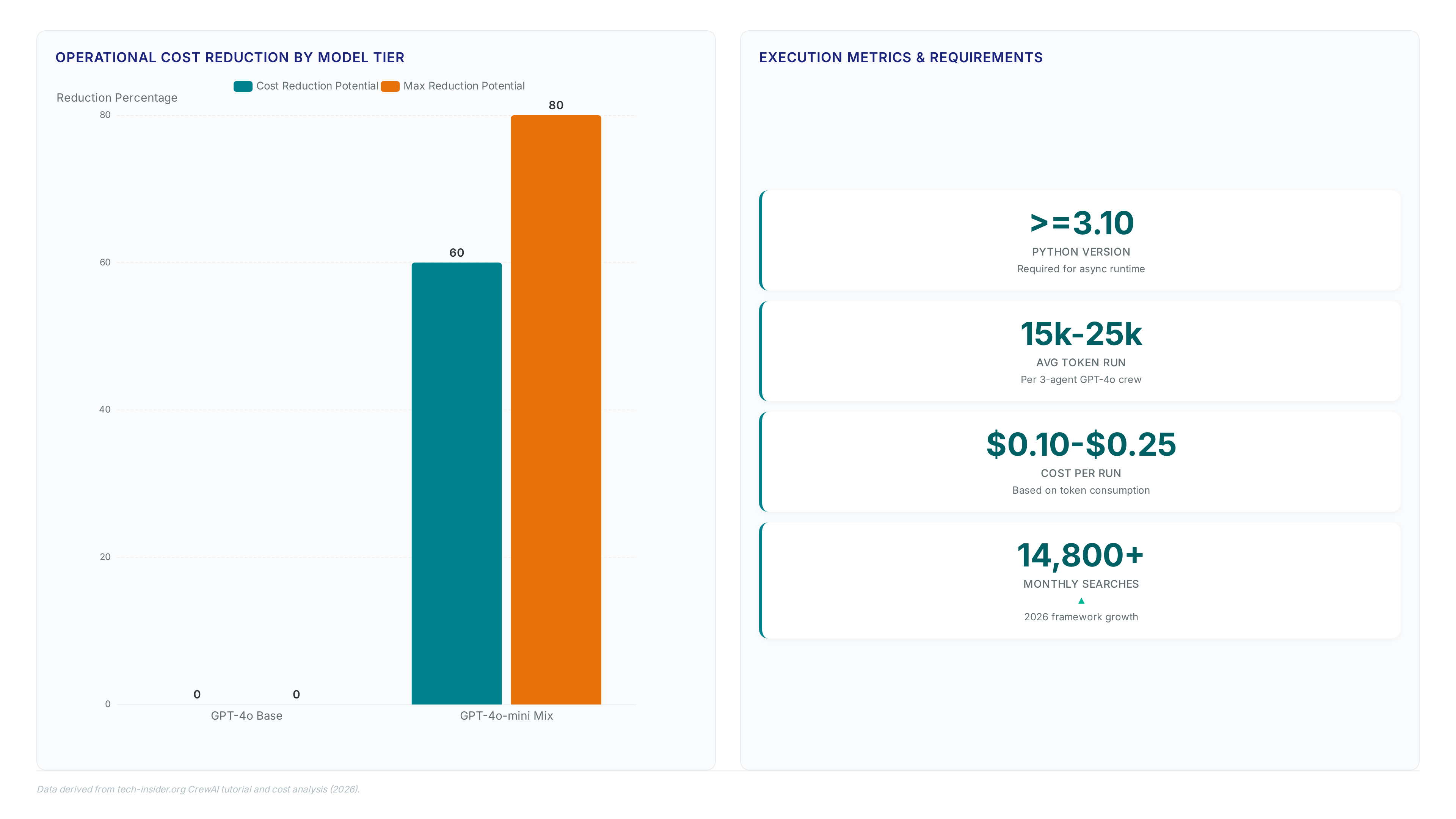
Python >=3.10 powers the async runtime required to initialize a CrewAI project. The framework demands a specific directory layout where agents.yaml holds role-specific personas and tasks.yaml maps required outputs for every step. Logic lives inside crew.py, loading these YAML configurations, while main.py acts as the entry point for workflow execution. A .env file manages secrets like API keys to stop credentials from leaking into version control. Developers can inspect the Landing Page Generator inside the CrewAI-examples repository to witness this structure handling real-world automation. This separation keeps agent behaviors distinct from orchestration logic, allowing prompt engineering updates without code changes.
Rapid prototyping sometimes clashes with maintainability due to strict file separation. YAML simplifies configuration, yet complex flexible argument passing occasionally forces builders to bypass static files for inline Python definitions. Mastering both declarative configuration and Pythonic logic becomes mandatory to fully exploit event-driven control mechanisms. Organizing these components properly lets teams scale from single-agent scripts to complex, multi-agent systems without refactoring the entire codebase.
Executing Crews: Dependency Locking and Runtime Commands
Production execution starts only after exporting OPENAI_API_KEY and SERPER_API_KEY environment variables to prevent runtime authentication failures. The underlying LiteLLM router cannot connect to upstream providers without these credentials set in the shell session before launch. Operators must navigate to the project root and run crewai install to resolve transient dependency conflicts using UV, ensuring the local lockfile matches the remote manifest exactly. This step stops version drift that frequently breaks agent coordination during scale-out operations.
- Set environment variables for API access.
- Run
crewai installto lock dependencies. - Execute the workflow via
crewai run.
The command sequence triggers logic set in crew.py, which loads role definitions from agents.yaml and task parameters from tasks.yaml. Rapid iteration conflicts with environment stability; skipping the install step speeds up local testing but risks subtle failures when deploying to continuous integration pipelines. Simple looping scripts do not enforce such strict structures, yet this framework relies on consistent package states across all nodes for event-driven control. Developers seeing unexpected behavior should verify that crewai update has been applied if Poetry errors surface during the bootstrap phase. Console logs and a generated report.md file containing aggregated intelligence appear in the output. Tracking the result.token_usage attribute allows engineers to monitor consumption boundaries programmatically after every run. Maintaining cost predictability in high-frequency automation scenarios depends on this visibility.
Troubleshooting Checklist: Tiktoken Errors and Poetry Dependencies
Install the package directly into your active virtual environment before initializing CrewAI components to resolve missing tiktoken modules. Conflicting version constraints within the pyproject.toml file often cause dependency resolution failures, requiring a clean lock operation using UV tools.
- Execute
crewai updateto force a reconciliation of the dependency tree and clear stale cache artifacts. - Verify the src/ directory contains
main.py,crew.py, and aconfig/folder holdingagents.yaml. - Confirm that
tools/subdirectories are populated to prevent import errors during agent coordination phases.
| Error Type | Likely Cause | Resolution Command |
|---|---|---|
| ModuleNotFoundError | Missing tokenizer | pip install tiktoken |
| Lockfile mismatch | Stale dependencies | crewai update |
| Import Failure | Incorrect path | Verify src/ structure |
Poetry-managed projects may isolate site-packages differently than standard pip installations, causing the interpreter to miss shared libraries. Clean environments result from this separation, yet tokenization utilities assumed present by some LLM providers require explicit installation. Structural gaps like these prevent the multi-agent architecture from loading role definitions entirely, unlike simple scripting errors. Builders must match the shell environment to the IDE interpreter path to avoid silent failures during task delegation. AI Agents News recommends validating the config/ directory structure before attempting complex Flows logic.
Measurable ROI from Enterprise-Grade Agent Automation
Crew Control Plane: Centralized Observability for Agent Metrics
Real-time visibility defines the Crew Control Plane, capturing necessary metrics, logs, and traces as agents execute. This Unified Control Plane acts as a central nerve center for enterprises needing granular sight into distributed agent coordination. Basic scripting tools lack this unified interface for managing workflow state across complex, event-driven automations.
Built-in monitoring exposes performance data through attributes like result.token_usage. Organizations gain actionable insights while maintaining flexibility, as the CrewAI AMP Suite supports both on-premise and cloud deployment options depending on security and compliance requirements. Developers choose between local logs or a managed dashboard based on their immediate debugging needs.
| Capability | Standalone Scripts | Crew Control Plane |
|---|---|---|
| State Visibility | None | Real-time traces |
| Integration | Manual coding | Smooth connectors |
| Security | Ad-hoc | Advanced measures |
Teams must balance real-time analytics benefits against the operational overhead of maintaining persistent connectivity for observability data. This tension dictates whether groups apply the free tier for development or commit to the full CrewAI AMP Suite for on-premise enterprise scaling. Some prefer isolated testing environments first. Others require immediate production-grade tracing from day one. The choice depends on infrastructure maturity.
Implementing AdvancedAnalysisFlow with Conditional Logic Operators
Precise workflow branching within Flows uses logical structures to evaluate conditions before triggering specific Crews. These structures function as guards, ensuring that agents execute only when set thresholds are satisfied. Logical operators allow for complex decision trees where tasks trigger based on whether any single condition evaluates to true or if every specified criterion is met simultaneously. This distinction allows engineers to construct strong workflows without embedding brittle conditional logic directly into agent prompts. Complex branching becomes manageable code rather than fragile prompt engineering.
Developers can observe this pattern in documented use cases where a researcher agent must gather facts before an analyst generates a report. By wrapping these steps in a structured Flow, the system enforces strict execution order based on real-time data validation.
| Operator | Trigger Condition | Use Case |
|---|---|---|
or_ |
Any condition met | Broad market alerts |
and_ |
All conditions met | High-confidence trade execution |
A specific challenge arises when combining these operators with asynchronous agent responses; the Flow manages execution paths to ensure state consistency across tasks. For enterprises requiring deeper visibility into these conditional branches, the Crew Control Plane provides the necessary tracing to debug workflows. State drift disappears under this scrutiny.
Running Crews Inside an Existing Enterprise Perimeter
For a mature team the deployment question is rarely what a crew can do; it is where the crew runs and who can audit it afterwards.
The enterprise-mcp-server repository, one of the 22 public repositories in the CrewAI organization as of mid-2026, illustrates a pattern where Model Context Protocol monitors crew deployments in production environments. This approach allows teams to use existing security perimeters rather than building new ones. The framework offers flexible low-level customization, allowing engineers to configure granular access controls and internal prompts to meet specific audit requirements.
About
Priya Nair serves as AI Industry Editor at AI Agents News, where she specializes in tracking product launches and platform shifts within the autonomous agent system. Her daily work involves rigorous verification of framework updates and market movements, making her uniquely qualified to analyze the release of crewai 1.15.1. While her primary beat often covers commercial platforms like Devin or Cursor, Nair applies the same technical scrutiny to open-source frameworks, ensuring builders receive accurate, hype-free assessments of new capabilities.
In this article, she connects her experience evaluating multi-agent coordination tools to dissect CrewAI's latest features, specifically its claim of being entirely independent from LangChain. By using her background in tech-industry reporting, Nair contextualizes how this "lean, lightning-fast" update impacts engineers choosing between orchestration frameworks. Her analysis reflects AI Agents News' commitment to providing concrete details over marketing fluff, helping technical leaders decide if CrewAI's focus on collaborative intelligence fits their architecture.
Conclusion
Scaling multi-agent architectures reveals that raw token consumption becomes the primary bottleneck for sustainable operations. While basic sequences function adequately in prototypes, production environments demand rigorous cost controls because unchecked context accumulation erodes value rapidly. Relying solely on high-cost models for every interaction creates an operational deficit that undermines the very efficiency automation promises to deliver. Teams must transition from simple linear chains to optimized workflows that strategically route tasks based on complexity rather than defaulting to maximum capability for every step.
This is where the split between Crews and Flows stops being a taxonomy question and becomes a budget one. Flows route simple, high-frequency work through deterministic branches and single LLM calls, while Crews keep their autonomy for the open-ended steps that genuinely need negotiation between roles. Switching non-critical agents to smaller models inside that structure lowers cost without giving up task completion, and the window for such structural changes closes once legacy patterns become entrenched in the codebase.
Start by mapping your current agent sequences to identify high-frequency, low-complexity tasks that can be rerouted immediately. Use the Crew Control Plane to trace these execution paths and isolate where state consistency checks can replace redundant model calls. This specific audit establishes the baseline required to justify broader architectural refactoring next quarter.
Frequently Asked Questions
A single run costs between a few cents and a quarter due to high context usage. This expense adds up quickly since a typical execution consumes 15,000 to 25,000 tokens per run.
Yes, switching non-critical agents to GPT-4o-mini can reduce operational costs by a significant margin. This strategy maintains task completion rates while significantly lowering the token budget for high-volume setups.
No. Version 1.15.1 of crewai is a standalone Python framework built from scratch, without LangChain. That isolation lets developers modify internal prompts and execution logic without navigating external library constraints or version conflicts.
The source code repository for CrewAI contains 22 distinct public repositories as of mid-2026. This extensive collection supports the framework's status as the fastest-expanding multi-agent AI solution with over 14,800 monthly searches.
CrewAI has certified over 100,000 developers through its community courses as of 2026. This large community provides reliable support resources for engineers aiming to master collaborative intelligence and event-driven workflows.
References